
The brutal truth is this: many of the highest paid specialties are not “high paying” so much as they are “high call, high disruption, high burnout risk.” The data backs that up far more clearly than most recruitment brochures.
If you are chasing a top-compensation specialty and ignoring call frequency, you are misreading the numbers. You will overestimate your effective hourly rate, underestimate fatigue, and misjudge your long‑term satisfaction.
Let’s quantify what you are actually trading.
1. The Core Equation: Salary per Disrupted Hour
Residents and attendings obsess over base salary. They almost never quantify the cost of being on call. That is a mistake.
You need to think in three layers:
- Base salary
- Call burden (frequency, in-house vs home, intensity)
- Effective rate: pay divided by all hours your life is constrained by work, not just “scheduled” hours
Let’s define a simple framework. Very rough national-level ballparks for attendings, using commonly cited MGMA / AAMC ranges and typical private‑practice / mixed models. These are not precise offers; they are directional.
- Orthopedic surgery: $650,000
- Neurosurgery: $800,000
- Cardiology (interventional): $650,000
- Gastroenterology: $600,000
- Radiology (diagnostic): $550,000
- Anesthesiology: $520,000
- Emergency medicine: $450,000
- Hospitalist (IM): $320,000
Now layer in call frequency and type. Below is a simplified snapshot of what I actually see across large health systems and mid‑sized private groups.
| Specialty | Weeknight Call | Weekend Call | Call Type |
|---|---|---|---|
| Neurosurgery | 1:2–1:3 | 1:2–1:3 | In-house or home |
| Orthopedic Surgery | 1:4–1:6 | 1:4–1:6 | Mostly home |
| Interventional Cardio | 1:4–1:6 | 1:4–1:6 | Home, heavy pages |
| Gastroenterology | 1:6–1:8 | 1:6–1:8 | Home, variable |
| Radiology | 1:5–1:7 nights | 1:5–1:7 weekends | In-house/remote |
| Anesthesiology | 1:4–1:6 | 1:4–1:6 | In-house/home |
| Emergency Medicine | No “call” | 8–14 shifts/month | In-house only |
The raw call ratio alone is misleading. A home call for GI where you sleep all night is not the same as in‑house trauma neurosurgery. You have to translate call into disrupted hours.
A simple approximation that tracks surprisingly well:
- In-house night call (24hr): count as 24 clinical hours
- In-house 12hr overnight shift: 12 clinical hours
- Heavy home call: 8–12 “effective” hours (you are tethered, may get called in)
- Light home call: 4–6 “effective” hours (you can mostly live, but not fully)
This is crude. That is fine. You are looking for signal, not perfection.
2. Comparing Specialties: Pay per Hour of Control Lost
Let me make this concrete with stylized, but realistic, attending-level scenarios.
Assumptions for each specialty below:
- 48 working weeks per year
- Scheduled daytime clinical hours: ~45 hours/week (clinic + OR + admin)
- Call burden as specified
- Values are order‑of‑magnitude, not contractual promises
Scenario 1: Orthopedic Surgery vs Gastroenterology vs Radiology
We will model three “high paid, decent lifestyle” fields and convert their numbers into something you can compare.
Step 1: Approximate yearly hours
- Orthopedic surgery (community hospital group)
- Base: $650,000
- Call: 1:5, mix of trauma and general, home call but often going in
- Weekday: 1 weekday call/week (effective ~8 hrs additional constraint)
- Weekend: 1 full weekend every 5 weeks (assume 16 effective hrs Sat + 16 Sun = 32)
Yearly additional call burden:
- Weekday call: 1 day/week × 48 weeks × 8 = 384 hours
- Weekend call: 48 weeks / 5 ≈ 10 weekends × 32 = 320 hours
- Daytime scheduled: 45 hrs/week × 48 = 2160 hours
Total “constrained” hours ≈ 2160 + 384 + 320 = 2864 hours
- Gastroenterology
- Base: $600,000
- Call: 1:7, mostly home, significant variation in nighttime calls
- Weekday call: about 0.7 nights/week (1 out of 7), assume 6 effective hours per call night
- Weekend: ~1 weekend every 7 weeks (assume 20 effective hrs per weekend – lighter than ortho)
Yearly call:
- Weekday: 0.7 × 48 × 6 ≈ 202 hours
- Weekend: 48 / 7 ≈ 7 weekends × 20 = 140 hours
- Daytime: 45 hrs/week × 48 = 2160 hours
Total ≈ 2160 + 202 + 140 = 2502 hours
- Diagnostic Radiology (group with in-house night coverage)
- Base: $550,000
- Day shifts: Mix of 8–10 hr days, call made of “nighthawk” blocks
- Call: 1 week of nights every 7 weeks (7 nights × 10 hrs = 70 hrs)
- During night week, reduced day work before/after; net weekly hours maybe 60 instead of 45
Simplified yearly:
- Regular weeks (6 out of 7): 6 × 48/7 ≈ 41 weeks × 45 hrs = 1845 hours
- Night weeks (1 out of 7): 7 weeks × 60 hrs = 420 hours
Total ≈ 1845 + 420 = 2265 hours
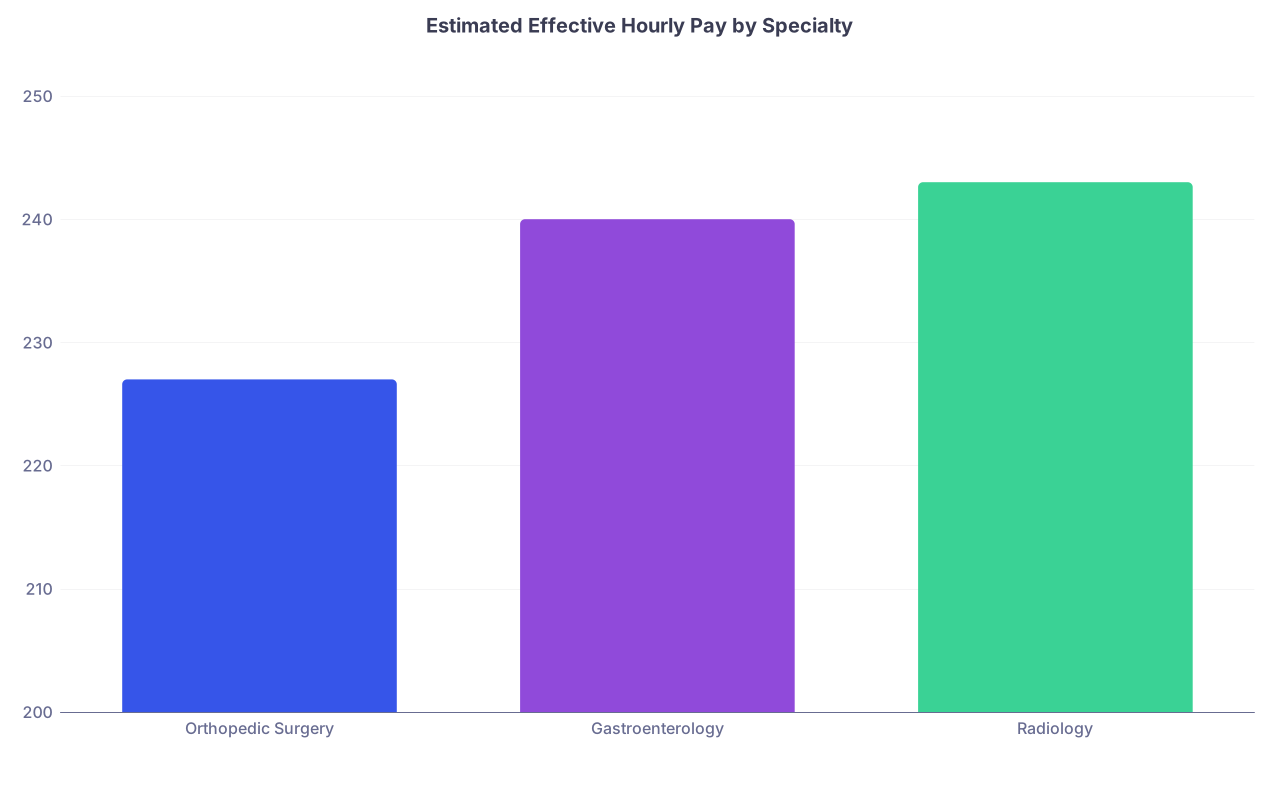
Now compute simple effective hourly rate:
| Category | Value |
|---|---|
| Orthopedic Surgery | 227 |
| Gastroenterology | 240 |
| Radiology | 243 |
Orthopedic: $650,000 / 2864 ≈ $227/hr
Gastroenterology: $600,000 / 2502 ≈ $240/hr
Radiology: $550,000 / 2265 ≈ $243/hr
The data pattern is obvious: higher headline salary does not always give you higher $/hour. Radiology and GI, with lower call friction, approach or surpass ortho on effective hourly pay, despite lower nominal salaries.
Scenario 2: Neurosurgery vs Interventional Cardiology vs Anesthesiology
Now let us look at the true “call monsters.”
- Neurosurgery (academic / large tertiary center)
- Base: $800,000
- Call: 1:3 in a 3-person group, mix of in-house and home, lots of emergent cases
- Assume: 2 weeknights of call/week, each ~12 effective hours
- Weekends: 1 out of 3 weekends on heavy call, about 40 effective hrs (you are basically “owned” that weekend)
Yearly:
- Weekday: 2 × 48 × 12 = 1152 hours
- Weekend: 48 / 3 = 16 weekends × 40 = 640 hours
- Daytime: 50 hrs/week × 48 (most neurosurgeons run longer days) = 2400 hours
Total ≈ 2400 + 1152 + 640 = 4192 hours
Effective rate: $800,000 / 4192 ≈ $191/hr
- Interventional cardiology
- Base: $650,000
- Call: 1:5 for STEMI / emergent cath, heavy phone traffic
- Weekday: ~1 call night/week (10 effective hrs)
- Weekend: 1 weekend every 5 weeks, 30 effective hrs
Yearly:
- Weekday: 1 × 48 × 10 = 480 hours
- Weekend: 48 / 5 ≈ 10 weekends × 30 = 300 hours
- Daytime: 45 hrs/week × 48 = 2160 hours
Total ≈ 2160 + 480 + 300 = 2940 hours
Rate: $650,000 / 2940 ≈ $221/hr
- Anesthesiology
- Base: $520,000
- Call: 1:5 overnight call, mix of in-house and late stay
- Assume: 1 in‑house overnight q5 (~12hr) plus some late rooms; approximate 1.2 extra “shifts”/week of 8 hrs each (9.6 hrs/week)
- Weekends: 1 of 5 weekends with 24 effective hrs
Yearly:
- Weekday call: 9.6 × 48 ≈ 461 hours
- Weekend call: 48 / 5 ≈ 10 weekends × 24 = 240 hours
- Daytime: 45 hrs/week × 48 = 2160 hours
Total ≈ 2160 + 461 + 240 = 2861 hours
Rate: $520,000 / 2861 ≈ $182/hr
Neurosurgery has the highest salary in the set. It does not have the highest effective hourly pay. Interventional cardiology, with slightly less psychotic call, wins on $/hr, while anesthesiology looks surprisingly average when you fully load its call.
3. Call Frequency vs Salary: The Tradeoff Curve
Put this all on one conceptual curve: as call frequency and intensity increase, salary rises, but not in a straight line. The tradeoff is non-linear and specialty specific.
Typical trends in high‑paid fields:
- Baseline: $200–250/hr effective rate for most “procedure-heavy, high paid” specialties if you account for call
- Low‑call comparators (outpatient derm, outpatient plastics, concierge IM) often land at similar or even higher $/hr with dramatically fewer disrupted nights, just with lower total annual income ceiling
- The very highest salaries (neurosurgery, some ortho, some IR) often buy you more total dollars but at a discount on hourly rate because you are on the hook nearly all the time
The rational choice is not purely $/hr, though. You care about:
- Total yearly income
- Schedule predictability
- Sleep integrity
- Family and personal time windows that are not constantly at risk
Still, the data show a consistent pattern: you rarely get “crazy salary + minimal call” in one package unless you are in a very unusual niche (remote teleradiology nights, high‑end cosmetics without hospital work, etc.).
4. Emergency Medicine and Hospitalist Medicine: High Hours, Different Model
A quick detour, because people often compare EM and hospitalist work to the surgical call burden.
Emergency Medicine
EM does not have “call” in the traditional sense. You are either on a scheduled shift or you are not. That clarity has economic consequences.
Typical EM numbers (non‑academic, non‑crisis pay):
- Salary: ~$400,000–$450,000 full‑time
- Shifts: 12–14 shifts/month, 8–12 hours each
- Total hours: 140–160 hours/month → 1680–1920 hours/year
Take the middle: say $430,000 on 1800 hours → $239/hr
That stacks up extremely well against ortho, interventional cardiology, GI, etc. But the shape of the time is different:
- Nights and weekends are heavily represented
- Every hour is “on” (no real downtime on shift)
- Recovery time after nights is not trivial, but we usually ignore it in the math
If you treat post‑night “dead days” as half‑productive, your lifestyle cost is higher than the raw hours suggest. Yet the core point stands: EM is one of the few high-income fields where the hourly rate is very clear and call does not exist as a separate variable.
Hospitalist (as a baseline comparator)
- Salary: ~$280,000–$330,000
- Schedule: 7-on/7-off, 12 hr shifts
- Hours: 7 days × 12 = 84 hrs per “on” stretch, 26 such weeks/year = 2184 hours
At $320,000 and 2184 hours → $146/hr
Call? Not in the usual sense. But those 7 straight 12‑hour days, with pages beyond “official” hours, function like a quasi-call structure. The hourly rate is significantly lower than procedural specialists, but the predictability is higher, and total salary is lower.
5. Resident‑Level Reality: Call Frequency Before You Get Paid
You are not choosing just an attending job. You are choosing 3–7 years of residency call first. That phase is where the tradeoff is most punishing: maximal call, minimal pay.
Residents in high‑paid surgical fields live a very different life than, say, a radiology or anesthesia resident.
A typical comparison for PGY2–4:
| Specialty | In-House Call Nights/Month | Weekend Frequency |
|---|---|---|
| Neurosurgery | 6–8 | 2–3 weekends/month |
| General Surgery | 4–6 | 2 weekends/month |
| Orthopedic Surgery | 4–6 | 2 weekends/month |
| Interventional Track IM | 3–5 | 2 weekends/month |
| Radiology | 2–4 | 1–2 weekends/month |
| Anesthesiology | 3–5 | 2 weekends/month |
| Emergency Medicine | 12–16 shifts, mix of days/nights | Variable |
Residents get paid roughly the same across specialties at a given institution (e.g., $65,000–$75,000), regardless of call frequency. So on a resident level, neurosurgery or ortho are absolute disasters from a $/hour perspective.
Rough back‑of‑envelope:
- Surgery resident: often 70–80 real hours/week, plus in‑house call; effective $/hr often near $20–$25
- Radiology resident: commonly 55–65 hrs/week; effective $/hr closer to $30–$35
You are effectively subsidizing your future specialty’s income profile with years of underpaid call. If you hate nights and high‑intensity call, choosing neurosurgery or interventional cardiology “for the money” is mathematically incoherent.
6. How to Analyze an Actual Job Offer (Step by Step)
Enough theory. Here is a simple, data‑driven process I actually use when advising residents evaluating offers.

| Step | Description |
|---|---|
| Step 1 | Get Offer Details |
| Step 2 | Quantify Salary Components |
| Step 3 | Map Weekly Schedule |
| Step 4 | Quantify Call Frequency |
| Step 5 | Convert Call to Hours |
| Step 6 | Calculate Total Yearly Hours |
| Step 7 | Compute Effective Hourly Rate |
| Step 8 | Stress Test Lifestyle |
Step 1: Extract the real numbers
You need, in writing:
- Base salary / expected collections / RVU comp
- Expected clinic/OR hours per week
- Call frequency: weekday, weekend, holiday
- Call type: in‑house vs home, response time expectations
- Differential pay for call (stipends, bonuses, extra RVUs for call‑driven work)
If a recruiter hand‑waves this, that is your first red flag.
Step 2: Convert to yearly time cost
Use a simple table for yourself:
- Daytime: X hours/week × 48
- Weekday call: nights/week × “effective hours” × 48
- Weekend call: weekends/year × “effective hours per weekend”
Fill it with conservative assumptions. If people tell you, “You might get called in once or twice,” treat that as “you will get called in.” The optimistic fiction disappears the week you sign.
Step 3: Calculate effective hourly rate vs alternatives
Now put it alongside at least one alternative job in the same specialty with a different call profile.
Example:
Job A (Interventional Cardiology)
- Salary: $650,000, call 1:4, heavy
- Total hours (your calc): 3100 → $210/hr
Job B (Same specialty, more partners)
- Salary: $580,000, call 1:6, moderate
- Total hours: 2700 → $215/hr
On a pure hourly basis, Job B is actually “better paid” even with lower salary. It also offers better sleep, better weekends, lower burnout. I have seen people reflexively take Job A because “650K sounds bigger,” then regret it within 18 months.
Step 4: Stress-test your lifestyle tolerance
Numbers do not capture everything. But they expose lies you tell yourself.
Ask yourself:
- How many nights of real sleep disruption per month can I handle and still be functional?
- How many weekends am I willing to sacrifice to the hospital?
- Do I want any meaningful non‑clinical life (kids, hobbies, travel) in the next decade?
Then align those qualitative answers with the quantitative call profile. If the numbers and your stated tolerance do not match, the job is wrong for you.
7. Specialty-Specific Patterns: Who “Wins” on Call-Adjusted Pay?
Let me synthesize the patterns across high-paid specialties.
Relatively favorable call-adjusted fields (within “high pay” tier)
These tend to provide a high enough salary with call arrangements that do not obliterate your life.
- Diagnostic Radiology – particularly groups with fair night coverage, telerad options, and decent staffing.
- Gastroenterology – especially larger groups with spread out call, though this varies wildly by practice.
- Some outpatient-focused Orthopedics – elective sports/hand, minimal trauma, limited ED call, often trade some salary for fewer nights.
- Anesthesiology in well-staffed groups – where true 24/7 burden is shared across many partners, not 3–4.
These often cluster in the $220–$260 effective $/hr range with call that is annoying, but survivable.
Brutal but high-total-pay fields
These give you very high gross dollars, but the data show your hourly rate compresses once call is factored.
- Neurosurgery
- Some spine-heavy Ortho
- Interventional Cardiology, especially STEMI-heavy centers with few partners
- IR in understaffed systems
These specialties can still be excellent choices, but only if you genuinely do not mind living “on leash” much of the time. If you go in for the money alone, you will feel cheated. Because the math will not back your fantasy.
“Surprisingly average” hourly pay despite big salaries
- Anesthesiology, when call is heavy and staffing is thin
- Some hospital-employed orthopedics with aggressive trauma obligations
- EM in oversupplied markets with dropping hourly rates (some areas now <$200/hr)
These can look like elite pay objectively, but once you factor in actual hours, you are not that far above some outpatient IM subspecialists or even hospitalists on a $/hr basis.
8. Visualizing the Tradeoff: Call Frequency vs Effective Pay
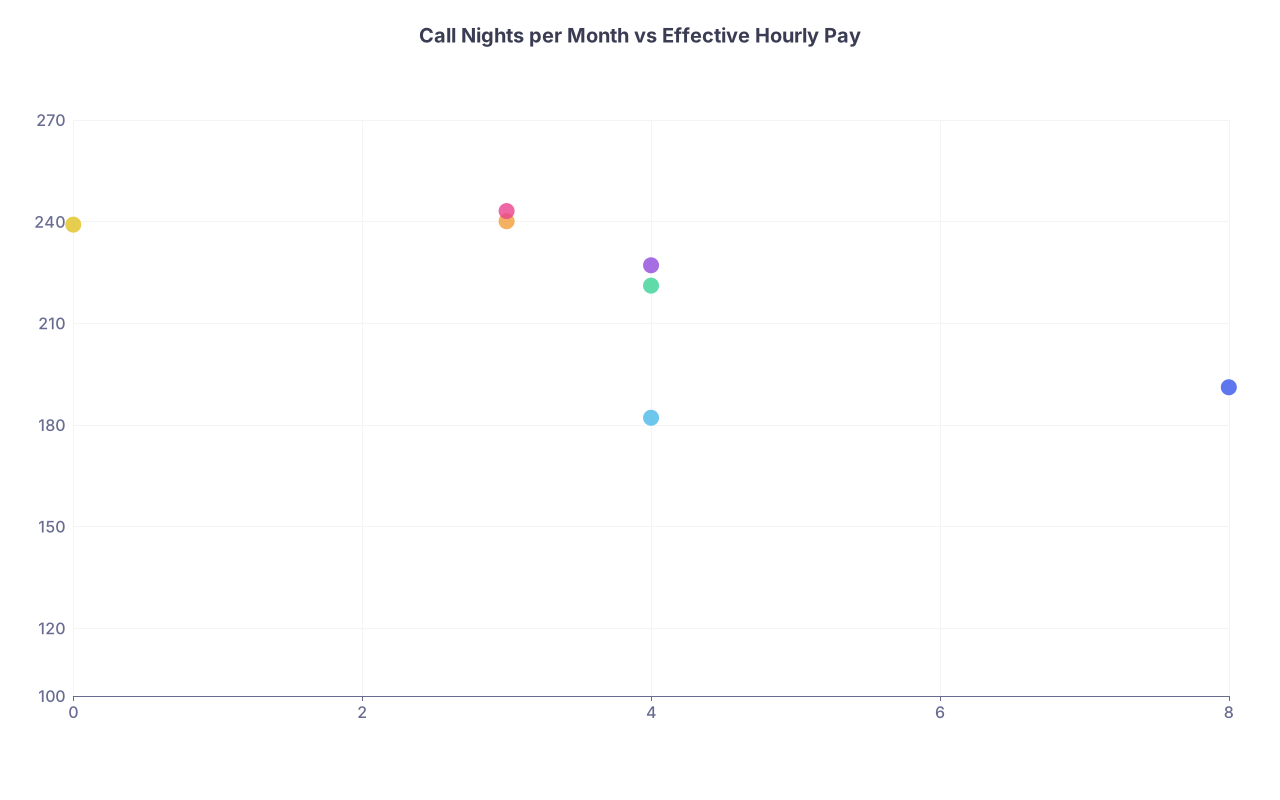
Here is a conceptual visualization tying call frequency to effective hourly rate for selected specialties, using the rough scenarios we walked through.
| Category | Value |
|---|---|
| Neurosurgery | 8,191 |
| Ortho | 4,227 |
| Interventional Cardio | 4,221 |
| GI | 3,240 |
| Radiology | 3,243 |
| Anesthesia | 4,182 |
| EM | 0,239 |
Interpretation:
- Neurosurgery: highest call nights, lower $/hr than you would assume, despite top raw salary.
- Radiology and GI: relatively few call nights, top of the $/hr cluster.
- EM: zero “call” but plenty of nights/weekends; $/hr competitive with proceduralists.
- Anesthesia: reasonably high call nights and middling $/hr in this approximation.
The exact coordinates will vary by practice, but the shape of this scatter is consistent across markets: the marginal dollar you earn beyond a certain point tends to come from sacrificing call‑free time, not from getting a better hourly deal.
FAQ (5 Questions)
1. Which high-paying specialty has the best balance of salary and call?
Across large samples, diagnostic radiology and gastroenterology often sit in the sweet spot: high six‑figure pay with manageable call structures, especially in larger groups where nights and weekends are spread across many physicians. Their effective hourly rate, once call is included, often matches or beats fields like orthopedics or interventional cardiology that advertise higher base salaries but impose heavier call.
2. Is neurosurgery ever “worth it” financially given the call burden?
If you look strictly at dollars per hour, neurosurgery rarely tops the charts. Its appeal is more about absolute income, the intellectual and procedural challenge, and niche power (few competitors, high leverage). The field is “worth it” only if you highly value those non‑financial components and tolerate chronic call. If you are neurosurgery‑indifferent and money‑motivated, the numbers point you toward other procedural fields with less punishing call.
3. How much should call frequency matter during residency selection?
It should matter a lot more than applicants usually admit. Residency is your worst‑case call scenario at the lowest pay of your career. If you already dread nights and weekend work as a student, choosing a call‑heavy surgical field “for the attending salary” is statistically misaligned with your preferences. You will spend 3–7 years under heavy call before you ever touch that salary.
4. Are there realistic ways to lower call burden without sacrificing huge income?
Yes, but it usually involves tradeoffs other than pure salary: joining larger groups to dilute call, choosing community over tertiary‑referral centers, avoiding Level 1 trauma hospitals, or prioritizing practices with dedicated nocturnists/nighthawks. Many physicians in high‑paid specialties quietly accept 5–15 percent lower salary to cut call frequency in half. The data show that can increase your effective hourly rate and improve your life.
5. How do I compare two offers in the same specialty with different call schedules?
Quantify each offer’s total yearly hours, including a realistic estimate of call burden. Compute effective $/hr for both. Then layer subjective factors on top: schedule predictability, partner culture, family needs, and long‑term growth. If the higher‑salary job has a lower effective hourly rate and a call profile that conflicts with your stated tolerances, the lower‑salary, lower‑call job is usually the rational choice, even if your ego resists it.