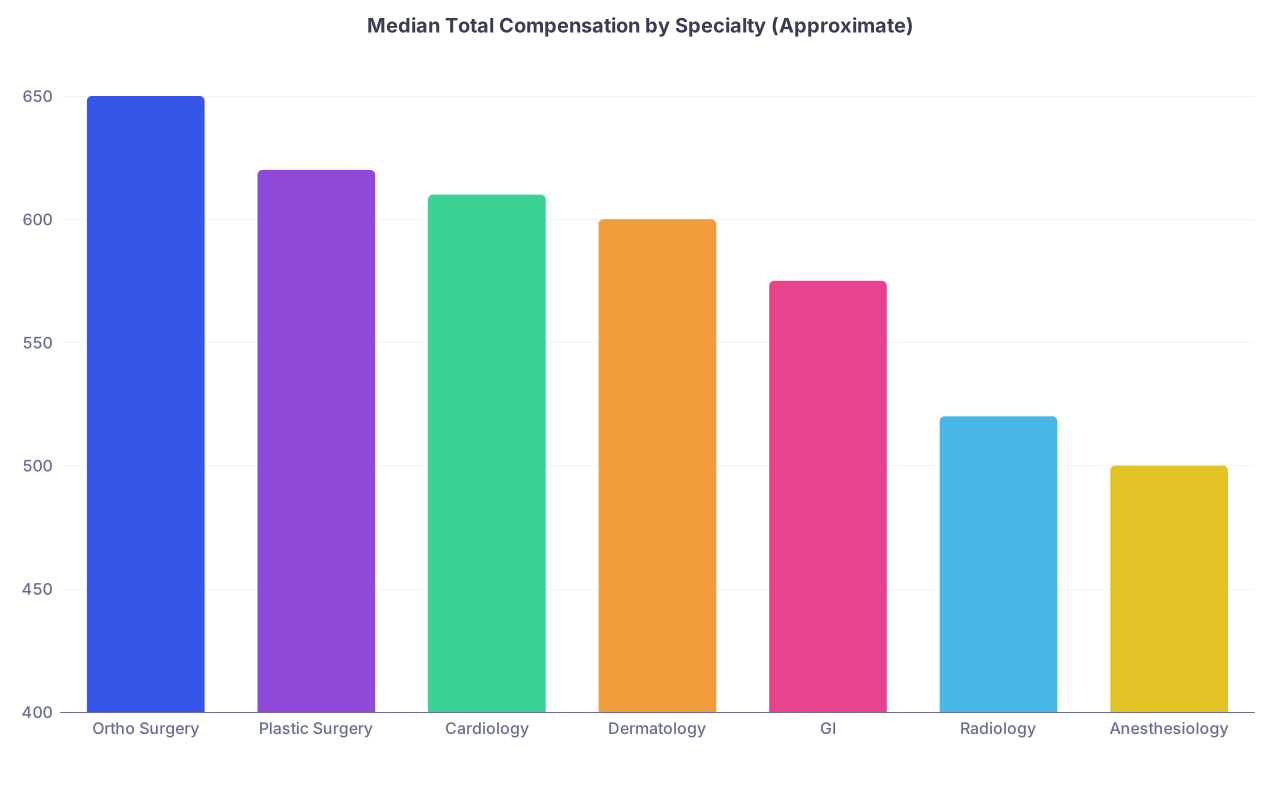
| Category | Value |
|---|---|
| Ortho Surgery | 650 |
| Plastic Surgery | 620 |
| Cardiology | 610 |
| Dermatology | 600 |
| GI | 575 |
| Radiology | 520 |
| Anesthesiology | 500 |
The mythology around “top-paid specialties” hides a simple truth: most of the money follows RVUs and collections discipline, not just the letters after your name.
If you want to understand why one orthopedic surgeon makes $450k while another clears $1.2M—with similar training—the data points to three levers: RVU targets, conversion factors, and collections efficiency. Miss any one of those, and the compensation story collapses.
Below I will walk through what the numbers actually look like in the highest paid specialties, how RVU and collections benchmarks interact, and what this implies for you as a resident or early attending trying to read a contract with a straight face.
1. The Core Math: RVUs, Conversion Factors, and Collections
Strip away the marketing. Compensation models in high-earning specialties boil down to a few equations.
wRVUs (work RVUs) → multiplied by a dollar conversion factor → modified by collections and overhead → equals your take-home, plus or minus base salary and quality bonuses.
The core relationships:
- Productivity:
Annual wRVUs produced - Compensation driver:
wRVUs × $/wRVU (conversion factor) - Collections performance:
Collections ÷ Charges (collection rate) - Effective compensation per RVU (after overhead):
(Collections – Overhead allocation) ÷ wRVUs
In high-paid specialties, the data consistently shows three patterns:
- Higher RVU opportunity per encounter (e.g., procedures vs office visits).
- Higher expected RVU targets from employers.
- Tighter linkage between pay and performance: less pure salary, more RVU and collections-based.
To put some scale to this, let us look at rough benchmark RVU requirements by “tier” of income.
| Income Tier (Total Comp) | Typical wRVU Range |
|---|---|
| $350k–$450k | 6,000–8,000 |
| $450k–$600k | 7,500–9,500 |
| $600k–$800k | 9,000–12,000 |
| $800k–$1M+ | 11,000–15,000+ |
These are composite ranges from MGMA, AMGA, and real contract data I have seen. Outliers exist, but if someone is making $900k in a procedure-heavy specialty, they are usually sitting north of 11,000 wRVUs or on a very favorable payor mix with a strong collections multiplier.
2. RVU Targets and Compensation in Top-Paid Specialties
Let us drill into specific specialties residents obsess over when they look at salary surveys: orthopedic surgery, plastic surgery, cardiology, dermatology, GI, radiology, and anesthesiology.
The figures below are rounded and blended from MGMA, AMGA, and major survey data from 2022–2024. Exact numbers vary by region, practice ownership, and subspecialty.
2.1 Snapshot: Productivity Benchmarks by Specialty
| Specialty | Median wRVUs | Median Comp ($k) | Implied $/wRVU ($) |
|---|---|---|---|
| Orthopedic Surgery | 9,500–10,500 | 600–700 | 60–70 |
| Plastic Surgery | 8,500–9,500 | 600–650 | 65–75 |
| Cardiology (non-intv) | 7,500–8,500 | 550–650 | 65–75 |
| GI | 8,500–9,500 | 550–650 | 60–70 |
| Dermatology | 7,000–8,000 | 520–620 | 70–80 |
| Radiology | 9,000–10,000 | 500–550 | 50–60 |
| Anesthesiology | 9,000–11,000 | 480–550 | 45–55 |
Those implied $/wRVU values are not the contract conversion factors; they are back-calculated from median reported comp and RVUs. Contracts often have explicit $/wRVU values that sit a bit lower, with base salaries and call pay making up the rest.
You should notice something quickly: dermatology and plastics often show a higher implied $/wRVU because of robust cash-pay and commercial payor mixes. Anesthesia and radiology tend to have lower $/wRVU but higher volume.
3. How Collections Benchmarks Tie In
RVUs measure work. Collections measure money. In the real world, those two do not move in perfect sync.
Key ratios:
- Collection rate = Collections ÷ Charges
- Dollars per RVU = Collections ÷ wRVUs
For top-paid specialties, typical collection rates:
- Commercial/academic employed groups: 35–55% of gross charges
- Efficient private groups with good payor mix: 45–65%
- Cash-heavy (aesthetics dermatology/plastics): 70–90%+ on the cash side, lower on insurance side
The essential benchmark employers track is not “how many RVUs did you do?” alone. They track:
- Total collections per full-time physician
- Collections per RVU
- Overhead as a percentage of collections (often 40–65%)
In several high-producing private groups I have seen:
- Orthopedic surgeon generating 12,000 wRVUs
- Gross charges: $4.0–4.5M
- Collections: $1.8–2.3M (40–55% collection rate)
- Overhead: $1.0–1.3M (high-cost OR, implants, staff)
- Physician net: $800k–$1.0M
The RVU target alone would not tell you that story. The collections data does.
4. Specialty-Specific Patterns
4.1 Orthopedic Surgery
Orthopedic surgery is a pure volume × acuity game.
Typical numbers for a busy private ortho:
- wRVUs: 10,000–13,000+
- Total comp: $700k–$1M+
- Contract conversion factors in employed models: $55–$70/wRVU, often with:
- Base salary: $450k–$550k
- Bonus above a threshold (e.g., start paying once you exceed 7,000–8,000 wRVUs)
Collections data:
- Gross charges can easily exceed $4M/year
- Collections: often 40–55% of charges, heavily payor-dependent
Key implication for residents: your OR access and case mix matter as much as your baseline conversion factor. A contract offering $70/wRVU sounds great until you discover you are blocked at 7,500 RVUs by limited block time.
4.2 Plastic Surgery
Two different worlds: reconstructive (insurance-heavy) and cosmetic (cash-heavy).
In reconstructive/academic-plastics:
- wRVUs: 7,000–9,000
- Comp: $450k–$650k
- $/wRVU in contracts: often $60–$80
In cosmetics/private pay:
- wRVUs become a weaker metric; many cash-pay encounters are not coded the same way.
- Revenue per hour can dwarf reconstructive work even at lower “RVU” counts.
- Collections rate on cosmetic work can effectively be 90–100%, minus merchant fees.
From a pure data standpoint, cosmetic-dominant plastics behaves more like a retail business than a standard RVU contract environment. RVU targets in those practices are often meaningless; they track monthly collected revenue instead.
4.3 Cardiology
Cardiology is deceptive. Residents see high salaries and assume procedures are the driver. The data shows procedure volume matters, but so do outpatient follow-ups and call.
Non-interventional cardiology:
- wRVUs: 7,500–8,500 median, with high producers 9,500–11,000
- Median comp: $550k–650k in private/non-academic
- $/wRVU: $65–$75 implied
Interventional cardiology:
- Usually 10–20% higher comp
- wRVUs somewhat higher, but also higher call burden and cath-lab dependence
Collections:
- Heavy Medicare component, typical collection ratios ~30–45% of gross charges.
- Private groups sometimes share a pooled collections bonus; employed hospital models are pure RVU-based.
5. Dermatology and GI: High Yield per Hour
5.1 Dermatology
Dermatology wins on revenue density per clinical hour, not necessarily raw annual RVUs.
Typical full-time dermatologist (insurance-heavy, not 100% cosmetic):
- wRVUs: 7,000–8,500
- Comp: $500k–650k in productive private groups
- Implied $/wRVU: often $70–80+
Add in cosmetics:
- Total income can jump to $700k–900k+ with similar or slightly higher hours.
- Cosmetics side does not always show up in RVU figures; collections per hour rise sharply.
Efficiency benchmarks I have seen in high-functioning dermatology groups:
- 25–35+ patients per half-day clinic
- Large share of procedures (biopsies, excisions, Mohs)
- Collections per RVU well above primary-care norms due to payor mix and procedure coding
5.2 Gastroenterology
GI is a procedure volume machine. Colonoscopies and EGDs dominate the revenue stack.
Typical private practice GI physician:
- wRVUs: 8,500–11,000+
- Comp: $550k–800k in high-producing groups
- Contract $/wRVU (employed): $60–70 commonly
Endoscopy suite productivity:
- One busy GI: 10–15+ procedures per day
- Large share of total collections coming from facility-fee-linked activities when the group owns the ASC
Collections:
- When GI groups own their endoscopy centers, total collections per physician can climb well above $2M.
- The RVU-based professional fee is only part of the economic pie; facility ownership and ancillaries drive the rest.
Residents often miss this: RVU targets in GI-employed models do not capture the upside that partners in private GI enjoy from the ASC and ancillary ownership.
6. Radiology and Anesthesiology: Volume and Group Economics
6.1 Radiology
Radiology compensation is less about RVUs per se and more about interpreted study volume and group contracts, but RVUs still underpin the work valuation.
Typical diagnostic radiologist:
- wRVUs: 9,000–11,000
- Comp: $450k–600k depending on group, geography, and call
- Implied $/wRVU: $50–60
Key productivity pattern:
- A high reading volume with good group-level contracts yields strong collections-per-RVU.
- Teleradiology and corporate groups sometimes push volume high but compress $/RVU.
One thing I see repeatedly: radiologists in democratic private groups with hospital contracts often outperform corporate-employed radiologists on collections per RVU, because the group negotiates and keeps more of the margin.
6.2 Anesthesiology
For anesthesiology, work is often measured in ASA units rather than pure RVUs, but many hospital-employed arrangements still map production to RVUs for compensation purposes.
Typical benchmarks:
- “RVU-equivalent” volume: 9,000–12,000+ depending on case mix and supervision ratios
- Comp: $450k–550k in many markets, higher in rural or high-demand areas
- Effective $/wRVU: $45–55
Collections data:
- Strong linkage to OR utilization and facility volume.
- Anesthesiology groups rely heavily on subsidies and facility support to cover gaps between collections and provider compensation.
So you might see an anesthesiologist “producing” a certain RVU volume, but the hospital subsidy is what pushes their actual paycheck into the competitive range. That subsidy does not show up in your RVU calculation; it shows up in the collections and subsidy line on the group’s P&L.
7. RVU Targets: Employed Models vs Private Practice
Residents often ask, “What is a reasonable RVU target for my first job?” The answer depends absolutely on whether you are:
- Hospital-employed / corporate
- In a private group, especially with ancillaries or ownership
Typical employed-hospital model for a high-paid specialty looks like this:
- Base salary + wRVU-based bonus
- Threshold: e.g., 7,000–8,000 wRVUs for ortho, GI, cardiology
- Bonus calculation: (Your wRVUs – threshold) × $/wRVU
- $/wRVU: often 10–25% below what the group’s collections-per-RVU would support (the difference pays overhead and margin)
Example: Hospital-employed orthopedic surgeon
- Base: $525k
- Target threshold: 8,000 wRVUs
- $/wRVU: $60
- You produce 10,000 wRVUs
Bonus = (10,000 – 8,000) × $60 = 2,000 × $60 = $120k
Total comp ≈ $525k + $120k = $645k
Behind the scenes:
- If hospital collections average $100 per wRVU on your work, your 10,000 wRVUs produce $1.0M in collections.
- They pay you $645k. Roughly $355k is covering overhead, staff, margin, and system support.
In private practice with a typical “eat-what-you-kill” formula:
- You might see 40–60% of collections after overhead.
- That same 10,000 wRVUs, if yielding $1.0M in collections:
- 55% to you = $550k
- 45% overhead = $450k
But if that group also has ASC ownership and ancillaries, your real total comp could be $700k–900k with profit distributions, even if the core professional collections split is similar.
Employed models: RVU target is the main lever.
Private models: collections and overhead efficiency matter as much or more.
8. Collections Benchmarks: What “Good” Looks Like
If you want actual benchmarks rather than vague comments, here is the pattern that shows up in high-functioning, top-paid groups:
| Metric | Strong Practice Range |
|---|---|
| Collection rate (charges→cash) | 45–65% |
| Overhead as % of collections | 40–55% |
| Physician net % of collections | 45–60% |
| Collections per wRVU | $80–$120+ (procedure-heavy) |
A practical check: If your group is collecting $80–$120 per wRVU and your compensation per wRVU is $45–$70, you are in a reasonably healthy zone. When that spread grows (say, group collects $140 per RVU and pays you $55), someone else is keeping the delta.
9. What Residents Should Actually Do with This Data
As a resident, you do not need to memorize the exact RVU benchmarks. You do need to internalize four habits before you sign anything:
Always ask for expected wRVU targets and historical averages for the position.
Do not accept, “Our doctors are very busy.” Ask: “What were the last three physicians’ actual wRVUs and total comp in this role?”Ask for the collections per RVU and typical collection rate.
If they refuse to share, that tells you as much as the numbers would have.Compare the offered $/wRVU to implied $/wRVU from national surveys.
If MGMA shows your specialty at $65–75 per wRVU (implied) for median, and the contract offers $45, you are subsidizing a lot of margin.Diagnose the bottlenecks: OR time, cath lab access, endoscopy blocks, clinic support.
High RVU targets are meaningless if the institution throttles your ability to generate volume.
One last visual to drive the point home.
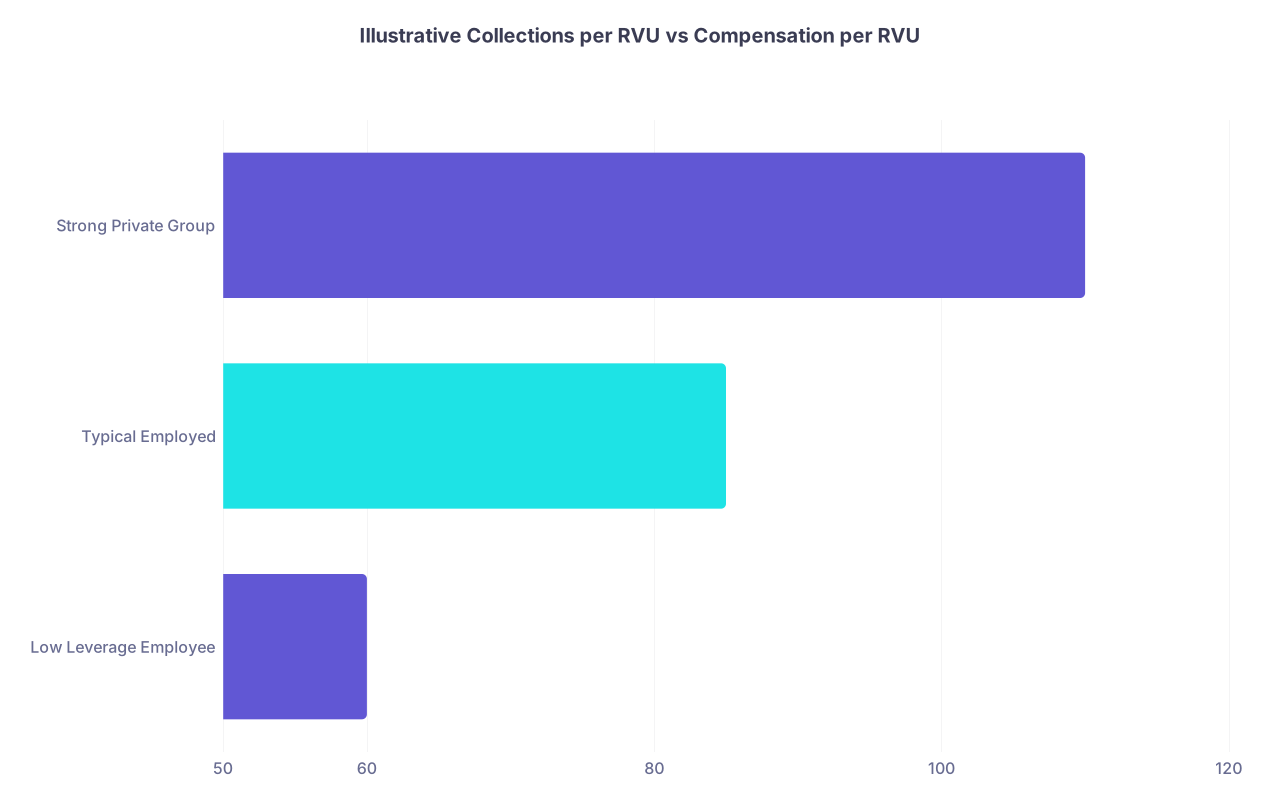
| Category | Value |
|---|---|
| Low Leverage Employee | 60 |
| Typical Employed | 85 |
| Strong Private Group | 110 |
This chart shows collections per RVU. In a low-leverage employee setting, you might be paid $45/RVU while the system collects $60. In a strong private group, they might collect $110/RVU, and you keep $60–70 of that. Same work. Different economics.
10. Specialty Choice vs Practice Model
You can make $900k in orthopedics or GI in the right environment. You can also get stuck at $450k in the same specialties with constrained volume or a weak contract. The data is brutal on one point:
The variance within a specialty often exceeds the variance between specialties.
I have seen:
- A private GI in the Midwest: 11,500 wRVUs, $1.1M+ total with ASC distributions.
- A hospital-employed GI in a coastal city: 8,000 wRVUs, $550k with no ancillaries and brutal call.
- A private general cardiologist: 10,000 wRVUs, $800k+ including imaging lab ownership.
- An academic non-interventional cardiologist: 6,000 wRVUs, $380k and research time.
Same core specialty. Completely different economic function.
Residents obsessively rank specialties by “average salary” while ignoring practice structure and payor mix. The data shows this is a mistake. RVU targets and collections benchmarks tell you how a specific job will treat you, not what your specialty “should” pay.

Key Takeaways
- Top-paid specialties are high-earning because of procedure-driven RVUs and strong collections per RVU, not magic. Your actual pay depends on RVU targets, conversion factor, and group efficiency.
- Variability within a specialty (ortho, GI, cardiology, derm) is enormous. A specific job’s RVU expectations, collections data, and practice model matter more than national “average salary” tables.
- As a resident, you should demand concrete numbers: historical RVUs, collections per RVU, and pay structure. If the math does not add up, it is not a “good opportunity,” no matter how impressive the specialty label sounds.