

You are halfway through residency. It is 9:30 p.m., you are still in the hospital, and you just got a text from a co-resident: “Ortho guy I met at conference. 3 years out. Cleared 900k last year. Same med school as us.”
You look at your own paycheck. You do the math on your projected attending salary in your current field. You subtract your loans, the cost of childcare you do not yet have, housing in any city you would actually want to live in, and the 10 years of delayed retirement savings.
The numbers do not work.
So now you are here: considering a mid-residency pivot into a higher-paying specialty. You are not the first. You will not be the last. But most people flail, ask vague questions, and then either give up or blow themselves up politically at their home program.
Let us not do that.
Below is the actual playbook. Not theories. What I have seen work.
Step 1: Get Brutally Clear On Your Endgame
Before you touch ERAS, talk to your PD, or whisper the word "switch" to anyone, you need a clear target and timeline. Money alone is not enough of a compass. It is a strong motivator. It is not a plan.
1.1 Know which specialties are realistically “more lucrative”
You are not going from community family medicine to pediatric endocrinology and “fixing” your income. Many subspecialties pay less than general practice.
If you are trying to move up the income ladder, you are usually looking at:
- Orthopedic surgery
- Neurosurgery
- Interventional cardiology (from IM)
- Gastroenterology (from IM, especially high-RVU private practice)
- Radiology (especially IR, but DR is solid)
- Dermatology
- Anesthesiology (strong in many markets)
- Ophthalmology
- ENT
- Certain procedural pain practices (usually via Anesthesia or PM&R)
Here is a blunt comparison:
| Specialty | Typical Range (USD) |
|---|---|
| Family Medicine | 230k–300k |
| General Internal Med | 250k–320k |
| Hospitalist | 270k–350k |
| Dermatology | 450k–900k+ |
| Orthopedic Surgery | 600k–1.2M+ |
| Interventional Cardiology | 550k–900k+ |
| Radiology (DR) | 450k–750k+ |
| Radiology (IR) | 550k–900k+ |
Numbers vary by region and practice model, but the direction is stable: procedural and imaging-heavy fields pay more. Cognitive-heavy fields, less.
1.2 Confirm what is actually possible from your starting point
Reality check:
- You will not “lateral-transfer” from PGY-3 family medicine into PGY-4 neurosurgery. That is fantasy.
- Highly competitive fields (derm, ortho, ENT, optho, IR from scratch) will often treat you like a fresh applicant, not as a “PGY-2 discount hire.”
- Some paths are reapplications from the beginning. Others can use your current year(s) as partial credit.
Strong starting points for a lucrative pivot:
- From Internal Medicine → Cards, GI, pulm/crit, heme/onc, even rads or anesthesia with reapplication. Strong launchpad.
- From Surgery prelim or categorical → Ortho, ENT, plastics, IR, anesthesia. Pain if you play the long game.
- From Anesthesia or PM&R → Pain, critical care, some procedural niches.
- From Transitional year/prelim → You are essentially “re-entering” the match anyway.
Weak but not hopeless trajectories:
- From Psychiatry, Pediatrics, FM → You may end up redoing an entire new residency. It can still be worth it financially over a 25–30-year career.
You need to draw your actual trajectory on paper:
“Now” → “What I must complete” → “Application cycle” → “Next residency start” → “Total extra training years” → “First high-earning year.”
If that still makes financial (and personal) sense over the long haul, then proceed.
Step 2: Do Silent Recon Before You Make Noise
Residents blow this step all the time. They announce they want to switch, then discover they are not eligible or competitive, and now their home PD knows they are halfway out the door.
You reverse it:
2.1 Get clear on eligibility and structure
For each target specialty, you must answer:
- Is this a new categorical residency or a fellowship after my current residency?
- Are there ACGME rules allowing prior credit? (Example: some rads programs may give IM residents PGY-2 credit for prelim medicine units; most derm programs will not.)
- Do programs accept off-cycle residents, or will you be sitting out months?
Do this research:
- Check ACGME Program Requirements for the target field.
- Look at several program websites for language like:
- “We occasionally accept residents transferring from other ACGME programs.”
- “We accept up to 6 months of prior IM training toward PGY-2 year.”
- Ask anonymously at first. Email coordinators as “curious PGY-2” without naming your PD.
2.2 Quietly audit your competitiveness
You cannot guess your competitiveness. You need hard inputs:
- Step 1 (if numeric), Step 2 CK score
- Class rank / AOA / med school name
- Any relevant research (especially for derm, rads, ortho, neurosurg)
- Red flags: leaves of absence, professionalism issues, failed rotations
You are aiming for this honest classification:
- Tier 1: Strong scores, no red flags, decent research → competitive for most high-paying fields with effort.
- Tier 2: Middle-of-the-road stats, but no major issues → possible with strategy, networking, and possibly less competitive geographies.
- Tier 3: Low scores and/or red flags → you may still pivot, but probably into relatively more lucrative, not absolute top of the food chain (e.g., from FM to anesthesia in a less saturated market, or from peds to PICU, etc.).
This dictates whether you chase derm in a coastal academic center or anesthesia in the Midwest.
Step 3: Financial Reality Check Before You Burn Years
You are thinking “more lucrative” so we are going to get financial. Quickly.
3.1 Calculate your “delta” in lifetime income
Basic back-of-the-envelope:
- Estimate current specialty attending income.
- Estimate target specialty income.
- Calculate difference per year.
- Multiply by ~25 practice years.
- Subtract:
- Extra years in training at resident salary
- Delayed attending income
- Potential extra loans/relocation costs
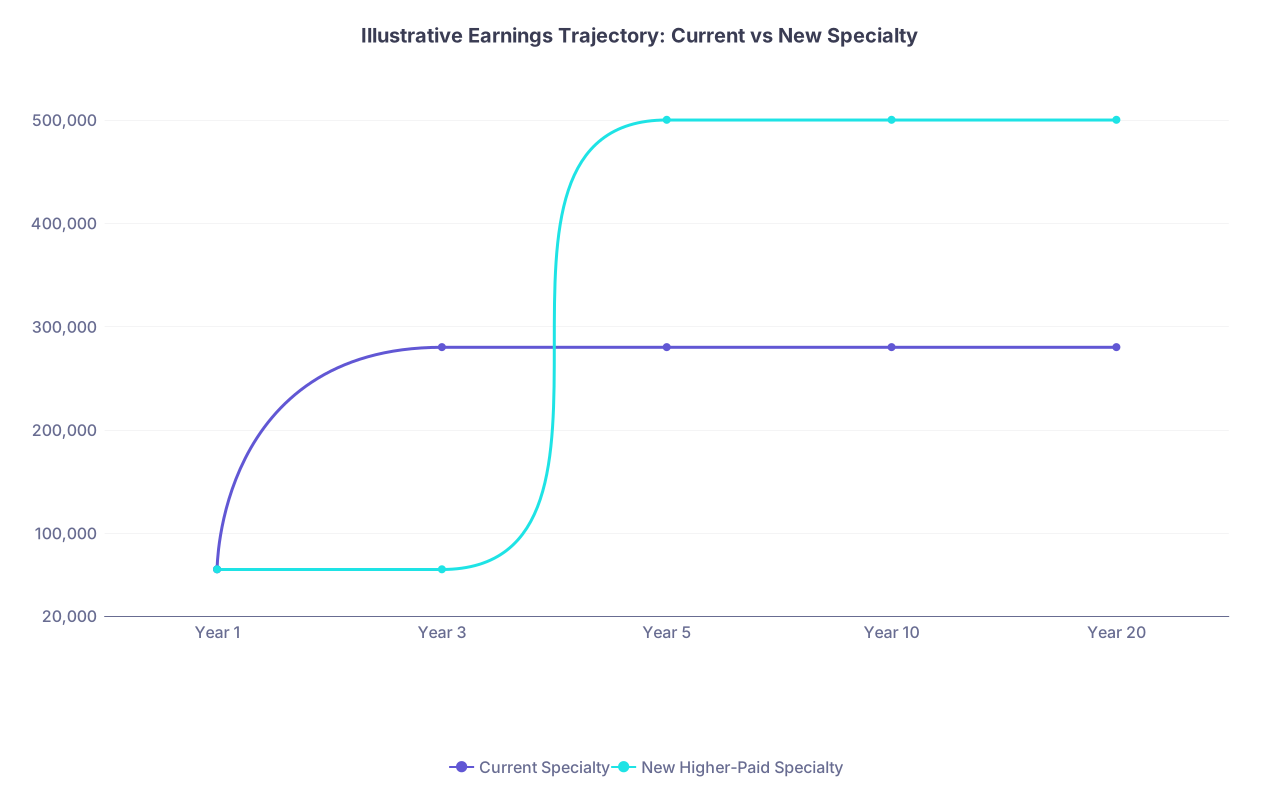
| Category | Current Specialty | New Higher-Paid Specialty |
|---|---|---|
| Year 1 | 65000 | 65000 |
| Year 3 | 280000 | 65000 |
| Year 5 | 280000 | 500000 |
| Year 10 | 280000 | 500000 |
| Year 20 | 280000 | 500000 |
If your new field pays $250k/year more and you delay that by 3 extra training years, you are still up ~ $6M over 25 years (rough, pre-tax, ignoring growth).
This is why, even with extra years, a pivot to a truly higher-earning field can be rational.
3.2 Check your personal runway
If you have:
- Kids
- Partner who cannot move
- Severe financial strain already
You need a support plan:
- How many months of negative cash flow can you tolerate for a gap year, research year, or off-cycle change?
- Can you moonlight in your current field during the gap (where allowed)?
- Do you need to aggressively cut lifestyle for 12–24 months to make this feasible?
If the math is impossible, that does not mean the pivot is dead. It might mean you choose:
- A lucrative subspecialty from your current base, not a full restart.
- A high-RVU private practice or rural model within your field (hospitalist nocturnist, EM in underserved markets, procedural-heavy practice).
But get the numbers out of your head and onto paper first.
Step 4: Build a Tactical Timeline (Not Vibes)
You are in residency. Your schedule is not your own. You need a written, date-driven plan.
4.1 Three core timelines you are juggling
- Match/Application Cycle
- ERAS opening, application submission, interview season, rank list deadlines.
- Your Current PGY Calendar
- Rotations that give you visibility, letter writers, elective time.
- Licensing / Exams
- Step 3 timing (huge leverage if you can pass before applying to a new specialty).
Map them together. A simple template:
- Month 0–2: Silent recon, polish CV, identify 2–3 target specialties and geographic zones.
- Month 3–5: Targeted rotations/electives with potential letter writers in the new field.
- Month 6: Take/passed Step 3 if plausible; start drafting personal statement.
- Month 7–9: Have the conversation with your PD and key mentors.
- Month 10–12: Submit ERAS (either for categorical switch or for subspecialty fellowship). Attend interviews.
Use a simple Gantt-style plan to keep yourself honest:
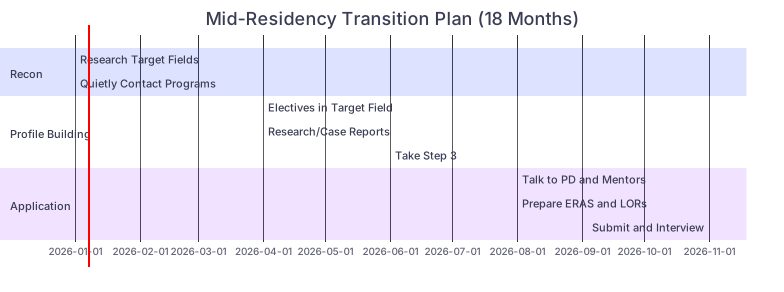
| Task | Details |
|---|---|
| Recon: Research Target Fields | a1, 2026-01, 2m |
| Recon: Quietly Contact Programs | a2, after a1, 2m |
| Profile Building: Electives in Target Field | b1, 2026-04, 3m |
| Profile Building: Research/Case Reports | b2, after b1, 4m |
| Profile Building: Take Step 3 | b3, 2026-06, 2m |
| Application: Talk to PD and Mentors | c1, 2026-08, 1m |
| Application: Prepare ERAS and LORs | c2, after c1, 2m |
| Application: Submit and Interview | c3, 2026-11, 4m |
You adjust dates to your reality, but you need something this concrete.
Step 5: Engineer Competitiveness Fast
You cannot change your Step 1 at this point. You can change almost everything else.
5.1 Get yourself physically in front of the new specialty
This is non-negotiable:
- Schedule electives or away rotations in the target field as early as possible.
- Do not just show up. Tell them: “I am exploring a serious transition into this specialty and want to learn what is required at your level.”
On these rotations:
- Show up early. Stay late. Yes, the basic stuff, but this time it matters more because you are on audition.
- Ask for discrete, visible tasks: “What can I own on this service that makes your day easier?”
- Be the person they remember by name when your application crosses their desk.
I have watched miserable IM residents pivot into GI or cards almost entirely off strong elective impressions and 1–2 heavy-hitter letters.
5.2 Create at least one piece of niche-aligned academic output
You do not need a PubMed empire. But for derm, rads, ortho, etc., having zero specialty-related output screams tourist.
Pick quick wins:
- Case reports from your elective (especially visually rich, imaging-heavy, or procedural cases).
- Simple retrospective chart reviews under a faculty member who already has IRB infrastructure.
- Posters at local/regional specialty conferences.
Push for at least one concrete line on your CV directly in the new field. Ideally within 6–12 months of deciding to pivot.
5.3 Pass Step 3 early if at all possible
Programs love not having to worry about your licensing exams. Step 3 in your pocket says:
- “I take exams seriously.”
- “I am low-risk.”
- “I can focus entirely on your program’s learning once I arrive.”
I have seen a mediocre applicant become a “safe bet” after a solid Step 3 and a strong letter.
Step 6: Manage the Politics With Your Current Program
This part is touchy. You cannot wing it.
6.1 Sequence your conversations correctly
Wrong order (common and disastrous):
- Tell co-residents you are unhappy and want out.
- Rumors reach chief, then PD.
- PD hears it third-hand. Now you are “disloyal” before you even ask for help.
Better order:
- Do at least 2–3 months of quiet recon and early electives.
- Line up at least one faculty ally, ideally outside your current dept (like a hospitalist or ICU attending who respects your work).
- Talk to your PD in a scheduled, non-rushed meeting with a clear plan.
6.2 How to talk to your PD without burning the house down
Come in with:
- A specific target specialty (or two, max).
- A sketched plan for timing (when you would potentially leave, how you will complete current obligations).
- An honest but non-accusatory explanation:
- “I have realized that I am best suited for a more procedural field…”
- “Long-term, my career and financial goals align better with [X]…”
What you say explicitly:
- “I want to be transparent and ask for your guidance before I make any moves.”
- “I am committed to doing excellent work here until I transition. I do not want to leave you in a bad spot.”
- “I would value your honest assessment of where you think I stand and what would make this realistic.”
You are trying to convert your PD into a reluctant ally instead of a blocked adversary.
6.3 Letters of recommendation reality
Strongest possible scenario:
- Your current PD writes: “This resident has been excellent for us, and while we are sad to see them go, we fully support their transition into [X] and believe they will thrive.”
More common scenario:
- PD writes a neutral “factual” letter. Fine. Then your key heavy-hitter letters must come from your target specialty.
If your PD is hostile or unsupportive:
- Do not pick a fight.
- Double down on external support: letters from specialty attendings, research mentors, program directors at places where you rotated.
- Programs do read between the lines. If every other letter raves about you, one lukewarm PD letter will not sink you.
Step 7: Choose the Right Transition Mechanism
Not all transitions are standard ERAS → PGY-1 again. You have multiple pathways, depending on your field.
7.1 Standard categorical re-entry (start over)
You apply as a new categorical resident (for example, from PGY-2 IM to PGY-1 rads or anesthesiology).
Pros:
- Clean slate in the new field.
- ACGME-compliant, standard; everyone knows the rules.
Cons:
- Extra years of training.
- Emotionally hard to “go backwards” in PGY level.
This is often the path for:
- Internal medicine → Radiology, Anesthesia, Dermatology
- Pediatrics/FM → Anesthesia, Radiology, etc.
7.2 Advanced positions with credited prior training
Some specialties allow entry at PGY-2 with a prior clinical year (like Medicine or Surgery).
Common for:
- Diagnostic radiology
- Anesthesia
- Derm (sometimes, depending on structure)
If your current PGY year meets the criteria, you can:
- Finish current PGY-1/2
- Then move into PGY-2 in the new field without repeating.
You must confirm with each program whether they will accept your prior year as valid.
7.3 Unfilled positions / off-cycle transfers
Quiet but powerful option.
- Monitor NRMP’s SOAP, program websites, and whisper networks for unfilled PGY-2+ spots.
- Email program coordinators directly with:
- CV
- Brief personal statement explaining your path
- Letters attached or available upon request
This works particularly well for:
- Anesthesia
- Radiology
- Some surgical subspecialties
- IM subspecialties (as fellows) if you are near completion of IM
You can sometimes bypass the entire yearly match if you find a program with a resident who left unexpectedly.
7.4 The fellowship route (if you are in IM, Peds, etc.)
If you are in internal medicine, you have the easiest technical path to a more lucrative life:
- Finish IM.
- Match into cardiology, GI, pulm/crit, heme/onc, or even interventional subspecialties.
Yes, it takes more years. But:
- You keep your current linear trajectory.
- No need to explain a “switch” or re-entering match from scratch.
- Many of these fields match or surpass “top specialties” in actual take-home pay once in private practice.
For a lot of current IM residents with money concerns, this is the smartest way forward.
Step 8: Build a Persuasive Application Narrative
Programs are not dumb. They will ask: “Why is this person leaving their field? Will they leave ours too?”
You need a coherent answer.
8.1 Your story has to sound like growth, not escape
Wrong framing:
- “I am miserable in IM. I hate clinic. I want more money.”
- “My program is toxic.” (Even if true, this makes you look unstable.)
Right framing:
- “Through my work in IM, I realized that I am most engaged when doing [procedural/imaging/acute care] work. I kept gravitating to [cardiology consults, radiology reading rooms, OR time]. Over time, it became clear that my long-term career fit is in [target specialty].”
You can weave in money indirectly:
- “I am looking for a career that allows long-term sustainability: the ability to support a family, manage my loans, and practice in a way that feels energizing instead of depleting. [Target specialty] aligns with that future.”
8.2 Address the elephant — explicitly but briefly
In interviews, you will be asked, “Why leave your current specialty?”
A solid 3-part answer:
- Insight: “During my residency in [current field], I discovered that the aspects that most energized me were [X, Y, Z].”
- Alignment: “That pattern aligns more deeply with [target specialty] — its focus on [procedures/acuity/diagnostics/longitudinal care] fits how I want to practice medicine.”
- Commitment: “This is not a sudden reaction. I have taken [electives, research, shadowing] steps over the last year to confirm the fit. I am committed to building a career in [target field].”
Say it cleanly once. Then pivot back to what you offer them.
Step 9: Protect Your Sanity In the Middle of the Chaos
This process is stressful. You are doing a full-time job (residency) and effectively running another full-time job search.
A few practical survival moves:
- Set a weekly “transition block”: 2–3 hours, same time each week, purely for emails, writing, ERAS work, and follow-ups. Guard it.
- Delegate what you can at home: If you have a partner, be explicit: “For the next 6 months, I need more coverage here so I can make this jump. It will pay off later.”
- Decide what you’ll let drop: You cannot be chief resident, lead quality project director, and run 5 papers while switching. Drop non-essential leadership and committee noise.
Burnout will kill this transition faster than any score cutoff.
Step 10: Play the Long Game Even If You “Lose” Round One
Two hard truths:
- You might not match into the dream specialty on the first pass.
- You can still end up in a much better financial and personal position than if you never tried.
If you do not match:
- Ask directly for feedback from programs that interviewed you. Some will respond with useful specifics.
- Decide whether to:
- Strengthen your application with a research year, prelim year in a related field, or more electives.
- Re-target to a different but still lucrative field (for example, from derm → rads, from ortho → anesthesia or PM&R → pain).
You are not locked into a binary: “Ortho or bust, derm or die.” There are multiple routes to a high-income, sustainable career.
Key Takeaways
- Do the unglamorous work first: silent recon, financial math, and timeline planning before announcing you want to switch.
- Engineer competitiveness quickly: targeted electives, at least one aligned academic product, and Step 3 in your pocket.
- Treat this like a professional negotiation: manage your PD relationship, pick the right transition pathway, and present your pivot as a mature, clarified fit — not an impulsive escape.


