
Residency moonlighting can either accelerate your financial life or quietly destroy your training, your license, and your health. The difference is how you set it up.
If you are in a high-earning specialty—EM, anesthesia, radiology, critical care, surgical subspecialties—you are under special pressure. You see attendings walking around with incomes that dwarf your resident salary. Locums recruiters start sniffing around PGY-2. Senior residents talk about pulling in an “extra attending salary” moonlighting. Most of them are leaving out the risk math.
You do not need more vague “be careful” warnings. You need a step-by-step, field-tested protocol to set up moonlighting that is:
- Financially worth it
- Legally defensible
- Training-safe
- Sleep-preserving
Let’s build that.
1. Decide if You Should Moonlight At All (Not Everyone Should)
First problem: residents jump straight to “Where can I moonlight?” instead of “Should I moonlight this year?”
Answer that first.
Run this hard filter checklist
If any of these are “yes,” you stop here and fix them before adding extra work:
Are you struggling clinically at baseline?
- Below-average evaluations
- Attending feedback about “medical decision-making needs work”
- Remediation, probation, or academic warning
If you are not a rock-solid PGY for your level, you have no business taking independent responsibility elsewhere. You are one bad outcome away from a career-level problem.
Are you below target on required case volumes or procedures?
- Surgery: behind on index cases
- Anesthesia: low central lines, low neuraxial numbers
- EM: shift counts low, procedure log looks thin
Do not trade future attending competence for a few extra dollars right now.
Are you consistently sleep-deprived already?
- Less than 6 hours most nights
- Regular post-call “I feel unsafe driving” moments
- You are using caffeine like a medication, not a tool
Moonlighting does not magically create new hours. It steals from sleep, relationships, or study. Usually sleep.
Any recent professionalism or wellness flags?
- Late notes, missed labs, communication complaints
- Your PD has “concerns”
- You are dealing with heavy personal/family issues
In those cases, adding a second employer is like adding a second bomb.
If you pass that filter—meaning you are clinically strong, on-track with training, and reasonably well-rested—then moonlighting can make sense.
Now we get specific to high-earning fields.
2. Understand Specialty-Specific Realities (EM, Anesthesia, Rads, ICU, Surgical Subspecialties)
Not all moonlighting is created equal. The risk-benefit curve looks very different by specialty.
| Specialty | Typical Moonlighting | Risk Level | Pay Range (USD/hr) |
|---|---|---|---|
| EM | Community ED, low-acuity sites | Moderate | 130–225 |
| Anesthesia | Community call, OB, GI suites | High | 150–250 |
| Radiology | After-hours prelim reads | Moderate | 90–180 |
| Critical Care | Nocturnist in step-down/ICU | High | 150–250 |
| Surgical Subspecialties | Minor OR/procedures, call | Very High | 150–300+ |
Emergency Medicine
Moonlighting is practically built into the culture.
Pros:
- You are already shift-based
- Many community EDs are desperate for coverage
- Pay is strong even as PGY-3+
Risks:
- Under-resourced community sites: no backup, minimal consultants
- Expectation creep: “You can handle higher acuity, right?”
- Charting pressure to “look like an attending”
Fix it:
- Stay in low- to moderate-acuity sites only
- Require real-time backup: on-site attending or immediately available
- Hard limits on number of shifts per month (we will get there)
Anesthesiology
This is where I have seen some of the worst moonlighting setups.
Common traps:
- OB anesthesia with one resident covering multiple labor rooms alone
- Community ORs where “you’re basically the attending, but we’ll pay you like a cheap locum”
- Overnight call with minimal supervision
These are high-malpractice-risk environments. Epidurals, stat C-sections, difficult airways. If you moonlight in anesthesia, supervision and case selection must be non-negotiable.
Radiology
Tends to be easier to make safe, if you are smart.
Typical:
- Night/weekend prelim reads
- Telerads-like arrangements as senior residents
Risks:
- Over-reading volume → burnout and errors
- Non-ACGME workloads but attending-level expectations
- Poor integration with your training program (no feedback loops)
Fix:
- Cap studies per hour
- Make sure reports are clearly labeled as prelim by resident
- Confirm malpractice coverage specific to telerad-like reading
Critical Care / Hospitalist-Style Moonlighting
ICU shifts, rapid response, step-down coverage.
These can be lucrative and resume-friendly. They can also be where your first code as sole responsible MD goes sideways and lands in litigation.
You want:
- Explicit attending backup plan
- Clear scope: are you admitting? writing orders? just cross-covering?
- Reasonable census caps
Surgical Subspecialties
I have seen residents cover community call where they are the only “surgery” in-house. Wrong. That is an attending’s job.
Safe(ish) options:
- Assisting in ORs (ophtho, ortho, ENT, plastics) where a real attending is primary
- Simple procedures (lines, ports) with backup available
- Anything that keeps you inside your actual training level
If someone wants you to independently manage trauma, emergent appendectomies, or major vascular issues while calling an attending from home, walk away.
3. Get Program Approval the Right Way (Paper, Not Vibes)
Residents get burned all the time by trying to moonlight “quietly” or with only a casual hallway thumbs-up from an attending.
That is not protection. That is how you own all the risk personally.
Your non-negotiable steps:
Read your GME / program policies first
- Some programs: moonlighting completely banned
- Others: only internal moonlighting allowed
- Some require PGY-3+ and specific board exam passes (e.g., USMLE Step 3)
Confirm ACGME work-hour implications
- All moonlighting hours count toward the 80-hour weekly limit
- PD is responsible for tracking and compliance
- “Off the books” moonlighting puts them at risk → they will not protect you if things blow up
Have a formal meeting with your PD Go in with:
- A draft schedule: how many shifts, where, what hours
- Written description of job: acuity level, supervision, census, call expectations
- Clear statement: “I will keep my total under 80 hours per week and will stop if it interferes with my training.”
Then ask for written approval:
- Email confirmation or signed moonlighting form
- Document filed with GME
Get it into MedHub/New Innovations/your tracking system
- Many institutions have a moonlighting log
- If there is a system, use it religiously
- If there is no system, create your own written log (dates, hours, location)
If your PD hesitates, listen. They know about previous disasters you have never heard of.
4. Build a Safe Weekly and Monthly Schedule (Numbers, Not Feelings)
Residents are terrible at estimating their own capacity. “I can handle it” are famous last words.
You need numeric rules.
The hard caps
Assume:
- ACGME 80-hour weekly average
- 1 day off in 7 on average
- In-house call frequency and post-call rest requirements still apply
Now layer moonlighting:
Weekly cap
For high-intensity specialties (EM, ICU, anesthesia, surgery):- Max 12–16 hours of moonlighting per week
- Preferably in no more than 2 shifts
For lower-intensity (some radiology reading, low-acuity cross-cover):
- Max 16–20 hours per week with breaks and low stress
Post-call rule
- Never moonlight post-call from your primary residency
- No 24+ hour call followed by a moonlighting shift
- If your home program has a 24-hour call, the next calendar day is sacred
Day off rule
- Protect your guaranteed 1 in 7 day off from all clinical work
- That day is no shifts, no crossover, no “just a few charts”
Night shift stacking
- Never do more than 3 consecutive night shifts including residency + moonlighting
- After a run of nights (residency or moonlighting), insist on 24 hours of true off time if at all possible
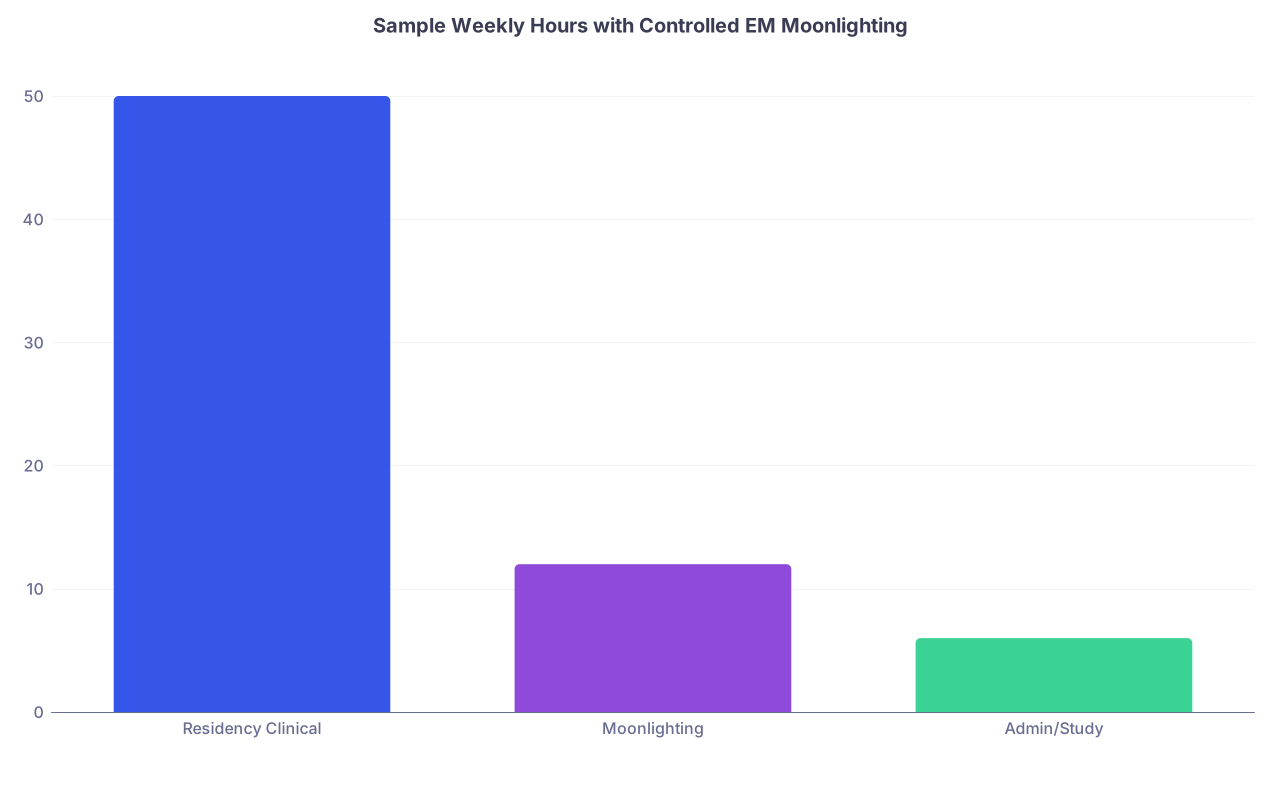
To make this concrete, let’s model a safe EM PGY-3 schedule with moonlighting.
| Category | Value |
|---|---|
| Residency Clinical | 50 |
| Moonlighting | 12 |
| Admin/Study | 6 |
That gets you to roughly 68 hours. Hard but survivable. The moment your “Residency Clinical” creeps up to 60–65, moonlighting must drop or stop.
5. Lock Down Malpractice, Licensing, and Credentialing (This Is Where People Get Sued Personally)
This is the part residents try to skip because it is boring. It is also the part lawyers care about.
Step 1: Get malpractice coverage in writing
Non-negotiable details to confirm (in writing, not just verbally):
- Are you covered individually? Or under a group / hospital policy?
- Is the policy claims-made or occurrence?
- What are the limits? (Typical: $1M/$3M in many US states)
- Does it include tail coverage if you leave?
If you are asked to provide your “own” malpractice:
- Talk to a real broker who works with residents/fellows
- Compare quotes and make sure tail coverage is included or clearly priced
Step 2: Confirm your license is appropriate
You must:
- Hold the correct individual state medical license for where you work (often not just a “training license”)
- Check if moonlighting is allowed under your training license (many states say no)
- Avoid crossing state lines casually for tele-type work
If a site says, “We can bill you under the attending’s license, do not worry about it,” that is a red flag. Billing fraud is not a small issue.
Step 3: Hospital privileges and credentialing
You are not a med student anymore. You cannot work “shadow-attending” without proper credentialing.
Ensure:
- You are formally credentialed at the site
- Your role is defined: Resident moonlighter vs independent contractor
- Your permitted procedures are spelled out
I have seen residents do C-sections at small hospitals with zero credentialing beyond “the OB guy said it was okay.” Then a complication hits, and suddenly nobody remembers agreeing to anything.
You want paperwork.
6. Choose the Right Moonlighting Jobs: What to Accept, What to Refuse
Money is not the only variable. It is not even the main one.
Here is how to evaluate offers quickly and ruthlessly.
Green flags
You want jobs where:
Supervision is real, not theoretical
- On-site attending, or immediately available and truly responsive
- Clear escalation plan and known phone numbers
Scope of practice is resident-appropriate
- You are not expected to perform procedures you are not credentialed or trained for
- You can say “no” without culture backlash
Workload is predictable and capped
- Reasonable patient volume or study count
- No history of constant “unsafe” complaints by prior moonlighters
Orientation is formal
- Actual onboarding, EMR training, crash cart location, protocols
- You are not just thrown onto the schedule
Compensation is transparent and fair
- Written rate, clearly defined (hourly vs per shift vs per RVU)
- No ridiculous clawback terms or vague “productivity” schemes for a resident
Red flags (walk away)
If any of these show up, do not negotiate. Just leave.
- “Coverage only; you will call the attending if things get hairy”
- “We need you to sign off as the attending; we will help you with the documentation”
- Unwillingness to show you malpractice details or claim “you are under our umbrella, trust us”
- Historical complaints from other residents about unsafe census or acuity
- Pay structured to push speed over safety (e.g., per-study reading with no volume cap)
If it feels like they are trying to get attending-level work out of you for cheaper, they are. Do not be the discount attending.
7. Money: Make It Actually Worth It After Taxes and Fatigue
A lot of residents are shocked when they realize how little net they are keeping. You need to see the numbers clearly.
Let us run a simple EM example:
- Pay: $180/hour
- Shift: 8 hours
- Gross: $1,440
You are probably being paid as an independent contractor (1099):
- Assume effective tax burden: ~30–35 % (income tax + self-employment)
- You might need to pay your own malpractice, licensing, commuting, food, etc.
Say your all-in hit is 35 %. Net take-home: ~$936
Now ask yourself:
- Is $936 worth:
- 8 hours of cognitive load
- Losing half a free weekend
- Being more tired on your main job in the coming days
Sometimes yes. Sometimes no. But at least be honest.
For many people, the best strategy is:
- Do fewer, higher-paying shifts
- Say no to lower-paying, high-acuity garbage offers
- Use that money intentionally (loan lump sum, emergency fund, specific savings goal)
| Category | Value |
|---|---|
| 4 Shifts | 3744 |
| 8 Shifts | 7488 |
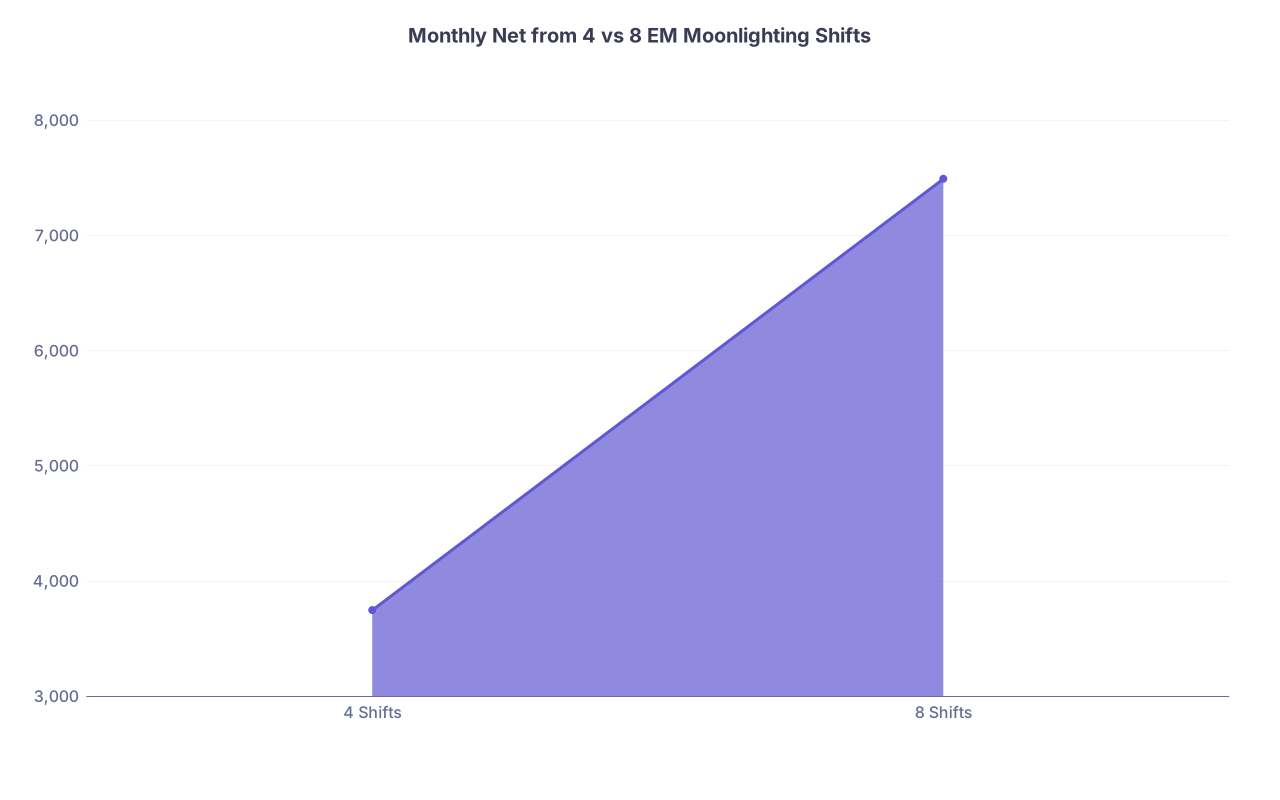
Same EM example as above, net per shift ~$936.
Four well-chosen shifts: ~$3,700.
Eight shifts: ~$7,500 and a good chance you ruin your month and maybe your evaluations.
Know your number. The exact dollar is less important than having a target and stopping when you hit it.
8. Protect Your Training and Reputation While Moonlighting
The hidden cost of bad moonlighting is not just fatigue. It is how you start showing up in your actual program.
Set non-negotiable performance rules
Home program always comes first
- If your evaluations dip, you stop moonlighting
- If you get direct PD feedback about fatigue, you stop
- If your board prep or case logs lag, you cut shifts
No moonlighting the month before crucial exams
- In-training exams
- Board exams (e.g., ABA ADVANCED, ABEM)
- Important or high-stakes rotations
Never hide moonlighting issues from your PD
- If you are overcommitted, tell them and scale back
- If a moonlighting site is unsafe, tell them; they might ban the site, and that helps everyone
Protect your name at outside sites Remember: That community OB nurse or ED chief will talk. Referrals, future jobs, reputational whispers—they all start here.
Basic survival rules:
- No complaining about your main program at moonlighting sites
- No “I am just a resident” attitude—if you take the job, act like a professional physician (within your scope)
- Chart cleanly and defensively
9. Operational Checklist: How to Start Moonlighting Safely Step-by-Step
Let me compress this into a practical sequence. Follow this, and you will skip 90 % of common disasters.

| Step | Description |
|---|---|
| Step 1 | Decide to Moonlight |
| Step 2 | Pass Hard Filter |
| Step 3 | Review Program Policy |
| Step 4 | Meet with PD |
| Step 5 | Secure Written Approval |
| Step 6 | Evaluate Job Offers |
| Step 7 | Confirm Malpractice and License |
| Step 8 | Set Schedule Caps |
| Step 9 | Start with 1-2 Shifts |
| Step 10 | Monitor Fatigue and Evaluations |
| Step 11 | Cut Back or Pause |
| Step 12 | Continue with Limits |
| Step 13 | Any Problems |
Detailed protocol:
Step 1: Self-audit
- Confirm you are clinically strong, on-time with charts, and not chronically sleep-deprived.
- Ask 1–2 trusted attendings, “Do you think I am ready to take independent shifts in a controlled setting?”
Step 2: Policy and PD
- Read GME and program moonlighting policies word for word.
- Meet with PD and get explicit approval for moonlighting in writing.
Step 3: Find and filter jobs
- Talk to senior residents you trust: “Which sites are actually safe?”
- Reject any offer with attending-level responsibility and weak backup.
Step 4: Nail the logistics
- Get malpractice details and contracts in writing.
- Verify licensing and credentialing. No shortcuts.
- Clarify schedule, pay, and expectations up front.
Step 5: Set strict caps
- Max 1–2 shifts per week to start, staying well within 80 hours total.
- Protect post-call days and 1 day off in 7 from all work.
Step 6: Trial period
- First 4–6 weeks: treat as a pilot.
- Watch your mood, sleep, errors, and residency feedback closely.
Step 7: Adjust or abort
- If your life feels like a constant scramble, cut shifts by half or stop completely. Money is replaceable. Your training and license are not.
10. Burnout, Fatigue, and the Point Where You Should Quit
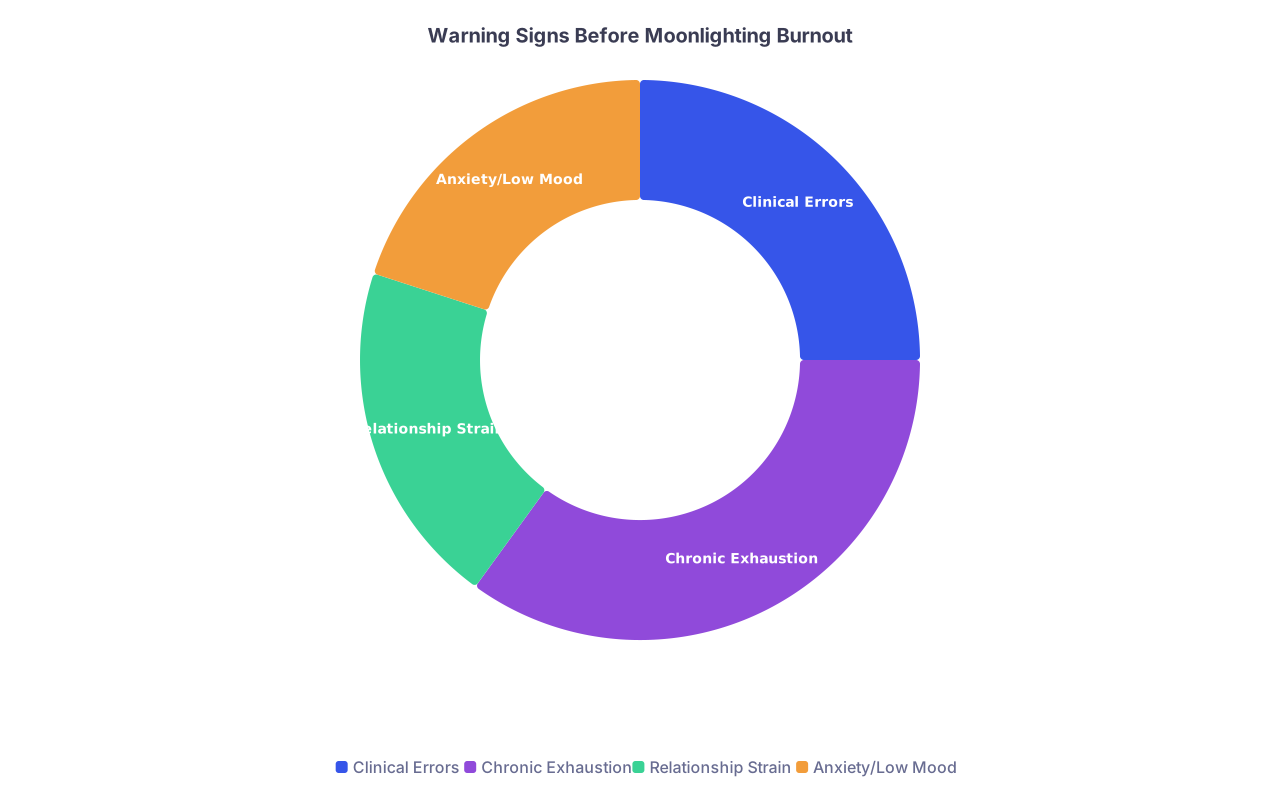
Let us talk fatigue signs that mean you should stop immediately. Not cut back. Stop.
Clinical red flags:
- You catch yourself making basic mistakes you never made before
- You are short-tempered with nurses, patients, or consultants
- You need caffeine just to avoid nodding off on rounds
Personal red flags:
- Your partner or friends say, “You are never around” or “You are not yourself”
- You wake up anxious with a sense of dread, not just tired
- You have no time to study, exercise, or do anything non-clinical
If you hit those, the solution is not “optimize time management.” It is to drop moonlighting and stabilize.
| Category | Value |
|---|---|
| Clinical Errors | 25 |
| Chronic Exhaustion | 35 |
| Relationship Strain | 20 |
| Anxiety/Low Mood | 20 |
These are not hypothetical. I have watched multiple high-potential residents drift toward serious burnout purely from stacking too much “easy” money on top of an already demanding training schedule.
11. When Moonlighting Makes Strategic Sense (And When It Does Not)
To end, let me be blunt: moonlighting is a tool, not a personality trait. Use it strategically.
Good reasons to moonlight during residency:
- You are clinically strong and want additional exposure that aligns with your specialty
- You have specific, time-limited financial goals (e.g., build a 6-month emergency fund, knock out a credit card, front-load loan payments)
- You are in a high-earning field where each extra shift has a meaningful financial impact
Bad reasons:
- FOMO because co-residents are doing it
- “Everyone in EM/anesthesia moonslights”
- Vague desire to “make more” with no clear plan for the money
Plan the end from the beginning:
- Decide now under what conditions you will stop moonlighting
- Write that down, and share it with someone you trust who will call you out
Key Takeaways
- Moonlighting in high-earning specialties can be a powerful financial tool, but only if your training, sleep, and competence are rock-solid first.
- Safe setup is boring but essential: written PD approval, proper malpractice and licensing, realistic schedule caps, and jobs with real supervision and resident-appropriate scope.
- Treat moonlighting as a short-term, strategic lever—not a default lifestyle. The minute it starts to erode your performance or your health, you cut it back or walk away.