

Most new attendings waste their first three high-income years. They inflate lifestyle, scatter money across random goals, and let interest quietly bleed them. You do not have to repeat that mistake.
You are about to make more money than you have ever seen. That is both an opportunity and a trap. The trap is subtle: “I can afford it now.” The opportunity is brutal and simple: you can become functionally debt-free and financially secure within 3–7 years if you follow a disciplined sequence.
This is the stepwise strategy I recommend to high-income new attendings in the highest paid specialties—ortho, neurosurgery, IR, cards, GI, derm, plastics, rad onc, anesthesia, EM at certain groups. Adjust the details, but do not skip the order.
Step 1: Stabilize Your Financial Baseline (First 3 Months)
Your first job contract is signed. Money is about to hit. Before attacking debt, you need a stable operating system.
1. Lock in your real post-tax income
Do not guess. Pull numbers.
Get your:
- Gross salary
- Expected bonus (conservative estimate)
- Retirement match details
- State and local tax situation
Take a recent pay stub (or use a solid online paycheck calculator for your state) and calculate:
- Net pay per month
- 401(k)/403(b)/457(b) contributions
- Health insurance, disability premiums, etc.
Write down your take-home number. That is your real ammunition.
2. Build a lean attending budget
Your first year is not the time for a “forever lifestyle” budget. You need a transition budget: stable, comfortable, not extravagant.
Aim to spend no more than 40–50% of your gross income on your total lifestyle (housing, food, cars, travel, everything). The rest is for:
- Taxes (already taken out in net pay)
- Retirement contributions
- Debt payoff
- Future big purchases (house down payment, etc.)
If your new salary is $500k:
- Target total lifestyle spend: ~$200–250k/year ($16.7–20.8k/month)
- That leaves a huge surplus to deploy.
If your budget is already approaching $25–30k/month as a first-year attending, you are walking into a trap.
3. Establish a 3–6 month emergency fund
Before you go aggressive on debt:
- Save 3–6 months of living expenses in a high-yield savings account.
- For dual high-income households, 3–4 months can be enough.
- For a single-income neurosurgeon in a high-risk specialty or with RVU variability, lean closer to 6 months.
This is not “extra cash you might invest when you get bored.” This is the buffer that stops a job change, lawsuit scare, or health issue from derailing your entire plan.
Step 2: Know What You Owe (No More Blind Spots)
You cannot fix what you have not measured. I regularly meet attendings 3–4 years out who still “roughly think” they owe $400–500k. That is not a plan. That is denial.
1. Build your debt inventory
Make a simple table for every debt:
| Debt Type | Balance | Interest Rate | Fixed / Variable | Term Remaining |
|---|---|---|---|---|
| Fed Student Loan | $320k | 6.0% | Fixed | 20 years |
| Private Loan | $80k | 8.5% | Variable | 15 years |
| Car Loan | $30k | 5.0% | Fixed | 4 years |
| Credit Card | $8k | 21.0% | Variable | Revolving |
| Personal Loan | $15k | 10.5% | Fixed | 5 years |
You need:
- Exact balances
- Exact interest rates
- Minimum monthly payments
- Any forgiveness/public service eligibility (PSLF, state programs)
- Any variable rates and when they reset
2. Categorize by priority
Use this hierarchy:
- Toxic unsecured debt
- Credit cards, personal loans, anything >10–12%
- High-interest debt
- 7–10%: private loans, some older student loans
- Moderate-interest student loans
- 4–7%: many refinanced or newer grad loans
- Low-interest secured debt
- Mortgages at 3–5%, car loans under 3–4% (optional to accelerate)
Your new attending income gives you the one thing that kills debt: large, consistent surplus cash flow. The only way to waste it is to spread it thinly across everything at once.
Step 3: Decide Your Path: PSLF vs Aggressive Payoff
For federal student loans, there is one fork in the road you must choose early as an attending. Straddling the middle is the worst choice.
1. If PSLF is realistically in play
This is you if:
- You have direct federal loans
- You are or will be working at a qualifying 501(c)(3) or government employer
- You have or will have 10 years of qualifying payments (including residency and fellowship) within a reasonable timeframe
Then your strategy is:
- Stay in an income-driven repayment (IDR) plan
- SAVE, PAYE, IBR (depending on your situation and rules when you read this)
- Do not accelerate principal on loans that will be forgiven.
- Maximize retirement accounts and other pre-tax contributions to legally reduce your adjusted gross income (AGI), which lowers IDR payments and increases eventual forgiveness.
- Save for the tax bomb only if under a non-PSLF forgiveness regime (current PSLF is tax-free; long-term IDR forgiveness may not always be).
You then reallocate what you would have used for loan payoff to building wealth and other goals.
If you are in ortho at a county hospital with long-term employment likely, PSLF can be extraordinarily valuable. But it requires stability and commitment to the non-profit path. Many attendings underestimate how often they switch to private practice within a few years.
2. If PSLF/forgiveness is not likely
Then stop pretending it might be. Your path is:
- Refinance high-rate loans (once you are attendings with stable income)
- Aggressively pay off within 3–7 years
For many high earners in private practice, this is the correct path. A private practice cardiologist making $700k with $400k in loans at 7% should not drag them out for 20 years.
Step 4: The Actual Stepwise Attack Plan
Here is the core protocol. Adjust numbers, keep the order.
Step 4.1: Minimums on everything, attack list clear
- Pay minimum payments on:
- All student loans (federal and private)
- Mortgage
- Car loans (unless toxic)
- Ensure no late fees, no dings on credit.
Then line up your “attack list” from highest to lowest priority, based largely on interest rate and risk:
- Credit cards and personal loans
- Private student loans >7–8%
- Remaining student loans 5–7%
- Auto loans >4–5% (optional depending on temperament)
- Mortgage (if accelerating, but often last)
Step 4.2: Kill toxic and high-interest debt first (0–12 months)
Every extra dollar goes here until items 1 and 2 are gone.
If you are clearing only credit cards and personal loans for your first 6–9 months as an attending, that is not a failure. That is you untying the anchor before you sprint.
A realistic sample:
- EM attending, $450k income, $20k/month net after taxes and retirement
- Lifestyle budget: $10k/month
- Minimum payments on all loans: $4k/month
- Surplus for debt attack: $6k/month
You hammer:
- $10k credit card at 20% → gone in 2 months
- $15k personal loan at 11% → gone in 3 more months
- Then shift that freed-up $600–800/month minimum + $6k surplus into private 8.5% student loans
Within year 1, all your toxic debt can be dead.
Step 5: Optimize Student Loan Strategy (High-Income Version)
Now the heavy part: student loans.
1. Decide on refinancing timing
Do not reflexively refinance in month 1 as an attending. Check:
- Are you certain you will not pursue PSLF or other federal forgiveness?
- Are you comfortable giving up deferment/forbearance protections?
- Is your income stable (contract not short-term locums with big uncertainty)?
Once those are “yes”:
- Shop multiple lenders the same week: Laurel Road, SoFi, Earnest, ELFI, CommonBond (or whatever is competitive when you read this).
- Compare fixed vs variable:
- In a stable or rising-rate environment, fixed is safer.
- In a high-rate but expected-falling environment, a short-term variable with a fast payoff can be rational.
If you are planning to pay off in 3–5 years, a slightly lower variable rate can be acceptable, but do not pick it if rate increases will ruin your sleep.
2. Match loan term to your payoff target
Do not pick a 15-year refinance because the monthly payment looks small. You are not a typical borrower anymore.
- If you plan to clear debt in 5 years, choose a 5- or 7-year term with:
- Automatic payments
- No prepayment penalties
- Treat that as a floor, not the ceiling. You will pay extra.
You want structural pressure: the minimum is already forcing decent progress, and your extra payments accelerate it.
3. Aggressive payoff phase (Years 1–5 as attending)
This is your main sprint.
Let me outline a realistic aggressive plan for an ortho attending:
- Income: $800k
- Effective tax rate + payroll: ~40%
- Net: ~$40k/month
- Lifestyle: $15k/month (still extremely comfortable)
- Retirement contributions: $5–7k/month
- Remaining monthly surplus: $18–20k/month
Debt:
- $450k student loans total, average 6%
- Refinanced to 4.5% on a 7-year fixed
If this attending commits $15k/month to loans (beyond required minimum), they can be debt-free in ~3 years, not 7.
The key: Front-load the pain. The more you pay early, the less interest you ever owe, and the faster compounding can shift to your side.
Step 6: Integrate Wealth Building Without Losing Focus
You cannot ignore retirement and investing until all debt is gone. That is also dumb. The solution is staged.
Baseline rule: Always capture “free money”
- Contribute at least enough to get your full employer match on 401(k)/403(b). Always.
- If you have a defined benefit or cash balance plan, fund it as contractually required.
Targeted structure for high-income attendings
Once toxic debt is gone and student loans are refinanced:
Max tax-advantaged accounts every year:
- 401(k)/403(b): $23k+ (amount will vary by year)
- Backdoor Roth IRA (if allowed): $6.5k+
- 457(b) if offered (and reasonably safe): another $23k+
- HSA if high-deductible health plan: ~$4k–8k depending on year and family status
Then slam loans with the remainder
Order of operations each year:
- Employer retirement match
- HSA (if you have one)
- Max 401(k)/403(b)/457(b)/backdoor Roth
- Aggressive loan payoff with every extra dollar
- Taxable brokerage investing only after you are on a clear sub-5-year loan payoff trajectory
This way, you are not choosing between debt freedom and future wealth. You are doing both—just with aggressive sequencing.
Step 7: Handle the Big Purchases (House, Cars, Kids) Without Torpedoing the Plan
High-income new attendings blow up their debt payoff plan with three specific moves:
- Oversized first house
- Brand-new luxury vehicles
- Rapid lifestyle creep with kids' expenses, travel, private schools
1. House: delay and size ruthlessly
Protocol:
Delay home purchase for 1–2 years if:
- You have no emergency fund
- Your loans are not refinanced and organized
- You are unsure you will stay in that city/practice beyond a few years
When you buy:
- Keep total home-related costs (mortgage, taxes, insurance, maintenance) under 20–25% of gross income.
- Avoid 0% down doctor loans if it means stretching way above what you would otherwise afford. Use them strategically, not as an excuse to overspend.
For a $700k income, you do not need a $2M house as your first home. A $900k–1.2M home can be perfectly comfortable and still allow rapid debt payoff.
2. Cars: one nice, one reasonable at most
Rule of thumb that works:
- The total value of all your cars should be less than your gross annual income.
- For new attendings still with heavy debt: less than half your annual income.
You want reliable, safe, and respectable. You do not need a $180k car in year one. If you want the Porsche, buy the slightly used one later, after the loans are gone.
3. Kids and lifestyle inflation
You will feel pressure from colleagues:
- Private schools
- Expensive clubs and activities
- International vacations multiple times per year
- Designer everything
If your loans will be gone in 3–5 years with your current plan, every major lifestyle upgrade that stretches that to 10 years is a trade you should consciously reject. You are not depriving your family by being disciplined for three years. You are buying them freedom.
Step 8: Specialty-Specific Realities You Must Factor In
High-income specialties are not identical. They carry different risks and trajectories.
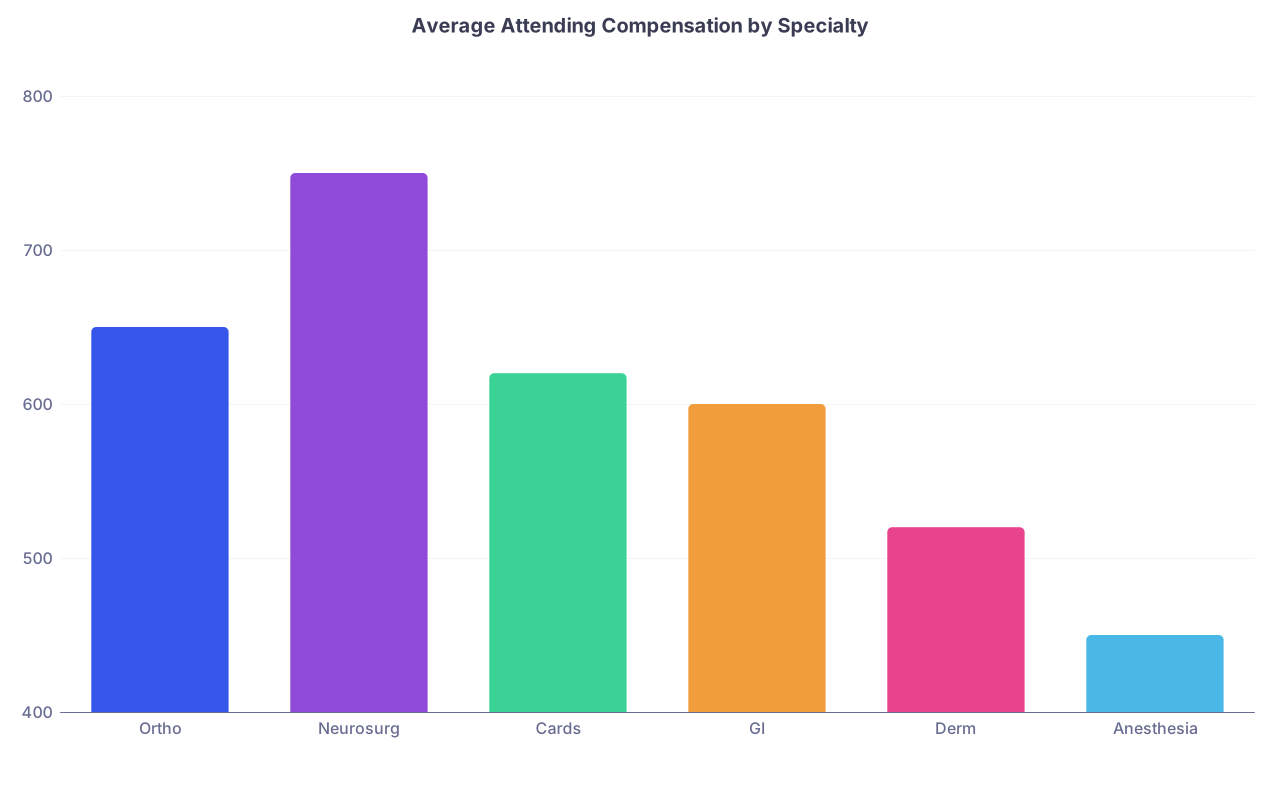
| Category | Value |
|---|---|
| Ortho | 650 |
| Neurosurg | 750 |
| Cards | 620 |
| GI | 600 |
| Derm | 520 |
| Anesthesia | 450 |
Ortho / Neurosurgery / Spine
- High risk of disability or needing to reduce case load in mid-career.
- High malpractice environment.
- Often strong early earning years.
You should:
- Carry own-occupation disability insurance before and after finishing training.
- Front-load loan payoff aggressively within first 3–7 years in case your case volume must drop later.
Cardiology / GI / IR
- Often a mix of hospital employment and private practice.
- Income can change significantly with group changes and partnership tracks.
You should:
- Be conservative in the first 2–3 years until partnership or long-term contracts are stable.
- Avoid locking yourself into huge fixed personal expenses (house, private schools, multi-car leases) before income is durable.
Derm / Plastics
- Often strong autonomy and cash-pay components.
- Income may ramp over a few years as you build a practice.
You should:
- Avoid overestimating first-year income; use conservative projections.
- If income is variable, build a larger emergency fund (6–9 months) before hyper-aggressive payoff.
Anesthesia / EM / Radiology
- Groups can be bought or restructured with little warning.
- Compensation models can shift quickly.
You should:
- Prioritize liquidity a bit more:
- Larger cash buffer
- More flexibility in fixed expenses
- Still aggressively pay down debt, but leave yourself the option to dial back for 6–12 months if your group changes compensation unexpectedly.
Step 9: Concrete Example: A 5-Year Plan for a High-Income Attending
Let us walk a simplified scenario. No fluff, just numbers.
Profile:
- 34-year-old new ortho attending
- Income: $800k
- Federal + state taxes and payroll: ~40% effective
- Net: ~$40k/month
- Student loans: $500k at weighted average 6.5%
- Car loan: $30k at 5%
- Credit card: $12k at 19%
- Rent: $4k/month
- Other living expenses: $8k/month
- No kids yet, partner making $120k but we will ignore that for now (upside only)
Phase 1: First 6 months
- Build emergency fund:
- Target: $60k (about 4 months of expenses)
- Save: $10k/month → done in 6 months
- Minimum payments:
- Loans minimum: $3.5k/month
- Car: $600/month
- Credit card: minimum $300/month
- Extra cash after emergency fund each month:
- Net: $40k
- Lifestyle (rent + others): $12k
- Retirement (401k maxed over year): ~$2k/month
- Minimums: ~$4.4k
- Surplus: ~ $21.6k/month
Apply surplus to high-interest debt:
- Month 1: $12k credit card gone + start hammering car (extra $9.6k)
- Month 2: Car loan gone (remaining ~$20k) + start saving for refi premiums / costs
- Months 3–6: All surplus now goes to student loans, still federal at 6.5%, while you prep for refinancing at month 6–9 once stable.
By month 6:
- Emergency fund: $60k
- Car/credit: $0
- Student loans: maybe down to ~$470–480k
Phase 2: Refinance and sprint (Months 7–42)
At month 7:
- Refinance $475k to 4.5% on a 7-year term.
- Required payment: say ~$6.5k/month.
- But you will not pay $6.5k. You are aiming at $20k/month.
Budget now:
- Net: $40k
- Lifestyle: still $12–13k (including modest improvements)
- Retirement contributions: $4–5k/month (401k + backdoor Roth + maybe start a bit of 457)
- Loan minimum: $6.5k
- Remaining surplus: ~$16k/month
- Your actual loan payment: $22–23k/month (minimum + surplus)
At $22k/month, that $475k disappears in just over 2 years. Add a buffer for real life—call it 30–36 months.
So in ~3 years as an attending:
- Student loans: gone
- Car loans: gone
- Credit cards: gone
- Retirement accounts: already underway for 3 years
- Emergency fund: intact
Then your monthly free cash flow jumps from $18–20k to ~$35k+ overnight. That is when you can seriously upgrade house, cars, travel, kids’ schools—because you are building on a clean foundation instead of cotton candy.
Step 10: Guardrails to Keep You From Sabotaging Yourself
Three habits keep high-income attendings from drifting back into financial chaos.
1. Automate everything important
- Automatic transfers:
- Retirement contributions
- Loan payments (minimum + extra)
- Monthly taxable investments (once loans nearly gone)
You want as little “manual willpower” in this system as possible. Use autopilot for the good stuff and friction for the bad stuff (no autofill for shopping cards, no mindless subscriptions).
2. Cap lifestyle increases by rule
Set a personal rule:
- Each time your guaranteed income rises, you can increase lifestyle spending by no more than 25–30% of the raise.
- The other 70–75% goes to:
- Debt payoff
- Retirement accounts
- Investments
- Future big goals
So if your income jumps from $500k to $700k, you do not suddenly deserve a $200k lifestyle jump. Take $50–60k of that and live better. The rest makes you free.
3. Schedule an annual “financial attending check-in”
Once a year (same month), you:
- Update your debt inventory
- Update your net worth (assets – debts)
- Adjust your payoff timeline
- Decide any one lifestyle upgrade you genuinely want (new car, better travel, home project) that still keeps you on track
This is where you course-correct. It prevents the slow drift from “I will crush this in 3 years” to “Somehow it is year 9 and I still owe $180k.”
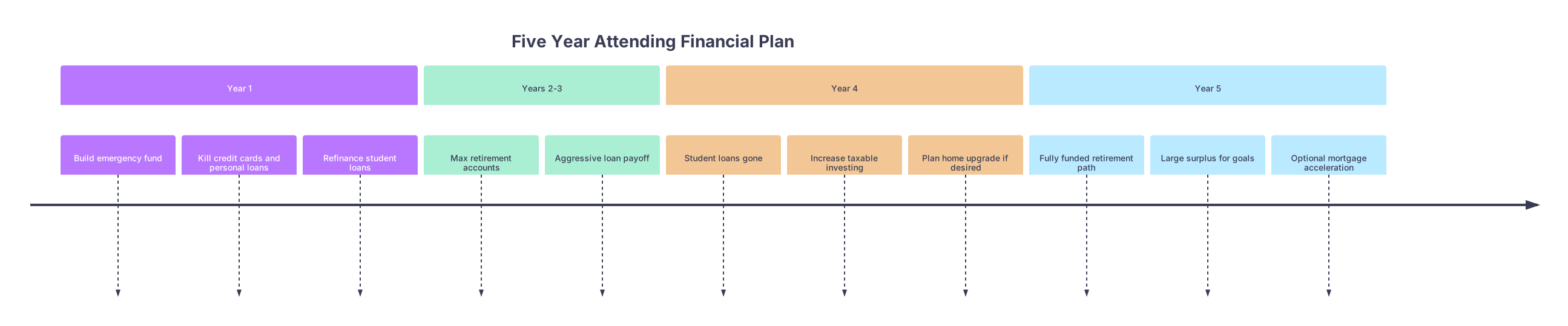
For clarity, here is what a simplified 5-year progression might look like:
Bottom Line
Three key points and you are done:
- Sequence beats chaos. Stabilize your cash flow, kill toxic debt first, then aggressively target student loans while still capturing retirement benefits. No more random, half-hearted payments everywhere.
- Front-load the hard work. Your first 3–5 attending years are your financial leverage point. Use your high income to erase debt quickly before lifestyle inflation cements bad habits.
- Let your future choices drive today’s discipline. Massive early surplus cash flow is rare. If you channel it with a clear stepwise strategy now, you will buy yourself decades of flexibility in both medicine and life.


