

You are in your third year of residency in a procedure-heavy field—orthopedics, GI, interventional cardiology, IR, anesthesia, ENT, urology, whatever your flavor—and you are starting to see the attendings’ pay numbers. Someone casually mentions, “Yeah, he does 11,000 work RVUs a year” and another says, “My last group paid $65 per RVU.” You realize you have absolutely no structured plan for how to make that kind of money without burning out or doing something sketchy.
You suspect there is a method to it. Some attendings seem to finish by 3 PM and out-earn colleagues who are there until 7. Same specialty. Same hospital. Very different RVU income.
Here is the fix: a step-by-step plan to approach RVU-based income like a system, not magic.
Step 1: Understand the RVU Game You Are Actually Playing
Before you “optimize,” you need to know which rules apply at your future job. Residents usually skip this and get crushed.
There are three components of an RVU, but for your income, you mostly care about work RVUs (wRVUs). That is what your effort, time, and complexity are paid on.
Common structure in procedure-heavy fields:
- Base salary tied to a wRVU target (e.g., 7,000–10,000 wRVU/year)
- Conversion factor = dollars per wRVU after you hit a threshold
- Sometimes tiered: $55/RVU up to 9,000, then $65/RVU above that, etc.
You need to be able to compare offers rationally.
| Job Type | wRVU Target | $/wRVU Above Target | Typical Total wRVU | Realistic Total Pay* |
|---|---|---|---|---|
| Academic GI | 6,500 | $40 | 7,500 | ~$450k |
| Private GI (busy) | 9,000 | $60 | 12,000 | ~$800k |
| Employed Ortho | 8,000 | $55 | 10,000 | ~$700k |
| Independent IR Group | 9,500 | $65 | 13,000 | $1M+ |
| Hospitalist w/procs | 4,500 | $45 | 5,500 | ~$300k |
*Rough numbers including base + bonus + ancillaries where applicable.
Key actions during residency and job hunt:
Get your current attending to show you their actual RVU report.
Not vaguely. The literal monthly or quarterly printout. Look at:- Total wRVU
- Encounters
- Top 10 CPT codes by frequency
- Site of service (ASC vs hospital vs office)
Learn your specialty’s wRVU benchmarks.
Ask your PD or senior folks about MGMA/AMGA medians for:- wRVUs/year
- Total compensation
- Compensation per wRVU
Ask every recruiter these direct questions:
- “What is the exact wRVU target for the base salary?”
- “What is the wRVU conversion factor?”
- “What were your last three hires’ actual wRVUs and total income in year 2 and 3?”
- “Is there an upper cap on RVUs or bonus?”
If they will not answer those clearly, I already know what the job is: not great.
Step 2: Optimize the Mix of Procedures vs E/M From Day One
In procedure-heavy specialties, your procedure mix is your engine. Not your raw hours.
Ten 40-minute low-RVU procedures can pay worse than six 30-minute high-RVU ones. This is where junior attendings lose money for years.
Example: GI
- Screening colonoscopy: ~3–4 wRVU
- Colonoscopy with polypectomy: ~4–6 wRVU
- EGD + biopsy: ~3–4 wRVU
- Office visit: 1.5–2.5 wRVU for new, 1–2 RVU for follow-up
You could pack a clinic with 25 follow-ups and still barely touch a half-day of procedural RVUs.
During Residency: Train for High-Yield Work, Not Just Variety
You want competence in the procedures that:
- Have solid wRVU values
- Are common in community practice
- Fit into short, repeatable time blocks
In orthopedics, that is not the once-a-year complex pelvic reconstruction. It is:
- Primary total knees and hips
- Bread-and-butter shoulder scopes
- Carpal tunnels, trigger fingers
- Basic fracture care
In ENT:
- FESS
- Tonsillectomies
- Tubes
- Thyroid/parathyroid for many practices
Your practical training plan:
- Map your procedure log now. Highlight:
- Which CPT families you are strong in
- Which high-volume/high-RVU procedures you barely touch
- Go to the fellowship director or a high-volume attending and say:
- “I want to be very fast and safe at X, Y, Z because I know they drive RVUs in practice. Can I scrub in with you specifically for those cases this month?”
- On call: deliberately choose to do the workhorse procedures yourself when safe instead of punting to senior just because they are around.
You are building your future “menu.” Do not let it be random.
Step 3: Build a Scheduling System That Actually Produces RVUs
RVU income is a scheduling problem more than a “work ethic” problem.
The highest earners I have seen in procedure-heavy fields are not martyrs. They use:
- Template design
- Protected procedure blocks
- Efficient pre-op / post-op routing
- Minimal dead space
They understand what an empty 30-minute slot costs.
Design Your Future Template Before You Start the Job
Sit with an attending who lets you see their scheduling template. Then sketch your own ideal week on paper.
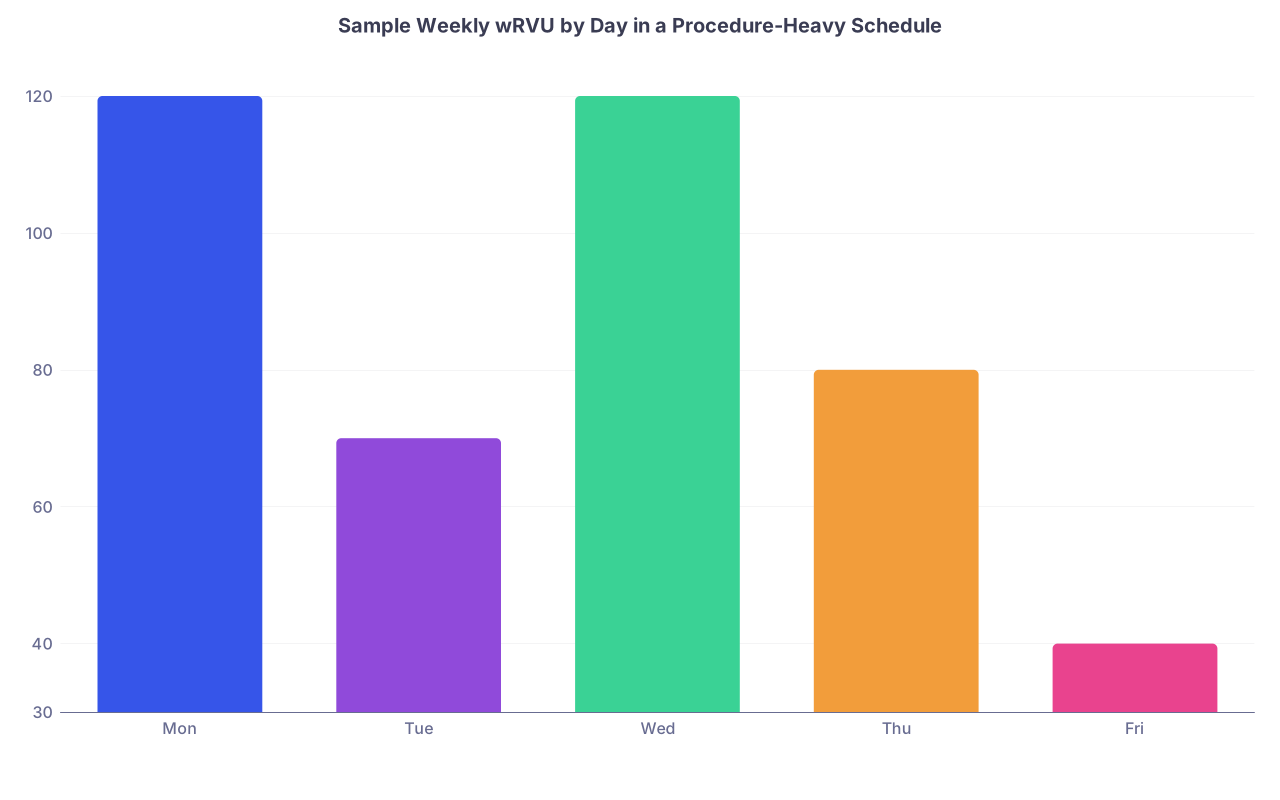
Example: Busy GI partner schedule (clinic + endo):
- Mon: Full-day endoscopy (30–45 procedures)
- Tue: AM clinic, PM endoscopy
- Wed: Full-day endoscopy
- Thu: AM clinic, PM advanced cases / overflow
- Fri: Rotating – ASC, hospital inpatients, or admin if high RVU already met
Calculate rough RVUs for that pattern:
| Category | Value |
|---|---|
| Mon | 120 |
| Tue | 70 |
| Wed | 120 |
| Thu | 80 |
| Fri | 40 |
If you consistently sit above ~400–450 wRVU/week, you are in top-earning territory for most procedure-heavy fields.
Combat the Hidden RVU Killers
Three common problems derail new attendings:
- Swiss-cheese schedule
20–40 minute gaps between cases or visits. - Too many low-RVU follow-up visits jammed into prime hours
- Inefficient turnover and prep
Attack plan:
Insist on templated blocks, not pure open-access scheduling.
For example:- 8:00–12:00: ASC procedures only
- 1:00–3:00: New patient consults (higher RVUs)
- 3:00–5:00: Follow-ups, quick visits
Use an access policy:
- High-Yield: New problems needing likely procedure → short wait, prioritized.
- Low-Yield: Simple routine follow-ups → booked into lower-value slots or APP clinics when appropriate.
Track one month of your schedule (as a resident on elective or senior). Note:
- How many procedures got canceled due to poor pre-op readiness
- How many clinic no-shows and last-minute cancellations you had
- How many “filler” low-RVU visits ended up in your best time blocks
Then design how you want your future MA, scheduler, and APP to handle these. In writing. Before you sign a contract, ask the group:
- “How much control will I have over my schedule template after 3–6 months?”
- “Who controls block time in the OR/ASC? On what basis can it increase?”
If the answer is “the senior partners decide and it takes years,” your RVU ceiling is already pre-set. Lower than you want.
Step 4: Get Ruthlessly Good at Documentation and Coding (Ethically)
You can do the same work as the attending down the hall and leave 15–25% of your RVUs on the table. Just by documenting poorly.
This is not about gaming the system. It is about not donating your work for free.
During Residency: Treat Coding as a Core Skill, Not Admin Nonsense
For procedure-heavy fields, focus on:
- Correct CPT selection (and modifiers)
- Accurate E/M level support for pre-op and post-op visits
- Appropriate use of add-on codes
Example: Orthopedics
- New patient complex joint problem → often supports 99204/99205 with appropriate history, exam, and decision making.
- Using injections with procedures correctly (e.g., aspiration vs injection vs both)
- Using modifiers 50 (bilateral), 51 (multiple procedures), 59 (distinct procedural service) appropriately.
Concrete training steps:
Ask your coder or billing department to:
- Print 10 of your own notes (or a friendly attending’s notes) with the assigned codes and RVUs.
- Sit with you for 30–45 minutes and walk through “what would have changed the level or allowed an add-on code?”
Once a week:
- Take 2–3 of your most complex patients that week.
- Manually code them yourself on paper:
- E/M level
- Procedure codes
- Modifiers
- Compare to what billing actually submitted.
You are building the habit of asking: “Did I just document everything I actually did and thought?” Not: “Can I upcode this?” There is a big difference.
The Day You Start as an Attending: Avoid These Three Coding Mistakes
Under-documenting complexity
Example: minimal ROS, no mention of co-morbidities in a pre-op visit, so it looks “simple” even when it is not.Missing add-on codes for extra work you actually did:
- Additional lesions
- Bilateral procedures
- Extended time or unique imaging guidance when appropriate
Letting templates create cloned garbage that gets downcoded or flagged.
Lean on your coder early. Ask them directly:
- “Where do new attendings in this group most often lose RVUs?”
- “Can you flag my charts for the first 3 months if I am consistently under-coding or missing add-on codes?”
The people in billing know exactly who leaves money on the table. Do not be that person.
Step 5: Engineer Your Team and Workflow Around RVU Generation
High RVU productivity in procedure-heavy fields is a team sport. If you try to do everything yourself, your income ceiling is lower. Period.
You want to spend the maximum number of minutes per day doing RVU-dense tasks:
- Procedures
- Higher-level decision-making visits
- Interpreting studies
- Coordination that only you can legally bill for
Everything else should be pushed to:
- Advanced practice providers (PAs/NPs)
- RNs
- MAs
- Schedulers
- Centralized pre-op teams
Build This Structure Early
Your first 6–12 months matter. This is when your patterns and your reputation form.
Core moves:
Push all possible pre-op and routine post-op visits to APPs
You see:- Complex new patients
- Surgical decision-making visits
- Complicated post-ops or failures APPs see:
- Stable post-ops at set intervals
- Routine follow-ups
- Medication refills, basic education
Standardize pre-op requirements.
Work with your group and pre-op clinic to:- Create checklists for required labs, imaging, clearances
- Avoid last-minute day-of-surgery cancellations (RVU and time killers)
Optimize intra-op and procedure room flow.
You want:- Turnover times minimized
- Instruments and supplies standardized for your bread-and-butter cases
- A consistent team whenever possible
Ask for this during job negotiation:
- “Will I have a dedicated MA / nurse?”
- “Am I allowed to employ or use a shared APP? How is their cost allocated?”
- “Can I choose my own OR or ASC staff lineup for regular block time?”
You are not being high-maintenance. You are protecting future RVU output.
Step 6: Choose the Right Practice Environment for Procedure-Heavy Work
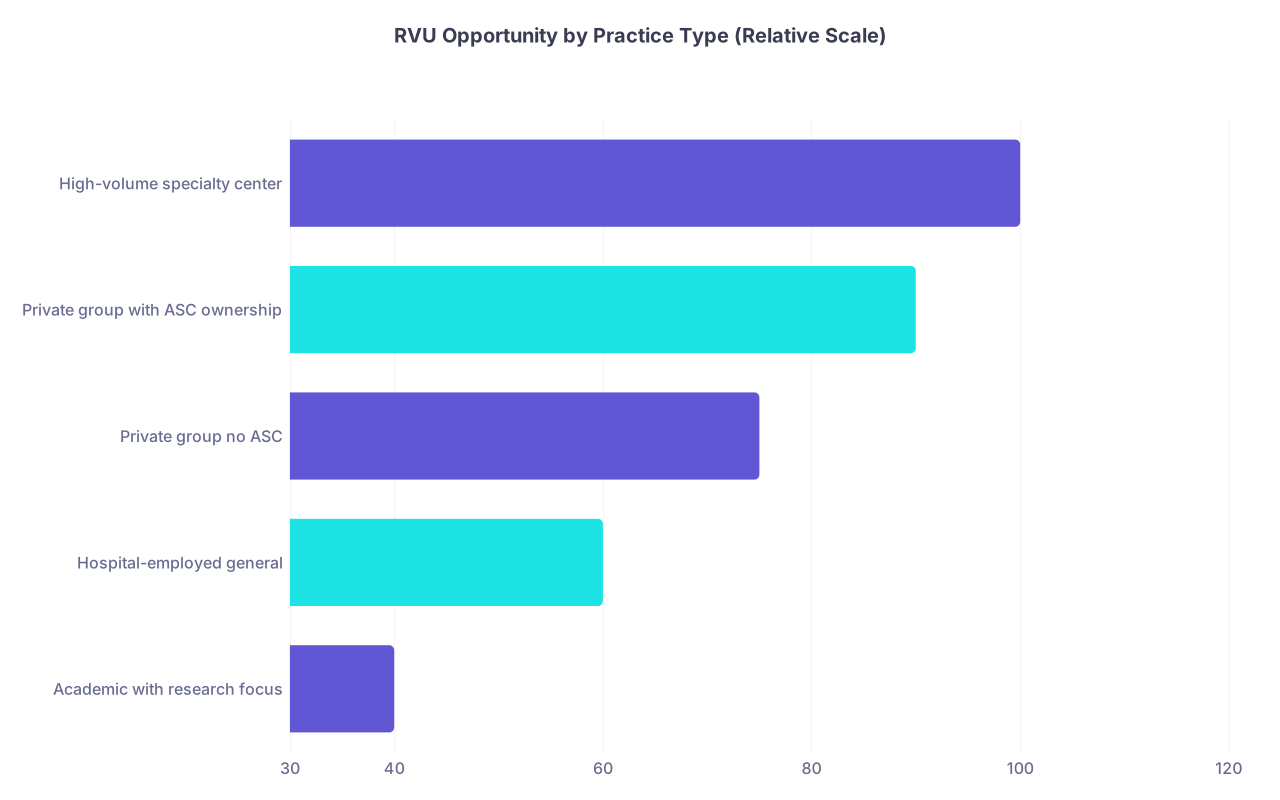
Your RVU income is not just about how hard you work. It is about the ecosystem. Some environments are RVU engines. Others are RVU deserts.
Common setups for procedure-heavy specialties:
- Academic center
- Hospital-employed
- Private group, partnership track
- Private equity-backed group
- Direct ownership of ASC, imaging, etc.
Here is the blunt version: If you want to maximize RVU income, pure academic with heavy non-clinical time is rarely the best vehicle. Possible, but not common.
The key is alignment:
- Does the practice actually have more procedural demand than supply?
- Are they turning patients away?
- Do they have unused OR/ASC blocks?
- Or are you fighting for scraps behind entrenched senior partners?
| Category | Value |
|---|---|
| Academic with research focus | 40 |
| Hospital-employed general | 60 |
| Private group no ASC | 75 |
| Private group with ASC ownership | 90 |
| High-volume specialty center | 100 |
When you interview, ask targeted questions:
- “How many new patient referrals do you currently turn away or schedule more than 4–6 weeks out?”
- “Is there unused block time in the OR or ASC right now?”
- “In the last 2 years, has any provider left because they felt they could not build or maintain a high-volume procedural practice?”
Then ask the newer partners, not just the president of the group:
- “How long did it take you to get to your current RVU level?”
- “What was your first-year and third-year wRVU totals?”
If no one is hitting high numbers, you are not special. You will not magically fix their broken system solo.
Step 7: Protect Yourself from RVU Burnout and Ethical Drift
Here is the dark side of RVU-based pay: The system rewards doing more. Not always doing what is best.
You need guardrails. Otherwise you will:
- Over-schedule yourself and burn out
- Be tempted (or pushed) to recommend borderline-indicated procedures to hit targets
Your plan must include ethical and sustainable limits from the start.
Concrete rules to adopt:
Set a max number of cases per day that you can do safely and attentively.
Example: “I will not book more than 8 major joint replacements in a day” or “No more than 20 screening colonoscopies in one full day.”Create a personal “yellow flag” list.
Situations where you pause before recommending a procedure:- Marginal benefits vs optimized conservative care
- Patient clearly driven by anxiety more than pathology
- Secondary gain issues
Build in actual recovery time.
High-RVU months are often unsustainable if every week looks the same. For example:- Aim for 2 heavy-procedure days + 2 moderate + 1 lighter/administrative per week
- Once you hit a comfortable annual RVU and financial goal, stop trying to squeeze more from every month.
You are not a machine. The surgeon who is still operating well into their 60s with a strong income is the one who learned to say “no” long before they were forced to.
Step 8: Track Your RVUs Like a Business Owner, Not an Employee
Most early attendings never look at their RVU reports until the end of the year, when it is far too late to correct.
Treat your monthly RVU numbers like a pilot treats a fuel gauge.
What You Should Be Tracking
Every month, for yourself:
- Total wRVUs
- wRVUs per clinic session
- wRVUs per OR/ASC day
- Top 10 CPT codes by:
- Frequency
- Total wRVUs generated
Simple spreadsheet. It might look like this:
| Month | Total wRVU | Clinic Sessions | OR/ASC Days | wRVU/Clinic Session | wRVU/OR Day |
|---|---|---|---|---|---|
| Jan | 950 | 12 | 8 | 40 | 65 |
| Feb | 1100 | 10 | 10 | 45 | 70 |
| Mar | 1050 | 11 | 9 | 42 | 68 |
If you see, for example:
- OR/ASC days are flat
- Clinic sessions are climbing
- But wRVUs are not moving much
…then your mix is wrong. You are stuffing your week with low-RVU work.
Use these numbers to make concrete requests:
- “My average OR day is driving 70 RVUs. My clinic session gives 40. I want to convert one clinic half-day into another ASC block.”
- “My new patient slots are overrun. We need to shift routine follow-ups to APPs or add another APP.”
The person who shows up with actual data gets taken seriously.
Step 9: Negotiate RVU Terms Like They Actually Matter (Because They Do)
By the time you are reading job offers, it is too late to fix a bad compensation model with “working harder.”
You want to negotiate structure, not just base salary.
Core levers:
RVU target
- You want the target close to median for your specialty, not 90th percentile.
- Use MGMA/AMGA data or specialty society data as backup.
Conversion factor ($/wRVU)
- Lower targets can justify a slightly lower conversion factor.
- But be very wary of high targets with low rates.
Ramp period.
- You want:
- 1–2 years of guaranteed base salary
- Either low/no RVU requirement early, or a subsidized target that scales
- You want:
Infrastructure promises in writing.
- OR/ASC block time by month X
- At least Y clinic rooms and 1 dedicated MA
- Access to APP support by month Z or by hitting a certain RVU threshold
If they say, “We don’t really do contracts with specific block time commitments,” that is code for “You will fight for scraps and the seniors will win.”
Say no.
Step 10: Create a 3-Year RVU Growth Blueprint
Last step: Tie all of this into a concrete timeline. Most people drift. You are going to run a plan.
Year 0 (Residency / Fellowship)
Focus:
- Get exposure to high-volume, high-RVU procedures
- Learn documentation and coding from real coders
- Study RVU benchmarks and compensation models
- Build relationships with attendings in high-volume practices
Goals:
- Be comfortable as primary operator for common high-RVU procedures in your field
- Be able to read and interpret a monthly RVU report
Year 1 as Attending
Focus:
- Panel and referral base growth
- Template and block time configuration
- Establishing team and workflow
Tactics:
- Weekly review of:
- Schedule utilization
- Cancellations and no-shows
- RVUs per session
- Aggressively eliminate:
- Schedule gaps
- Low-value follow-ups in prime time
- Work closely with coders for optimization
Target:
- Reach 50–70% of your specialty’s median wRVU by the end of year 1, depending on practice setting.
Year 2–3 as Attending
Focus:
- Procedural optimization and scaling
- Adding ancillaries if possible (ASC ownership, imaging, etc.)
- Solidifying boundaries to avoid burnout
Tactics:
- Push for more:
- ASC/OR blocks
- Redistribution of follow-ups to APPs
- More new patient access
- Quarterly RVU review with leadership:
- Show data
- Request specific changes
Target:
- Hit or exceed 75–90th percentile wRVU for your specialty if you want “maximized” income, with acceptable lifestyle.
- Then evaluate: Is more RVU worth the trade-offs, or do you hold steady and focus on efficiency and satisfaction?
Key Takeaways
- High RVU income in procedure-heavy fields is not random. It is a mix of the right procedures, the right environment, and a tightly designed schedule and team.
- You must treat RVUs like a business metric: understand the compensation model, track your numbers monthly, and adjust your case mix and workflow deliberately.
- If you combine strong procedural skills, ethical documentation, smart scheduling, and a supportive practice structure, your RVU income ceiling is very high—without selling your soul or your health to get there.


