
The belief that you need a high-paid specialty to reach financial independence is flat-out wrong.
You can absolutely reach financial independence in a lower-paid specialty. Pediatrics, family med, psychiatry, PM&R, even academic internal medicine. It’s been done. Repeatedly. The people who don’t get there? Most of them don’t fail because of income. They fail because of lifestyle creep, bad debt decisions, and drifting without a plan.
Let me walk you through what actually matters and how to make FI work if you’re not going into ortho or derm.
Step 1: Understand the Math (Not the Myths)
You don’t need a $1M income to be financially independent. You need:
- A clear target number
- A consistent savings rate
- Enough time for compounding to do its thing
A common rule of thumb is the 4% rule: you’re “financially independent” when your invested assets are about 25x your annual spending. So:
- Spend $80K/year → FI target ≈ $2M
- Spend $120K/year → FI target ≈ $3M
- Spend $200K/year → FI target ≈ $5M
Notice what that depends on: spending, not income.
A pediatrician making $230K who spends $90K and saves $80–90K a year can hit FI faster than an orthopedic surgeon making $700K and spending $500K.
To make this concrete, let’s compare a realistic lower-paid specialty and a high-paid one.
| Scenario | Income (attending) | Annual Spending | Annual Investing | Years to ≈$3M (7% return) |
|---|---|---|---|---|
| Family Med | $250K | $100K | $100K | ~18–20 years |
| Psychiatry | $280K | $110K | $110K | ~17–19 years |
| Ortho Surgery | $700K | $250K | $200K | ~13–15 years |
Ortho still wins on speed, sure. But look at those numbers: family med and psych still hit FI within 2 decades of starting as an attending. That’s a 40s-to-early-50s independence timeline, not “work until you’re 70.”
Step 2: Get Real About Lower-Paid Specialty Numbers
Let’s be honest: “lower paid” in medicine is still very well paid in the real world. You’re not choosing between $65K and $700K. You’re often choosing between:
- Primary care: $220–275K
- Psych: $260–330K
- PM&R: $230–290K
- Peds: $200–250K
- EM (depending on market): $280–350K
Versus:
- Ortho, neurosurg, derm, plastics: $600K+
Here’s the part people skip: lifestyle expectations scale with peers. The ortho group is buying ski houses and boats. The pediatricians are more likely to live in normal neighborhoods and send their kids to public school. That social environment alone can make FI much easier in a “lower” paying field.
Step 3: Know What Actually Moves the Needle
You control several levers way more than you think. These are where FI is won or lost, especially in lower-paid specialties.
1. Where you live and work
This is huge. A family med doc in rural or mid-size markets can easily earn as much or more than a subspecialist in a major coastal academic center.
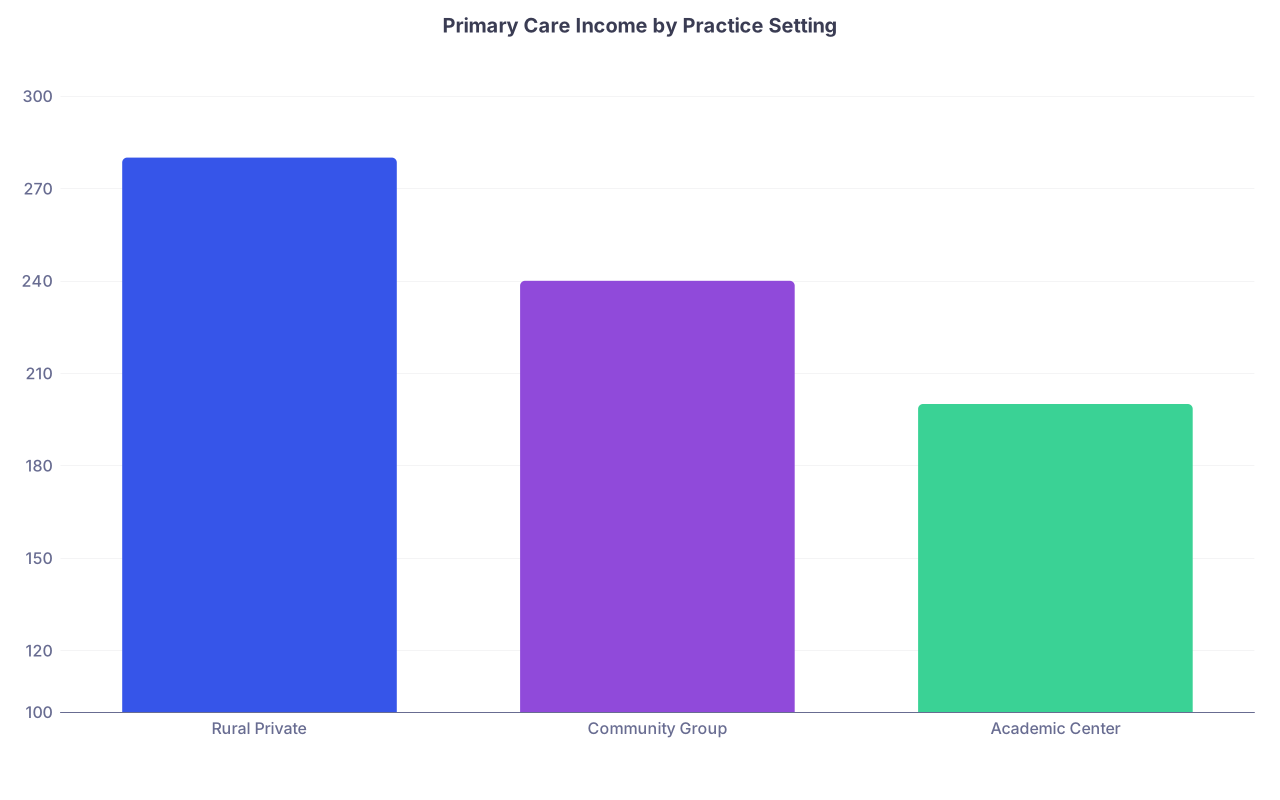
| Category | Value |
|---|---|
| Rural Private | 280 |
| Community Group | 240 |
| Academic Center | 200 |
You want to make FI easier in a lower-paid field?
- Avoid HCOL city + academic salary + huge rent/mortgage + private school
- Consider LCOL or MCOL areas with RVUs/production bonuses
- Look at hospital-employed or large group practices that pay well for primary care/psych
A rural psychiatrist earning $330K with a $2,000/month mortgage is in a far better FI position than a neurosurgeon in San Francisco paying $12,000/month to exist.
2. Your fixed costs
If your mortgage, car payments, daycare, and student loans eat 70% of your take-home, you’re dead in the water.
Where people blow it:
- $1.3M house because “we’ll grow into it”
- Two new luxury SUVs on 5–7 year loans
- Private school x3 kids when public is fine
- Lifestyle inflation before loans are under control
You can be a financially independent pediatrician if you stop trying to live like a cardiologist with two ex-wives and a lake house.
3. Student loans
Yes, they’re a problem. No, they’re not an automatic FI death sentence in lower-paying specialties.
You have three main paths:
- Aggressive payoff (high-income, low-expense situation)
- PSLF (government/academic/nonprofit work for 10 years of qualifying payments)
- Long-term IDR with eventual forgiveness (more niche; usually less ideal if you’re a full-time attending for decades)
Lower-paid specialties often fit PSLF beautifully because:
- They’re common in academic and nonprofit hospitals
- They align with clinic/hospital employment instead of pure private practice
- The pay gap vs private is often less dramatic than in surgical fields, so you’re not sacrificing as much
A psych attending making $240K at a nonprofit, paying IDR for 10 years and getting six figures of loans forgiven, is in fantastic shape to then ramp up savings.
Step 4: Build a Realistic FI Plan for a Lower-Paid Specialty
Let me give you a clean, practical framework.
Step A: Pick your FI lifestyle, not your FI number
Don’t start with “I want $5M.” Start with: “What kind of life do I want?”
Example: You’re a future family physician who wants:
- Paid-off modest house in a MCOL town
- 2 kids, public school
- 1–2 trips a year, nothing crazy
- Decent but not extravagant car every 8–10 years
- Some money to help kids with college, not full freight at $90K/year privates
That might cost you, in retirement:
- $70–90K/year in today’s dollars
Call it $85K. 25x that is about $2.1M. That’s your initial FI target. More is fine, but you know the minimum viable number.
Step B: Estimate your attending cash flow
Take a reasonably conservative number:
- Family med attending income: $240K
- Effective tax rate (federal + state + payroll): ~30% → $72K
- Take-home after tax: $168K
Now carve out a starting budget:
- Living expenses: $90K
- Loans: $20K (for first 5–10 years)
- Investing: $50–60K
- Misc / buffer: $10–20K
That $50–60K/year into investments, starting in your early 30s, grows very nicely.
Use a simple scenario:
- Invest $55K/year from age 32 to 50 (18 years)
- 7% annual return
- Future value ≈ $2.1–2.3M
Yes, that roughly hits your $2.1M target by 50. Earlier if:
- Your income rises
- You moonlight a bit
- You increase savings once loans are paid off
None of this depends on “derm money.”
Step 5: Use Specialty-Specific Advantages
Every specialty has levers. Lower-paid ones are no exception. Use them.
Primary Care (FM, IM, Peds)
Advantages:
- Relatively flexible to go part-time once you’re close to FI
- Easy to stack side work: urgent care, telehealth, after-hours clinic
- Good fit for PSLF or 401(a)/403(b) mega-tax-advantaged setups at large systems
Playbook:
- During early attending years, consider an extra clinic half-day or some urgent care shifts to add $20–40K/year straight into investments
- Use employer retirement accounts aggressively: 401(k)/403(b), plus maybe 457(b)
Psychiatry
Advantages:
- Very strong demand, including telehealth
- Outpatient-heavy, predictable schedules
- High-ROI side gigs (cash-pay practice, consulting, telepsych)
Playbook:
- Start with W-2 job to secure PSLF or loan strategy
- Add telepsych 1–2 evenings/week; that extra $30–60K/year invested accelerates FI massively
- Long-term optionality: small private practice with high margins and fewer hours once you’re near FI
PM&R / Non-Procedural Specialties
Advantages:
- Often reasonable hours
- Ability to mix inpatient, outpatient, consulting work
- Less burnout risk → more sustainable long-term income
Playbook:
- Don’t chase every RVU dollar at the expense of your health; consistency matters more
- Use extra bandwidth to actually handle your finances: re-shop insurance, optimize taxes, plan investing
Step 6: Understand What Will Sabotage You
Here’s where people actually blow FI in lower-paid fields.
Buying the “I deserve it” story every year
- You do deserve rest, comfort, and some fun
- You don’t “deserve” to erase your financial freedom for granite and an Escalade
Letting peers set your baseline
- If your friend in ortho buys a $2M house, that’s not your template
- Your specialty’s average lifestyle is your benchmark, and even that can sink you if you match the top 10% spenders
Avoiding money decisions because you’re “bad with finances”
- You made it through pharmacology and path
- You can learn how index funds and Roth IRAs work; it’s easier than Step 1
Waiting too long
- The first 5 attending years are critical
- If you inflate everything early and then “figure it out later,” later becomes much harder
Step 7: A Sample FI Roadmap for a Lower-Paid Specialty
Here’s what a reasonable pathway might look like for, say, a pediatrician.

| Step | Description |
|---|---|
| Step 1 | MS3 - Choose Peds |
| Step 2 | Residency - Live Like Student |
| Step 3 | Residency - Learn Basics of FI |
| Step 4 | PGY3 - Decide Loan Strategy |
| Step 5 | First 3 Attending Years - Keep Housing Modest |
| Step 6 | Max Retirement Accounts |
| Step 7 | Pay Down Loans or PSLF |
| Step 8 | Years 5-10 - Increase Savings Rate |
| Step 9 | Hit Coast FI or Full FI |
| Step 10 | Reduce Clinical Load or Retire Early |
This is not fantasy. I’ve seen variations of this play out:
- Modest apartment during residency
- Learn about PSLF vs refinancing before signing contracts
- First attending job in a MCOL or LCOL city
- House: 2–3x income max, not 5–6x
- Max 401(k)/403(b), Roth IRA, plus some taxable investing
- Kids arrive, life gets more expensive, but income also increases with raises/bonuses
- By early/mid 40s: Coast FI (you could stop saving and still retire comfortably at 60+)
- By late 40s/early 50s: full FI, optional work
Step 8: The Trade-Offs vs High-Paid Specialties
Let’s be honest about pros and cons.
High-paid specialty advantages:
- Shorter raw time to FI if lifestyle is controlled
- Easier to recover from financial mistakes
- More leverage for building extreme wealth (not just FI)
High-paid specialty downsides:
- Longer/more intense training (7–10 years post-MD)
- Often worse lifestyle, more call, more burnout risk
- Higher social/lifestyle expectations
Lower-paid specialty advantages:
- Shorter training in many cases (FM, peds, psych, IM)
- More predictable hours; better for parents/families
- Easier to meaningfully change lifestyle once near FI (drop to 0.6–0.8 FTE, outpatient-only, etc.)
Lower-paid specialty downsides:
- Less room for financial error
- You must be more intentional with housing, cars, schools, and loans
- Hitting FI super early (30s) is less realistic without serious side income or extreme frugality
If you love a lower-paid specialty? It’s almost always better to choose that and get disciplined with money than to chase a high-income specialty you hate just for the paycheck. Burnout destroys financial plans.
FAQs: Financial Independence in Lower-Paid Specialties
1. What savings rate do I actually need as a lower-paid specialist to reach FI?
Aim for at least 20% of gross income going to retirement/investing as a floor. If you want FI in your 40s or early 50s, 25–35% is more realistic. On a $250K income, 25% is $62.5K/year. That’s very doable once loans are under control and housing is reasonable.
2. Is PSLF basically required for FI in lower-paid specialties?
No. PSLF is a powerful tool, especially if you’re in peds, psych, or primary care at nonprofits, but it’s not required. It just accelerates the timeline. You can refinance and pay off $200–300K of loans over 5–10 years on a $230–280K salary, then ramp up investing. PSLF is a strategy, not a necessity.
3. How much house is “too much” for someone in a lower-paid specialty?
As a rough rule: keep the purchase price under 2–3x your gross annual income. So if you make $250K, stay under ~$500–750K. If you’re in a crazy HCOL market where that’s impossible, understand you’re trading FI speed for location. One of the quickest ways to destroy your FI prospects in a lower-paid specialty is a stretch house.
4. Can part-time work and FI coexist in a lower-paid specialty?
Yes, and this is actually one of the best uses of FI. Once you hit “coast FI” (enough invested that it’ll grow to a full retirement by your 60s without more contributions), you can drop to 0.6–0.8 FTE, cover current expenses with work, and let investments ride. Primary care and psych are especially friendly to part-time arrangements.
5. Should I try to do a high-paying side gig (like real estate or day trading) to “make up” for lower salary?
No. Don’t gamble because you feel underpaid. If you enjoy real estate and want to own a few rentals carefully, that can help. But chasing day trading, crypto, or highly leveraged deals because you’re “just a pediatrician” is how people blow up their finances. The boring path—broad index funds, consistent savings, controlled lifestyle—works just fine at your income.
6. What’s a realistic age to reach FI in a lower-paid specialty?
If you start as an attending around 30–32, live below your means early, and maintain a 25–30% savings rate once loans are stabilized, FI in your late 40s to early 50s is realistic. Hitting FI in your early 40s is possible but usually requires either very low expenses, strong side income, or both.
7. What should I do right now if I’m in residency and leaning toward a lower-paid specialty?
Three things:
- Learn the basics of student loans and decide whether PSLF probably fits your future.
- Practice living on a modest resident budget and avoid lifestyle creep when your co-residents start upgrading.
- Read one solid physician finance book or blog series and sketch a rough FI plan (target lifestyle, savings rate, and likely first attending job setting).
Open a blank note on your phone right now and write down three numbers: your expected attending income, your ideal annual spending, and your rough FI target (25x that spending). That’s your starting point. From there, your job isn’t to “make derm money.” It’s to make those three numbers actually line up.