
It’s 7:30 p.m. You just finished a brutal call shift, opened your email, and there they are: two offers. One from a big hospital system with a clean salary, RVU bonus, and a shiny signing bonus. The other from a private specialty group dangling partnership and “mid-seven figures realistic” in 3–5 years.
You’re in a high-paying specialty (ortho, neurosurg, GI, cards, rads, anesthesia, derm, urology) and you’re wondering: if I want to be at the very top of the income curve, should I go hospital-employed or join a private group?
Here’s the answer you’re looking for:
For true top earners, private groups and ownership models still win most of the time.
But there are big exceptions, and plenty of ways to screw it up.
Let’s break this down like an attending who’s actually read contracts and watched people win and lose real money.
The Core Question: Who Keeps the Last Dollar?
If you remember nothing else, remember this:
The highest paid physicians are almost always the ones who capture the last dollar of revenue, not just a slice.
Hospital-employed = you’re usually paid a structured slice of what you generate.
Private group/ownership = you and your partners split what’s left after expenses.
In simple terms:
- Hospital-employed:
“We’ll pay you $X per year + RVU bonus + small quality incentives. We keep the rest.” - Private group:
“You help us grow the pie, we share the profit. No hard cap if the pie keeps growing.”
Top earners sit in structures where:
- Margins flow to them, not an employer.
- They control—or at least strongly influence—operations, staffing, and ancillaries.
- They can scale: more cases, more sites, more ASC equity, more imaging, etc.
If your goal is “top 10–20% of earners in my specialty,” hospital-employed can absolutely work.
If your goal is “very top, top 1–5%,” you almost always need ownership somewhere in the chain.
How the Money Actually Flows (High-Yield Reality Check)
Let’s make this concrete. This is roughly how high-earning structures tend to compare.
| Feature | Hospital Employed | Private Group / Ownership |
|---|---|---|
| Income ceiling | Usually capped or soft ceiling | Can be very high, no hard cap |
| Risk | Low to moderate | Moderate to high |
| Time to peak earnings | Fast (day 1) | Slower (2–7 years) |
| Control over schedule | Limited | Greater (varies by group) |
| Ancillary revenue (ASC, imaging) | Usually hospital keeps | Partners can own/share |
| Admin/overhead headaches | Minimal | Significant for partners |
You trade certainty (hospital job) for upside and control (group/ownership).
That’s the fundamental tension.
Specialty-Specific Reality: Who Wins Where?
Some specialties lend themselves much more to private group dominance. Others have been swallowed by health systems and PE (private equity) and the “private” upside is more limited.
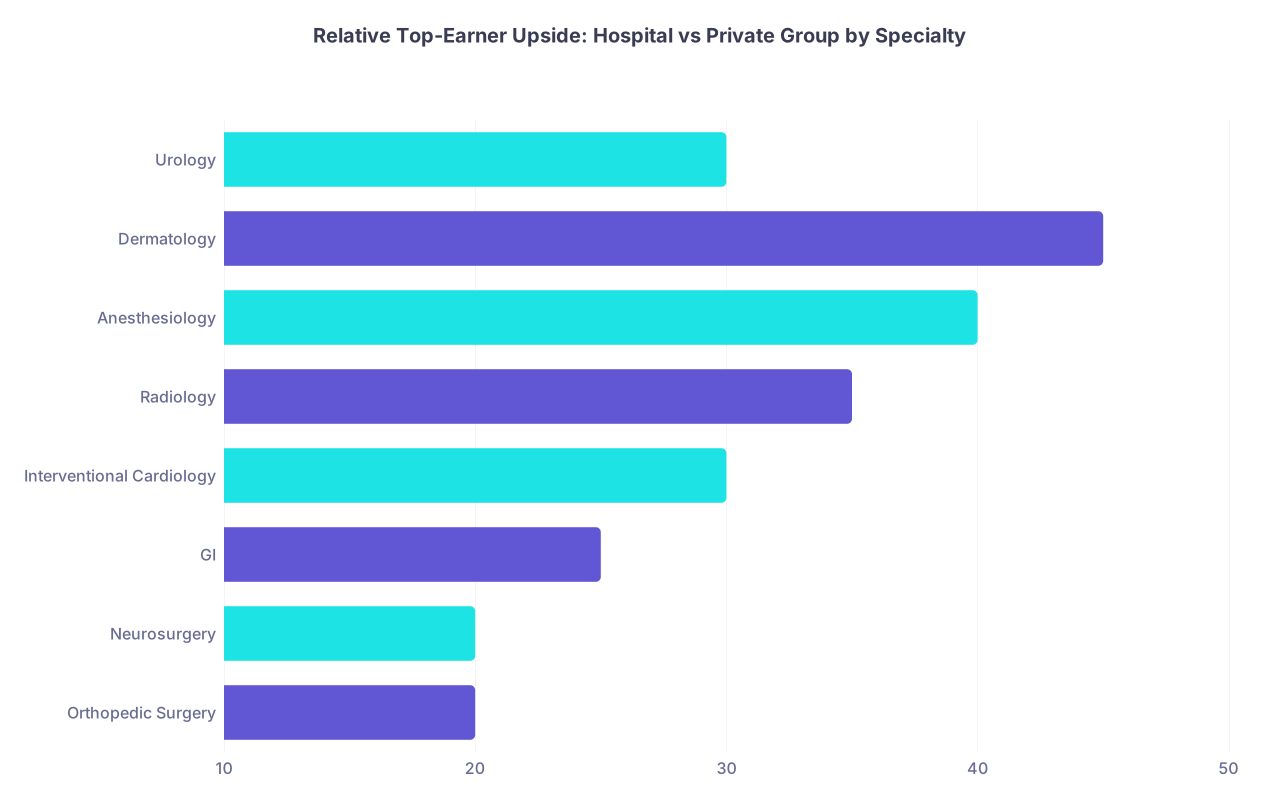
Here’s how I’d call it, strictly from a top-earner perspective.
| Category | Value |
|---|---|
| Orthopedic Surgery | 20 |
| Neurosurgery | 20 |
| GI | 25 |
| Interventional Cardiology | 30 |
| Radiology | 35 |
| Anesthesiology | 40 |
| Dermatology | 45 |
| Urology | 30 |
Think of the values this way: higher number = more relative upside in private group/ownership vs hospital employment.
Orthopedic Surgery & Neurosurgery
- Peak earners almost always come from:
- Strong private groups with ASC ownership.
- Spine-focused practices with imaging, PT, injections.
- Multi-site groups that control referral flow.
- Hospital-employed ortho/neuro can still make $800k–$1.2M+ in busy setups, but:
- The hospital is eating the ASC margin, implant margin, and facility fees.
- Your upside is limited by RVU caps or compensation committee politics.
If you’re a workhorse surgeon and want to be in the true top tier?
You should be at least seriously exploring private group + ASC equity.
GI & Interventional Cardiology
Same story with some twists.
- GI:
- Private GI groups with ASC, pathology, and infusion can easily 2–3x your income vs a plain hospital-employed job over time.
- PE-backed GI groups can still pay very well, but late-joiners usually don’t see the same equity pop as the founders.
- Interventional Cardiology:
- Huge volume + ownership in cath lab, imaging, and office-based labs = very high ceilings.
- Hospital jobs pay solidly, but often cap you once you’re “too” productive.
Radiology & Anesthesiology
These are messy because of PE and hospital contracting games.
- Radiology:
- Traditional democratic groups with equal partnership + imaging center equity = great for top earners.
- Telerad + PE-backed models can pay high salaries but usually with more ceiling and less equity.
- Hospital-employed radiology can be decent, but you’re rarely a true top earner long-term.
- Anesthesiology:
- Biggest winners are partners in large anesthesia groups with facility contracts, good stipends, and ASC ties.
- Hospital-employed anesthesia tends to pay well early but rarely scales to the very top unless you’re in an extreme call-heavy situation.
Dermatology & Urology
- Dermatology:
- Private derm with cosmetics, cash-pay procedures, and multiple locations can blow hospital-employed derm out of the water.
- Pure hospital-employed derm: nice lifestyle, lower ceiling.
- Urology:
- Top earners: group with ASC, imaging, lab/PSA, and maybe radiation oncology alignment.
- Hospital jobs: stable, simpler, lower ceiling.
Bottom line:
For the highest paid specialties, the pattern is consistent—top earners tend to sit in groups with ownership and ancillaries, not in standard W-2 hospital roles.
When Hospital-Employed Actually Wins (Or Comes Close)
Now the twist: hospital jobs aren’t “bad.” There are specific scenarios where they’re actually the best move, even if you care a lot about money.
1. Unicorn Compensation Guarantees
Sometimes a hospital is desperate:
- New service line.
- Competitor building across town.
- Rural or mid-market where they can’t recruit.
You’ll see:
- Massive base plus:
- RVU rates way above MGMA median.
- No meaningful cap for 2–3 years.
- Guaranteed income that rivals or beats local private groups, at least early.
I’ve seen ortho, GI, and cardiology folks making seven figures as hospital-employed because the RVU deal was written by optimists who’d never seen a true workhorse.
The catch:
- These unicorn deals often get “revised” once you prove how productive you are.
- Renewal contracts usually lower RVU rates or add caps.
- Admin suddenly discovers you’re “outlier expensive.”
2. You Don’t Want Business Risk. At All.
Some people hate:
- Partner drama.
- Hiring/firing staff.
- Managing billing and collections.
- Worrying about payer mix and contract renegotiations.
If that’s you, forcing yourself into an ownership role purely for a hypothetical extra $300–500k/year you might never see is dumb. You’ll be miserable.
You can absolutely land in the top 20–25% of income for your specialty in a strong hospital-employed job in a high-demand region, especially if you work hard.
3. Market Is Fully Captured by a Health System
In some cities:
- The hospital owns the major ASCs.
- Private groups have been bought or crushed.
- Referrals are controlled by system-employed PCPs.
In that environment, a “private” group might just be a glorified staffing company with no real leverage or ancillaries. Your upside is limited anyway.
In those markets, a well-negotiated hospital deal might be the rational move, even if it annoys the “real doctors are in private practice” crowd.
Where Private Groups Go Wrong (And Nuke Your Upside)
“Private group” isn’t automatically good. Some of these setups are financial traps dressed up as opportunity.
Red flags I’ve seen blow up people’s earnings:
- Endless partnership track:
“Partnership in 5–7 years” becoming 9+ years. Or never.
Translation: you’re cheap labor, not a future owner. - Buy-in numbers that make no sense:
Paying $600k–$1M for “goodwill” in a group with declining collections and upcoming retirements is insanity. - Tiny or fake equity:
PE-backed structure where “partnership” is really:- Small revenue share.
- No real vote.
- No meaningful upside if the group sells again.
- No control of ancillaries:
You work like a dog, but:- ASC belongs to someone else.
- Imaging belongs to a separate LLC you’re not in.
- You’re just a high-output employee with a slightly fancier title.
If a private group can’t show you:
- Transparent books.
- Clear, written partner track.
- Realistic partner comp numbers from multiple current partners (not just the rainmaker).
- Reasonable buy-in terms.
Then your “private group upside” is mostly marketing.
A Simple Decision Framework: Where Should a Top Earner Lean?
Here’s the streamlined way to think about it.

| Step | Description |
|---|---|
| Step 1 | High paying specialty |
| Step 2 | Hospital job or lifestyle group |
| Step 3 | Negotiate best hospital deal you can |
| Step 4 | Hospital job with aggressive RVU deal |
| Step 5 | Join private group with clear path to ownership |
| Step 6 | Want to maximize top end income? |
| Step 7 | Is there a strong private group with ancillaries? |
| Step 8 | Are you willing to accept business risk and delay income? |
Real talk:
- If your top priority is income ceiling and you can tolerate risk/headache:
You should lean hard toward private group with true ownership. - If your top priority is security + high but not insane pay:
A strong hospital-employed job is totally defensible.
Numbers: What “Top Earner” Actually Looks Like
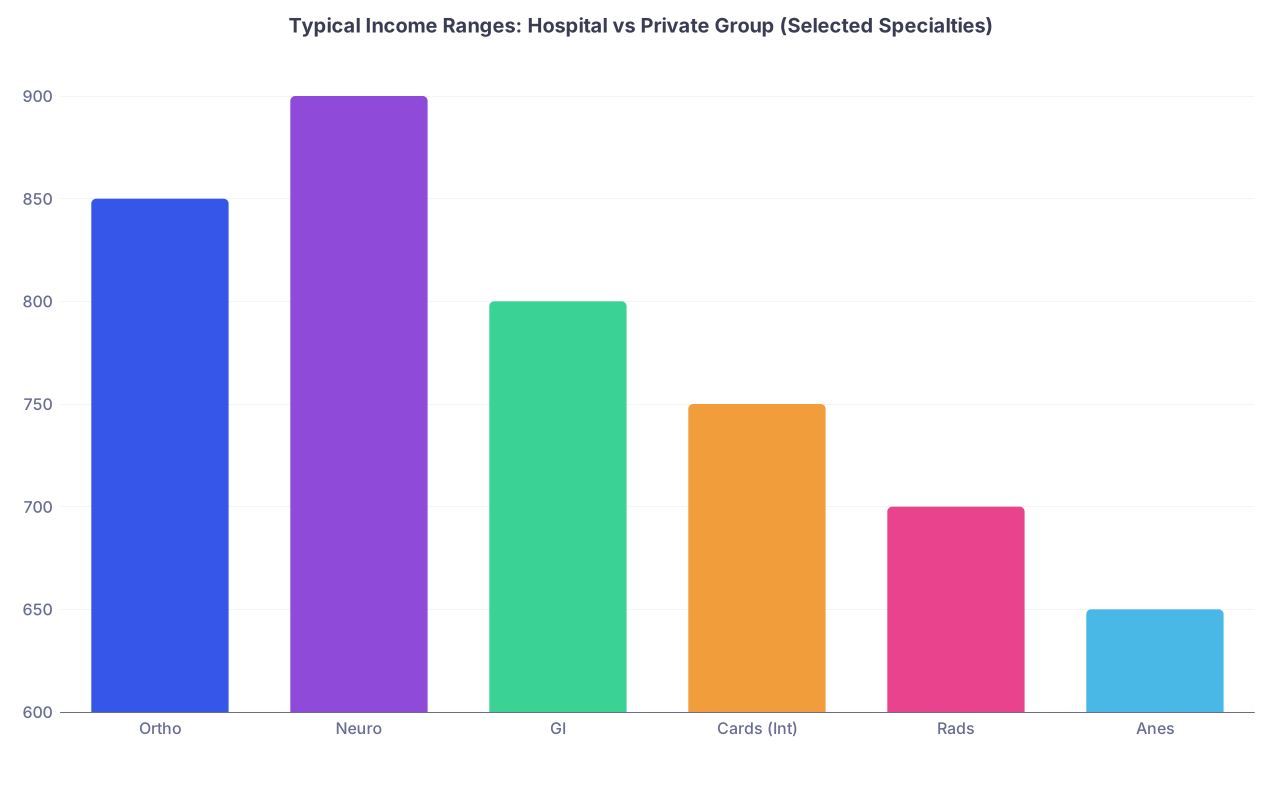
Let’s put some ballpark numbers on this. These are rough, directional, and obviously vary by geography and practice, but the spread is the point.
| Category | Value |
|---|---|
| Ortho | 850 |
| Neuro | 900 |
| GI | 800 |
| Cards (Int) | 750 |
| Rads | 700 |
| Anes | 650 |
Use this as a framework:
- Hospital-employed high earners (busy, good RVU deals):
- Many high-paying specialties land between $600k–$1.2M.
- Some rare unicorns crack $1.3–1.5M, usually temporarily.
- Private group partners with ancillaries:
- Common range for partners in strong markets: $900k–$2M+, depending on specialty and equity.
- True top 1–5% outliers can go well north of that with:
- Multiple ASCs.
- Imaging, PT, infusion, OBLs.
- Leadership roles and ownership stakes in more than one entity.
Again, not everyone hits those numbers. But if we’re talking top earners, that’s where they tend to live.
How to Protect Yourself Either Way
Whatever you choose, don’t be naïve. Top earners don’t just work hard—they structure their deals intelligently.
Minimums you should be doing:
- Pay a real healthcare contract attorney to review the offer. Not your cousin the divorce lawyer.
- Get actual partner income data (last 3 years, multiple partners, anonymized if needed).
- Understand:
- How RVUs are defined and paid.
- What happens if you crush your targets.
- Who owns the ancillaries—and whether you ever can.
- Non-compete radius and duration. Especially in hospital-owned markets.
And don’t kid yourself:
Your first job doesn’t have to be your final structure. A lot of people:
- Start hospital-employed to learn, build volume, and get comfortable.
- Move into private group / ownership once they understand their value and the local landscape.
That’s a perfectly valid path to top-earner status.
FAQ (Exactly 6 Questions)
1. If I know I want to be a top earner, should I skip hospital jobs entirely?
Not automatically. Hospital jobs can be a smart first step while you learn the ropes, pay down debt, and figure out your preferred city and team. But if, five years out of training, you’re still in a standard W-2 hospital role in a high-paying specialty, your income ceiling is probably lower than it could be in a strong private group with ownership.
2. Are private equity–backed groups good or bad for top earners?
Depends on timing and structure. Early partners who sell to PE often get a big one-time payout plus solid ongoing comp. Late joiners usually get:
- High salary.
- Little or no real equity.
- Less upside long-term vs traditional democratic groups.
They can still pay well, but if your goal is “own the asset and capture long-term growth,” PE setups usually cap that.
3. How long should a reasonable partnership track be?
For most high-paying specialties: 2–5 years is normal. Longer than that and I’d start asking why:
- Are they testing commitment?
- Are they just using you as cheap labor?
- Do they even intend to add more partners?
If the partnership track is vague or “flexible,” assume that’s not an accident.
4. Can hospital leadership roles (CMO, service line director) make me a top earner?
Rarely in pure cash terms. Those roles might add:
- $50–200k on top of your clinical income.
- Some schedule flexibility or influence.
But they usually don’t push you into the absolute top percentile of earners compared with owning large ancillaries or big equity stakes in a thriving group.
5. What if the best private group in town is politically toxic but pays incredibly well?
This is where you have to be honest with yourself. If the environment is miserable—constant partner wars, backstabbing over call, no trust—huge pay won’t fix that for long. I’d rather see someone take:
- Slightly lower but still strong pay,
- In a stable, functional group or hospital job, than chase an extra $300–400k to be miserable for a decade.
6. How early in residency should I start thinking about this hospital vs private question?
PGY-2/PGY-3 is early enough to start learning how different models work. You don’t need a firm decision until you’re signing offers, but:
- Pay attention on rotations: who’s hospital-employed vs group vs ASC-based?
- Ask attendings (off the record) what they actually take home and what they regret.
- Read a couple of basic practice management / physician finance books.
The earlier you understand the game, the less likely you are to walk blindly into a “nice” job that quietly caps your potential.
Key points to walk away with:
- For true top earners in the highest paid specialties, private groups with real ownership and ancillaries usually beat hospital employment over the long run.
- Hospital-employed roles still make sense if you prioritize stability, don’t want business risk, or can land a rare, aggressively structured RVU deal.
- The model matters less than the specific deal in front of you—understand the numbers, the ownership, the politics, and your own risk tolerance before you sign anything.