
The myth about equity tracks is simple: people think it’s about RVUs and “being a hard worker.” It isn’t. The partners are not just deciding who works hard. They’re deciding who they’re willing to make rich and legally marry into their business for 20+ years.
You want equity in ortho, neurosurgery, derm, GI, radiology, anesthesia groups? Then you need to understand how the partners actually think behind closed doors when they decide who gets an equity offer and who stays a glorified employee forever.
Let me walk you through how those conversations really go.
1. First, Understand What “Equity Track” Actually Means to Them
Residents and fellows get hypnotized by numbers. “Starting salary is 450k with partnership to 900k+ in 2–3 years.” You see that and think: jackpot. They see something else.
Partners are thinking:
If we make this person equity:
- They get access to our profit engine.
- They gain legal voting power.
- They’re harder to fire.
- They’ll see all the skeletons in the closet (billing practices, referral games, side deals, call coverage games).
That’s why they’re cautious. Equity is not a reward. It’s an invitation into the inner circle that can’t easily be undone.
In most high-paid specialties, the rough economic reality looks like this:

| Category | Value |
|---|---|
| Year 1 | 450000 |
| Year 2 | 500000 |
| Year 3 (Partner) | 900000 |
| Year 5 | 1100000 |
| Year 10 | 1400000 |
On paper you’re going from “paid well” to “generational wealth.” They know it. You should too.
So before they ever say, “Let’s put Dr Smith on the partnership track,” they’re asking one question:
Is this someone we want to share our profit and power with?
The rest of this article is just the criteria hidden inside that question.
2. What Partners Actually Discuss in the Closed-Door Meeting
Every practice has some version of the same scene:
Conference room. End of the quarter. The managing partner closes the door. There’s a list of names on a handout or a shared screen. Usually 2–5 associates up for “track discussion.”
I’ve sat in those meetings. The language is always more blunt than you’d expect.
Here’s roughly how the informal “scoring system” works in neurosurgery, ortho, GI, derm, radiology, anesthesia, cardiology groups.
2.1 The Unspoken Rubric
They are rating you on groups of things you never see written in a contract.
| Dimension | What They Actually Mean |
|---|---|
| Clinical | Competent, safe, low-disaster-risk, not a cowboy |
| Financial | RVUs, collections, payer mix, growth trajectory |
| Cultural | Drama level, politics, “vibe” with staff and partners |
| Strategic | How you help future deals, referrals, expansion |
| Risk | Malpractice, burnout, leaving, complaint magnet |
If you’re strong in clinical and financial but weak in cultural or risk, you might make more money for them short term but cost them more long term. That’s where people get quietly blocked from equity despite “crushing RVUs.”
The conversation does not sound like an academic evaluation. It sounds like this:
- “He’s very productive but I don’t want to share a call schedule with him for the next 15 years.”
- “She’s safe, staff love her, and Dr X wants to slow down — she’d be a good stabilizer.”
- “We just settled a complaint that started with her clinic. I’m not sure I want to bet the farm on that.”
- “He’s already poking around about our MSO contracts. That makes me nervous.”
They’re not saying this to you. They’re saying it about you.
3. Clinical Competence: The Minimum Bar, But It Can Sink You
Here’s the blunt truth: in high-paid specialties, almost everyone who makes it to an equity discussion is clinically competent. So being “good” isn’t a differentiator. Being unsafe absolutely is.
In neurosurgery and ortho, the phrase you never want to be associated with is “he scares me a little.” That might mean:
- Too aggressive on indications
- Cutting corners on pre-op or post-op
- Sloppy documentation that makes cases look bad in hindsight
Even one or two nightmare cases, heavily discussed in M&M or whispered about by staff, can freeze your equity track quietly. They’ll keep you as an employee to squeeze productivity out of you, but they won’t hand you power.
In derm or GI, the standard is different but the idea is the same. If your biopsies come back mismatched with your notes, if your colon prep complication rates raise eyebrows, if anesthesia keeps logging “difficult provider” flags on your cases—those data points do not die. They turn into sentences like:
“I just don’t want to be co-signing his complications as a partner.”
Clinical reputation inside the group matters more than your CV. Fellows come in showing off how many cases they did. Partners care more about how many fires they’d have to put out for you later.
4. Money: It’s Not Just RVUs, It’s the “Profit Delta”
Now for what everyone pretends isn’t the main factor but absolutely is: money.
In a high-earning practice, the partners are doing a simple mental calculation:
What is the difference between what this person brings in and what we pay them now?
Then: what happens to that difference if we make them equity?
Let’s make it concrete. Think about a busy ortho or GI associate.
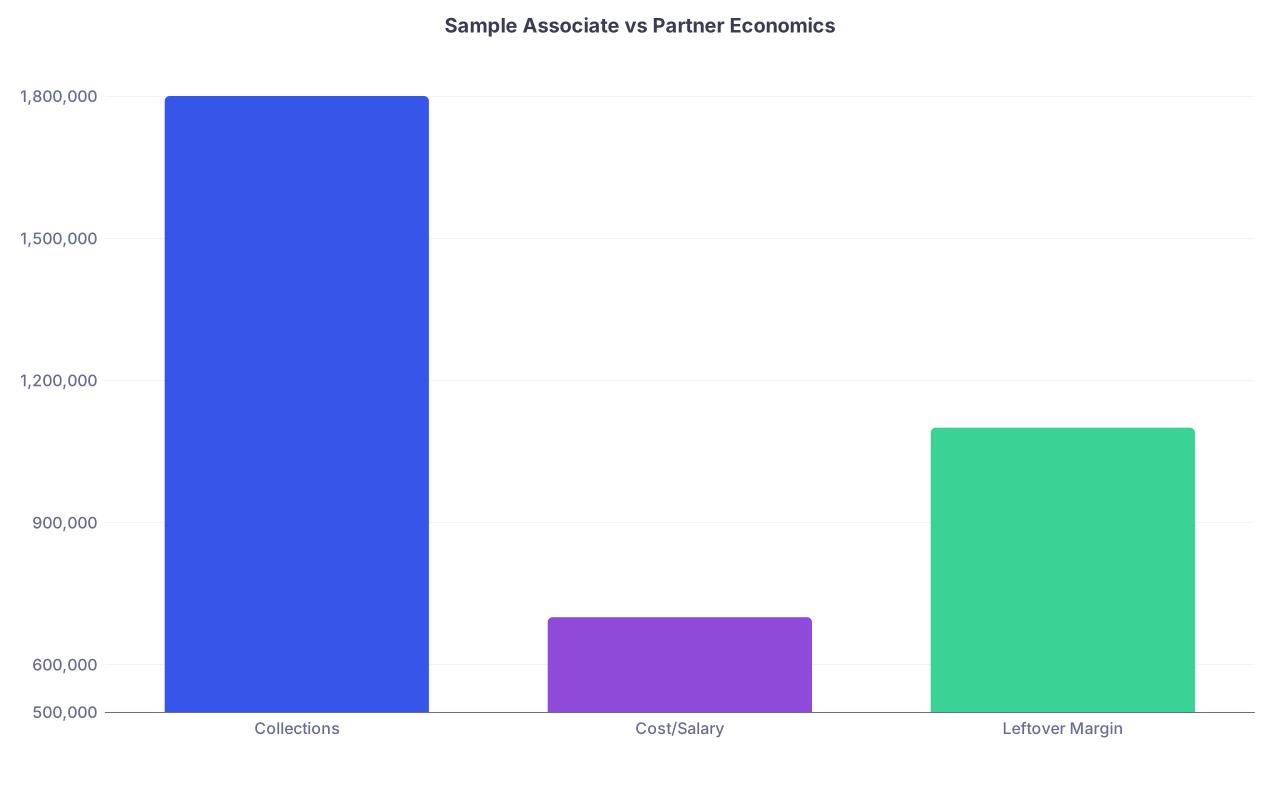
| Category | Value |
|---|---|
| Collections | 1800000 |
| Cost/Salary | 700000 |
| Leftover Margin | 1100000 |
As an associate, you may be producing $1.8M, getting paid $600–700k, and the group is pocketing the extra margin. You feel underpaid; they see you as a great asset.
When you become equity, that leftover margin is now shared. You stop being a profit center and become a profit sharer.
Partners will ask:
- Are we comfortable giving this person access to that level of profit?
- Does this person’s volume and payer mix grow enough year over year to justify expanding the pie?
- Or is this a zero-sum game where someone else’s income will drop?
Here’s the secret nobody tells you: If the group’s overall pie is not clearly growing, every new partner feels like a pay cut for existing partners. That’s where people mysteriously get stuck at “senior associate” level.
This is why GI and cardiology groups obsess over your referral base. They watch:
- Do referring PCPs follow you specifically?
- Are hospitalists and ED docs paging you by name?
- Are your clinic templates filling themselves or do schedulers have to push?
If your volume is self-sustaining and growing, you’re safer. If your volume exists only because they feed you cases, your leverage is lower.
5. The Real Killers (or Kingmakers): Culture, Politics, and Power
Here’s the messy part. The human nonsense. This is what residents and fellows underestimate the most.
In anesthesia, radiology, and big multispecialty groups, equity is 50% politics. Do not kid yourself.
You are not just asking: “Can I be partner?”
You are asking: “Will you let me into your political ecosystem, where votes and alliances decide call, vacation, investments, even who gets protected time?”
5.1 Staff Opinions Matter More Than You Think
If you treat staff poorly in a high-paid specialty, it absolutely gets back to partners. I’ve watched this scene play out:
Admin quietly pulls the managing partner aside:
“Just so you’re aware, we’ve lost three MAs from Dr Y’s pod in the last year.”
That sentence hits harder than you think.
It translates to:
She’s expensive and she’s driving staff away. That means hiring costs, training costs, and instability in clinic. Not worth making her equity.
On the flip side, when staff say: “If Dr Z leaves, I’m leaving with him,” that is power. I’ve seen that single-handedly push someone through a borderline partnership vote.
5.2 How You Handle Conflict
Every high-earning group has internal arguments: OR block time wars in ortho or neurosurg, procedural suite access in GI, case assignments in anesthesia, telerad vs on-site friction in radiology.
The partners are watching:
- Do you escalate every problem to “I’m being treated unfairly”?
- Do you undermine other docs to nurses or admin?
- Do you always take everything personally?
Someone who is perpetually aggrieved is a terrible equity partner. They become a constant “no” vote in meetings and a poison in the group text.
I’ve heard exact phrases like:
“He’s good, but the drama tax is too high.”
“She’s a strong cardiologist, but I do not want to argue with her at every shareholder meeting for the next twenty years.”
An associate who can fight for themselves without turning every disagreement into a full-scale war? That’s rare. And valuable.
6. Risk: Malpractice, Complaints, and the Flight Factor
Partners are paranoid about two risks:
You blowing up the practice.
Or you leaving with assets they helped build.
6.1 Malpractice and Complaint Risk
In high-risk fields like neurosurgery, ortho, interventional cards, even high-volume OB, they quietly track:
- Malpractice hits: even if you win, were you named often?
- Patient complaints: formal, documented ones.
- Hospital whisper networks: nurses and scrub techs telling stories.
One or two cases? Fine. A pattern? They back away.
I sat in a meeting at a large ortho group where the managing partner said, “He’s been named in four threatened suits in two years. I’m not marrying that.” That associate’s productivity was top five in the practice. Did not matter.
6.2 Will This Person Bolt?
The other risk is that you’ll use them as a launchpad. Build your name, learn the scripts, then either:
- Jump to a competitor
- Start your own shop nearby
- Join a hospital system and become a direct competitor with all their referral relationships
This is especially hot in derm, GI, radiology, and anesthesia where PE, hospitals, and big groups are constantly poaching.
They look for clues:
- Are you already talking about “working less” or moving states?
- Do you hint at “if they don’t make me partner by X date, I have options”?
- Have you been secretive about outside interests or side businesses?
If they sense you’re a flight risk, they’ll keep you at arm’s length. Better as a productive employee with a non-compete than a voting equity holder who can walk with inside knowledge.
7. Specialty-Specific Twists You Don’t Hear as a Trainee
The basic framework is the same, but each high-paid specialty adds its own flavor behind the scenes.

Ortho & Neurosurgery
Equity is tied to OR block time, device contracts, and sometimes ownership in surgery centers.
What they care about:
- Can you consistently fill block with high-yield cases, not just low-paying ones?
- Are you on good terms with the hospital CMO and OR director?
- Do device reps love you or fear you? That signals whether you’re a rainmaker or a headache.
Partners will ask: “Does he grow our ASC volumes?” If yes, equity comes faster.
Dermatology
The quiet game is about cosmetic vs medical vs Mohs and ancillary revenue (lasers, products, medspas).
What they watch:
- Are you willing to cross-sell within ethical bounds?
- Do patients book with you specifically months in advance?
- Do you protect the brand or act like a lone wolf influencer?
A derm associate who moves product, fills cosmetic slots, and doesn’t cannibalize the owners’ niche procedures? That person is gold.
GI & Cardiology
Here the game is: procedures, imaging, and ownership stakes in endoscopy centers or cath labs.
Key questions:
- Do referring PCPs and hospitalists trust you and send you the right mix of cases?
- Are you out there networking or just sitting in clinic hoping the schedule fills?
- Are you aligned with the group’s strategy (more hospital presence vs more ASC growth)?
If you show up to every hospital committee, take call reliably, and your name keeps coming up in a positive way with hospital admin, partners see that as leverage in future negotiations.
Radiology & Anesthesia
Here, integration with hospitals and systems dominates.
For radiology:
- Are you fast and accurate, with low addendum rates?
- Do surgeons and ED docs like your reads and your responsiveness?
- Are you a team player with overnights, weekends, unpopular sites?
For anesthesia:
- Are surgeons asking, “Can Dr X cover my room?”
- Do you work smoothly with CRNAs and AAs without blowing things up politically?
- Are you reliable on start times and turnover, so surgeons stay happy?
A rad or anesthesiologist who keeps surgeons happy without pissing off hospital admin is extremely partner-trackable.
8. How Voting and Timelines Really Work (Not What the Recruiter Told You)
Recruiters and contracts love nice, clean promises:
“Partnership eligible at year 2, typical advancement by year 3, subject to mutual agreement.”
The real structure usually looks more like this:

| Step | Description |
|---|---|
| Step 1 | Associate Year 1 |
| Step 2 | Associate Year 2 |
| Step 3 | Track Year 3 |
| Step 4 | Extended Associate |
| Step 5 | Equity Partner |
| Step 6 | Senior Associate or Exit |
| Step 7 | Informal Partner Review |
| Step 8 | Partner Vote |
Two key “gotchas” I’ve seen repeatedly:
The “informal” review is what actually decides your fate.
By the time you hit the formal vote, the decision is mostly baked. If people still have serious reservations at year 2, you’re probably not becoming equity on time. They’ll string you along or “need another year of data.”Votes are rarely unanimous, and personalities dominate.
I’ve seen practices where a single senior partner essentially holds veto power. If that person dislikes you, the vote mysteriously “gets delayed” or the bar shifts.
Sometimes they’ll create a new category just to keep someone from equity while keeping them around: “non-equity partner,” “senior associate,” “income partner.” Title bump. No real power.
9. What You Can Actually Do as a Resident/Fellow or Early Attending
You can’t change group politics, but you’re not powerless. You just have to stop acting like a student and start acting like someone being evaluated for a long-term business relationship.

9.1 During Residency/Fellowship
Start behaving like the kind of person partners want to bring in:
- Build a reputation for being safe, not flashy. People remember the cowboy cases.
- Treat staff well. The scrub techs and MAs you work with now will mirror that behavior later.
- Watch the attendings who are clearly partners vs just employed. Study how they talk to admin and other services.
You’re not just learning surgical technique or procedural skill. You’re learning how real-world power and money flow.
9.2 When You’re Evaluating Offers
Stop obsessing only over starting salary. Ask the uncomfortable questions:
- “Of the last five associates you hired, how many became equity on time?”
- “What happened with the ones who didn’t?”
- “Can I speak with a recent hire who just made partner?”
- “Is there a non-equity partner tier? How many people are in it?”
If they dodge those questions, you have your answer.
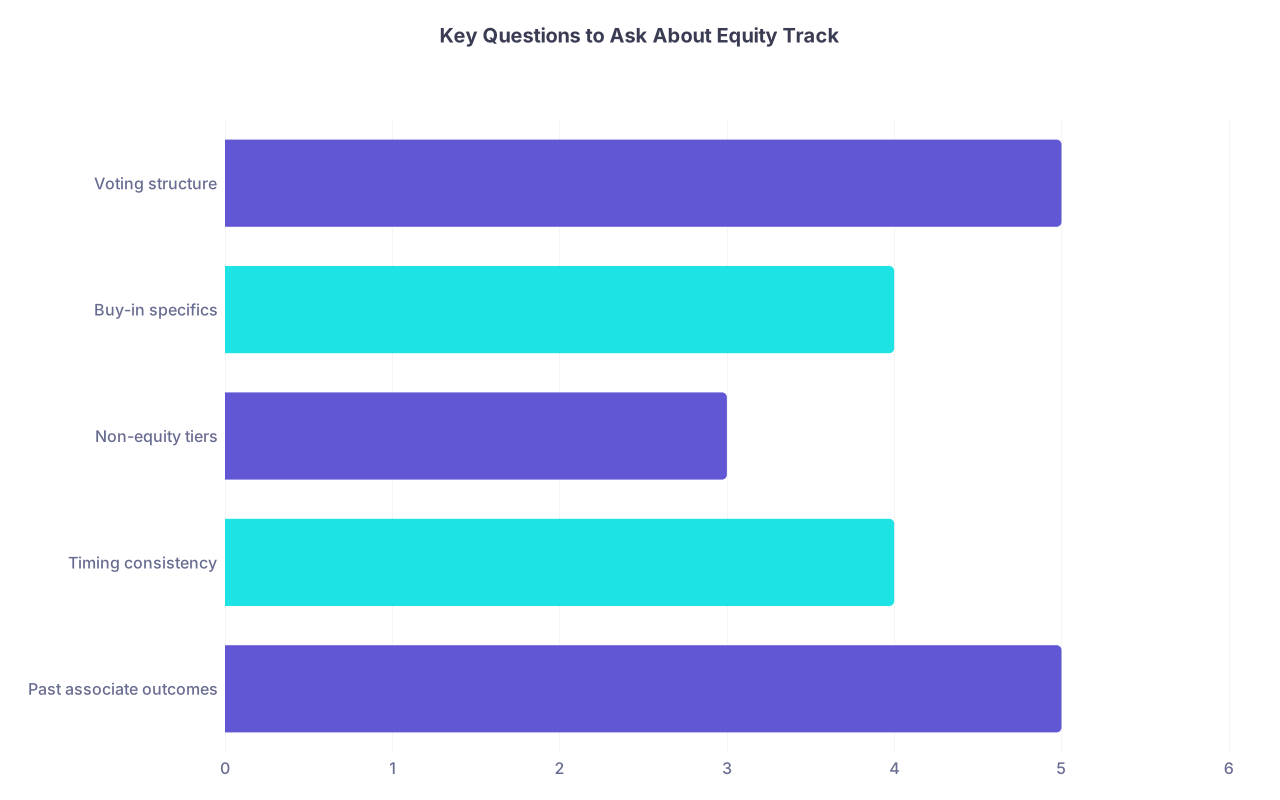
| Category | Value |
|---|---|
| Past associate outcomes | 5 |
| Timing consistency | 4 |
| Non-equity tiers | 3 |
| Buy-in specifics | 4 |
| Voting structure | 5 |
(That chart isn’t data; it’s emphasis. Those first and last points matter a lot.)
9.3 In Your First Two Years
This is your real audition. A few moves that carry disproportionate weight:
- Be the person who fixes small problems quietly instead of escalating every annoyance to leadership.
- Communicate clearly about time off, schedule changes, and conflicts. No surprises.
- When you make a mistake, own it early, document properly, and loop in the right people. Partners trust transparency more than “perfection.”
And one more thing: Do not gossip up. Vent horizontally if you must, not to partners or admin. The moment you’re seen as the person always complaining about others, your equity stock tanks.
10. The Equity Buy-In: Why the Dollar Amount Isn’t the Real Issue
You’ll hear numbers for buy-in in high-paid specialties that make your eyes pop: $200k, $400k, sometimes $700k+ over time, especially where there’s ASC or imaging center equity.
But from the partners’ perspective, the real question isn’t “Can you afford it?” It’s “Are you committed enough to put real skin in the game?”

They worry about:
- People who want equity for status but will not participate in governance.
- People who will push for short-term distributions over long-term reinvestment into buildings, centers, or tech.
- People who might balk at capital calls when times get tight (new EMR, legal situation, expansion, or buyout).
If you negotiate only on buy-in cost and not on what you’re actually buying (ownership of which entities, voting rights where, share class, how ASC profit is split vs professional collections), partners see someone who doesn’t really understand the business and is just chasing a title.
FAQ (Exactly 4 Questions)
1. Can you ever become equity if one senior partner clearly dislikes you?
Yes, but it’s uphill. In small and midsize private groups, one senior partner can effectively block you by influencing everyone else. Your options are: outlast them (retirement is real), build such overwhelming economic value that others push back, or recognize it’s a dead end and leave before you waste five prime years.
2. Do RVUs alone ever force a group to offer equity?
No. There’s no magical production threshold where they are obligated to give you partnership. I’ve seen people producing in the top quartile of a practice held at associate level because they were high drama, high risk, or politically toxic. RVUs buy attention, not automatic equity.
3. Are hospital-employed docs totally shut out of “equity”?
For the traditional partnership model, yes. But some systems are building quasi-equity structures: wRVU multipliers, quality bonuses, leadership stipends, and co-management agreements. It’s not true equity in the private-practice sense, but you can still angle for power and better economics; it just looks different.
4. How soon should I start asking about equity track after joining a practice?
You should clarify the structure before you sign, then largely stop talking about it for the first 12–18 months and focus on being indispensable. Constantly asking “When do I make partner?” in your first year reads as entitlement. When you have traction—strong volume, staff love you, no big issues—then you can revisit timing and expectations in a serious way.
Key takeaways:
Equity track in high-paid specialties is not about who works hardest; it’s about who partners trust with money, reputation, and long-term power. Clinical competence and productivity are entry tickets, not the decision point. Culture, risk, and politics decide who actually gets invited into the inner circle.