
It’s 6:45 a.m. You’re a PGY-5 in ortho, standing in the workroom of a big private group that everyone swears is “the place to be” if you want to make real money. On the screen is a production dashboard the practice manager just pulled up: columns of RVUs, collections, new consults, referral sources.
You notice something.
The senior spine guy and the senior sports surgeon each have fewer clinic days than you, fewer total encounters… and double your RVUs. New patient referrals cluster around their names like magnets. Your column looks like a trash bin: post-op checks, wound checks, follow-ups, ER call detritus.
Later, one of the junior partners mutters to you in the hallway:
“Yeah. The game’s rigged. Has been for years. You just haven’t seen how they do it yet.”
Let me walk you through how they rig it.
Because RVUs and referrals are the levers. And the senior people in the highest-paid specialties have been pulling those levers for years to protect their income while you grind.
First, understand the RVU religion they actually live by
You already know the brochure version: RVUs (relative value units) are how CMS “values” services – work RVUs (wRVU), practice expense, malpractice. Most physician comp is built off wRVUs.
What no one spells out in residency: in high-paying fields – cardiology, ortho, GI, neurosurgery, IR, radiation oncology – RVUs are the internal currency of power. Not just money. Power.
Every major group I’ve seen in these specialties runs on some flavor of:
- Base salary (guarantee) for a few years
- Then a conversion factor: dollars per wRVU
- Often with a threshold: you don’t share profits until you exceed X wRVUs
- And tiers: hit 10k, 12k, 14k wRVUs, and your effective pay per RVU rises
So on paper they tell you: “You eat what you kill.”
Reality: they control what you’re allowed to kill.
| Specialty | Junior Threshold (wRVU) | Senior High Producer (wRVU) | Common Conversion ($/wRVU) |
|---|---|---|---|
| Orthopedic Surgery | 7,000–9,000 | 12,000–18,000 | 55–75 |
| Cardiology | 8,000–10,000 | 14,000–20,000 | 55–70 |
| Gastroenterology | 7,500–9,500 | 13,000–18,000 | 50–65 |
| Neurosurgery | 9,000–11,000 | 15,000–22,000 | 70–90 |
| Interventional Rad | 8,000–10,000 | 13,000–19,000 | 60–80 |
Those numbers aren’t from a brochure. They’re what I’ve heard in actual partner meetings.
The moment your comp ties to RVUs, three questions matter:
- Who controls which cases hit your schedule?
- Who controls which referrals you ever see?
- Who controls the coding/capture and ancillary revenue around your work?
In almost every high-paid specialty group, the answer is the same: the senior partners and their allies.
How senior partners weaponize referrals (this is where it starts)
The RVU games are built on one thing: referral flow. In procedural specialties, referrals are oxygen. Control oxygen, control life.
Here’s how the seniors lock that down.
1. Primary care and ED “belong” to them
You think referrals are neutral. They’re not. Most big referrers – large IM groups, FQHCs, ED directors, hospitalists – already have a senior partner’s cell number saved under “Dr. Fix-It.”
I’ve seen this pattern in multiple groups:
- New patient comes into ED with rupture, cauda equina, STEMI, massive GI bleed.
- ED doc doesn’t page “ortho” or “GI”. They text:
“Hey Mike, got a hot one for you.” - Mike (senior partner) either takes it or directs who it goes to.
Guess who he sends high-RVU, high-complexity, commercially insured patients to?
Not you.
He’ll “be generous” and let new guys take uninsured, Medicaid, chronic pain, wound checks, and long follow-ups that burn clinic time and generate garbage RVUs.
The dangerous part? This isn’t visible in a contract. It’s invisible social wiring.
2. Office routing algorithms – the secret switch you never see
Almost every large practice uses some kind of scheduling logic. Epic, Athena, eClinicalWorks – doesn’t matter. There is always a rule somewhere that decides: “New patient with X problem → Dr. Y.”
Public version: “We assign based on subspecialty and earliest availability.”
Reality in more than a few groups: senior partner–friendly rules.
I’ve seen office managers quietly instructed:
- “New commercial insurance + spine issue → Dr. Senior Spine or Dr. Senior #2”
- “Medicare + chronic issues + workers’ comp → new guy”
The front desk doesn’t even realize they’re fixing the deck. They’re following “protocols” the senior partners “helped develop.” It looks like operational efficiency. It’s revenue steering.
You wonder why after two years you still have mostly follow-ups and low-paying cases while your senior colleague has one clinic day a week and a massive surgical schedule? That’s why.
3. “Call coverage” that’s not really shared
This is a classic in ortho, neurosurgery, GI, cardiology:
Official story: “We share call equally or in fair rotation.”
What actually happens: the lucrative emergent cases find their way to the senior names.
Examples I’ve personally seen:
- GI: Massive upper GI bleed comes in on Friday. You’re on call. ED doc texts senior GI partner: “Can you take this? It’s your long-time patient’s husband.” Patient goes to senior. RVUs: his.
- Ortho: Complex open tib-fib with commercial insurance. You’re post-call and already buried. Senior partner “helps you out” by “taking this one off your plate.” Translated: he just cherry-picked your best case.
Meanwhile, you keep the comminuted distal radius on no insurance, the infected diabetic foot, the “pain but no pathology” consults. Hours of your life, barely any RVUs.
The call pool is technically shared. The profits? Not really.
The dirty RVU tricks: how they inflate theirs and flatten yours
Once they control referral flow, they start manipulating RVUs themselves. This is where you see the real games in high-paying fields.
1. Procedure-heavy scheduling and RVU density
Senior partners understand something residents rarely think about: RVU density per hour.
Not just “how many patients I see” but “RVUs per block of time.”
They’ll:
- Stack procedure clinics: all high-RVU interventions in tightly packed blocks
- Offload time-sink visits to APPs or to you
- Reserve their limited clinic days for new consults and surgical candidates only
You end up with 30 follow-ups in an afternoon. They have 10 high-yield new patients and 3 procedures. You leave more exhausted. They leave with more RVUs.
In IR, I’ve seen senior guys protect mornings for ablations, complex vascular cases, kyphoplasties – all the big RVU generators – and let juniors drown in PICCs, G-tubes, biopsies, paracenteses.
Same number of “cases” in a day. Very different payoffs.
2. Coding “optimism” that magically favors seniors
Here’s an ugly secret: in many private groups, the senior partners quietly push the boundaries of coding. Not necessarily illegal, but extremely aggressive.
Patterns I’ve watched:
- Every cath with a borderline lesion becomes a stent
- Every colonoscopy has maximum allowable biopsies coded
- Every spine case bundles as many levels and adjuncts (e.g., interbodies, navigation, neuromonitoring) as possible
Junior partners, terrified of getting audited, code conservatively. Compliance officers don’t challenge the seniors. You’re the one getting the “documentation education” emails. They’re “big producers.”
If the group has coders or billers, guess who they’re more inclined to “help” upcode borderline cases for? The people who write their checks and hold power.
3. Capturing ancillaries around their patients
High-paying specialties have high-paying ancillaries: imaging, PT, DME, infusion, lab, ownership in ASCs and cath labs.
Watch this dynamic:
- Senior cardiologist steers his patients to the group’s cath lab (which he partly owns), then to nuclear stress (in-office), then to echo (in-office), then to device checks (often with RVU credit).
- You, as junior, inherit the long-term follow-up and med tweaks. Many of those touches generate little or zero incremental RVUs.
In ortho:
- Senior partner does the surgery at the ASC he owns, gets a cut of facility fees, maybe owns part of the implant distributorship, and sends post-ops to PT he also has equity in.
- You sit in clinic doing wound checks and six-month follow-ups for 1.0–1.5 RVUs a visit.
Same “care episode.” Their piece of the pie is 10x yours.
Internal politics: committees, leadership, and “policies” that lock you in
You think the RVU and referral games are bad. The real power move is when senior partners write the rules that justify all of it.
1. “Fair” comp plans that were written by the winners
Here’s a pattern I’ve seen in multiple large groups:
- Senior partners push through a “transparent RVU-based comp plan” with thresholds, tiers, and partnership buy-ins.
- The threshold is set at a level they easily hit with their existing referral base and case mix.
- You, with limited referrals and weaker case mix, barely make it to threshold. Or you miss it and “underperform,” reinforcing the narrative that “you just need to build more.”
They’ll talk endlessly about fairness and productivity alignment. What they do not mention: they’ve spent 10–15 years building a referral moat, then designed a comp plan that perfectly rewards people who already live inside the moat.
You’re told, “Once you build your own base, you’ll be just as successful.”
Often false. Because they will block you from eating their lunch.
2. Partnership tracks that delay your ability to share profits
In the highest-paid specialties, watch partnership structure very closely. You’ll see:
- 3–5 year “trial” periods as an employee or junior associate
- Then a massive “buy-in” to become full partner with profit-sharing rights
- During your non-partner years, you generate revenue that mostly floats to the existing partners
They have every incentive to keep you in that limbo phase as long as possible. Sometimes they’ll even “extend” your track with vague feedback like, “We just need to see more consistency,” while happily pocketing the delta between your production and your salary.
I’ve been in the room when a senior partner said, about a high-producing junior:
“Why would we rush to make him partner? He’s making us 800k a year as is.”
Not said in public. But that’s the real attitude.
3. Leadership roles that keep the spigot under their control
Medical director. Service line chief. Scheduling chair. OR block committee. Referral liaison. These are not vanity roles. They’re levers.
Who gets:
- To negotiate with the hospital about who gets block time?
- To “optimize” clinic templates for access?
- To decide which subspecialist covers which clinic locations (some of which are gold mines)?
In cardiology, the interventional chief quietly decides who’s staffed at the high-volume STEMI center versus the sleepy satellite. In GI, the endoscopy director chooses who gets prime block time and who’s stuck at 3 p.m. starts on Fridays.
Every one of those “operational” decisions is actually reshaping the RVU landscape.
Behind closed doors: common patterns in specific high-paying fields
Let’s get concrete. Here’s what I’ve seen, specialty by specialty.
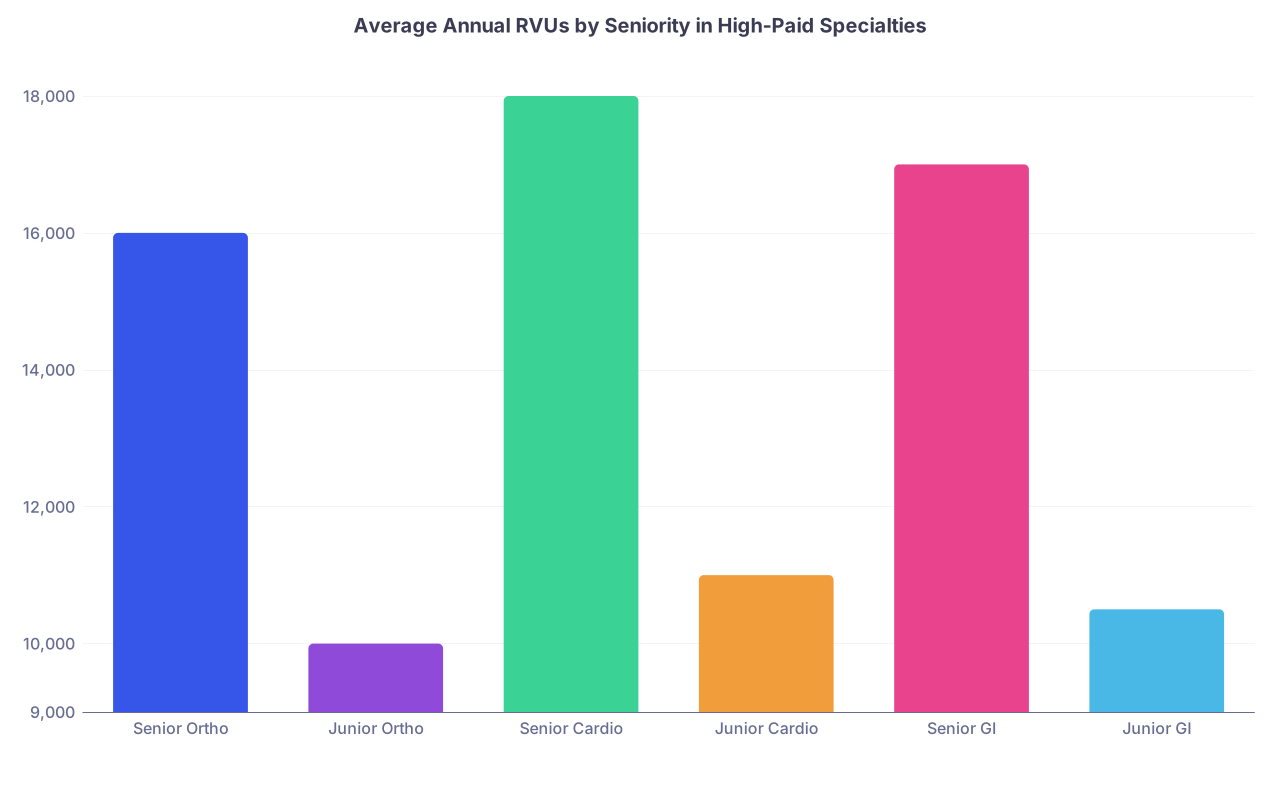
| Category | Value |
|---|---|
| Senior Ortho | 16000 |
| Junior Ortho | 10000 |
| Senior Cardio | 18000 |
| Junior Cardio | 11000 |
| Senior GI | 17000 |
| Junior GI | 10500 |
Orthopedic surgery
Classic games:
- Senior joints/spine surgeons hog big commercial referrals, keep primary TKA/THA and complex spine, push general trauma and revisions to juniors.
- Block time: seniors get early-morning, multiple-day blocks; juniors get half-days scattered or late starts. OR efficiency = RVU multiplier.
- Clinic: seniors have “surgical consult” clinics; juniors get mixed follow-up clinics. RVU yield per hour is night and day.
Result: senior guys clear $1–2M. Juniors scraping by at $500–700k and told “be patient.”
Cardiology
- Interventional and EP seniors maintain deep PCP and hospitalist relationships that funnel them procedures. You get chronic HF, AF follow-ups, lipid clinics.
- Cath lab: seniors get the complex interventions and CTOs, often self-referrals from their own clinic. You get diagnostics and “clean” caths.
- APP utilization: senior partners surround themselves with multiple NPs/PAs, who handle low-yield visits while all high-margin work flows to them.
You’re still “building your panel” while they’re printing RVUs on auto-pilot.
Gastroenterology
- Endoscopy block time is king. Seniors get full days at high-volume centers; you get split days or community sites with no anesthesia or poor turnover.
- They keep advanced cases (ERCP, EUS, EMR) and hottest referral sources; you drown in IBS, GERD, and constipation.
- Contracts sometimes pay the same RVU rate for clinic and endoscopy. Guess who spends more time in the procedure room and who is stuck in clinic?
Neurosurgery
- Seniors hold the keys to tumor boards, trauma leadership, spine center panels.
- Complex cranial and deformity spine stay with them; you’re stuck on bread-and-butter degenerative work and endless post-op follow-ups.
- Industry relationships (devices, navigation, robotics) tend to cluster around senior names, which reinforces their status and referral pull.
Interventional radiology
- Though IR is getting more employed, in private models: seniors grab PAD, Y-90, complex oncologic interventions. You do lines, drains, biopsies.
- They lock in referral relationships with oncologists, vascular surgeons, hospitalists who send them the lucrative stuff.
- They often control the lab schedule and can edge you into leftover time slots unsuitable for big cases.
How they protect their income against you specifically
This part is less talked about, but you’ll feel it the second you get close to their numbers.
Here’s the uncomfortable truth: once you start becoming truly productive, you’re not just a colleague. You’re competition.
So senior partners do three things:
1. They limit your brand
You will hear comments like:
- “Let’s not market individuals; we market the group.”
- “We don’t want patients choosing doctors; they should trust the practice.”
- “No one gets their own separate website or social media presence.”
That “we’re all equal” talk sounds noble. What’s really going on: seniors already have name recognition from years in the community. They don’t want you building a personal brand that could siphon off their referrals.
I’ve seen junior cardiac surgeons scolded for trying to speak directly to PCP groups or build social media presence. “It undermines the team.” Translation: “You’re poaching.”
2. They use “mentorship” as a control mechanism
There’s real mentorship. And then there’s the version where:
- Seniors “help you” by deciding which cases are “appropriate for your level”
- They “advise” referrers about which cases should go to them instead of you
- They discourage you from pursuing subspecialty niches that overlap theirs
You start talking about building a sports or complex spine niche? Suddenly there’s concern that “we don’t have enough volume to support two people doing that.” Funny, because there’s plenty of volume. Just not enough they’re willing to share.
3. They gatekeep opportunities that change your trajectory
Board positions. Hospital committees. National meeting talks. Industry connections. These are doorways into bigger referral bases and higher-paying opportunities.
Seniors quietly block you by:
- Keeping key roles “in the family” (the old boys’ club plus their chosen protégés)
- Letting you do grunt work for projects but taking the visible credit
- Suppressing your name when hospital admin asks, “Who should lead this?”
You remain “the workhorse.” They stay “the face of the program.”
What you can actually do about it (without getting crushed)
You’re not going to walk into a partner meeting as a PGY-5 or first-year attending and blow this all up. You’d get vaporized. But you are not powerless.
1. During recruitment: stop being blinded by headline income
When you see a job offer in a high-paying specialty, ignore the top-line “$900k–$1.2M potential income.”
Ask about structure. Specifically. And do not accept vague answers.
At a minimum, you want clear responses to:
- How are new patients assigned? New consults? Is there a written policy?
- Who controls scheduling templates? Who can change them?
- Will I get my own block time? When? What happens if OR/cath/endo capacity is tight?
- What was the actual wRVU and take-home range for the last three docs who joined?
If the answer is a hand-wave and “Everyone does fine here, we’re busy,” that’s senior partners telling you: “Trust us, we stay rich.”

| Step | Description |
|---|---|
| Step 1 | Job Offer |
| Step 2 | High Risk - Seniors Control |
| Step 3 | Medium Risk - Negotiate |
| Step 4 | Lower Risk - Consider Offer |
| Step 5 | Clear RVU data? |
| Step 6 | Transparent referral rules? |
| Step 7 | Block time secured? |
2. In the first 2–3 years: build your own independent referral spine
You will not break their system, but you can leak around the edges.
Things I’ve seen work:
- Direct, high-touch service to referrers the group has neglected: community clinics, rural PCPs, urgent cares. Seniors ignore them; you show up, give your cell, turn consults around fast.
- Find niche needs the seniors don’t want: second opinions on complex cases, tough revision work, call back-up, new procedures they aren’t willing to learn. Make yourself indispensable in those gaps.
- Be physically present where the referrals are: tumor boards, rounds with hospitalists, ED huddles. Seniors are tired and stop showing up. You show up, and people remember.
You’re not going to steal their 20-year relationships. But you can build new ones.
3. Learn the RVU and scheduling math better than they do
Do not be the naïve doc who has no clue which of their activities actually generate income. In high-paid specialties, that ignorance is punished.
Sit with billing and coding. Ask them plainly:
- Which codes drive most revenue?
- Which visit types and procedures have the best RVUs per hour in our system?
- Where in our workflow are RVUs being lost – undercoding, missing charges, poor documentation?
Then adjust your own practice:
- Minimize dead time in clinic with smart scheduling.
- Identify which kinds of visits you can safely move to APPs.
- Optimize your documentation so you’re not leaving legitimate RVUs on the table.
You’re not going to catch up to the senior guy with a 10-year referral head start. But you can close the gap faster than they expect if you stop playing blindfolded.
4. Watch the politics and pick your battles
Last piece of insider advice: don’t start a holy war your first year.
You will see unfairness. Cherry-picking. “Coincidences” that always benefit the same three names. If you confront it head-on, publicly, with no leverage, they will label you “not a team player” and you will be done.
Instead:
- Document. Quietly track your referrals, case mix, RVUs per clinic/OR hour.
- Learn who in the group is actually fair and who is just smiling while they feed you scraps.
- Once you have some numbers and goodwill in the bank, then raise specific issues: “My clinic templates are 80% follow-ups while Dr. Senior’s are 70% new patients. Can we rebalance that?”
You’ll see quickly whether there’s any real interest in fairness or if the system is fully locked.
The short version
If you’ve read this far, you already get it, but let me distill it.
- In the highest-paid specialties, senior partners protect their income by controlling referrals, scheduling, and ancillaries, then wrapping it all in “fair” RVU-based comp plans they wrote for themselves.
- The games are subtle: steering hot referrals, cherry-picking emergent cases, structuring clinic and block time to maximize their RVUs per hour while you mop up low-yield work.
- Your only real defenses are choosing your first job wisely, demanding clarity about how referrals and RVUs are actually distributed, and quietly building your own referral spine and RVU literacy from day one.
The system isn’t fair. But it’s not random. Once you see the levers, you can stop being surprised by where the money goes—and start positioning yourself to take more of it.