

You are three years into a “moderate” paying specialty. Think hospitalist, general neurology, rheumatology, GI in a saturated market, non-interventional cards, outpatient psych in an RVU factory, academic anything. You are working 50–60 hours a week, your W2 says $240–320k, and somehow the math does not add up.
Loans still there. Daycare crushing you. Retirement basically a rumor.
Meanwhile you keep hearing about the orthopod down the hall clearing $800k, the derm group partner taking home seven figures, the anesthesiologist who “just does some side stuff” and bought a second house in cash.
Here is the hard truth: your base specialty might never pay like ortho or neurosurg.
Here is the better truth: with a disciplined, structured side‑gig plan, you can absolutely move your total comp into that range over a few years.
Not by “manifesting.” By work. But work that is:
- leveraged
- repeatable
- not dependent on your primary employer
Let me walk you through how to turn a mid‑tier specialty into a high‑earning career without burning yourself out in two years.
Step 1: Get Clear on the Math (What “High Earner” Actually Means)
Before you start chasing every shiny side gig, you need targets. Otherwise you just stack extra work and wonder why nothing feels different.
Define your current reality
Take one evening, no phone, and pull the numbers:
- Base salary or guaranteed comp
- Average bonus for the last 2–3 years (if any)
- Total hours per week (clinical + admin)
- Number of weeks you actually work (account for vacation/CME)
Now calculate:
- Effective hourly rate = total pre‑tax comp ÷ (hours per week × weeks per year)
I routinely see:
- Hospitalist: $260k on 15 shifts/month → effective ~$125–150/hr
- Outpatient IM/Neuro/Psych: $230–280k on 50–55 hr weeks → often under $100/hr
- Academic medicine: $190–230k on 60+ hr weeks → $70–90/hr
You cannot fix what you don’t quantify.
Define “high earner” in concrete dollars
For most physicians in moderate‑pay specialties, moving into “high earner” territory means:
Target annual compensation (total, not just W2 from the main job):
- Aggressive but realistic target: $500–700k within 3–7 years
- Ultra high earner target: $800k+ if you are willing to aggressively build and scale
Target effective hourly rate:
At least 1.5–2x your current rate over the entire portfolio of work.
Now you know the gap:
Example:
- Current: $280k, ~55 hours/week, 48 weeks → ~2,640 hours/year
→ Effective rate ≈ $106/hr - Goal: $600k with no more than 60 hours/week
→ 60 × 48 = 2,880 hours/year
→ Needed blended rate ≈ $208/hr
You do not get there with another hospital committee and some “productivity bump.” You get there by bolting on higher‑margin work.
Step 2: Know Which Side Gigs Actually Move the Needle
Most of the random ideas you hear on physician Facebook groups are noise. Surveys. Novelty apps. $200 honoraria for “advisory panels” that consume an entire evening. This is hobby money.
If your goal is serious income, you want side gigs that:
- Pay at least 1.5–3x your base hourly rate, or
- Scale beyond your direct hours (equity, ownership, royalties, or hiring others), or
- Build an asset (reputation, IP, business) that compounds.
Here is a quick tiering of common physician side gigs by income potential:
| Tier | Side Gig Type | Typical Potential Range |
|---|---|---|
| 1 | Locums / per diem | $30k–$200k+/year |
| 1 | Telemedicine | $20k–$200k+/year |
| 1 | Real estate (active) | $20k–$500k+/year |
| 2 | Expert witness work | $20k–$150k/year |
| 2 | Niche consulting | $20k–$250k/year |
| 2 | Private practice add-on | $50k–$300k/year |
| 3 | Content / education | $5k–$100k/year |
| 3 | Surveys / honoraria | <$10k/year |
You can mix these, but if your calendar is already stuffed, you start with Tier 1 and surgical Tier 2.
Step 3: Protect Time and Energy First (Or You Will Flame Out)
The dumbest move I see: someone already working 55 hours/week adds three unstructured side gigs and then asks why they are miserable.
You fix this upfront with clear constraints:
Set a maximum weekly work cap.
For most, 60 hours/week is the upper limit if you want this to be sustainable. Less if you have young kids or other obligations.Block designated side‑gig time.
Two options that generally work:- 1–2 evenings per week (e.g., Tue/Thu 6–10 pm)
- 1 full weekend day every other week
Create a non‑negotiable recovery window.
At least 1 full day per week with zero work. Not “answer a few messages.” Zero.
Then you choose side gigs that fit inside those boxes. If a gig blows through your caps repeatedly, you either raise the rate or cut it.
Step 4: High-Leverage Side Gig #1 – Locums and Per Diem
This is the blunt instrument. It is not creative. It is not glamorous. It works.
You are in a moderate pay specialty. Somewhere out there, your exact skill set is under‑supplied and worth 1.5–2.5x what you are being paid now.
How to do this correctly
Define your rate floor.
As a rough starting point:- Take your effective hourly rate.
- Multiply by 1.5–2.
That is your minimum acceptable locums hourly.
If you are a hospitalist making ~$120/hr equivalent, you should not touch locums under $180/hr. I have seen hospitalists easily getting $200–260/hr in the right markets.
Work with multiple agencies and direct contracts.
Agencies will anchor you low. You:- Register with 2–3 agencies.
- Tell each your minimum rate and be willing to walk.
- Ask bluntly, “Where are the consistently understaffed sites that pay at or above X?”
Target short, intense bursts – not chronic extra shifts.
Better model:- 7–10 days straight of high‑rate work a few times a year
instead of - Dribbling in one extra poorly paid shift every other weekend.
- 7–10 days straight of high‑rate work a few times a year
4. Use locums to change your overall hourly mix.
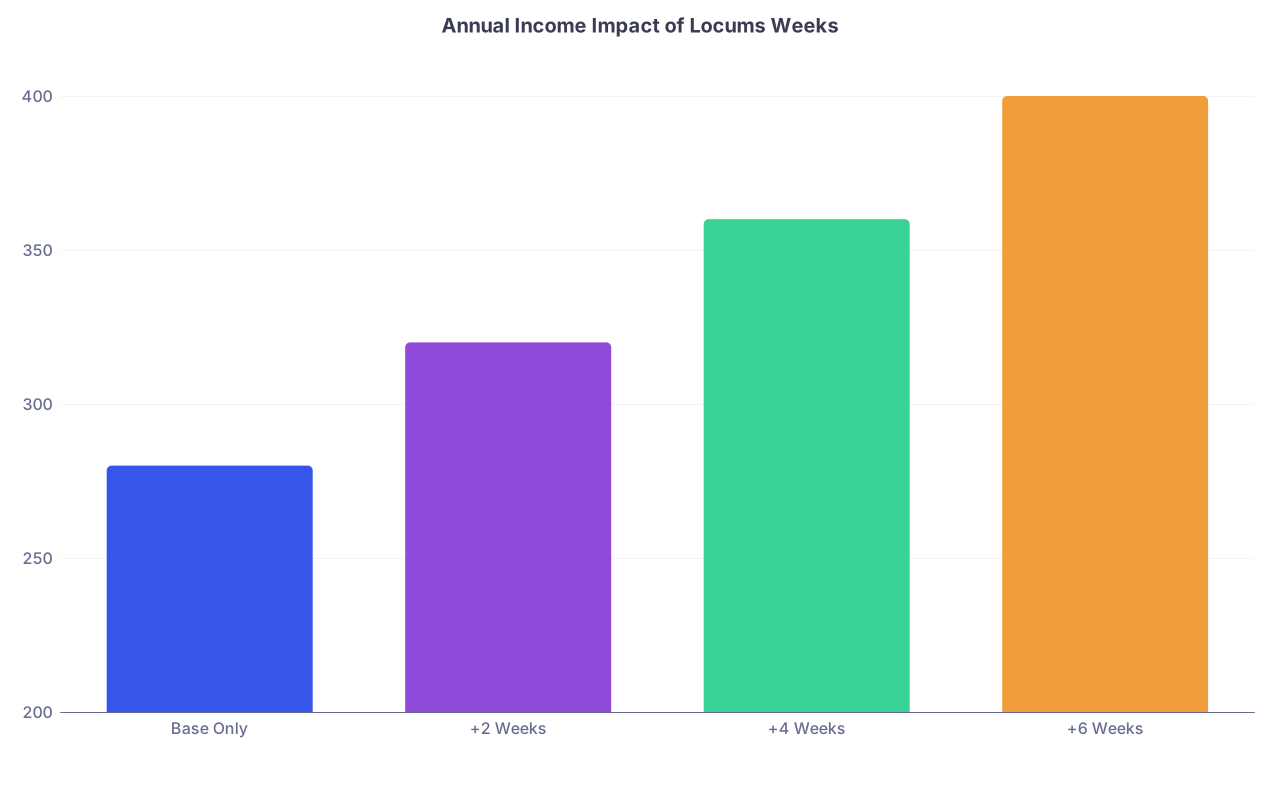
Example:
- Base job: 48 weeks/year, 50 hours/week → 2,400 hours
- Add: 4 weeks of locums at 50 hours/week → 200 hours
If:
- Base effective rate: $110/hr → $264k
- Locums rate: $220/hr → $44k for those 200 hours
You just added $44k. But that is the beginner version.
Ramp this to:
- 6 weeks/year of locums
- Slightly higher negotiated rate
Now you are potentially adding $70–120k on top of your “moderate” salary, without side businesses, without extra training.
| Category | Value |
|---|---|
| Base Only | 280 |
| +2 Weeks | 320 |
| +4 Weeks | 360 |
| +6 Weeks | 400 |
(Numbers above in thousands; assume $110/hr base, $220/hr locums.)
If you are in a clinic‑based specialty, the locums may be inpatient consults, rural coverage, or niche clinics. They still exist. You just have to be picky and patient.
Step 5: High-Leverage Side Gig #2 – Telemedicine as a Volume Engine
Telemed is where many moderate‑pay specialists quietly double their income.
This is most dramatic for:
- Psych
- Primary care / urgent care
- Endocrine
- Sleep
- Rheum (depending on state regs and payer mix)
How to do telemedicine the smart way
Pick platforms or build your own.
There are three telemed models:
Platform W2/1099 (e.g., Amwell, Teladoc, various startup platforms)
- Pros: no overhead, easy onboarding
- Cons: rates vary widely, you are a cog
Local/regional telehealth contractor
- Often pay better than big national brands
Your own telehealth practice
- Highest ceiling, more hassle, but real business asset
Know your target hourly yield.
You should be aiming for:
- $150–300/hr equivalent for most moderate specialties
- Possibly higher if you do cash‑pay niche (e.g., ADHD in adults, weight loss, HRT)
Use telemed to monetize off‑hours.
Peak windows that work:
- Early mornings (6–8 am)
- Evenings (6–10 pm)
- Weekend half‑days
You can stack 2–3 of these windows per week and generate a surprising amount of income.
Example scenarios (conservative):
Psych:
- 2 evenings + 1 Saturday half‑day/week
- 10–12 patient visits per block at $120 net per visit (after platform cut)
- ~$3,600–4,300/week → ~$150–220k/year
Primary care / urgent care telemed:
- 2 evenings/week
- 8–10 visits per session at $60–90 net per visit
- ~$1,000–1,800/week → $50–90k/year
If you build your own telemed micro‑practice (especially cash pay), these numbers go up. Way up.
Step 6: High-Leverage Side Gig #3 – Expert Witness and Niche Consulting
Most physicians underestimate what their expertise is worth outside the exam room.
Expert witness work
This is not just for surgeons. I have seen:
- Hospitalists testifying on standard of care for sepsis, discharge practices, documentation
- Psychiatrists on capacity, involuntary holds, med side effects
- Neurologists on stroke timing, MS misdiagnosis, seizure management
- IM/Peds on basic inpatient care, failure to diagnose, etc.
Typical rates:
- $300–600/hr for chart review and prep
- $400–800/hr for depo/trial
- Daily minimums are common
You do not need dozens of cases to move the needle. A handful of well‑structured cases per year can easily add $30–100k.
How to get started:
- Create a simple one‑page CV tailored to medico‑legal work
- Register with 1–2 expert witness referral services
- Reach out to local med‑mal firms with a concise email: who you are, what you do, any admin roles or teaching titles
- Be explicit about your hourly rates and minimums
Industry consulting
Think:
- Advisory boards for pharma/med device
- Clinical content review for digital health firms
- Product development consultation
You are aiming for:
- $300–500/hr
- Clear deliverables
- No “we will pay with equity later” nonsense as your core compensation
You might not hit $200k/year with this alone, but as a layered side gig alongside locums or telemed, it adds meaningful, intellectually different income.
Step 7: Medium-Leverage – Private Practice Add‑On or Micro‑Clinic
This is where many moderate pay specialties unlock serious upside.
You do not need to quit your job and open a 5‑physician group with a 10‑year lease. You can:
- Start a microsite: half‑day clinic once a week in a subleased space
- Focus on high‑value niches that your employed job cannot or will not support
For example:
- Neurology: headache clinic, migraine infusions, EMG/NCS with efficient throughput
- Psych: cash‑pay ADHD, OCD, trauma therapy with integrated med management
- IM/FP: concierge or direct primary care for a small panel
- Rheum: infusion‑focused model with tight operations
You are looking for:
- High revenue per visit/hour
- Control over payer mix and pricing
- Potential to hire extenders later
This takes setup. Credentialing, legal structure, malpractice, billing. But once it is running, it becomes an asset separate from your W2.
I have seen:
- Part‑time private psych practices gross $400–500k on 20–25 hours/week
- Sleep specialists with home‑sleep testing and CPAP management generating sizable side revenue
- Rheumatologists with in‑office infusion suites making 2–3x what their base salary alone would be
The key is to start small and focused, then scale only the profitable parts.
Step 8: Real Estate – The Non‑Clinical Multiplier
Yes, everyone talks about real estate. Yes, much of the hype is garbage.
But: if you want to break out of salary ceilings, owning assets that throw off cash and appreciate is one of the most reliable routes.
Two viable approaches for busy physicians:
Simple, high‑quality rentals
- 1–2 small multifamily or single‑family homes in solid markets
- Professional management
- Moderate leverage, positive cash flow from day one
Participating in physician‑vetted syndications
- Money only, no active work
- You are trading time for lower control and moderate returns
Do not expect real estate alone to turn you into a millionaire overnight. Expect:
- Early years: tax benefits + modest cash flow
- Later years: serious net worth from equity buildup and appreciation
The real value for this discussion: it is one of the few side “gigs” that eventually pays you while you are not working more hours.
Step 9: Systematize – Turn Random Gigs Into a Strategy
If you stop at “do some locums, see some telemed patients, maybe a few consults,” you will top out. You will hit a ceiling around $400–500k and feel maxed out.
To get beyond that and still have a life, you need a simple system.
1. Build a personal “income stack”
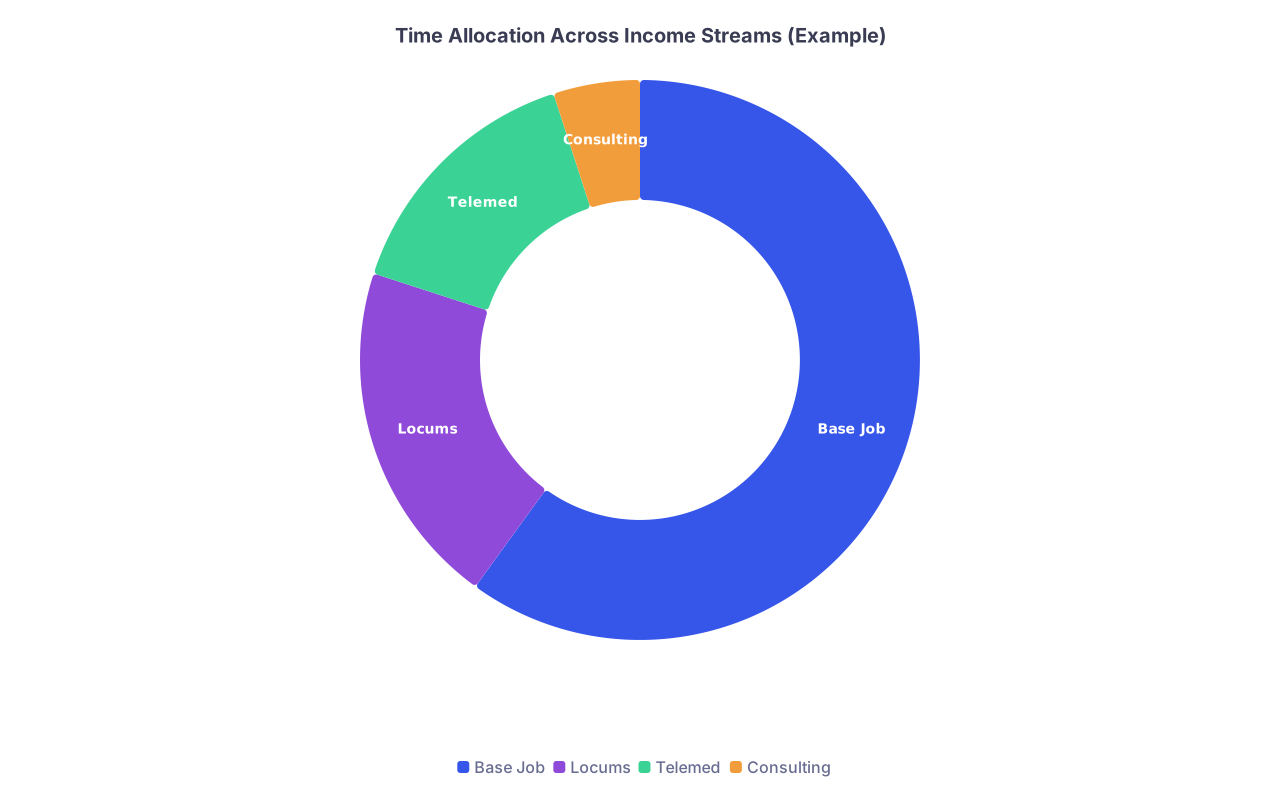
You want 2–4 layers that complement each other. Example:
Layer 1 – Base job
Layer 2 – High‑pay, time‑bound work (locums blocks)
Layer 3 – Structured telemed windows each week
Layer 4 – 1–2 expert witness cases per quarter
Layer 5 – Long‑term asset building (real estate or micro‑practice)
That is a high‑earner stack for a general neurologist, psychiatrist, hospitalist, or primary care doc.
2. Design your weekly rhythm
Use a simple planning model:
- Core clinical days (employed) – guarded, predictable
- Side gig blocks – fixed, recurring
- Deep work blocks – for legal reviews, consulting, admin
- Recovery blocks – no work, true rest

| Step | Description |
|---|---|
| Step 1 | Mon - Base Job |
| Step 2 | Tue - Base + Evening Telemed |
| Step 3 | Wed - Base Job |
| Step 4 | Thu - Base + Admin Evening |
| Step 5 | Fri - Base Job |
| Step 6 | Sat - Side Gig Block |
| Step 7 | Sun - Recovery Day |
You do not “fit things in.” You assign them.
3. Quarterly review
Every 3 months, sit down and ask:
- Which side gig paid the most per hour?
- Which drained me the most?
- Which has upside I am not exploiting?
- What can I cut ruthlessly?
Then you:
- Raise rates where justified
- Drop low‑yield work
- Add one experiment if you have capacity
Step 10: Common Traps to Avoid
You can absolutely screw this up. I have seen it.
Watch for these traps:
Low‑pay, high‑friction gigs
- “Advisory” roles paying $150/hr with 90‑minute Zooms and constant emails
- Telemed platforms that pay <$70/hr when you do the math properly
- Surveys and panels as anything more than pocket change
Overcommitting early
- You do not start with 3 new side gigs at once.
- You start with one, stabilize it, then add another.
Lifestyle creep
- If your income goes from $280k to $480k and your spending rises to match, you have changed nothing except your stress level.
Tax and entity chaos
- Once you cross ~$20–30k/year in 1099 income, talk to a real CPA.
- You likely need an LLC taxed as S‑corp or at least a clean Schedule C structure.
- Do not mingle business and personal accounts.
Employer conflicts
- Read your contract. Carefully.
- Look for non‑compete language, outside clinical work restrictions, IP rules.
- When in doubt, get a contract lawyer to review. $300 now beats a lawsuit later.
Putting It All Together: A Concrete Example
Let me make this painfully specific.
You are:
- Outpatient psychiatrist
- Employed at a large system
- Salary: $260k
- Work: 45–50 hr/week, 46 weeks/year
You decide “I want to be at $600k within 5 years without working 80 hours/week.”
Year 1–2:
- Add 1 telemed platform: two evenings/week, one Saturday half‑day/month
- Net ~$80k/year
- Take 1–2 simple expert witness cases: brief chart review and a depo
- Net ~$20–30k/year
Total: $260k + $80k + $25k = ~$365k
You are still around 55 hr/week. Manageable.
Year 2–3:
- Negotiate down clinic days slightly (if possible) or maintain while optimizing efficiency.
- Transition some telemed volume into your own small, cash‑pay telepsych practice two evenings/week.
- Now those two evenings net $120–150k/year.
- Add 2–3 expert witness cases/year.
- Another $40–60k.
Total:
- Base: $260k
- Telemed/cash: $140k
- Legal: $50k
= $450k
Year 3–5:
- Build the practice: hire a part‑time therapist or NP, take a small office or fully virtual.
- Practice gross climbs to $300–350k; your net after help, rent, software maybe $200–230k.
- Modest increase in expert work as your name spreads: $70–100k/year.
- Keep base job or switch to 0.8 FTE if finances and benefits allow.
Total could look like:
- Base job (0.8 FTE or full): $200–260k
- Practice net: $200–230k
- Expert work: $80k
Now you are at: $480–570k. In psych. Without 70‑hour weeks.
Scale a similar path for neurology (headache or sleep focus + telemed + legal), hospitalist medicine (locums + consults + real estate), rheum (infusions + consulting), etc.
The exact numbers will vary. The structure does not.
Tools You Should Actually Use
Two quick categories that make this simpler:
Organization and scheduling
- Google Calendar or Outlook with:
- Color‑coded blocks (base vs telemed vs locums vs admin vs recovery)
- A simple spreadsheet with:
- Hours worked per gig
- Invoiced vs paid
- Effective hourly rate

Legal/financial infrastructure
- Business checking account (separate from personal)
- Accounting software or at least a clean Excel template
- CPA who understands small professional practices and 1099 income
- Malpractice coverage checklist:
- Does your primary policy cover outside work?
- Do you need separate tail or entity coverage?
When You Should Not Add Side Gigs (Yet)
There are seasons where your best move is not to add income. It is to fix the foundation.
Hit pause if:
- You are in serious burnout already (dread, cynicism, errors, or health issues)
- Your home life is barely holding together
- You have no basic handle on your financial picture (zero budget, unknown debt totals)
In those cases, the playbook is:
- Stabilize hours or change your base job to something less toxic.
- Clean up your financial baseline (understand fixed expenses, loans, etc.).
- Then add one tightly defined, high‑yield side gig and see how your life responds.
Quick Snapshot: Side Gig Mix by Specialty
Just to spark ideas:
| Specialty | Primary High-Yield Gig | Secondary Gig | Long-Term Play |
|---|---|---|---|
| Hospitalist | Locums blocks | Expert witness | Rentals or micro-IM |
| Neurology | Tele-neuro / call | Headache clinic | Sleep practice |
| Rheumatology | Infusion-focused locums | Industry consulting | Infusion suite stake |
| Psychiatry | Telepsych / cash | Expert witness | Group practice |
| Primary Care | Tele-urgent / DPC | Occupational medicine | Concierge micro-clinic |
| Category | Value |
|---|---|
| Base Job | 60 |
| Locums | 20 |
| Telemed | 15 |
| Consulting | 5 |
Final Check: Are You Actually Becoming a High Earner?
Every 6–12 months, answer three questions:
- Has my total compensation moved at least 20–30 percent since last year?
- Has my effective hourly rate across all work meaningfully increased?
- Do I still have at least one protected day off per week and basic life stability?
If you are adding income but your effective hourly rate is stagnant and your life is a mess, you are not a high earner. You are just an overworked one.
Key Takeaways
- Your “moderate” specialty is not the ceiling. The way you structure your time and gigs is.
- Stack high‑yield, controlled side work (locums, telemed, expert witness, micro‑practice) into a deliberate weekly and yearly plan, not random extra shifts.
- Protect your time, negotiate hard, and regularly prune low‑yield gigs so your blended hourly rate and total income both rise without your life falling apart.


