
The myth that “doctors in high-paying specialties automatically make more” is incomplete. The data shows something quieter but more powerful: in procedure-based fields, income tracks case volume at least as strongly as it tracks specialty choice.
If you ignore volume, you will misread the financial landscape of surgery, interventional radiology, GI, cardiology, anesthesia, and similar fields. Two physicians in the same specialty, same city, same group can differ by several hundred thousand dollars a year. The main predictor is not “talent” or “prestige.” It is how many billable procedures they push through the system, and what kind of procedures those are.
Let me walk through the numbers.
1. The basic equation: RVUs, volume, and payer mix
Strip away the romance. In procedure-heavy fields, compensation is fundamentally an output of three levers:
- Work RVUs per case (complexity / intensity)
- Number of cases (volume)
- Dollars paid per RVU (payer mix, contracts, geography)
Compensation ≈ (wRVUs per case × cases per year) × ($ per RVU) + non-RVU extras
For most hospital-employed proceduralists, the core is a wRVU-based model. You hit a base salary at some threshold (say 7,000–9,000 wRVUs), then earn a per-RVU bonus above that.
The volume lever is the most behaviorally controllable. You cannot personally change Medicare rates or the macroeconomic environment. You can, however, adjust how efficiently you turn OR or lab time into wRVUs.
To make this concrete, look at an illustrative comparison across a few high-paying specialties.
| Specialty | Typical Annual wRVUs | Common Income Range ($) |
|---|---|---|
| Orthopedic Surgery | 9,000–13,000 | 600,000–900,000 |
| Interventional Cardiology | 11,000–16,000 | 650,000–900,000+ |
| Gastroenterology (procedural) | 8,000–12,000 | 550,000–800,000 |
| Interventional Radiology | 8,000–12,000 | 550,000–800,000 |
| General Surgery | 7,000–11,000 | 450,000–700,000 |
These are broad strokes, but the pattern is obvious: as wRVUs climb, compensation follows almost linearly within each specialty, controlling for geography and payer mix.
Now, zoom in a bit on how volume translates to dollars.
2. Microeconomics of a single procedure
Every procedure-based field has a “bread and butter” case that drives most of the revenue. For ortho joints, it might be total knees/hips. For GI, colonoscopy + EGD. For interventional cardiology, diagnostic cath + PCI. For anesthesia, ASA 2–3 bread-and-butter cases, unevenly distributed across sites.
You can model income impact with simple math.
Take a conservative outpatient GI example (numbers rounded for clarity):
- Screening colonoscopy:
- wRVUs: ~3.4–3.6 (depends on coding, biopsy, polypectomy)
- Effective $ per wRVU: say $50 (blend of Medicare + commercial)
- Revenue per case: 3.5 × $50 ≈ $175 to the physician pool (this is physician comp basis, not facility fee)
If a GI attending adds:
- 2 extra colonoscopies per day
- 4 days/week of procedures
- 48 working weeks/year
Additional annual cases: 2 × 4 × 48 = 384 cases
Incremental wRVUs: 384 × 3.5 ≈ 1,344
Incremental income at $50/RVU: 1,344 × $50 ≈ $67,200
That is one modest efficiency gain – two extra cases per day – yielding ~ $60–70k per year in many comp models.
Now extrapolate this across multiple years and procedures or switch to a higher-RVU case mix, and you see why “busy” proceduralists routinely break the 75th or 90th income percentile.
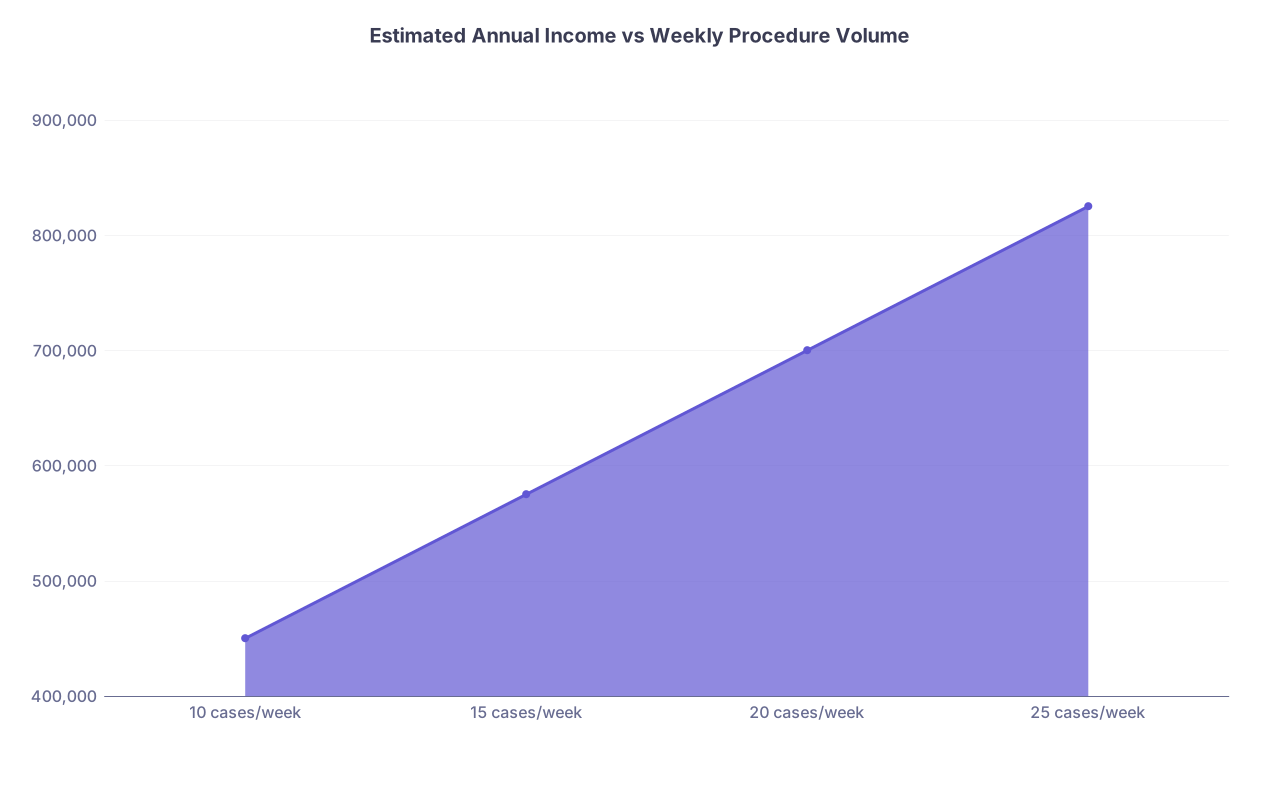
Here’s a simple visualization of how annual income can move with modest changes in weekly case volume for a mid-RVU procedure (e.g., arthroscopy, EP ablations scaled down, complex endoscopy):
| Category | Value |
|---|---|
| 10 cases/week | 450000 |
| 15 cases/week | 575000 |
| 20 cases/week | 700000 |
| 25 cases/week | 825000 |
The numbers will differ per field, but the slope is the story. More cases, more income, fairly predictably.
3. High volume vs high complexity: which pays more?
A frequent misconception among residents is that the highest-paying physicians must be doing the “fanciest” cases. The data and real compensation experiences say otherwise.
There are essentially two volume strategies:
- High-volume, moderate-complexity cases
- Lower volume, high-complexity, high-RVU cases
Most of the top earners blend both, but different fields lean one way or the other.
Case study: orthopedic surgery
Orthopedic RVUs (approximate):
- Total knee arthroplasty: ~20–22 wRVUs
- Total hip arthroplasty: ~20–22 wRVUs
- Arthroscopic rotator cuff repair: ~15–17 wRVUs
- Simple carpal tunnel release: ~7–8 wRVUs
Now do the math for a joint replacement-focused ortho attending:
Assume:
- 6 primary joints per week (3 hips, 3 knees)
- 48 weeks/year
- 21 wRVUs per case
- Effective $55/RVU
Annual joint RVUs: 6 × 48 × 21 = 6,048
Income from joints alone: 6,048 × $55 ≈ $332,640
Add:
- 5 smaller cases/week averaging 10 wRVUs each
- 48 weeks/year
Annual small-case RVUs: 5 × 48 × 10 = 2,400
Income from small cases: 2,400 × $55 = $132,000
Combined: 8,448 wRVUs → ~$464,640 from professional fees, before any call stipends, bonuses, or ancillary ownership. Bump the case numbers modestly and you are well into the $600k–$800k range under typical private-practice formulas.
What actually drives the income here? Not a handful of exotic revisions. It is a predictable drumbeat of joints and smaller bread-and-butter cases stacked efficiently on the schedule.
Case study: interventional cardiology
Interventional cardiology looks different but follows the same logic.
Rough numbers:
- Diagnostic left heart cath: ~7–8 wRVUs
- PCI (stent): ~12–14 wRVUs added
- Complex PCI or multi-vessel: more, but not double
If an interventional cardiologist performs:
- 10 diagnostic caths/week at 8 wRVUs
- 8 PCIs/week at 13 wRVUs
- 48 weeks/year
- $50/RVU effective rate
Annual cath RVUs: 10 × 48 × 8 = 3,840
Annual PCI RVUs: 8 × 48 × 13 = 4,992
Total: 8,832 wRVUs → 8,832 × $50 ≈ $441,600 in wRVU-based compensation
A busier operator doing 15 caths + 10 PCIs weekly jumps into the 12,000+ wRVU territory. The slope of income with respect to volume is steep.
You see the same pattern in EP (ablations, device implants), IR (vascular interventions, embolizations, drainage), and anesthesia (ASA modifiers + units × volume). Higher complexity helps, but not nearly as much as consistent high case count plus efficient turnover.
4. The non-linear parts: capacity limits and bottlenecks
The relationship between volume and income is not perfectly linear. There are capacity ceilings and frictions:
- OR block time: You cannot bill cases you are not allocated time for.
- Support staff: Inefficient anesthesia, nursing turnover, or tech support will cap throughput.
- Facility politics: How cases are distributed between partners, service lines, or competing groups.
- Call burden and burnout: There is a real human limit where the marginal case is not worth the marginal fatigue.
But for most early- and mid-career attendings, the bigger issue is under-using capacity, not hitting the ceiling.
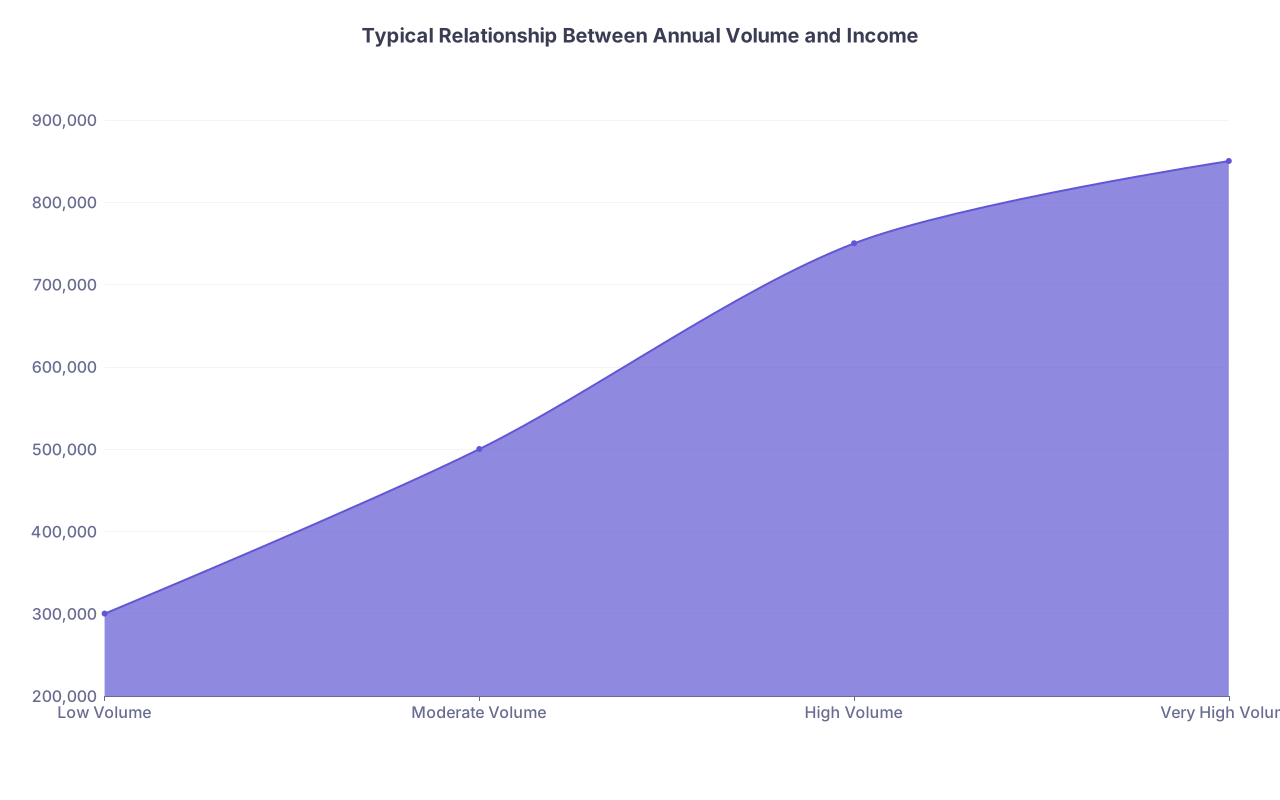
Here is the rough pattern I have seen repeatedly in data from groups across surgery, GI, and cardiology:
| Category | Value |
|---|---|
| Low Volume | 300000 |
| Moderate Volume | 500000 |
| High Volume | 750000 |
| Very High Volume | 850000 |
- Low to moderate volume: Each incremental case meaningfully increases income.
- High volume: Still strong gains, especially where bonus multipliers kick in.
- Very high volume: Marginal gains slow as you hit schedule and human limits; indirect costs (burnout, errors, turnover) creep up.
The “sweet spot” for most procedural physicians who want high income without total burnout is high but not insane volume. Enough to leverage the comp formula aggressively, not so much that every day feels like trench warfare.
5. How payer mix distorts the volume–income link
Volume is not created equal. A 20-wRVU day at a practice 90% commercial pays very differently from the same 20 wRVUs at a safety-net hospital with 80% Medicaid/uninsured.
You can approximate the multiplier like this:
- High-commercial-practice effective rate: maybe $55–$70 per RVU
- Medicare-heavy: $42–$50 per RVU
- Medicaid-heavy: $30–$40 per RVU or worse
Same RVUs, wildly different dollars.
| Category | Value |
|---|---|
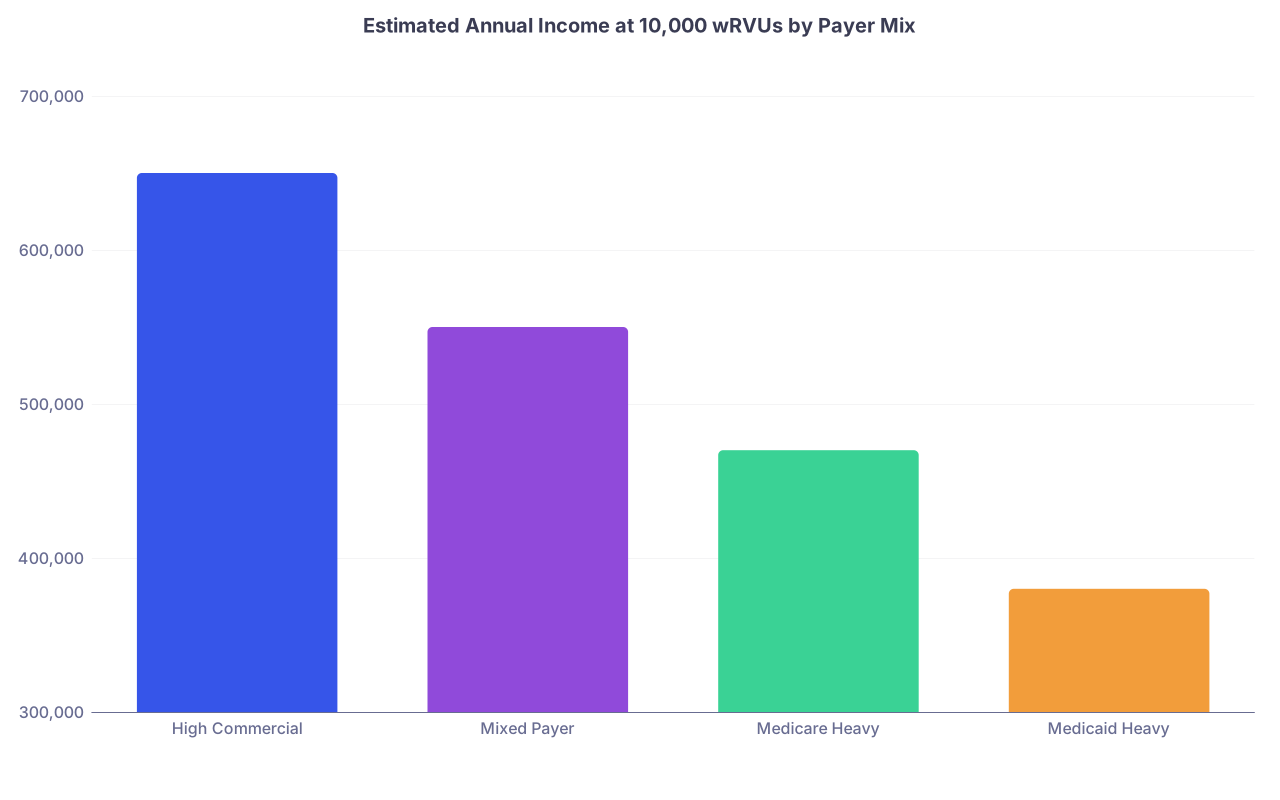
| High Commercial | 650000 |
| Mixed Payer | 550000 |
| Medicare Heavy | 470000 |
| Medicaid Heavy | 380000 |
Given 10,000 wRVUs:
- High commercial mix: 10,000 × $65 ≈ $650,000
- Mixed: 10,000 × $55 ≈ $550,000
- Medicare heavy: 10,000 × $47 ≈ $470,000
- Medicaid heavy: 10,000 × $38 ≈ $380,000
So two surgeons doing exactly the same number and type of cases can differ by $200–$250k/year based solely on payer environment.
This is why you will see:
- A busy community ortho in a high-income suburb clearing more income than an academic neurosurgeon with “prestige” but lower payer mix and fewer RVUs.
- GI docs in ASC-heavy, commercially insured markets breaking $1M+, while equally skilled counterparts in safety-net systems cap out near half that.
Volume still correlates strongly with income. But the slope of that correlation depends heavily on payer mix and setting.
6. Academic vs private: the same volume, different outcomes
Residents consistently underestimate how much practice setting reshapes the volume–income relationship. Two broad patterns:
-
- Volume per attending often lower (shared with fellows, more complex scheduling, more nonclinical time).
- $ per RVU sometimes modestly lower.
- Income capped but more stable; heavy emphasis on teaching, research, prestige.
Private practice / private-equity-backed / high-throughput groups:
- Higher volume pressure and higher throughput infrastructure.
- Often higher $ per RVU (negotiated commercial contracts, ASC ownership, productivity-heavy comp).
- Stronger income gradient with volume.
To illustrate, here is a stylized comparison for a high-volume GI doc:
| Setting | Annual wRVUs | $ per RVU (effective) | Estimated Income ($) |
|---|---|---|---|
| Academic GI | 8,000 | 45 | 360,000 |
| Private GI (mixed) | 10,000 | 55 | 550,000 |
| Private GI (ASC-heavy) | 12,000 | 65 | 780,000 |
Now notice: the highest earner is not just doing more cases. They are also in a setting where each RVU is monetized more aggressively (ASC technical fees, better payer mix, fewer uncompensated teaching hours).
The volume–income correlation is steeper in private and ASC-centric models than in academic centers. Same specialty, totally different financial gradient.
7. The hidden multipliers: ownership, ancillaries, and call
A naive view would stop at RVUs. Serious income analysis cannot.
High-volume proceduralists unlock multiple secondary revenue streams that piggyback off their case counts:
- ASC or imaging center ownership
- Ancillary services: PT, DME, infusion centers
- Professional vs technical fee splits
- Call stipends and trauma contracts
These often scale with volume in a superlinear way.
Example: orthopedics with ASC ownership
Imagine a joint-focused ortho surgeon:
- 6 joints/week done at a partner-owned ASC
- Facility fee margins from each case (after expenses, overhead, etc) might add another $500–$1,500 per joint to the owner distribution over time
Even conservatively:
- 6 joints/week × 48 weeks = 288 cases/year
- $800 net per case to the ownership pool → $230,400/year
That is on top of the professional fees from the same volume. So the same set of joints now contributes:
- ~$330k from professional fees (as calculated earlier)
- ~$230k from ASC distribution = ~$560k attributable to that slice of practice alone
At that point, “volume” is not only tied to direct RVU-based comp; it is an equity-like lever.
Interventional cardiology and IR have similar dynamics with OBLs (office-based labs), freestanding cath labs, or shared ownership models.

Call coverage is another multiplier. High-volume trauma surgeons or interventional cardiologists often pair larger base volumes with:
- Stipends for call
- Procedural volume created by call (nighttime STEMIs, trauma ORs, emergent scopes)
If you hate call, this is a tradeoff. But the income gradient with volume steepens significantly when a large share of high-acuity, high-RVU cases come from call.
8. How residents should interpret “highest paid specialties”
Residents hear lists like:
- Orthopedics
- Neurosurgery
- Cardiology (interventional)
- Gastroenterology
- Dermatology (procedural/cosmetic, though partly cash-pay)
- Radiology / IR
- Anesthesia (variable)
They look up median incomes and draw naive conclusions. The better mental model is this: within each of these fields, the income spread between 25th and 90th percentile is often $300–$600k. The primary drivers of where you land on that curve:
- Case volume
- Payer mix
- Practice ownership and ancillaries
- How aggressively your compensation plan rewards RVUs
A surgical subspecialist doing 7,000 wRVUs in a low-paying region might earn less than a general surgeon doing 11,000 wRVUs with great payer mix and ASC ownership.
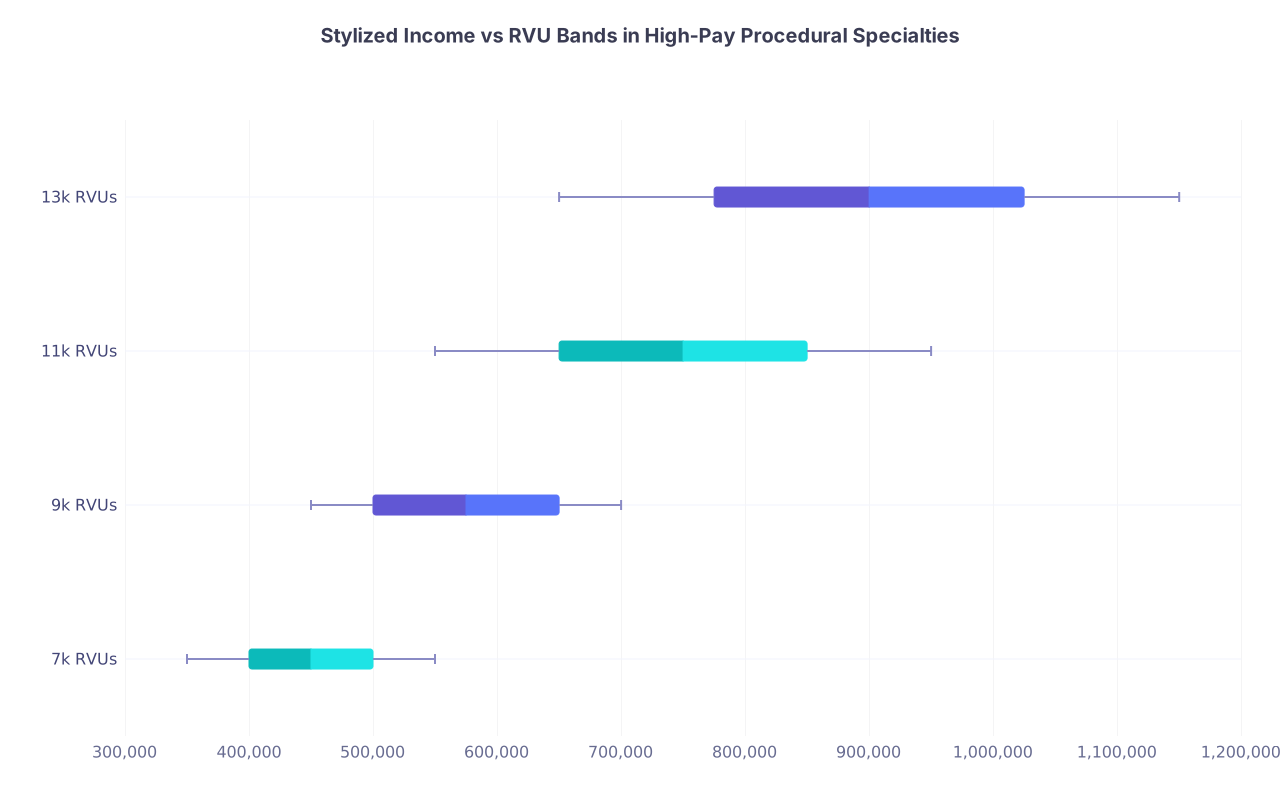
Here is a simplified view of income vs RVU bands across “highest paid” procedural specialties:
| Category | Min | Q1 | Median | Q3 | Max |
|---|---|---|---|---|---|
| 7k RVUs | 350000 | 400000 | 450000 | 500000 | 550000 |
| 9k RVUs | 450000 | 500000 | 575000 | 650000 | 700000 |
| 11k RVUs | 550000 | 650000 | 750000 | 850000 | 950000 |
| 13k RVUs | 650000 | 775000 | 900000 | 1025000 | 1150000 |
The key observation: as RVUs (a proxy for case volume) increase, the entire income distribution shifts upward. The boxes do not just widen; they move.
So if your goal is to be at the upper end of your specialty’s pay scale, the question to ask is not merely “Which specialty pays most?” but:
- How easily can I generate high case volume in this field?
- Does the typical practice pattern in that specialty allow sustained high throughput?
- What is the local infrastructure like for efficient volume?
An interventional cardiologist in a saturated, under-resourced market with poor cath lab access may earn less than a procedural GI in a strong ASC ecosystem with endless screening demand.
9. What you can actually control
You cannot control Medicare. You cannot fully control payer mix in residency. You can control where you practice, how you structure your job, and how you use your time.
From a numbers perspective, here is what matters most if you are targeting the high-income tail of procedure-based fields:
Choose a specialty where procedures are central, not marginal.
“Procedure-based” should mean a large majority of your revenue, not 10% of your work.Prioritize environments that reward productivity.
RVU-based or profit-sharing models, ASC or lab ownership opportunities, decent $/RVU.Protect access to high-volume case streams.
Adequate OR block, endo lab time, cath/EP rooms, IR suites. Good referral base. Solid scheduling and staffing.Become ruthlessly efficient, but not reckless.
Short turnovers, standardized approaches, minimal wasted motion. Case volume is often time management dressed up as productivity.Watch your ceiling.
There is a point at which more volume produces diminishing economic and personal returns. Hitting 11,000 RVUs might be smart. Pushing for 17,000 with no life outside the hospital is a different argument.

And, bluntly, you have to care. The physicians I see consistently at the 90th percentile or above treat their schedules and workflows like a business. They know their wRVU numbers. They know payer mix. They argue over block time with data, not feelings.
10. The bottom line: how case volume really correlates with income
You wanted the correlation; here it is in plain language.
Across major procedure-based fields:
- Within a given specialty and region, case volume (as measured by wRVUs) explains a large share of income variance between individual physicians.
- Doubling roughly from a “low” volume (
7,000 wRVUs) to “very high” (13,000 wRVUs) commonly increases income by 60–120%, depending on payer mix and comp model. - The correlation is moderated – but not erased – by payer mix, practice setting, and ownership of ancillaries.

If you are aiming for the highest paid specialties, you are really aiming at two overlapping targets:
- High RVU-per-case procedures
- Structures that let you perform many of them efficiently, with favorable reimbursement
Focus only on specialty labels and you miss the real drivers. Focus on the volume, the payer mix, and how compensation is structured, and you finally see the real income landscape of procedure-based medicine.
Key takeaways
- In procedure-heavy fields, individual income tracks case volume (wRVUs) strongly within each specialty; the busiest operators usually sit at the top of the pay curve.
- Payer mix, practice setting, and ownership of ancillaries bend the volume–income slope up or down, often by hundreds of thousands of dollars per year at the same case volume.
- If you want to convert “high-paying specialty” into actual high pay, you must secure both: access to high case volume and a compensation structure that rewards it.