
The question isn’t “Is a higher paying subspecialty worth it?” The real question is: How many extra years of your life are you actually willing to trade for that bump in income—and when is that trade flat‑out stupid?
Let’s answer it precisely, not with vague “follow your passion” fluff.
The Core Math: What’s an Extra Year of Training Actually Worth?
You don’t need a PhD in economics to frame this. You need three numbers:
- What would you earn as a generalist (no extra fellowship)?
- What would you earn as a subspecialist?
- How many extra years of lower income are you signing up for?
Put simply:
Break‑even years ≈ (Income lost during extra training) ÷ (Extra annual income as an attending)
Let’s walk through a clean example.
Say you’re choosing between:
- General internal medicine: ~$260k/year
- GI (2–3 year fellowship): ~$550k/year in a realistic private practice setting
Assume:
- Residency pay: ~$70k/year
- Fellowship pay: ~$75k/year
- Extra training: 3 years
Extra training cost:
- What you could be making for those 3 years as a hospitalist: 3 × $260k = $780k
- What you actually make in fellowship: 3 × $75k = $225k
- Income lost: $780k − $225k = $555k
Extra annual income as attending GI vs general IM:
- $550k − $260k = $290k/year
So:
- Break‑even time ≈ $555k ÷ $290k ≈ 1.9 years
After ~2 years as an attending GI, you’re financially “ahead” compared with the hospitalist path.
That’s how you should think about it. Not “GI pays more,” but “GI catches up by Year 2 and then laps the field.”
Now contrast that with a smaller pay bump specialty. You’ll see quickly where the math stops making sense.
Rough Benchmarks: Extra Years vs Extra Pay
Here’s the rule-of-thumb I use when med students or residents corner me in the hallway:
- +1 year of training is only worth it if you reasonably expect at least +$50k to +$75k/year sustained income bump.
- +2 years: you should be looking at +$150k/year or more.
- +3+ years: if you’re not clearing +$200k/year more than the base specialty, purely financial justification gets shaky unless lifestyle, geography, or procedure enjoyment stack heavily in its favor.
Is that aggressive? Yes. But remember: extra years are taxed in three ways:
- You’re earning less salary.
- You’re losing compound investment time.
- You’re losing non‑financial life years (kids, health, burnout risk).
So the bar shouldn’t be low.
Concrete Specialty Comparisons: Where It Usually Makes Sense
Let’s look at some real‑world patterns using ballpark US numbers (these vary by region/practice).
| Base vs Subspecialty | Extra Training | Base Pay | Subspecialty Pay | Annual Bump |
|---|---|---|---|---|
| IM → Cardiology | 3 yrs | 260k | 550k | +290k |
| IM → GI | 3 yrs | 260k | 550–600k | +290–340k |
| IM → Heme/Onc | 3 yrs | 260k | 450–500k | +190–240k |
| Peds → Peds Cardiology | 3 yrs | 230k | 350–450k | +120–220k |
| Anesthesia → Pain | 1 yr | 450k | 600–800k | +150–350k |
| EM → Critical Care | 2 yrs | 375k | 420–500k | +45–125k |
Three clear winners:
- Procedure‑heavy IM subspecialties (cards, GI, heme/onc in many markets): Big jumps, especially with RVU or partnership.
- Pain management (from anesthesia, PM&R): 1 year for a potentially huge income jump and lifestyle flexibility.
- Interventional specialties within radiology and cardiology: Often 1 extra year for mid–high six figures.
Now look where the math gets… fuzzy:
Long fellowships for modest pay bumps (many pediatric subspecialties, EM→CCM in some markets, IM→endo/rheum/allergy in certain settings).
Don’t Ignore the Time Value: Age and Career Length Matter
Same fellowship. Same numbers. Totally different answer at:
- 28 years old vs
- 37 years old with 2 kids and loans and already burned once by training.
If you’re younger and planning a 25–30+ year career, a 2–3 year delay with a large pay bump almost always wins financially. The curve has decades to compound.
If you’re:
- Switching specialties late,
- Contemplating a 2nd fellowship,
- Or already mid‑career,
Then those extra years cut deeper. You won’t have as many high‑earning years left to amortize the training cost.
Rough personal rule I tell residents:
- If you’ll finish fellowship after age ~40, the financial justification alone better be very strong (huge pay bump or massive quality-of-life upgrade). Otherwise it’s mainly a lifestyle or passion choice, not an economic one.
Lifestyle Is a Multiplier, Not a Footnote
I’ve seen people chase an extra $75k/year and wake up utterly miserable: more call, more nights, more malpractice exposure, less control. On paper, they “won.”
Here’s the part nobody quantifies but you feel hard:
- Nights and weekend calls with young kids at home.
- Procedures with high personal risk/tension.
- Clinic volumes that push you straight toward burnout.
You should ask:
- Does this subspecialty increase or decrease my control of schedule?
- What does call actually look like in my region? (Not the brochure version.)
- Can I reasonably cut back later and still earn well?
An extra $150k/year for 20 years is $3 million before tax. Huge.
But if that path also doubles your burnout risk and divorce risk, the calculation isn’t so clean.
I’d absolutely back someone choosing:
- A slightly lower paying subspecialty that gives:
- Fewer nights/weekends
- Part‑time options
- Geographic flexibility
- Strong demand and low unemployment risk
…over a maximal-earning but soul‑killing fellowship.
The Hidden Costs: Loans, Delayed Investing, and Burnout
Let’s talk about the stuff that doesn’t show up on the MGMA tables.
1. Student loans
Every extra year of training where you’re making $70–80k instead of $250–300k is:
- Another year your debt accrues interest (if not PSLF).
- Another year you don’t meaningfully pay down principal.
For many people with 300k+ loans, the “hidden” cost of a 3‑year fellowship is easily $50–100k in extra interest and missed repayment.
2. Investing delay
The first 5–10 years out of training are golden for investing. A single $50k invested at 32 vs 35 can be a huge difference at 60.
If fellowship delays your:
- 401(k)/403(b) maxing
- Backdoor Roths
- Taxable investing
- Home purchase (if that’s your goal)
…that opportunity cost stacks hard over decades.
3. Burnout and career longevity
This one is real. I’ve watched:
- An interventional cardiologist cut back to half‑time at 48 because the call and stress were wrecking him.
- A high‑earning subspecialist switch to a much lower paying outpatient job just to stay sane.
What’s the point of chasing an extra $250k/year if you can only tolerate that job for 5–7 years before bailing?
You should be asking: Can I see myself doing this at 55? At 60? If the honest answer is no, then your “career earning projections” are fantasy numbers.
A Simple Framework: How Many Extra Years Are Justified?
Let me give you a brutally simple decision tool.

| Step | Description |
|---|---|
| Step 1 | Choose base specialty job |
| Step 2 | Consider subspecialty |
| Step 3 | Needs 50k plus annual bump |
| Step 4 | Needs 150k plus annual bump |
| Step 5 | Needs 200k plus and lifestyle win |
| Step 6 | Financially reasonable |
| Step 7 | Primarily passion choice |
| Step 8 | Extra training years |
| Step 9 | Lifestyle better or equal |
Make yourself answer these questions honestly:
- How many extra years?
- What’s the realistic (not brochure) income bump in the region and practice type I actually want?
- Will my lifestyle be:
- Clearly better
- About the same
- Obviously worse
- Will this still be true if reimbursement tightens and salaries compress 10–20%?
If:
- Extra years are 1–2
- Pay bump is ≥$150k/year
- Lifestyle is equal or better
→ Training is usually justified on financial grounds alone.
If:
- Extra years are 3–4+
- Pay bump is < $100–150k/year
- Lifestyle is worse
→ You should assume you’re doing this for passion/identity, not “smart money.”
Realistic Market Data: How Much More Do Top-Paid Subspecialties Actually Make?
Let’s visualize the jump from base specialties to higher paid subspecialties.
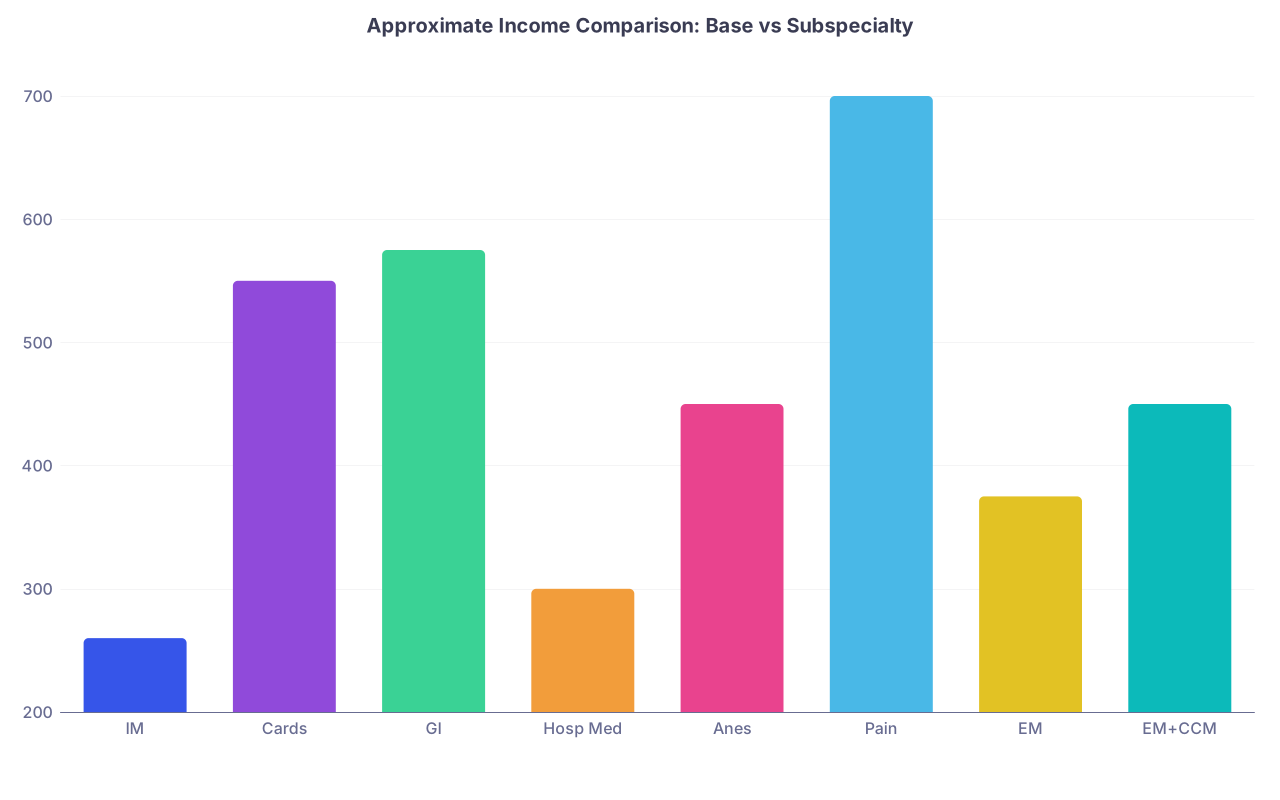
| Category | Value |
|---|---|
| IM | 260 |
| Cards | 550 |
| GI | 575 |
| Hosp Med | 300 |
| Anes | 450 |
| Pain | 700 |
| EM | 375 |
| EM+CCM | 450 |
Rough translation:
- IM → Cards/GI: +$250–300k/year for 3 extra years. That’s a strong trade financially.
- Gen IM → hospitalist: +$40k or so, no extra training. In pure dollars-per-year-of-life, this might beat some extra fellowships with modest pay jumps.
- Anesthesia → Pain: +$150–250k for 1 extra year, with more outpatient options. Excellent from a money/lifestyle standpoint, assuming you like the work.
- EM → CCM: sometimes +$50–100k for 2 extra years, sometimes almost no bump depending on setting. That’s where people get burned if they expected a major financial upgrade.
Step-By-Step: How You Should Run the Numbers
You don’t need perfect accuracy. You need reasonable estimates and honesty. Do this:
Identify the real paths you’d take.
Not hypothetical “academic unicorn job,” but:- Likely city/state
- Community vs academic
- Group vs employed
Pull actual pay ranges.
Look at:- MGMA/Medscape/FMV data
- Job postings (yes, lots now list ranges)
- Recently graduated fellows in that region
Estimate extra income:
- Subspecialty realistic range – base realistic range = extra per year
Estimate income lost during extra training:
- Years of fellowship × what you’d earn as a generalist
minus - Years of fellowship × your actual trainee salary
- Years of fellowship × what you’d earn as a generalist
Calculate break‑even:
- Lost income ÷ extra annual income
Reality‑check with lifestyle:
- Ask current attendings: “What do your nights, weekends, and vacation really look like?”
- What’s the burnout rate? Would they choose it again?
If the break‑even is under 5 years and you like the work, you’re on solid ground financially. If it’s 10+ years and you’re lukewarm on the field, that’s a red flag.
Quick Snapshot: Training Length vs Pay for High-Earning Fields
| Path | Total Training Post-MD | Typical Pay Range |
|---|---|---|
| EM (no fellowship) | 3–4 yrs | 325–450k |
| IM → Cardiology | 6 yrs | 450–700k+ |
| IM → GI | 6 yrs | 475–750k+ |
| Anesthesia (general) | 4 yrs | 350–550k |
| Anesthesia → Pain | 5 yrs | 550–900k+ |
| DR → Interventional Radiology | 6–7 yrs | 600–900k+ |
You can see the pattern: the most financially justifiable extra years are usually:
- Short (1–3 years)
- Procedural
- High RVU/low commodity risk
FAQ: Common Questions About Extra Years vs Extra Pay

1. Is a 1-year fellowship almost always “worth it” financially?
If the fellowship leads to at least ~$50–75k more per year, yes, it’s usually worth it from a pure money standpoint, because:
- Lost income in that 1 year is relatively small.
- You have many attending years to make up the gap.
But a 1-year fellowship with no pay bump (or worse, a pay cut job-wise) is basically a hobby or CV move, not a financial move.
2. Are long fellowships (3–4+ years) ever a bad financial decision?
Yes. Classic bad deals:
- 3-year fellowship for a +$30–50k bump and worse hours.
- 4-year path to a niche subspecialty with uncertain job market or low private practice options.
- Situations where you think you’ll earn “GI money” but 90% of jobs in your region are low-RVU academic with modest salaries.
If the numbers don’t clearly justify it, you should assume you’re doing it for love of the field, not for money—and be honest with yourself about that.
3. How do student loans change the equation?
Loans amplify the cost of extra training years because:
- Interest keeps growing while you’re in low-income mode.
- You delay aggressive payoff or PSLF completion.
If you’re deep in six-figure debt and not firmly on a PSLF track, the bar for “extra years are worth it” should be higher. You need a bigger pay bump to comfortably dig out.
4. Should I ever choose a lower-paying subspecialty over a higher-paying one?
Absolutely. Money is one variable, not the only one. I’d choose:
- A field I like + good lifestyle + reasonable pay
over - A field I tolerate + brutal lifestyle + top-tier pay
…every single time. You’re going to do this for decades. A smaller income with a life you actually enjoy often beats a “maxed out” salary chained to regret.
5. What about future changes—AI, reimbursement cuts, scope creep?
You should assume:
- Some downward pressure on procedures and imaging over the next 20 years.
- More employed positions and fewer classic high-paying partnerships.
- Payers squeezing RVUs.
So don’t do a marginal financial decision today assuming future pay will increase. If the math only barely works now, it may not work in 10–15 years. Choose fields with durable demand and flexibility.
6. What’s one practical way to compare options right now?
Open a blank page and create two columns:
- Column A: “No fellowship” path – realistic salary, lifestyle, city.
- Column B: “Fellowship” path – extra years, realistic salary, lifestyle.
Write down:
- Years to attending
- Expected starting salary
- Typical call/weekends
- How many years until you’re “ahead” financially
If you don’t clearly like the Column B work more and see a meaningful financial or lifestyle improvement, that extra training probably isn’t justified.
Open a note on your phone or laptop right now and write down your top 2–3 realistic career paths—base vs subspecialty. For each, add three numbers: total years of training, realistic starting salary, and lifestyle (good/ok/bad). If you can’t clearly defend the extra years with both money and life quality, you just answered your own question.