
You’re a PGY-2 or PGY-3 staring at your senior’s schedule. They’re about to graduate, walk into a seven-figure job… and you’re wondering if tacking on another 1–2 years of fellowship will actually move the needle on income—or just delay your attending paycheck for a title and an extra line on your CV.
Let me be blunt: a lot of fellowships don’t pay you back financially. Some do. Some do massively. And some are prestige plays that look good on paper but barely budge your lifetime earnings.
This is the cheat sheet you wish someone had handed you before you clicked “apply.”
The Core Question: Does This Fellowship Monetize, Or Just Specialize?
Before we go specialty-by-specialty, you need a simple lens:
- Does the fellowship clearly shift you into a higher-paying procedure set?
- Does it give you scarce skills that hospitals or groups have to pay more for?
- Does it measurably increase your RVU potential (more billable units per hour)?
- Or is it mostly academic/branding with similar or lower clinical income?
If you can’t answer “yes” to at least one of the first three, you’re probably not getting a big income boost. You might get a nicer niche and job satisfaction, but not a big jump in the paycheck.
Let’s walk through the big buckets.
Internal Medicine: Which Fellowships Actually Pay Up?
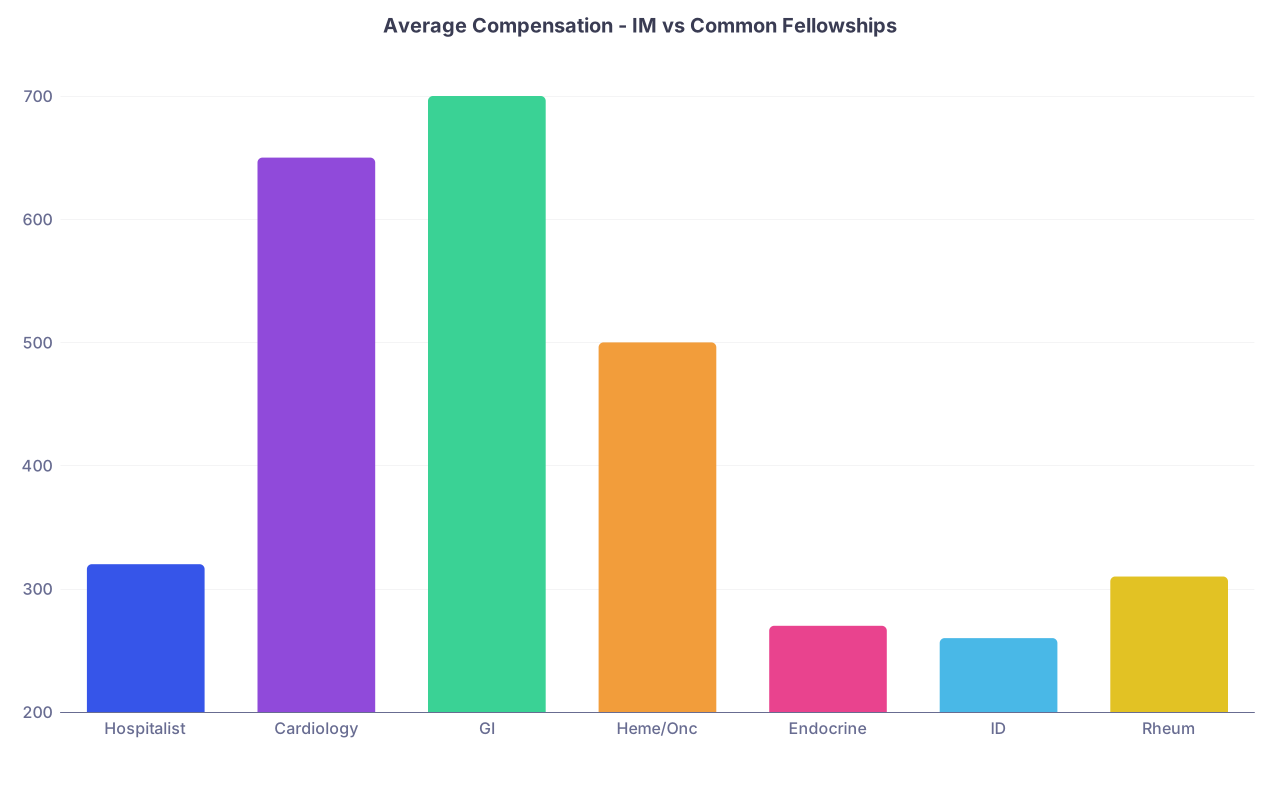
This is where most people overestimate the payoff. Not all IM fellowships are created equal.
| Category | Value |
|---|---|
| Hospitalist | 320 |
| Cardiology | 650 |
| GI | 700 |
| Heme/Onc | 500 |
| Endocrine | 270 |
| ID | 260 |
| Rheum | 310 |
Clear Income Boosters
These are the ones that, in most markets, clearly beat going straight into hospitalist/primary care work.
Cardiology (general, then subspecialties)
Core cardiology already pays well above hospitalist work. Within cards:
- General non-invasive: strong increase vs hospitalist.
- Interventional: big bump—often $800k+ potential in busy private groups.
- EP: similarly high, sometimes higher, but job markets can be narrower.
Why? High-RVU procedures, call stipends, and heavy downstream revenue. Hospitals will throw money at these services.
Gastroenterology
If you measured “fellowship ROI” only by income, GI is almost always near the top. Standard bread-and-butter colonoscopies and EGDs print RVUs. Add advanced procedures (ERCP, EUS) and you can push even higher—but those advanced skills are more market- and group-dependent.
GI beats hospitalist medicine by a huge margin in nearly every compensation survey.
Pulm/CCM – it depends
Critical care alone isn’t reliably a money machine; pulmonary plus ICU plus sleep lab can be.
Pure intensivist jobs can pay well on an hourly basis, but there’s burnout and shift caps. True income jump happens when you combine:
- Outpatient pulm clinic
- Procedures (bronchs, thoracenteses)
- Sleep medicine (interpretation revenue, long-term clinic)
If you land in a well-structured private group with all three, yes, this can be significantly above general IM/hospitalist.
Middle of the Pack: Income Similar or Slightly Higher
Heme/Onc
Comp is usually solid—often higher than hospitalist—driven by infusion revenue and longitudinal care. But it’s not in the same league as GI/cards in many regions. There’s also significant cognitive and emotional load.
Rheumatology
Surprisingly decent income in some markets because of shortage + infusion revenue. Often better than primary care, may be comparable to or a bit above well-paid hospitalist gigs, but it’s not a GI-level boost.
Financially Weak ROI (Strictly on Income)
These fellowships are often chosen for interest, lifestyle, or academic work—not money.
- Endocrinology – Often lower than hospitalist pay, despite extra training. Highly cognitive, fewer procedures, frequent under-compensation.
- Infectious Disease – Perennially underpaid relative to expertise. Great if you love the work, bad if you’re chasing income.
- Geriatrics, Palliative Care – Noble, necessary, and almost always a pay cut vs hospitalist. These are mission-driven, not income-driven fellowships.
If your metric is “measurable income boost,” most IM cognitive subspecialties fail that test.
Anesthesia: Where the Needle Really Moves
Anesthesia is already well-compensated. The key question: do you lose 1–2 years of attending pay for a niche, or do you actually expand your earning ceiling?

Pain Medicine: The Big One
If you want the clearest fellowship → income boost story, this is it.
- Procedures are high-RVU: injections, RFA, spinal cord stimulators, etc.
- You can build clinic-based, controllable schedules with very high earning potential.
- In many markets, a successful pain physician out-earns general anesthesiologists.
Yes, there’s regulatory risk and business complexity, but strictly on numbers, pain is one of the best ROI fellowships in medicine.
Cardiac Anesthesia
Does it always pay more? Not necessarily. But in many private groups:
- Cardiac call pay
- Extra stipends for TEE skills
- Cardiac-only shifts that command a premium
You’re more “indispensable,” which helps when contracts and stipends are renegotiated. Income potential goes up, but it’s market- and group-structure dependent.
Critical Care Anesthesia
Financially, mixed bag. Some groups pay a premium for ICU plus OR coverage; others pay roughly the same or even less if you’re a full-time intensivist. This one is usually lifestyle/interest-driven rather than a guaranteed pay bump.
Regional/OB/Neuro Anesthesia
Great for skills and employability. But they usually don’t come with clear, consistent salary jumps over general anesthesia, especially in large groups where pay is equalized.
Surgery: Do Subspecialties Really Pay More?
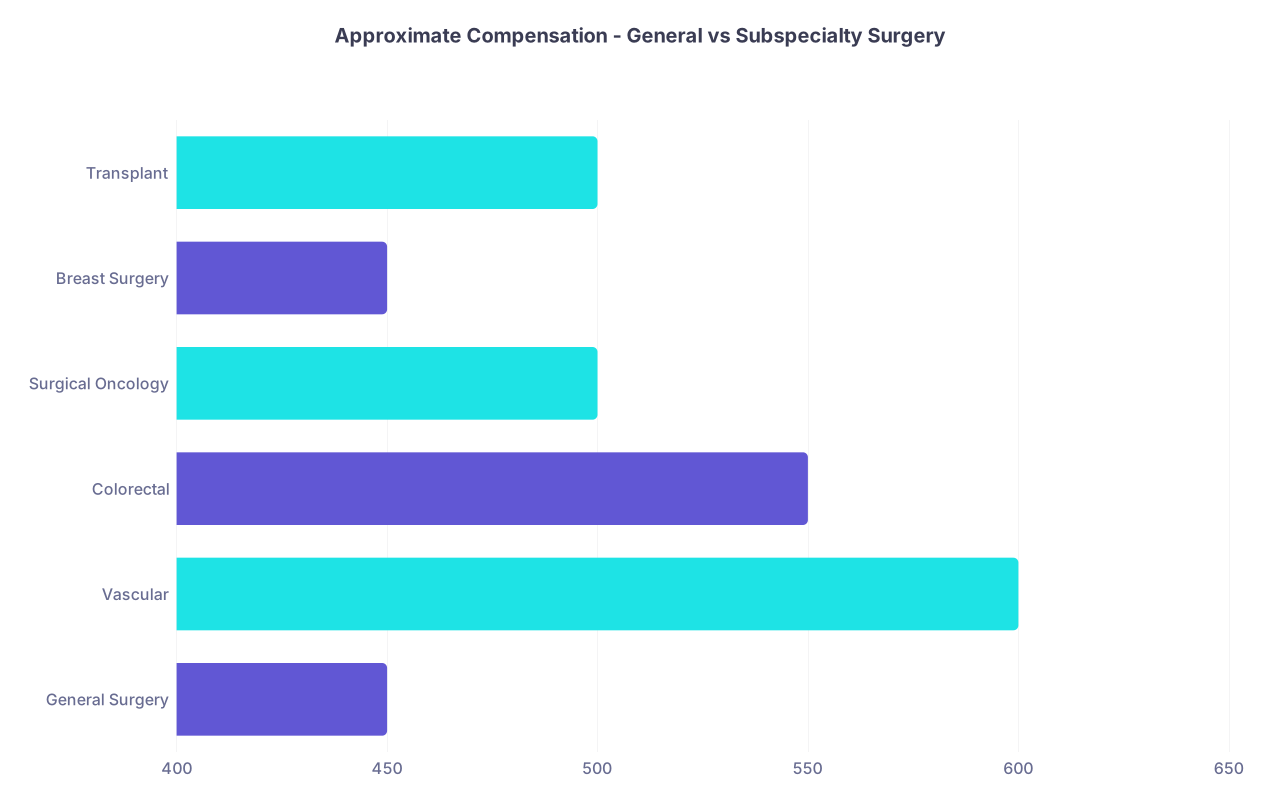
General surgery is the baseline. Most people assume “any surgical fellowship = more money.” Not always.
| Category | Value |
|---|---|
| General Surgery | 450 |
| Vascular | 600 |
| Colorectal | 550 |
| Surgical Oncology | 500 |
| Breast Surgery | 450 |
| Transplant | 500 |
Often Higher-Paying Surgical Fellowships
Vascular Surgery
Vascular tends to pay above general surgery in many markets because:
- Aging population = more disease
- High complexity and procedural density
- Call coverage is brutal → hospitals pay to keep you
You’ll work. But the pay bump is real in many settings.
Colorectal Surgery
Often better than bread-and-butter general due to complex referrals and high RVUs. But in some markets, well-run general surgeons doing a high volume of elective cases rival or beat colorectal. Still, you usually have solid income upside.
Ortho Subspecialties (from Ortho, not Gen Surg)
Just to mention: spine, sports, and hand from an ortho base can push you into extremely high-comp territory. But that’s a different residency path.
Prestige, Not Always Pay
Surgical Oncology
Highly specialized, often academic. Real talk: lots of surg onc graduates take academic or hybrid positions that pay at or even below high-volume private general surgery. It’s a meaningful path, but not an automatic pay boost.
Breast Surgery
Lifestyle can be better. Niche is rewarding. But income is often comparable to or lower than high-volume general surgery. Many breast surgeons are in academic or large system practices with standardized comp.
Transplant Surgery
High acuity, high prestige, brutal lifestyle. Compensation is not always proportionate. Many are in academic centers. This is almost never an income-maximizing choice.
Radiology: Do Fellowships Actually Increase Income?
Radiology is fellowship-heavy—most people do one. The trick is that many fellowships don’t pay more; they just make you employable.
| Fellowship | Typical Income Impact vs General | Job Market Effect |
|---|---|---|
| IR | Often higher | Strong demand |
| MSK | Similar or slightly higher | Good in private groups |
| Neuro | Similar | Needed in subspecialty |
| Body Imaging | Similar | Employability boost |
| Mammo / Breast | Similar or lower per RVU | High demand |
Interventional Radiology (IR)
This is the radiology analog to pain medicine in anesthesia.
- Procedural, high-RVU, and irreplaceable.
- Many IR docs command higher total compensation, especially in hybrid models (clinic + procedures + imaging).
- Call and burnout can be rough, but strictly on income, IR is one of the few radiology fellowships that reliably adds upside.
Diagnostic Fellowships (Neuro, Body, MSK, etc.)
Most of these:
- Don’t dramatically change your starting salary vs a general radiologist.
- But massively increase your chances of getting hired into desirable groups.
- In some groups, subspecialty skills allow you to negotiate a bit better, but not a multiple.
The real payoff is job security and possibly partnership track, not some big RVU explosion.
Emergency Medicine: Fellowships Are Usually Lifestyle/Interest, Not Money
If you’re in EM and thinking “maybe a fellowship will pay more,” temper expectations.
Common EM fellowships:
- Ultrasound
- Toxicology
- EMS
- Peds EM
- Critical Care
Most of these lead to roles that are academic, leadership, or niche clinical. They almost always lower your hourly rate if you move into academic centers, or at best match community EM income.
The exception: critical care can build a dual practice (ED + ICU) that’s decent, but again, not some giant jump. Many EM docs without fellowship already make very strong incomes by just working more shifts or higher-acuity/community settings.
If your goal is strictly income, EM fellowships usually don’t help. They’re about interest, career diversity, and burnout management.
Pediatrics: Fantastic For Meaning, Not For Maximizing Income
Pediatrics is structurally underpaid compared to adult medicine. Most pediatric fellowships don’t fix that.
Child neurology, PICU, peds cardiology, peds GI—some of these pay better than general peds, but rarely reach adult subspecialty levels. You’ll often add 3+ years of training for a modest bump that still sits below many adult medicine peers.
If you love kids and the subspecialty, go for it. But if the question is “measurable income boost vs not doing fellowship,” the pure financial ROI isn’t great in peds almost across the board.
Quick Reality Check: The Cost of Extra Training
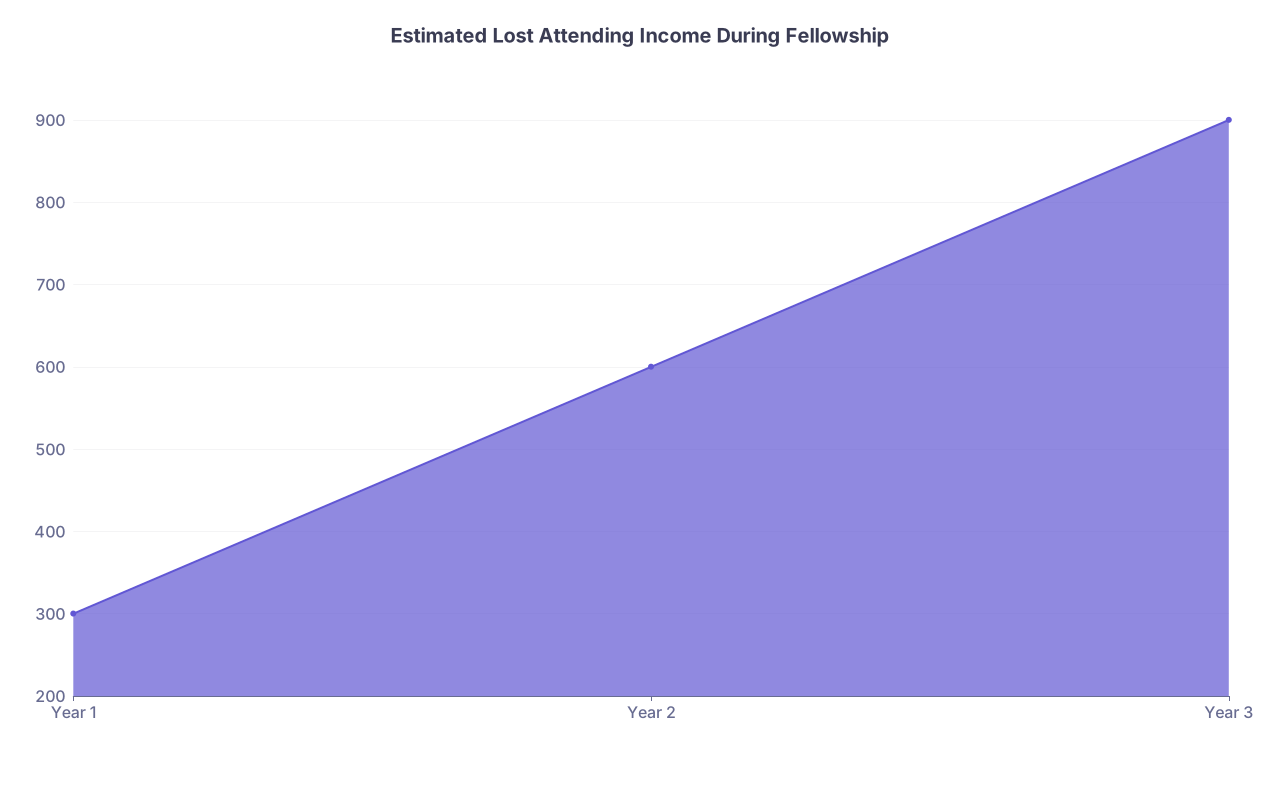
You can’t judge a “pay raise” just by final salary. You also need to factor in:
| Category | Value |
|---|---|
| Year 1 | 300 |
| Year 2 | 600 |
| Year 3 | 900 |
- 1–3 years of lost attending income (you’re at $65–75k instead of $300–600k+)
- Extra years of interest on your loans instead of paying them down
- Delayed retirement savings and compounding
This is why low-paying fellowships are such a bad financial trade. If a fellowship only gets you from $320k to $350k but costs you 2 years of $320k, it takes a long time to come out ahead—if you ever do.
Contrast that with something like GI or interventional cards, where you may jump from $320k to $700–900k. That can make up for 2–3 years of lost income pretty quickly.
A Simple Framework: Should You Do This Fellowship For Money?
This is the blunt decision tree I’ve walked residents through:

| Step | Description |
|---|---|
| Step 1 | Considering Fellowship |
| Step 2 | Skip fellowship |
| Step 3 | Do it for interest, not money |
| Step 4 | Risky - research more |
| Step 5 | Good financial ROI |
| Step 6 | Does it raise ceiling pay by 30 percent or more? |
| Step 7 | Do you love the niche? |
| Step 8 | Is job market strong in your region? |
If you’re honest, a lot of fellowships end up in the “do it for interest, not money” bucket.
Fellowships That Commonly Deliver a Real, Measurable Income Boost
Here’s the short, specialty-agnostic list where the financial upside is usually real:
- Cardiology (especially interventional and EP)
- Gastroenterology
- Pain Medicine (from anesthesia or PM&R)
- Interventional Radiology
- Many ortho subspecialties (spine, sports, hand, joints)
- Some vascular surgery and high-volume colorectal surgery roles
- Certain pulm/CCM practices with sleep and procedures built in
And here are the ones that usually don’t, purely financially:
- Endocrinology, ID, geriatrics, palliative
- Most EM fellowships
- Many pediatrics subspecialties
- A big chunk of academic-leaning surgical and medicine fellowships
Bottom Line
Three things to walk away with:
- Only a handful of fellowships reliably move you into a clearly higher-paying tier (GI, cards, IR, pain, some surgical subspecialties). Those are the “true income boost” paths.
- Many fellowships are great for interest, job satisfaction, or niche expertise—but are financially neutral or negative vs going straight into practice.
- Don’t romanticize the word “fellowship.” Run the math: lost attending years, realistic salaries in your actual target market, and how long it takes to break even. Then decide if you want it for money, for meaning, or both—and be honest about which one is really driving you.