
You’re midway through second year or early in clinicals. Everyone around you is obsessing over “highest-paid specialties” lists, RVUs, and MGMA percentiles. And you’re sitting there thinking: “Honestly…I care more about control over my time than squeezing out every last dollar. Did I just disqualify myself from the ‘smart choices’ club?”
No. But you do need a different playbook.
This is for you if:
- You like nice things and you do care about money
- But you’d pick schedule control, location choice, or burnout protection over chasing the absolute top salary tier
- You’re trying to reconcile that with the constant noise about ortho, derm, gas, and rads being “the only rational choices”
Here’s the answer you’re looking for: you can absolutely value flexibility more than maximum income and still be very well paid. You just need to be deliberate about which specialties, practice models, and long‑term moves you choose.
(See also: Is chasing a highest-paid specialty worth it for me personally? for more.)
Let’s break it down.
Step 1: Get Honest About What “Flexibility” Actually Means for You
People say “flexibility” but mean totally different things. Before you pick a specialty, you have to define your version or you’ll pick badly.
Common versions of flexibility:
Time flexibility
- Ability to choose part‑time vs full‑time
- Control over days of the week (e.g., no Fridays, or 7-on/7-off)
- Ability to scale down in your 40s/50s without your income dropping to nothing
Lifestyle / schedule predictability
- Minimal nights/weekends/holidays
- Low or no in‑house call
- Ability to reliably attend kids’ events, trips, etc.
Location flexibility
- Work in big city, small town, or rural — your choice
- Ability to move states without retraining
- Telemedicine or remote options
Role flexibility
- Multiple ways to use your skills (clinic, hospital, industry, admin, teaching, telehealth)
- Ability to pivot if you burn out on direct patient care
Pick your top 2. Seriously, write them down. Because different specialties are good at different flavors of flexibility. For example:
- EM: great time flexibility (shifts) but garbage circadian rhythm
- Derm: fantastic schedule predictability, weaker geographic flexibility (desired locations saturated)
- Psych: strong in time + role flexibility, increasing telehealth options
- Ortho: high pay, but real flexibility usually comes later and requires leverage (partnership, niche, or ownership)
You’re not choosing “flexible vs rich.” You’re choosing “which type of flexibility, with how much income, at what training cost.”
Step 2: Stop Thinking in “Highest Paid” vs “Everything Else”
The internet acts like there are two buckets:
- “High income”: ortho, neurosurg, derm, rads, gas, ophtho, maybe some cardiology
- “Everyone else”: enjoy your 200k and burnout
That’s lazy thinking.
Here’s the reality: there’s a big middle zone where you can earn very good money and often have better flexibility than the ultra‑top tier.
| Specialty | Typical Full-Time Range* | Flexibility Potential |
|---|---|---|
| Emergency Med | $320k–$450k | High (shifts, 0.7 FTE) |
| Anesthesiology | $350k–$500k | Moderate–High |
| Radiology | $400k–$650k | High (telerads, remote) |
| Psychiatry | $260k–$400k | High (outpt, telehealth) |
| Outpt IM/FM | $220k–$320k | Moderate–High |
*Ballpark attending ranges in the U.S., not guarantees; vary heavily by region and practice.
Notice something? You do not have to pick a low‑paying specialty to get flexibility. In fact, some of the most rigid, grindy lives I’ve seen are in “high‑pay” procedural fields where the doc is chained to high-volume OR days and a call schedule for years.
If flexibility is your priority, you should be looking hard at:
- Emergency medicine
- Anesthesiology
- Radiology (especially telerads)
- Psychiatry
- Outpatient internal medicine / family medicine (in the right practice model)
- Hospitalist IM (with caveats)
Step 3: Understand How Flexibility Actually Shows Up in These Fields
Let’s go specialty by specialty with a “flexibility lens,” not just the usual Step score gossip.
Emergency Medicine
The value proposition: pure shift work. When your shift is over, you’re done. No panel, no inbox.
Flexibility strengths:
- Easy to cut to 0.7–0.8 FTE and still earn more than many full‑time primary care docs
- Can swap shifts, cluster them, or do locums
- Jobs almost everywhere, including rural areas with big pay
Trade‑offs:
- Nights, weekends, holidays are baked in
- Burnout and ED crowding are real problems
- Market in some urban areas feels tighter
Who it fits: You want time and schedule flexibility more than circadian stability, and you’re okay signing up for a physically and emotionally intense job.
Anesthesiology
Anesthesia’s reputation as the “good hours, good pay” field is mostly earned, though call and early mornings are real.
Flexibility strengths:
- Many groups allow part‑time once you’re established
- Locums can be extremely lucrative and flexible
- Ability to pivot to pain, sedation clinics, or office‑based practices later
Trade‑offs:
- Residency is demanding
- In many private groups, you pay your dues before getting real schedule control
- OR scheduling and late cases can wreck your day unpredictably
Great if you want: high income with the possibility (not guarantee) of dialing back later without walking away from the field.
Radiology
Rads is a top contender if flexibility is your #1 and you still want very strong income.
Flexibility strengths:
- Teleradiology = work from anywhere with high pay
- Nights/weekends can be optional if you’re okay making a bit less
- Easy to move between locations / employers
Trade‑offs:
- Work can be isolating
- Sitting all day, attention‑heavy
- Call and nights still exist in many groups, especially early on
If you want location and schedule flexibility and you’re good with screen time, rads is a power move.
Psychiatry
Psych is the quietly overpowered flexibility specialty right now.
Flexibility strengths:
- Massive demand, easy to go part‑time and still make a very solid income
- Telepsych is mainstream — genuine remote work
- Mix of inpatient/outpatient/consult/forensic/workers’ comp/VA/academics
Trade‑offs:
- Emotional load is high
- Inpatient call and coverage can be draining
- Reimbursement is good but not surgical‑level
If you want role flexibility plus geographic freedom and are okay making less than the surgical high‑flyers but more than enough to live very well, psych is hard to beat.
Outpatient IM / FM
Everyone loves to trash primary care pay. They conveniently skip over the fact that it offers some of the best long‑term flexibility if you choose the right setup.
Flexibility strengths:
- Easy to reduce FTE (4‑day weeks, 0.7–0.8 FTE)
- Many models: direct primary care, concierge, employed, FQHC, telehealth
- Can add side work: urgent care, telemed, informatics, admin
Trade‑offs:
- Inbox burden can be brutal in bad systems
- RVU compensation can push you into volume traps
- You must be choosy about employers
With a smart practice choice (e.g., concierge, DPC, or strong employed system with panel limits), you can make decent money and control your life more than almost any other specialty.
Step 4: Think in Practice Models, Not Just Specialties
This is where most students get it wrong. They pick “derm” or “cards” and assume the field itself guarantees a lifestyle. It doesn’t. Your practice model and contract matter more than Reddit suggests.
Core practice levers:
-
- Employed: more predictable income, less control, easier to go part‑time
- Ownership: higher upside, more risk, higher admin headache, but more power over schedule once established
RVU vs salary vs hybrid
- Pure RVU: can be golden handcuffs; harder to cut back without huge income hit
- Salary + modest bonus: better for those prioritizing time over marginal extra pay
Call burden
- Call pay is seductive but wrecks true flexibility
- Ask explicitly: post‑call days? In‑house vs beeper? Actual frequency?
Telehealth options
- Strong in psych, primary care, some subspecialties
- Weak in procedures and in‑person heavy fields
If flexibility matters more than maximal income, your goal is a setup that lets you opt into enough work, not as much as humanly possible.
Step 5: Match Phase – How to Signal Your Priorities Without Red Flagging Yourself
You can’t go into interviews saying, “I really don’t want to work that hard.” That’s not what you mean anyway. You mean: “I want a sustainable career with room for a real life.”
You can safely signal that by:
Asking residents:
- “How easy is it for graduates to find 0.8 or 0.9 FTE jobs?”
- “What kinds of practice models are recent grads choosing?”
- “Do people feel comfortable turning down extra shifts?”
Asking faculty:
- “How well does this specialty support physicians who want to reduce clinical time later for family, admin, or other interests?”
- “What proportion of your graduates are in shift‑based or part‑time roles 5–10 years out?”
You’re looking for patterns. If every answer is basically, “Everyone works 1.2–1.3 FTE, it’s just how the field is,” that’s not your people.
Step 6: Play the Long Game Financially
If you’re okay earning, say, 20–30% less than your maximum possible income, then you need to be smarter with money than the doc who just brute‑forces it with a 700k salary and chaos.
Basic strategy:
Avoid lifestyle creep early. Use your first 3–5 attending years to:
- Pay down high‑interest debt
- Build a real emergency fund
- Start investing like an adult (401k/403b, Roth/Backdoor Roth, taxable)
Target “enough,” not “max.”
- Figure out your “enough number” for annual spending.
- Work backwards: what income supports that with room for savings at 0.8–1.0 FTE?
Once you hit basic financial security, your flexibility options explode. You can cut back days, change jobs, or say no to toxic systems without panicking.

| Category | Value |
|---|---|
| Max RVU Grind | 550 |
| Standard Full-Time | 400 |
| 0.8 FTE | 320 |
| 0.6 FTE + Side Gigs | 260 |
The point: You don’t need max income to live extremely comfortably. You need a coherent money plan plus a field that allows downshifting without destroying your career.
Step 7: Red Flags if You Value Flexibility
Things that should make you pause:
- A specialty where everyone says, “Real control comes once you’re partner…around year 7–10”
- Cultures that glamorize 70–80 hour weeks as a badge of honor, even post‑training
- Contract structures where your base salary is low and everything is RVU or call dependent
- Fields where subspecialization is mandatory to get decent jobs, adding more years of training and debt
Not saying you must avoid these completely. But if your gut says “I want options by my mid‑30s,” don’t lock yourself into a track that only gives real flexibility at 45.
A Simple Decision Framework
If you want a quick framework, use this:
Pick your top 2 flexibility types:
- Time / FTE control
- Schedule predictability
- Location freedom
- Role diversity
Shortlist 3–4 specialties that score well on those.
For each, answer:
- What does part‑time or 0.8 FTE look like and pay?
- How many different ways can I use this training at 45 if I burn out on frontline care?
- How hard is it to change employers or locations?
During clinicals and electives, ignore the hype and watch:
- Are attendings clearly trapped, or do they have options?
- Do people talk openly about cutting back or changing roles…or like it’s betrayal?
Your specialty choice should fit both who you are at 30 and who you might be at 50.

| Step | Description |
|---|---|
| Step 1 | Value Flexibility Over Max Income |
| Step 2 | Consider EM, Psych, Outpt IM |
| Step 3 | Consider Rads, Psych, EM |
| Step 4 | Consider Derm, Outpt IM, Psych |
| Step 5 | Consider IM, FM, Psych |
| Step 6 | Evaluate Practice Models |
| Step 7 | Plan Finances For 0.8–1.0 FTE |
| Step 8 | Top Flex Priority |

FAQs
1. If I care about flexibility, should I avoid the “highest paid” specialties altogether?
No. You should avoid rigid thinking, not high‑pay fields. Anesthesiology and radiology, for example, can be both high income and highly flexible, especially with telerads or locums. What you should avoid is choosing a specialty purely for its average salary while ignoring culture, practice models, and call.
2. Is primary care a bad choice if I still want to earn well?
Not automatically. Traditional high‑volume RVU primary care can be brutal for relatively modest pay. But concierge, direct primary care, strong academic or integrated systems with capped panels, and hybrid clinical/admin roles can give you solid income plus very good control over your schedule. The trick is: you must be very selective about your practice setting.
3. Does going part-time ruin my career or future options?
Usually no, if you plan it. In most fields, dropping from 1.0 to 0.7–0.8 FTE is socially and professionally acceptable, especially once you’ve built a reputation. Problems arise when you go to very low FTE early in your career without establishing yourself, or when your subspecialty requires high volume to maintain skills. But for psych, primary care, hospitalist IM, EM, and many outpatient specialties, modest FTE cuts are normal.
4. How much income do I realistically give up if I prioritize flexibility?
Depends on specialty and how aggressively you cut back. A common pattern: a rads, gas, or EM doc working 0.8–0.9 FTE might earn 70–85% of a max‑RVU grinder’s income, but with 20–30% fewer hours and much less call. For many, that trade is a no‑brainer. You’re giving up the last slice of income for a huge gain in life quality.
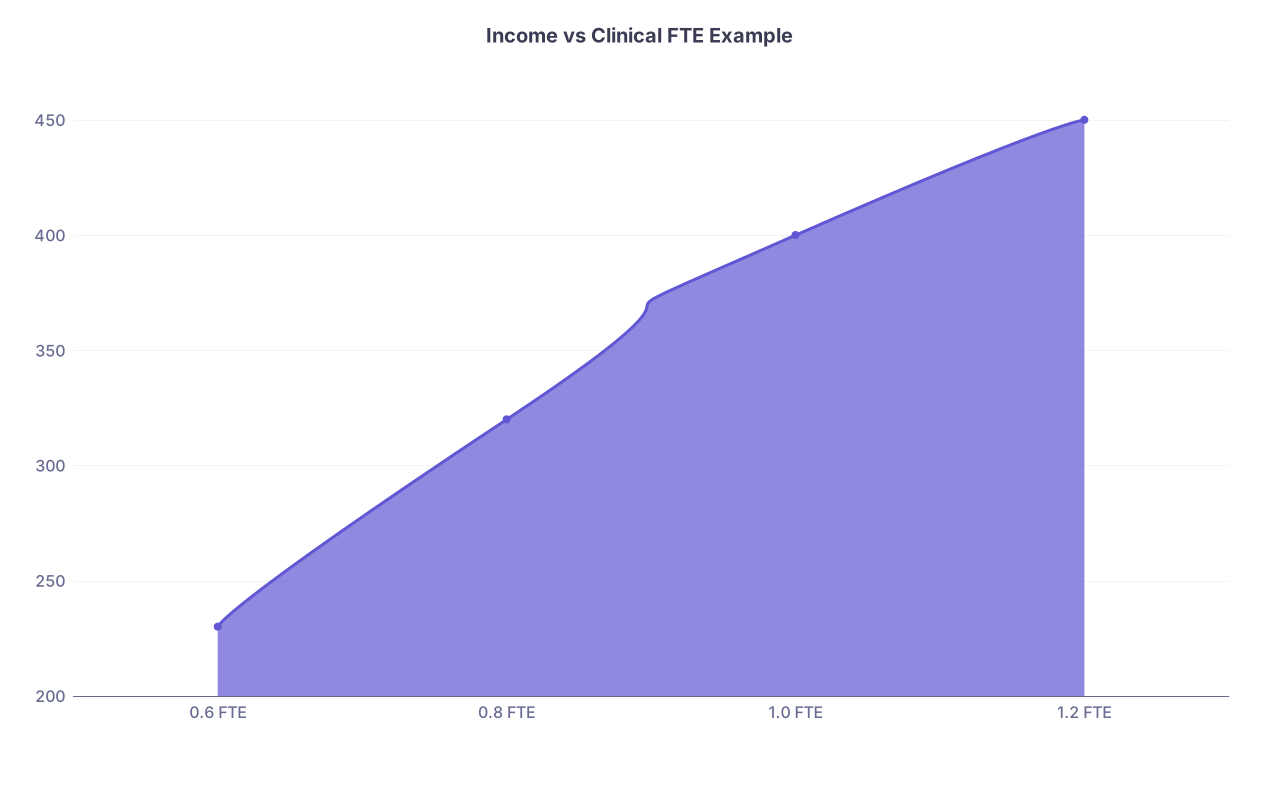
| Category | Value |
|---|---|
| 0.6 FTE | 230 |
| 0.8 FTE | 320 |
| 1.0 FTE | 400 |
| 1.2 FTE | 450 |
5. Will program directors judge me if I say I care about work-life balance?
If you say it clumsily, yes. If you sound like you’re trying to dodge work, it’s a red flag. If you frame it as wanting a sustainable, long career where you can show up as your best self for patients, it’s fine. Talk about resilience, longevity, and fit, not “I don’t want to work too hard.”
6. What if I choose a rigid specialty and later realize I want more flexibility?
You’re not doomed, but the path is steeper. Options: shift to a less intense practice setting (VA, academic with more protected time, smaller community hospital), add administrative/education roles to reduce clinical burden, or even retrain in another specialty. I’ve seen surgeons move to radiology or IM, EM docs move to psych, and proceduralists transition to industry or admin. It’s doable, but it costs years and money. Better to factor flexibility in upfront.
7. Bottom line: How should I think about “flexibility vs maximum income” when choosing a specialty?
Treat flexibility as a core design constraint, not an afterthought. Decide your top flexibility priorities, shortlist specialties that naturally support those, and then choose practice models that protect your time instead of monetizing every spare minute. Use your early attending years to build financial security so you can afford to say no. You’re not rejecting high income—you’re rejecting the obsession with maximum income at the expense of your life.
Key points:
- Flexibility isn’t vague; define which kind you care about (time, predictability, location, role) and pick specialties that match that profile.
- Practice model and financial planning matter as much as specialty. You can earn very well at 0.8–0.9 FTE if you choose wisely and avoid lifestyle inflation.