
Do I actually need a “big–name” or super competitive residency to end up in the top salary bracket?
Short answer: No. Not for most of the highest paid specialties.
Longer, more honest answer:
You need the right specialty, the right practice setup, and enough competence and hustle way more than you need a name–brand residency. Prestige helps at the margins (academics, certain fellowships, urban elite jobs), but it is absolutely not the main driver of high physician income.
Let’s break this down like an attending who has 15 minutes between cases and is willing to tell you how it really works.
What actually drives top physician salaries?
The highest paid physicians in the U.S. tend to cluster around:
- Procedural specialties
- RVU-heavy outpatient work
- Call-heavy or coverage-scarce services
- Geographically less popular locations (think community, rural, exurban)
Residency program competitiveness by itself is not the main input. The big levers are:
- Specialty choice – Ortho vs peds. GI vs rheum. This is the biggest fork in the road.
- Practice type – Employed vs private practice vs partnership vs locums.
- Location – Midwest community hospital vs coastal academic center.
- Workload – How much you’re actually willing to work (clinic, OR, call, procedures).
- Negotiation and business sense – Understanding contracts, RVUs, buy-ins, ancillaries.
Where does residency program “brand” fit?
Honestly: below all of those.
Highest paid specialties: does residency competitiveness matter?
Here’s how this plays out in the actual high-income fields people chase.
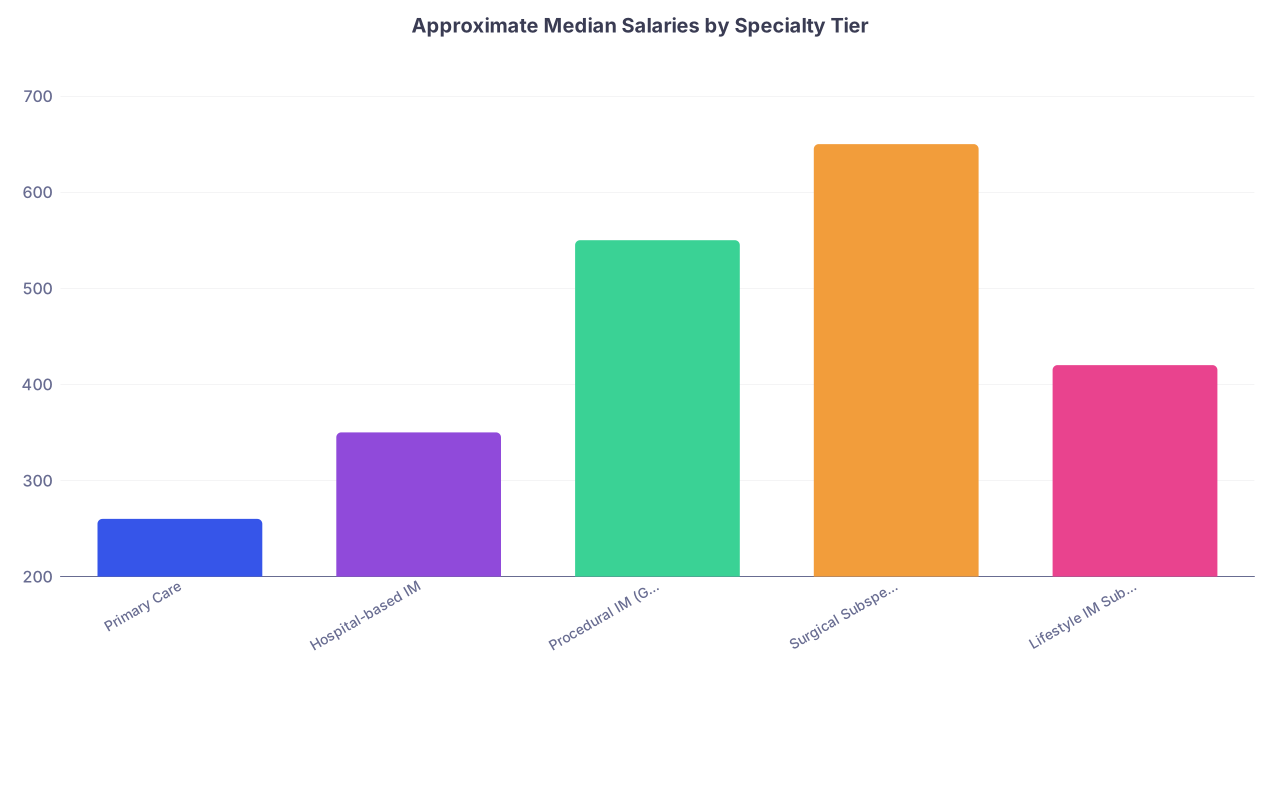
| Category | Value |
|---|---|
| Primary Care | 260 |
| Hospital-based IM | 350 |
| Procedural IM (GI/Cards) | 550 |
| Surgical Subspecialties | 650 |
| Lifestyle IM Subspecialties | 420 |
(Values are rough national ballparks in thousands, not offers in San Francisco academic centers.)
Orthopedic surgery
- Pay drivers: Procedures, implants, trauma call, volume.
- Do you need a “top 10” ortho residency to earn $800k+?
No. I’ve seen community-trained orthopods in the Midwest easily clear $900k–1M with call and a busy practice. - Where prestige helps: Landing ultra-competitive fellowships (hand at Mayo, complex spine at HSS) sometimes, getting plum urban or academic jobs, research-heavy careers.
But the orthopod doing bread-and-butter joints and fractures in a 300-bed community hospital with a good payor mix will often out-earn the big-name academic surgeon.
Neurosurgery
Same story, just with more complexity and a potentially longer grind.
- You absolutely need a solid neurosurgery residency; this is not something you can train for in a weak program and feel safe.
- But “solid” doesn’t have to mean “famous.”
- A neurosurgeon doing spine in a community setting can out-earn a brand-name academic cranial surgeon by hundreds of thousands per year.
Top salaries follow volume and case mix, not the logo on your diploma.
Cardiology & Interventional Cardiology
- Cards (especially interventional) is one of the most lucrative internal medicine-based routes.
- Residency competitiveness: you need a good IM residency to match a solid cardiology fellowship, but you don’t have to be at MGH or UCSF.
- What actually matters:
- Getting into a decent cardiology fellowship.
- If you want top-tier pay: often interventional or EP training, community practice, heavy procedural volume.
The cards doc in a 5-person group in a mid-sized town doing caths all day will usually out-earn the academic star with four first-author NEJMs and a title.
Gastroenterology
Same pattern.
- Need: solid IM → GI fellowship.
- Program prestige: helpful for some elite academic GI/advanced endoscopy spots, but 90% of private practice GI jobs care about:
- Can you scope safely and efficiently?
- Will you cover call?
- Are you reasonable to work with?
GI partners in community practices taking call and moving quickly through colonoscopies and EGDs routinely sit in the upper income brackets. Many of them trained in “normal” university or large community fellowships.
Radiology (diagnostic and IR)
Radiology is where people really overestimate prestige.
- For diagnostic radiology:
- ACGME-accredited, well-run residency matters.
- “Top 10” name — less critical unless you’re aiming for highly specific academic jobs.
- For IR:
- You need a good IR pathway, but again, not necessarily a top-5 program.
- High salaries in radiology come from:
- Group structure (equal-share partnerships pay very well).
- Workload (nights, weekends, telerads).
- Geography (big need in non-coastal urban and rural settings).
The telerad sitting at home reading 20,000 studies a year didn’t need a brand-name residency — they needed speed, accuracy, and a practice that pays.
Anesthesiology
- Very wide compensation spread depending on:
- Employment model (hospital-employed vs private group vs management company).
- Call, trauma, hearts, OB.
- Location.
- People from “average” anesthesiology programs routinely hit top decile incomes in the right private practice groups.
- Where big-name residency helps: academic jobs, niche fellowships (peds, cardiac) maybe, but even there, plenty of non-brand names get in.
So… when does a competitive or prestigious program actually matter for income?
There are situations where the program name and competitiveness change your earning ceiling.
Here’s where it can matter:
Ultra-competitive subspecialty fellowships
Pediatric cardiac surgery, complex skull base neurosurgery, certain advanced GI/endo or structural heart programs. Some of these do strongly prefer applicants from high-profile residencies or with big-name mentors.Elite academic positions in big coastal cities
If you want to be interventional cardiology section chief at a “holy trinity” institution in Boston/NYC/SF, pedigree and connections matter. But those jobs often do not pay top dollar compared with community.Crowded, desirable metro markets
When 150 GI docs are fighting for the same handful of prime LA or Manhattan jobs, name and fellowship may be a tie-breaker. Not the only factor, but a factor.Branding for private practice in competitive cities
Some practices use training pedigree as a marketing point. “Cleveland Clinic-trained” on their website. That can help you stand out to patients or referring docs, though again: that’s marketing, not inherent earning potential.
But for most people aiming at the top earning tier, these situations are not the main path.
| Scenario | Program Name Impact |
|---|---|
| Community private practice, Midwest | Low |
| Large academic job, coastal city | High |
| Ultra-competitive fellowship | Moderate–High |
| Standard cards/GI fellowship | Moderate |
| High-volume rural practice | Very low |
| Teleradiology / locums | Very low |
The real levers for top salaries (that you actually control)
Let me be blunt: a lot of med students obsess about the wrong thing. They refresh Reddit threads about “Tier 1 vs Tier 2” residencies and completely ignore the business side.
If you want a top-paying career, focus on these instead:
1. Specialty and subspecialty choice
By MS3, your biggest economic decision is which field you go into. Some rough patterns:
- High ceiling: Ortho, neurosurgery, ENT, urology, GI, cards, IR, anesthesia, radiology, certain surgical subspecialties.
- Moderate but still strong: EM (depending on market), hospitalist-heavy IM, heme/onc, pulm/crit, some procedural pain.
- Lower relative pay: Pediatrics, psychiatry (though growing), rheum, endocrine, academic-heavy jobs in any field.
You won’t outrun a low-paying specialty with prestige alone. A brilliant academic pediatrician from a “top 5” program will almost always earn less than a mid-career community GI from a perfectly average program.
2. Practice setting and location
High pay usually clusters around:
- Small to mid-sized cities or rural communities.
- Private practice or partnership-track groups.
- Places with physician scarcity and high procedure demand.
The shiny academic job in a coastal city can be amazing for lifestyle or prestige, but usually not your top earning option.

| Step | Description |
|---|---|
| Step 1 | Choose Specialty |
| Step 2 | High Earning Potential |
| Step 3 | Moderate Earning Potential |
| Step 4 | Higher Pay |
| Step 5 | Lower Pay |
| Step 6 | Solid Pay |
| Step 7 | Lower Pay |
| Step 8 | Procedural or Cognitive |
| Step 9 | Practice Setting |
| Step 10 | Niche or High Demand |
3. Volume, efficiency, and reputation
The docs at the top of the compensation distribution in their field usually share three traits:
- They work a lot. Extra OR days, more endoscopy blocks, more clinic sessions.
- They’re efficient without being reckless. Turnovers are fast, notes are concise, they’re not staring at the EMR for 45 minutes per patient.
- People like working with them. Referrers send them patients, OR staff doesn’t dread their cases, hospital leadership sees them as problem-solvers.
Residency program does not create those habits. Your mindset and training environment do.
4. Understanding contracts and business
This is where a lot of smart people get fleeced.
High-income attendings usually:
- Actually read and negotiate contracts (or pay a lawyer who does).
- Understand RVUs, collections, and overhead.
- Know what a fair partnership buy-in looks like.
- Think about ancillaries (surgery centers, imaging, real estate) if allowed by law and ethics.
Your future salary isn’t just “base pay.” It’s the entire structure of your job. Your residency name doesn’t do this work for you.
Common myths about competitive programs and income
Let’s kill a few bad ideas I see all the time.
Myth 1: “If I don’t match a top residency, I’ll never make top dollar.”
Wrong.
Plenty of very-high-income physicians come from mid-tier university or strong community programs. What they all have in common is strong clinical training and smart career choices, not a famous crest on their letterhead.
Myth 2: “Private practice only wants grads from prestige programs.”
In oversaturated urban markets, maybe they can be picky. In the places that actually pay the most? Most groups care about:
- Board certification.
- Good references.
- No major red flags.
- A sense that you’ll work hard and not be a nightmare.
The surgeon who finishes cases on time and doesn’t implode under pressure will beat the “top 5 program” diva in many hiring conversations.
Myth 3: “Academic jobs pay more if you’re from a top place.”
Usually the opposite.
Academic centers pay on strict scales. They might hire you because you trained at a top program, but that doesn’t mean they pay more than a hungry community hospital two states away.
So, do you need a competitive residency program to earn top salaries?
Here’s the distilled answer:
- You need to match into a specialty with strong earning potential if top salary is a major goal.
- Within that specialty, you need a good residency that trains you well enough to be safe, efficient, and competitive for fellowships if needed.
- A “competitive” or prestigious residency:
- Helps for certain fellowships.
- Helps in urban/academic job searches.
- Helps if you want an academic or research-heavy career.
- But for pure income in the highest-paid specialties, it’s secondary to:
- Specialty choice
- Practice setting
- Location
- Volume and work ethic
- Contract structure and business savvy
If you’re in a solid, non-top-10 residency and worried you’ve capped your income upside, relax. You very likely have not.

Practical steps if you care about ending up in the top income tier
Here’s what you can actually do, regardless of where you match:
Be brutally honest about what you want
If high income is a priority, stop pretending every specialty is equal. Rank specialties accordingly.During residency, chase competence, not just credentials
Take hard cases. Ask for feedback. Become the resident attendings trust.Learn the business side early
Talk to private practice attendings. Ask them about:- RVUs
- Collection rates
- Partnership models
- Call pay
Read a physician finance book or two. Seriously.
Be flexible on geography and setting for at least your first job
That first 3–5 years can rocket you into the top earnings bracket if you pick the right location and group.Keep your record clean
No professionalism disasters. No major patient safety issues. A clean reputation will matter more than where you trained when hiring committees decide who they want to work with for the next decade.
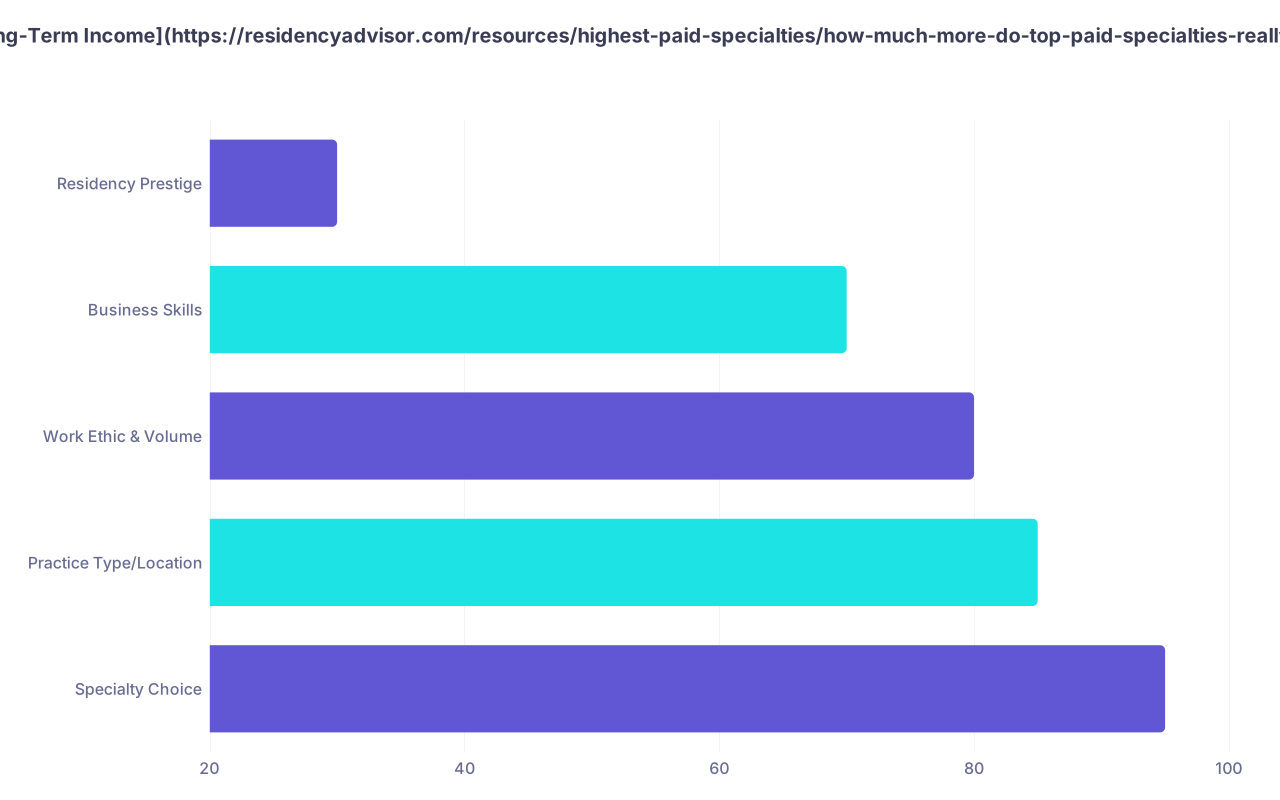
| Category | Value |
|---|---|
| Specialty Choice | 95 |
| Practice Type/Location | 85 |
| Work Ethic & Volume | 80 |
| Business Skills | 70 |
| Residency Prestige | 30 |
FAQ: Competitive Residency and High Physician Income
Can a community-trained doctor really earn more than someone from a top academic program?
Yes. Happens all the time. A community-trained orthopedist in a busy regional hospital taking trauma call can easily out-earn an academic orthopedist at a “top 5” institution. The community doc is often doing more cases, more call, and getting a better slice of the revenue.If I want GI or cardiology, do I need a “big-name” internal medicine residency?
You need a good internal medicine program with decent fellowship placement, strong clinical training, and supportive faculty. A brand-name helps at the margins, but plenty of fellows in GI and cards come from mid-tier university or large community programs that interview well and have strong letters.Does program prestige affect my ability to get a high-paying first job?
In most community and smaller city markets, not much. Employers care about board eligibility/certification, references, and whether you seem like someone they can trust with patients and call. In hyper-competitive city markets, prestige might break a tie between similar candidates, but it’s rarely the main factor.Is it better to choose a more competitive specialty at a mid-tier program or a less competitive specialty at a top program if I care about income?
If income is truly the priority, the specialty matters more. A mid-tier ortho or anesthesia residency sets you up for a higher earning ceiling than a top-tier pediatrics or psychiatry residency, purely from a compensation standpoint. Of course, you also need to actually like the work enough not to burn out.How much does location really change salary within the same specialty?
A lot. A hospital-employed GI in a major coastal academic center might be offered low-to-mid $400k. A partner-track GI in a smaller city or underserved area can hit $700k–900k+ with call and procedures. Same fellowship type, totally different geography and practice model, radically different income.If I start in an academic job, can I later switch to higher-paying private practice?
Yes, many do. Your fellowship training and competence matter more than your initial job type. Some people do a few years of academic work for experience and then move to private practice or a higher-paying community setting. Just avoid getting stuck with extreme sub-subspecialization that has limited community demand unless you’re okay staying academic.What’s one thing I can do during residency to maximize future earning potential?
Find two or three attendings in your specialty who are doing the kind of job you want (high-volume community GI, busy ortho partner, procedural cardiologist) and ask them very specific questions about their path, contracts, and what they’d do differently. Then actually write down what they tell you. That real-world mentorship beats obsessing over rank lists and Reddit tier charts.
Open a blank page right now and write down the specialty, practice setting, and geography you’d be willing to choose to hit your income goals—and then compare that list to your current obsession with program prestige. Adjust your priorities accordingly.