
The usual “follow your passion” advice for fellowship is financially incomplete. The data shows that for many specialties, doing a fellowship is a negative‑NPV decision – you never fully earn back the income you forfeit in those extra training years.
This is an uncomfortable truth in medicine because culture and hierarchy still push people toward extra letters after their name. I am not against fellowship. I am against doing one blindly, without running the numbers.
Below I walk through net present value (NPV) trade‑offs of “fellowship vs no fellowship” across major specialties, using real‑world compensation ranges, training lengths, and conservative financial assumptions.
The Financial Framework: How We Will Compare Paths
Let me define the playing field first, in numbers.
I will compare two paths:
- Stop after residency → become an attending in the core specialty
- Add fellowship → become a subspecialist
For each path I estimate:
- Training length
- Initial attending salary
- Long‑run salary (once “fully ramped”)
- Net present value of lifetime earnings from the start of residency
Core assumptions
You can argue with any individual number. What matters more is directionality and magnitude.
- Real discount rate: 3% per year (inflation‑adjusted time value of money).
- Career length after training: to age 65.
- Start residency at age 26.
- Salary growth: 0% real (assume raises just keep up with inflation; we capture all “extra” with the starting salary differential).
- Resident salary: ignored at this stage because both paths share residency time; only incremental fellowship years matter.
- Taxes and benefits: assumed proportional to salary, so omitted. We are comparing pre‑tax NPVs; relative differences hold.
The key driver is simple: extra years at $70k–$80k vs earlier years at $300k–$400k, traded against a potentially higher salary later.
Basic NPV math (so we are on the same page)
If you earn $X each year from year t to year T, with real discount rate r:
NPV = Σ [ X / (1 + r)^n ] from n = t to T
For two paths A and B, we look at ΔNPV = NPVA − NPVB. Positive means path A dominates financially.
I will not dump full formulas everywhere – I will show the structure and the critical crossover ages / NPVs for concrete specialties instead.
Big Picture: Where Fellowship Financially Helps vs Hurts
Let me start with a 10,000‑foot view before diving into specialties.
There are three broad buckets:
- Fellowship almost always positive NPV
- Fellowship NPV‑neutral or mildly positive, highly context‑dependent
- Fellowship often negative NPV (financially irrational unless you have non‑financial reasons)
| Residency Base Specialty | Typical Fellowship Path | NPV Category |
|---|---|---|
| Internal Medicine | Cardiology, GI | Strongly Positive |
| Internal Medicine | Endocrine, Rheum, ID, Allergy | Often Negative or Slightly Pos |
| General Surgery | Vascular, CT, Surgical Onc, Trauma | Mixed / Program-Dependent |
| General Surgery | Plastics via GS route | Often Negative vs Integrated |
| Pediatrics | NICU, Peds Card, Heme/Onc | Mildly Positive or Neutral |
| Pediatrics | Endocrine, Rheum, ID | Frequently Negative |
| Anesthesiology | Pain, Cardiac Anes | Generally Positive |
| Emergency Medicine | Critical Care, EMS, Peds EM | Usually Negative NPV |
The strongest “yes, financially rational” fellowships are in high‑pay, high‑demand subspecialties that dramatically jump you from a mid‑tier to a top‑tier salary band: cardiology, GI, interventional pain, sometimes interventional radiology (for DR residents), etc.
The worst offenders are low‑pay, low‑procedure fellowships that add 2–3 years of training for little to no salary boost – classic example: endocrine from IM, or pediatric endocrine from peds.
Internal Medicine: The Clearest NPV Spread
Internal medicine is the best laboratory for this question because the base specialty salary is solid but not extreme, and fellowships range from “gold mine” to “financial self‑sabotage.”
Let us anchor on realistic U.S. compensation ranges (recent MGMA / Doximity / AMGA syntheses, rounded):
- General IM (outpatient + some inpatient): $260k–$325k
- Hospitalist medicine: $260k–$330k
- Cardiology (non‑invasive): $470k–$600k
- Interventional Cardiology: $600k–$800k+
- Gastroenterology: $550k–$750k
- Endocrinology: $235k–$275k
- Rheumatology: $270k–$340k
- Infectious Disease: $230k–$290k
- Allergy/Immunology: $280k–$360k
Example 1: IM vs Cardiology – fellowship is a financial slam dunk
Assumptions:
- IM residency: 3 years.
- Cardiology fellowship: 3 years.
- Start residency at 26.
- Finish IM at 29; finish cardiology at 32.
- General IM salary: $300k constant (real).
- Cardiology salary: $550k constant (non‑interventional, conservative).
- Discount rate: 3% real.
- Career ends at 65.
Path A – General IM (no fellowship):
- Earnings: $300k annually from age 29 to 65 → 37 years (29 through 65 inclusive is 37 earning points? Let us treat as 36 full earning years for simplicity – age 29–64).
- Start counting t = 3 years after residency start.
Path B – Cardiology (with fellowship):
- Earnings: $0 differential (vs IM) until end of fellowship; then $550k from age 32–64 → 33 earning years.
We care about relative NPV from the start of IM residency (age 26, t=0). I will keep numbers rounded to avoid fake precision.
Approx NPV general IM:
NPV(IM) ≈ 300k × Σ 1/(1.03)^n for n = 3 to 36
The sum of a discounted annuity from years 3–36 at 3% is roughly:
- Value years 3–36 ≈ 300k × [ (1 − (1.03)^−34) / 0.03 ] × (1/1.03^2)
Compute the core factor:
- (1 − (1.03)^−34) / 0.03 ≈ (1 − 0.360) / 0.03 ≈ 0.640 / 0.03 ≈ 21.3
- Adjust for first payment at year 3: divide by (1.03)^2 ≈ 1.0609 ⇒ 21.3 / 1.0609 ≈ 20.1
NPV(IM) ≈ 300k × 20.1 ≈ $6.0M (real)
Approx NPV cardiology:
NPV(Cards) ≈ 550k × Σ 1/(1.03)^n for n = 6 to 36
Use the same idea: 31 payments starting at year 6.
- (1 − (1.03)^−31) / 0.03 ≈ (1 − 0.400) / 0.03 ≈ 0.600 / 0.03 ≈ 20.0
- Adjust for first payment at year 6: divide by (1.03)^5 ≈ 1.159 ⇒ 20.0 / 1.159 ≈ 17.3
NPV(Cards) ≈ 550k × 17.3 ≈ $9.5M (real)
Difference:
ΔNPV ≈ 9.5M − 6.0M ≈ +$3.5M in favor of doing cardiology.
Cardiology fellowship is not a marginal upgrade; it is a substantial positive NPV decision even after sacrificing three years of $300k attending income, because the annual pay delta (~$250k) is huge and persists for >30 years.
You would need to shorten your career dramatically, pick a very low‑paying geography, or drastically under‑earn relative to median to erase this advantage.
Example 2: IM vs Endocrinology – fellowship destroys NPV
Now run the same framework for endocrine:
Assumptions:
- Endocrinology fellowship: 2 years.
- General IM salary: $300k.
- Endocrine salary: $250k (and often lower).
- Finish IM at 29; finish endocrine at 31.
Path A – General IM: same as above, NPV(IM) ≈ $6.0M.
Path B – Endocrinology:
- Earnings: $250k from age 31–64 → 34 earning years.
- So payments from year 5 to 36.
Annuity factor for 32 payments at 3%:
- (1 − (1.03)^−32) / 0.03 ≈ (1 − 0.388) / 0.03 ≈ 0.612 / 0.03 ≈ 20.4
- Adjust for first payment at year 5: divide by (1.03)^4 ≈ 1.126 ⇒ 20.4 / 1.126 ≈ 18.1
NPV(Endo) ≈ 250k × 18.1 ≈ $4.5M
ΔNPV ≈ 4.5M − 6.0M = −$1.5M
You are giving up roughly one and a half million dollars (in today’s money) to become an endocrinologist instead of practicing general IM. That is not a rounding error. That is a new house, full 529 for multiple kids, and earlier financial independence.
Subjectively rewarding? Maybe. Financially rational? No, not on earnings alone.
Internal Medicine – summary perspective
The pattern is clear:
- High‑pay, procedure‑heavy IM fellowships (cards, GI) → strongly positive NPV.
- Mid‑pay cognitive specialties (rheum, allergy) → borderline; depends on exact comp and your expected IM baseline.
- Low‑pay cognitive specialties (endocrine, ID, some academic‑heavy tracks) → clearly negative NPV for most U.S. markets.
Surgical Specialties: The General Surgery Fellowship Dilemma
Surgery looks different. Baseline general surgery compensation is already high. Many fellowships add extra training years with only modest pay increases, and in some cases you actually lower your long‑term earnings by narrowing your case mix.
Representative approximate ranges:
- General Surgery (broad mix, non‑academic): $400k–$550k
- Vascular Surgery: $500k–$650k
- Cardiothoracic Surgery: $650k–$900k (very wide spread)
- Surgical Oncology: $450k–$600k (heavily academic‑tilted)
- Trauma/Critical Care: $380k–$500k
- Bariatric‑focused general practice: often $500k–$700k in high‑volume private practice
Example 3: General Surgery vs Vascular Surgery
Assumptions:
- GS residency: 5 years, finish at 31.
- Vascular fellowship: 2 years, finish at 33.
- General surgeon salary: $475k.
- Vascular surgeon salary: $575k.
- Discount rate: 3%.
Path A – General Surgery:
- Earnings: $475k from age 31–64 → 34 years.
- So payments from year 5 to 36 (starting 5 years after residency start? No: start residency at 26, finish at 31 = year 5; yes.)
Annuity factor same as earlier for 32 payments starting at year 5:
- Factor ≈ 18.1 (same as above).
NPV(GS) ≈ 475k × 18.1 ≈ $8.6M
Path B – Vascular:
- Earnings: $575k from age 33–64 → 32 years.
- Payments from year 7 to 36.
Annuity factor for 30 payments starting year 7:
- Raw annuity: (1 − (1.03)^−30) / 0.03 ≈ (1 − 0.412) / 0.03 ≈ 0.588 / 0.03 ≈ 19.6
- Shift to year 7: divide by (1.03)^6 ≈ 1.194 ⇒ 19.6 / 1.194 ≈ 16.4
NPV(Vasc) ≈ 575k × 16.4 ≈ $9.4M
ΔNPV ≈ 9.4M − 8.6M ≈ +$0.8M
So vascular gives you maybe ~$800k of extra NPV in this simplified model. Contrast this with the $3.5M upside for cardiology from IM. That is a much weaker financial incentive for two extra years of intense subspecialty training and potentially narrower job markets.
Shift the assumptions just slightly:
- If your general surgery job pays $525k instead of $475k (common in some community settings).
- Or your vascular offer is on the low end at $525k.
- Or you reduce career length (burnout, early partial retirement).
You can very quickly flip that NPV advantage to zero or negative.
For many general surgeons, earning power is more influenced by:
- Case mix (bread‑and‑butter vs niche).
- Call burden and stipends.
- Employed vs private practice vs partnership model.
…than by adding a fellowship.
Example 4: General Surgery vs Trauma/Critical Care – usually NPV negative
Trauma/critical care is frequently an academic, lower‑paid track.
Assumptions:
- Same GS baseline: $475k.
- Trauma/CC salary: $425k.
- Fellowship: 1–2 years (take 2 to be conservative).
- NPV logic: fewer total career years at a lower salary.
You do not need full math here: taking 2 extra years, then earning $50k less per year for 30+ years, is obviously negative NPV. That is roughly:
- Lost early earnings: 2 × 475k = $950k nominal.
- Ongoing annual income delta: −$50k for, say, 30 years → nominal −$1.5M; discounted maybe −$1.0M.
Total hit easily >$1.5M in real terms.
You only do this if you are passionate about trauma/CC, not because it “pays off” financially.
Pediatrics: Low Baseline, Many Fellowships Still Do Not Pay
Pediatrics is more brutal from a financial standpoint. Baseline salaries are low, and many subspecialties do not meaningfully increase compensation relative to extra training time.
Approx ranges:
- General Pediatrics (outpatient): $210k–$260k
- Hospitalist Pediatrics: $230k–$280k
- Neonatology (NICU): $320k–$400k
- Pediatric Cardiology: $320k–400k
- Pediatric Endocrinology: $210k–$250k
- Pediatric Infectious Disease: $200k–$240k
- Pediatric Hem/Onc: $280k–$360k (often academic)
Example 5: Peds vs Neonatology – marginally positive NPV
Assumptions:
- Peds residency: 3 years, finish at 29.
- NICU fellowship: 3 years, finish at 32.
- General peds salary: $235k.
- NICU salary: $350k.
Path A – General peds:
- Earnings: 235k from age 29–64 → 36 years (payments years 3–36).
- Use earlier annuity factor for 34 payments starting year 3: ≈ 20.1.
NPV(Peds) ≈ 235k × 20.1 ≈ $4.7M
Path B – NICU:
- Earnings: 350k from age 32–64 → 33 years (payments years 6–36).
- Factor for 31 payments starting year 6: ≈ 17.3.
NPV(NICU) ≈ 350k × 17.3 ≈ $6.1M
ΔNPV ≈ 6.1M − 4.7M ≈ +$1.4M
So neonatal ICU is one of the few pediatric fellowships that seems to give a meaningful financial bump. Still, $1.4M NPV is a lot smaller than the cardiology case, especially given heavier night call and lifestyle strain.
Example 6: Peds vs Pediatric Endocrinology – strongly negative
Assumptions:
- Fellowship: 3 years.
- Peds salary: $235k.
- Peds endo salary: $220k.
Path A remains NPV ≈ $4.7M (general peds).
Path B – Peds Endo:
- 220k from age 32–64 (31 payments starting year 6; same ~17.3 factor).
NPV(PEndo) ≈ 220k × 17.3 ≈ $3.8M
ΔNPV ≈ 3.8M − 4.7M = −$0.9M
Again, nearly a million dollars in destroyed NPV. You only choose this for intrinsic interest.
Anesthesiology and Emergency Medicine: Mixed but Predictable
Anesthesiology
Baseline anesthesiology compensation is relatively high:
- General Anesthesia: $420k–$520k
- Cardiac Anesthesia: $500k–$650k
- Pain Medicine (procedural, high‑volume): $550k–$800k+ (varies by model)
- Critical Care Anesthesia: $380k–$480k (often academic heavy)
Most anesthesia fellowships are 1 year.
The NPV math is straightforward: giving up one year of $450k to get +$100k–$200k per year for 25–30 years is usually favorable.
Quick back‑of‑the‑envelope:
- Lost year: −$450k (discounted maybe −$420k real).
- Annual delta: +$150k for 28 years → ~$4.2M nominal, maybe ~$3.0M NPV.
Result: roughly +$2.5M NPV for a strong pain job vs general anesthesia. That is a big deal.
Cardiac anesthesia is a smaller bump, often +$50k–$100k. That might yield something like +$0.5M–$1.5M NPV depending on job and call structure. Still likely positive, but not automatic if your general anesthesia offer is strong.
Critical care anesthesia often reduces pay, so predictable negative NPV.
Emergency Medicine
Emergency medicine is where fellowship is often a financial mistake if you are maximizing earnings.
Baseline EM comp:
- Community EM: $280k–$400k, often >$350k for full FTE in non‑academic settings.
Common fellowships:
- Pediatric EM
- Critical Care
- Ultrasound
- EMS
- Toxicology
These fellowships usually add 1–2 years and often lead to either academic roles with lower hourly compensation or hybrid positions with similar pay but narrower market flexibility.
Pure financial angle:
- Giving up one year of $350k attending income, then getting $0–$30k annual uplift (or even a pay cut) in an academic EM role is at best mildly negative and frequently strongly negative NPV.
I have watched EM residents talk themselves into critical care because “it opens more doors.” Financially, it usually closes doors.
Unless you are leveraging EM+CC into very high‑pay intensivist schedules or locums strategies (which some do), the default EM fellowship path is not an earnings optimization move.
Visualizing Pay Gaps: Where Fellowship Jumps Matter Most
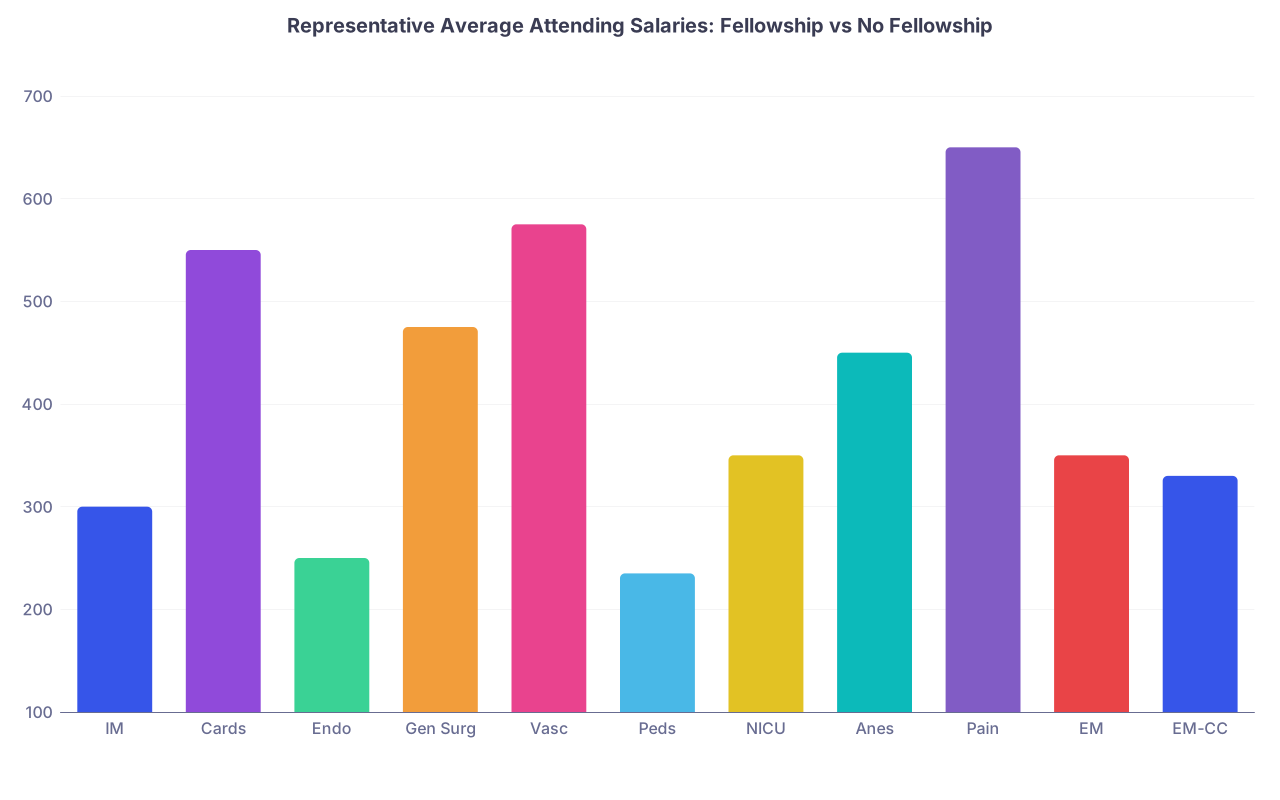
| Category | Value |
|---|---|
| IM | 300 |
| Cards | 550 |
| Endo | 250 |
| Gen Surg | 475 |
| Vasc | 575 |
| Peds | 235 |
| NICU | 350 |
| Anes | 450 |
| Pain | 650 |
| EM | 350 |
| EM-CC | 330 |
The bars that matter are the deltas:
- IM → Cards: +$250k
- IM → Endo: −$50k
- GS → Vasc: +$100k
- Peds → NICU: +$115k
- Anes → Pain: +$200k
- EM → EM‑CC/academic: often −$20k (or more) even if the official number looks similar, because of RVU and schedule differences.
Timeline View: How Extra Training Delays High Earnings
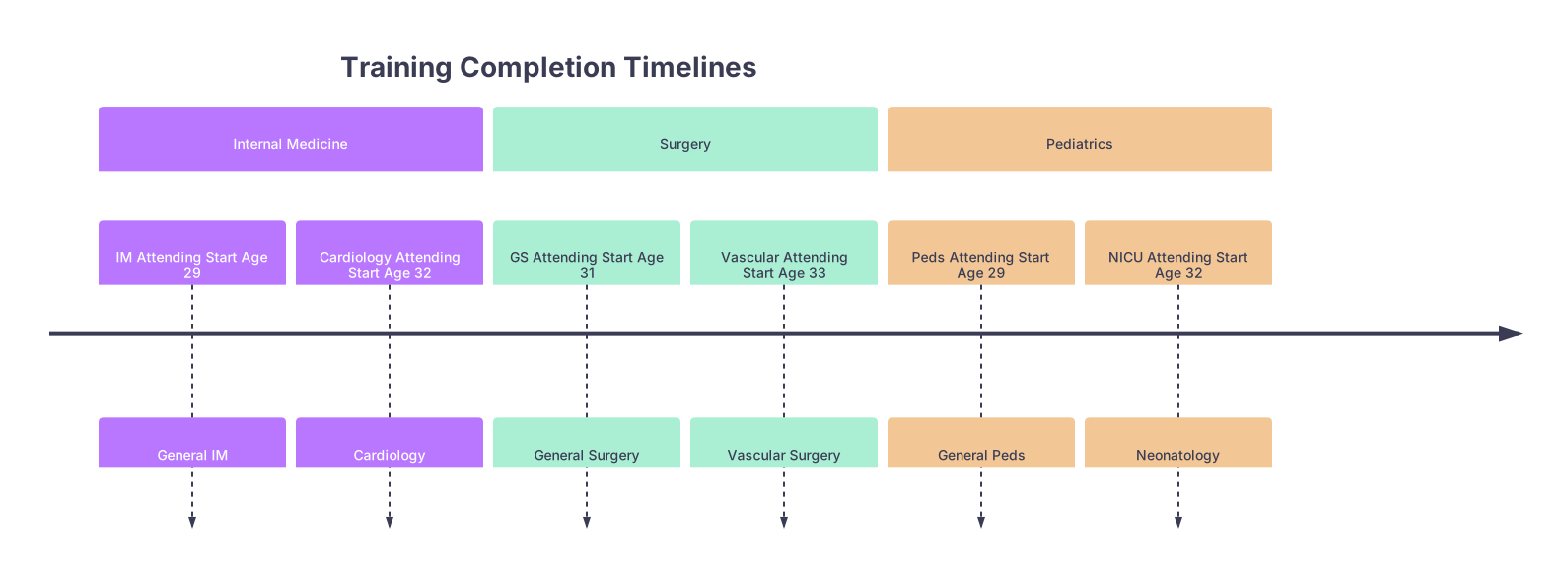
| Period | Event |
|---|---|
| Internal Medicine - IM Attending Start Age 29 | General IM |
| Internal Medicine - Cardiology Attending Start Age 32 | Cardiology |
| Surgery - GS Attending Start Age 31 | General Surgery |
| Surgery - Vascular Attending Start Age 33 | Vascular Surgery |
| Pediatrics - Peds Attending Start Age 29 | General Peds |
| Pediatrics - NICU Attending Start Age 32 | Neonatology |
Each extra year of fellowship is not just another year of modest pay. It is one fewer year of compounding high attending income.
From a wealth‑building perspective, those early attending years are disproportionately valuable. If you invest aggressively in your 30s, the money has decades to grow. NPV math already captures this with discounting, but behavioral finance makes it even starker: early years often determine whether you ever feel “ahead” financially.
Decision Framework: When Fellowship Makes Financial Sense
You should not memorize every number above. You need a simple decision framework you can apply specialty by specialty.
Ask four quantitative questions:
- How many additional years of training?
- What is the realistic salary difference vs my best no‑fellowship option?
- How stable is that higher earning path (job market, geography, procedure volume)?
- Am I likely to reduce my career length (early retirement, part‑time) if I choose the more demanding fellowship path?
Here is a simple rule of thumb that actually works:
| Extra Fellowship Years | Minimum Annual Pay Increase to Break Even (Approx, 3% Discount) |
|---|---|
| 1 year | ~$40k–$60k |
| 2 years | ~$80k–$120k |
| 3 years | ~$130k–$180k |
If the realistic salary bump is below these thresholds, you are likely destroying NPV.
You can of course fine‑tune with exact tables. But directionally:
- Cardiology, GI, Pain easily clear the threshold → financially rational.
- Most cognitive IM/peds fellowships do not → financially irrational.
- Surgical fellowships sit near the thresholds → heavily dependent on local job market and your negotiation skills.
Non‑Financial Factors (You Still Have to Live Your Life)
I am not pretending money is the only variable. It is not. But the honest move is to clearly separate:
- Financial logic (NPV, salaries, time cost), from
- Identity, interest, lifestyle, prestige.
If you love endocrine and would be miserable in general IM clinic, then the correct statement is:
“I am willing to give up roughly $1–1.5M of lifetime NPV to do the work I enjoy more.”
That is a rational, adult trade‑off.
What I see too often is the opposite: people assume “fellowship = higher pay” because that is how it works in some specialties (cards, GI, pain), then discover post‑fellowship that they are earning the same or less than strong generalists while carrying more call and a narrower job market.
Run the numbers before you lock in.
Quick Comparative Snapshot Across Selected Paths
| Base Specialty | Fellowship Path | Extra Years | Salary (No F) | Salary (With F) | NPV Effect (Directional) |
|---|---|---|---|---|---|
| IM | Cardiology | 3 | 300k | 550k | Strongly Positive (~+$3.5M) |
| IM | Endocrinology | 2 | 300k | 250k | Strongly Negative (~−$1.5M) |
| Gen Surg | Vascular Surgery | 2 | 475k | 575k | Slightly Positive (~+$0.5–1M) |
| Peds | Neonatology | 3 | 235k | 350k | Moderately Positive (~+$1–1.5M) |
| Anesthesia | Pain Medicine | 1 | 450k | 650k | Strongly Positive (~+$2–3M) |
| EM | EM Critical Care | 1–2 | 350k | 330–360k | Typically Negative |
This is not precise forecasting. It is a sanity check. If your personal numbers contradict this table, you should be very sure of your data source and contract specifics.
How to Run Your Own NPV in 10 Minutes
You do not need a PhD in finance. A basic spreadsheet is enough.
- Make two columns of ages: from residency start age to retirement age for both paths.
- Assign salary to each age for path A (no fellowship) and path B (with fellowship).
- Choose a real discount rate: 3% is reasonable.
- For each year n, compute: salary / (1.03^n).
- Sum column A, sum column B. Compare.
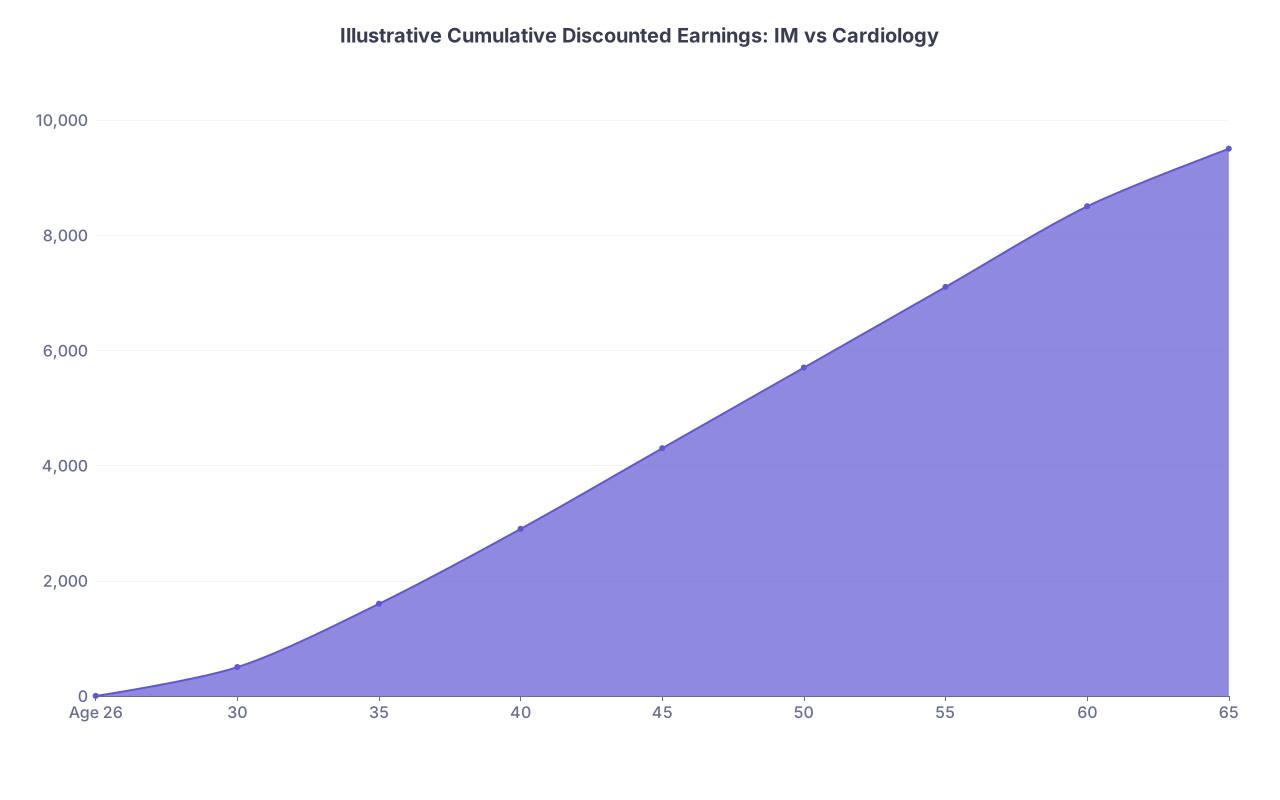
| Category | Value |
|---|---|
| Age 26 | 0 |
| 30 | 500 |
| 35 | 1600 |
| 40 | 2900 |
| 45 | 4300 |
| 50 | 5700 |
| 55 | 7100 |
| 60 | 8500 |
| 65 | 9500 |
If the subspecialty curve never meaningfully pulls away from the generalist curve by your mid‑40s, you likely made a negative‑NPV choice.
Final Takeaways
- Fellowship is not automatically a financial upgrade. The data shows large positive NPV in a few high‑pay subspecialties (cards, GI, pain) and strongly negative NPV in many cognitive or academic‑heavy tracks.
- The key drivers are simple: extra years of training and annual salary delta. If your fellowship does not add at least ~$50k per extra training year (and usually more), you are probably sacrificing over $1M of lifetime NPV.
- Decide with eyes open: do the math, then consciously choose whether you are willing to trade that NPV for interest, lifestyle, prestige, or mission. That is a reasonable trade. Pretending the numbers do not exist is not.