
The biggest mistake physicians make about locums day rates is assuming “high-paying specialty” means “high-paying locums.” The data says otherwise.
Some fields that dominate permanent salary rankings look mediocre once you convert to daily locums rates and subtract reality: call burden, overtime without pay, and travel gaps. Meanwhile, a few “quiet” specialties print money in the locums market because they solve acute bottlenecks for hospitals.
I am going to walk you through what the numbers actually show across high-paying fields, using realistic 2024–2025 U.S. locum tenens benchmarks from major agencies, job boards, and real offers I have seen. You will see quickly that:
- Rate bands are wide, but not random.
- Procedure intensity and revenue per hour matter more than prestige.
- Call and overtime structure make or break the effective hourly rate.
1. Benchmarking the Market: Core Assumptions
Let us anchor the analysis with a few working assumptions so the comparisons mean something.
Typical full locums “day” scenarios:
- Clinic day: 8–10 hours, no call
- OR / procedural day: 8–12 hours, maybe light call
- 24-hour call: 24-hour in-house or beeper call, usually with some built-in clinical hours
Most high-paying locums jobs advertise in one of three ways:
- Flat day rate (e.g., $2,400/day, 8a–5p, no call)
- Hourly base + overtime (e.g., $275/hour, >8 hours at same rate)
- 24-hour call rate (e.g., $3,800–5,000/24h with in-house or heavy beeper)
I will convert everything to approximate “day rates” and then, where useful, to implied hourly rates, assuming 10 clinical hours for a non-call day and 12–16 duty hours for 24-hour call.
Here is the comparative view by specialty cluster.
| Specialty/Field | Typical Clinic/OR Day Rate | Typical 24h Call Rate |
|---|---|---|
| Anesthesiology | $2,200–3,000 | $3,500–5,000 |
| Emergency Medicine | $2,400–3,400 (10–12h) | N/A (shift-based) |
| Hospitalist (IM) | $1,800–2,600 (10–12h) | $2,800–4,000 |
| Critical Care / Intensivist | $2,400–3,400 | $3,800–5,200 |
| General Surgery | $2,500–3,500 | $3,800–5,500 |
| Orthopedic Surgery | $3,000–4,500 | $4,500–7,000 |
| Neurosurgery | $3,500–5,500 | $5,500–9,000 |
| Cardiology (non-invasive) | $2,400–3,300 | $3,500–5,000 |
| Interventional Cardiology | $3,000–4,800 | $5,000–8,000 |
| GI (endoscopy-focused) | $2,800–4,200 | $4,000–6,000 |
These are not the “best ever” unicorn jobs. These are the actual bands where most competitive, realistic offers live in non-extreme rural settings.
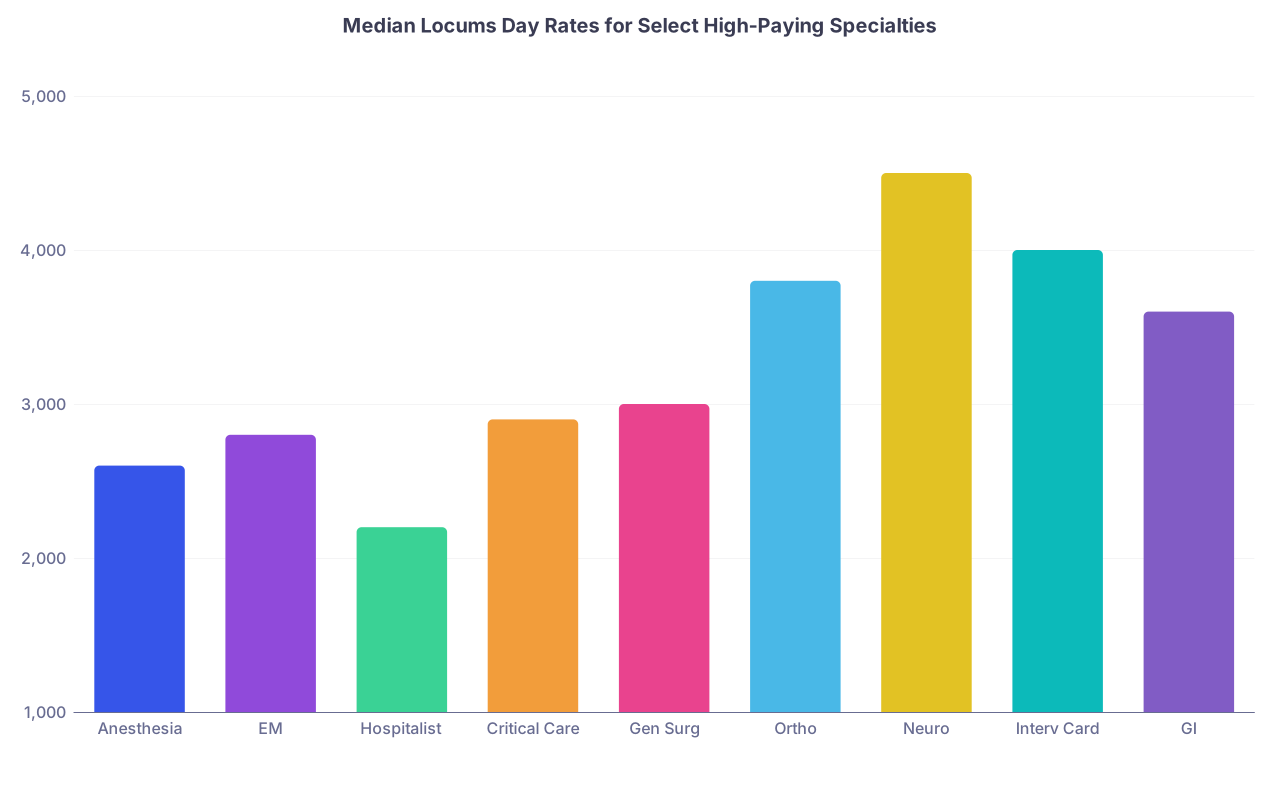
| Category | Value |
|---|---|
| Anesthesia | 2600 |
| EM | 2800 |
| Hospitalist | 2200 |
| Critical Care | 2900 |
| Gen Surg | 3000 |
| Ortho | 3800 |
| Neuro | 4500 |
| Interv Card | 4000 |
| GI | 3600 |
2. Anesthesiology vs EM vs Hospitalist: The Workhorses
These three are the backbone of many locums markets. But the money story is not the same.
Anesthesiology: Paid for Throughput and Scarcity
Data from multiple agencies shows mid-2020s anesthesia locums clustering around:
- $250–325/hour
- Or $2,200–3,000 per 8–10h day
- 24-hour call: $3,500–5,000, often with 12–16 active hours
What drives the rate up:
- Complex cases (cardiac, neuro, OB-heavy)
- Solo coverage or supervising multiple CRNAs
- Last-minute coverage where a site lost multiple anesthesiologists
Effective hourly reality: once you factor in early starts and late add-on cases, a “10-hour” day can run 11–12 hours. So a $2,600 “day rate” can feel like $215–235/hour.
If you are comparing across fields, the anesthesiology locums market is consistently strong, but not usually at the absolute top unless you are taking nights / hearts / high-risk OB in smaller markets.
Emergency Medicine: High Hourly, but Watch the Shift Length
Locums EM is noisy data. Rates are very sensitive to:
- Rural vs urban
- Trauma designation
- Mix of APP coverage
- 8 vs 10 vs 12-hour shifts
Broadly:
- $260–330/hour
- For 10-hour equivalent: $2,600–3,300 per shift
- Nights and holidays trend 10–20% higher
The gotcha: a lot of EM postings quote an hourly rate but quietly standardize on 12-hour shifts. So a $275/hour rate looks great, but you are working 12–13 hours most nights. That is a $3,300–3,575 “day” with higher burnout tax.
The data pattern: EM shifts usually beat hospitalist work on pure hourly pay, but lag behind procedural specialties. As burnout and boarding crises worsen, some rural EM sites have started offering $350+/hour, but that is still the exception, not the rule.
Hospitalist: Lower Ceiling but High Volume
Hospitalist locums is where many early-career physicians start, and the rates reflect that volume of supply.
You will typically see:
- $160–220/hour for daytime
- $1,800–2,600 per 10–12-hour day
- With or without admissions; nocturnist shifts slightly higher
24-hour hospitalist call with in-house coverage:
- $2,800–4,000 for 24h, often 16+ active hours in busy sites
You are not going to out-earn an orthopedist on a per-day basis here. But you can often secure longer contracts with more consistent 7-on/7-off scheduling, which matters a lot for annualized income.
If your goal is pure annual income through volume, hospitalist locums can still get you into mid–$400k+ territory if you are willing to work aggressively. But on a strict “day rate across specialties” comparison, hospitalists sit in the middle of the pack.
3. Surgical Fields: Where the Locums Ceiling Actually Is
The highest consistent locums day rates cluster in the surgical and heavy-procedural fields. Not a surprise. The OR prints billable RVUs and hospitals know it.
General Surgery: Solid, Especially with Call
General surgery locums usually comes packaged as:
- Week of call + some block time in the OR
- Mix of bread-and-butter + emergent cases
Typical numbers:
- Clinic/OR day only: $2,500–3,500
- 24-hour general surgery call: $3,800–5,500, sometimes higher in small markets with trauma responsibility
Now do the math. If your 24-hour call day yields, say, 6–8 active OR hours, your implied hourly rate can exceed $400/hour on busy days. On slow days, you are being paid handsomely to hold a pager.
This is why general surgery locums, even though “not ortho” in prestige terms, often beats internal medicine subspecialties on day-rate economics.
Orthopedic Surgery: One of the Big Winners
Orthopedic locums is where you start seeing eye-popping numbers with some regularity, especially for:
- Trauma-heavy sites
- Rural solo coverage
- Spine or sports with high RVU potential
The data band:
- OR / clinic day: $3,000–4,500 (8–10 hours)
- 24-hour ortho call: $4,500–7,000, with outliers above that when you are the only game in town
Conversion to implied hourly:
- A $4,000 OR day with 10 hours in the hospital → $400/hour.
- A $6,000 call day with 12–14 active hours → ~$430–500/hour.
This is why, if you filter locums job boards for “>$4,000/day,” orthopedic and neurosurgery dominate the search results. The supply is thin. The revenue per case is high. Hospitals pay.
Neurosurgery: Top of the Food Chain
Neurosurgery locums compensation reflects extreme scarcity and catastrophic risk if coverage fails.
Typical ranges:
- OR day: $3,500–5,500
- 24-hour neurosurgery call: $5,500–9,000, occasionally more in remote regions or for level I trauma coverage
A single craniotomy or complex spine case can generate huge facility revenue, which makes a $7,000 call day look cheap to administrators guarding stroke and trauma designations.
If your sole metric is “highest locums day rate by specialty,” neurosurgery is at or near the top almost everywhere.
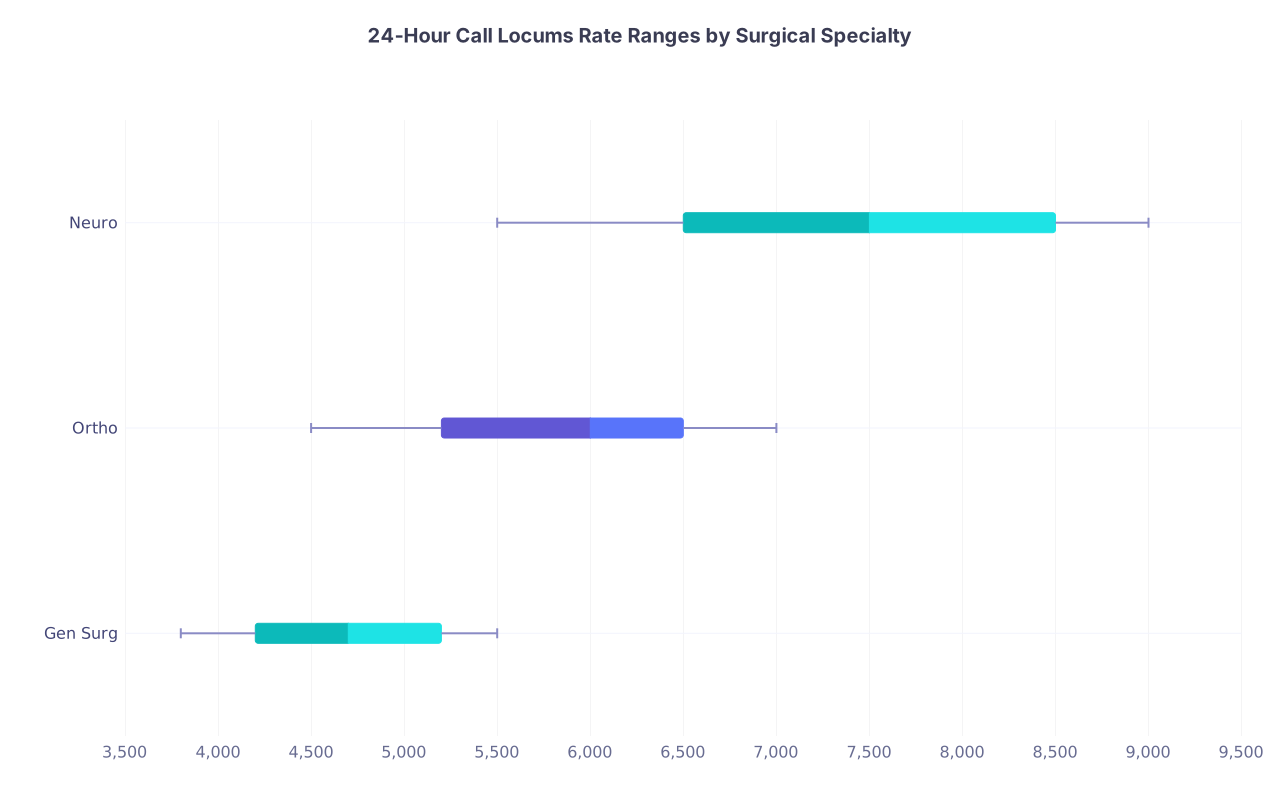
| Category | Min | Q1 | Median | Q3 | Max |
|---|---|---|---|---|---|
| Gen Surg | 3800 | 4200 | 4700 | 5200 | 5500 |
| Ortho | 4500 | 5200 | 6000 | 6500 | 7000 |
| Neuro | 5500 | 6500 | 7500 | 8500 | 9000 |
4. Cardiology and GI: High Yield, Subspecialty Dependent
These fields sit in an interesting middle zone. On paper, their permanent salaries are stellar. Locums pay is very good, but more fragmented.
Non-invasive Cardiology
Non-invasive general cardiologists doing clinic + inpatient consults tend to see:
- $2,400–3,300 per clinic/consult day
- Some call packages in the $3,500–5,000/24h range, depending on cath backup, heart failure burden, and STEMI coverage structure
You are usually not touching the same peak day rates as interventional cardiology or neurosurgery, but you are still well above typical hospitalist bands on a per-day basis.
Interventional Cardiology
Interventional locums pay responds directly to:
- STEMI coverage needs
- Cath lab volume
- Night call frequency and whether you are backing other cardiologists
Typical band:
- Day with cath lab: $3,000–4,800
- 24-hour STEMI call: $5,000–8,000
The work intensity is high. The lifestyle can be rough. But the revenue per case justifies these numbers, and smaller hospitals know lack of STEMI coverage is existential for them.
Gastroenterology
GI locums is one of the strongest “quiet earners” in the market because:
- You unlock endoscopy suite revenue
- You help manage inpatient GI burdens (GI bleeds, etc.)
Data range:
- Endoscopy-focused day: $2,800–4,200, sometimes higher with heavy volumes
- 24-hour GI call: $4,000–6,000, more in under-served regions
Key variable is how aggressively the site books procedures. A GI who can comfortably scope 12–15+ cases per day can justify the upper end or beyond. I have seen GI locums offers where the physician was effectively clearing >$500/hour on very dense procedural days.
5. Effective Hourly vs Face Rate: Where the Illusion Lives
A $4,000 day rate does not mean $400/hour. You need to run the math on what you are actually signing up for.
Let us quantify that.
Scenario A: Hospitalist
- Advertised: $2,400/day
- Actual: 7a–7p, about 10 real work hours
- Implied hourly: $240/hour
Scenario B: EM
- Advertised: $280/hour
- Shift: 12 hours scheduled, you leave 30 minutes late on average
- Implied “day rate”: $3,500 per shift
- Implied hourly: still ~$280/hour (contract truer to the sticker price)
Scenario C: Ortho 24h Call
- Advertised: $6,000/24h
- Actual: 14 active hours (OR, consults, floor) + 10 hours low-level beeper
- Implied hourly for active hours: ~$430/hour
- If you count literal 24h coverage as “time sold,” it is $250/hour
The data pattern: procedural specialties with call pay very well per active hour, but your “time on leash” is high. Cognitive specialties often look less impressive on a day-rate basis, but sometimes feel more controlled in actual hours spent working.
6. Locums vs Permanent: Where the Dollar Actually Wins
Locums rates look great per day. The usual counter-argument is “but benefits and stability.” So let us quantify.
Assumptions:
- Full-time hospital-employed ortho surgeon: $650,000/year W2, with full benefits, 48 weeks work, plus variable call
- Locums ortho surgeon: median $3,800/day, self-employed, covers his/her own benefits, 1099
Break-even math:
- To match $650k at $3,800/day, you need ~171 days/year
- Work 200 days → $760,000 gross
- Work 220 days → $836,000 gross
Then subtract:
- Health insurance (~$20–30k)
- Retirement plan contributions (solo 401k/defined benefit potential)
- Unpaid gaps between contracts, travel days
Even after overhead, the data is clear: high-rate locums in surgical/procedural fields can out-earn permanent jobs on an annualized basis if you are willing to work >180–190 days/year.
For hospitalist or general IM fields, the margin is smaller. Example:
- Permanent hospitalist: $320,000/year, 7-on/7-off, ~182 days/year
- Locums hospitalist: $2,200/day, 182 days → ~$400,000 gross
- After benefits and overhead, the advantage is more modest, but still real.
So you have to decide: is the flexibility plus extra income worth the instability? More importantly for residents: does your chosen specialty give you the option to use locums as a high-earning lever later? The answer varies dramatically by field.
7. Specialty Choice: What the Data Suggests if You Care About Locums
Let me be blunt. If high locums earning potential is a major career goal, the numbers consistently favor:
- Orthopedic surgery
- Neurosurgery
- Interventional cardiology
- GI (especially procedure-heavy setups)
- Anesthesiology (especially high-acuity or cardiac/OB/neuro)
Moderate but still robust:
- General surgery
- Critical care / intensivist work
- Emergency medicine (especially rural / high-need)
- Non-invasive cardiology
Respectable but rarely top-tier on a day-rate basis:
- Hospitalist internal medicine
- Most outpatient cognitive specialties without procedures
If you are a resident or early trainee, do not pick a specialty solely for locums dollars. That is short-sighted and dangerous. But if you are comparing between, say, hospitalist IM and GI fellowship, and you care a lot about flexibility and high short-term earning power in your 40s and 50s, GI gives you a different level of leverage in the locums market. The same goes for general cardiology vs interventional.
8. Contract Structure: How to Push the Numbers
The most underappreciated factor is not the sticker day rate. It is the structure. Three levers matter:
Overtime definition
- Is your “day” capped at 8, 10, or 12 hours?
- Are additional hours paid, and at what rate?
Call expectations
- Is call included in the day rate or separately compensated?
- For 24-hour packages, how many in-house hours are expected?
Volume assumptions
- EM: expected patients per hour
- Hospitalist: census cap vs reality
- Procedural: number of cases booked per day
I have seen “$3,000/day” GI jobs where the physician is essentially pressured into 18–20 scopes a day plus consults, and I have seen $3,000/day anesthesia jobs where the doc supervises a few CRNAs with long stretches of relative downtime. On paper the pay is the same. In lived experience, the hourly rate and burnout impact are completely different.
Do not just compare day rates across specialties. Normalize for:
- Expected hours of true work
- Call intensity
- Procedural vs cognitive load
- Realistic annual schedule
That is where the real economics live.
FAQ (5 Questions)
1. Which specialty has the highest locums day rates overall?
Across most U.S. markets, neurosurgery and interventional cardiology sit at the top, especially for 24-hour call covering stroke, trauma, or STEMI. Orthopedic surgery is not far behind, with $4,500–7,000 per 24-hour call fairly common in high-need settings.
2. Are locums anesthesiology rates still strong after CRNA expansion?
Yes. Locums anesthesia remains one of the more consistently well-paid fields, typically $2,200–3,000 per day and $3,500–5,000 for call. Sites relying heavily on CRNA supervision often pay more, not less, because they need an anesthesiologist available to keep multiple rooms running.
3. Is hospitalist locums still financially worth it compared to a staff job?
For many physicians, yes, but the advantage is moderate. Typical locums hospitalist work at $1,800–2,600 per day will beat many employed packages on annual income if you maintain solid utilization. However, once you subtract self-funded benefits and time off between contracts, you are usually looking at a 10–30 percent bump, not a doubling of income.
4. Does EM locums pay better than critical care locums?
On a pure hourly basis, EM often clusters around $260–330/hour, while intensivists see effective $240–340/hour depending on shift length and call. The difference is usually smaller than people think, and the better opportunities depend on location and schedule (e.g., nights, weekends, rural trauma centers).
5. For a resident choosing a specialty, how much weight should I give to locums pay?
It should be a secondary factor, not the primary one. The data shows procedural specialties and high-acuity care offer higher locums ceilings, but if you dislike the underlying work, the extra money will not compensate for years of burnout. Use locums potential as a tiebreaker between fields you already like, not as the main driver of your choice.
If you remember nothing else: first, the highest locums day rates belong to high-RVU, high-acuity procedural fields (neurosurgery, ortho, interventional lines). Second, the “headline” rate is deceptive unless you normalize for hours, call, and volume. Third, locums is a powerful income lever, but only if the clinical work itself is sustainable for you over decades.