It’s July 1st of your final year of residency. You just got your new badge with “PGY-3/PGY-5/Chief Resident” on it. Half your class is already talking about “offers,” “signing bonuses,” and “wRVU thresholds.” You? You have a vague idea you should get paid more than your current $68k and that orthopedics/derm/rads/EM/anesthesia/IR/etc. “pay well.”
That’s not a plan. And if you handle this year passively, you will leave six figures on the table. Easily.
Here’s the month‑by‑month, then week‑by‑week timeline for your final year so you actually land a top‑tier salary in the highest‑paid specialties instead of just taking whatever the first recruiter drops in your inbox.
Big‑Picture Timeline: Your Final Year at a Glance
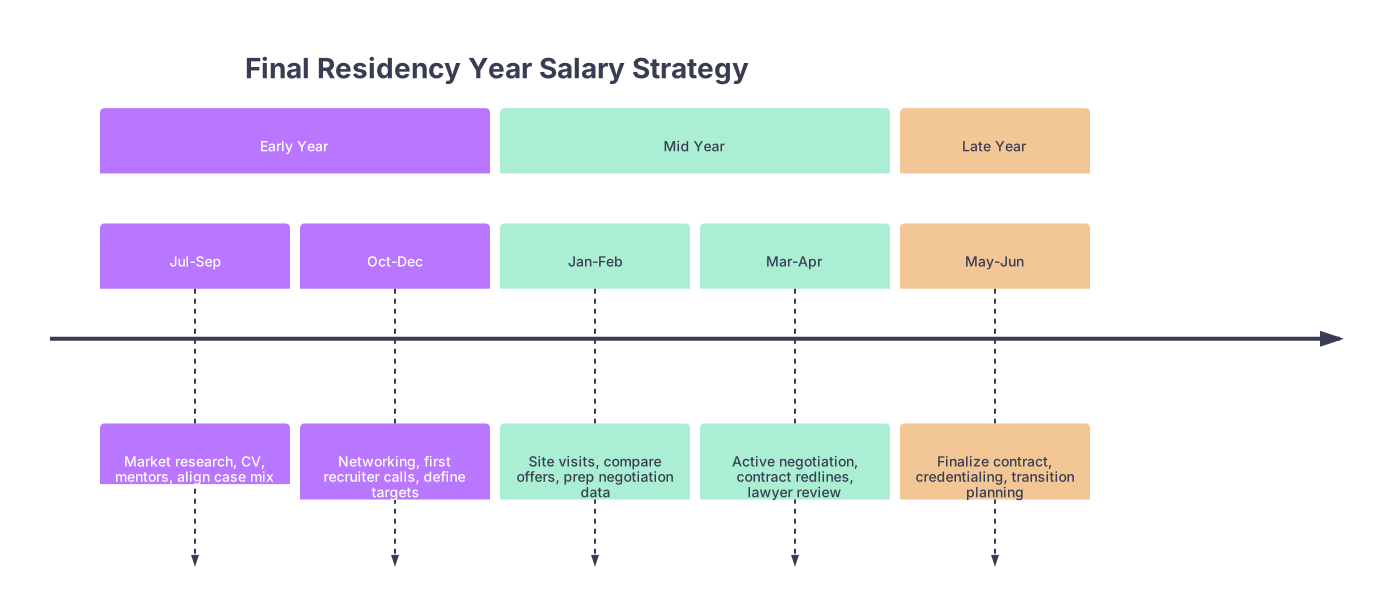
| Period | Event |
|---|---|
| Early Year - Jul-Sep | Market research, CV, mentors, align case mix |
| Early Year - Oct-Dec | Networking, first recruiter calls, define targets |
| Mid Year - Jan-Feb | Site visits, compare offers, prep negotiation data |
| Mid Year - Mar-Apr | Active negotiation, contract redlines, lawyer review |
| Late Year - May-Jun | Finalize contract, credentialing, transition planning |
At this point you should know: this is not “wait for offers and hope.” This is a project. Deadlines, tasks, and leverage.
Let’s walk it from July to June.
July–September: Set Up Your Leverage (You Can’t Negotiate What You Don’t Understand)
July: Know Your Market and Your Value
Right now you should:
Pick your target practice model (at least tentatively).
Highest paid tends to mean:- Orthopedics (esp. spine, joints, sports)
- Neurosurgery
- Cardiology (esp. interventional)
- Radiology (IR and high‑volume DR)
- Anesthesiology (cardiac, high‑acuity groups)
- EM (with caveats, and huge regional swings)
- GI, urology, some surgical subspecialties
Within each, private equity and large hospital systems love dangling big starting numbers with ugly fine print. You need to know your lane:
- Academic vs community vs private practice
- Employed vs partnership track
- Urban high‑COL vs regional/community low‑COL
Pull real compensation data. Not random Reddit threads.
Use:
- MGMA (if you can get it via faculty or department)
- Doximity Compensation Explorer
- Medscape Compensation Report
- Specialty society surveys (e.g., ASA, ACR, AAOS, ACEP)
Build yourself a quick reference:
Sample Median Salaries in Higher-Paid Specialties (Approximate) Specialty Early Career Median Top Quartile Range Orthopedic Surgery $550k–$650k $800k+ Cardiology $450k–$550k $700k+ Radiology $450k–$525k $650k+ Anesthesiology $400k–$475k $600k+ Emergency Medicine $350k–$450k $500k+ Numbers vary wildly by region. That’s the point. You want ranges, not a single “my friend makes X.”
Quantify your current productivity. Top salaries are built on proof of value.
- Ask your program for your case logs, RVUs, and call volume.
- Track:
- Cases per month
- Types of cases (complex vs bread‑and‑butter)
- Procedures you do independently
- Start a simple spreadsheet now. You’ll use this in negotiations later: “I’ve been consistently doing X cases/month with Y complexity and Z wRVUs.”
At this point in July, your action list:
- Draft a basic 1‑page CV
- Collect your case/volume data
- Create a compensation reference file (PDFs/screenshots of data)
August: Align Your Training With High‑Value Skills
If you want top‑end pay, you cannot be “generic.” The best offers go to people with specific, billable skills.
Right now you should:
Identify 1–2 high‑value niches within your specialty. Examples:
- Ortho: complex joints, sports, trauma, spine.
- Rads: high‑volume ER rads, MSK, IR procedures.
- Anesthesia: cardiac, OB, regional blocks, high‑acuity cases.
- EM: ultrasound, airway guru, critical care, administrative/ED flow.
- Cards: advanced imaging, structural, cath volume.
Talk to your PD or mentor about steering rotations.
Conversation you actually have:
“I’m targeting a high‑volume community/PP job focused on X. Over this year, I want to maximize experience in A/B/C and be able to quote my numbers. Can we structure my electives and call to emphasize that?”Start a micro‑portfolio. Nothing fancy. Just a folder with:
- Procedure logs
- Any quality projects (reduced turnaround, improved throughput)
- Leadership roles (chief, committee work)
- Teaching awards, if any
This is what you’ll draw from when a hiring doc asks, “So what exactly can you do on day one?”
September: Build Your Advisor Circle
You do not negotiate a top salary alone. The folks who already make that money know how they got there.
By now you should:
Identify 2–3 senior physicians in your specialty who are clearly doing well.
Not just “nice attendings.” The ones who:- Have excessive RVUs.
- Get pulled into leadership meetings.
- Are known for being “in demand.”
Schedule short meetings with each. Ask very direct questions:
- “If you were me, final‑year resident in 202X, targeting top compensation, what would you do between now and match out?”
- “What red flags do you see in contracts in our specialty?”
- “Who are the worst players in our regional market right now?”
Decide your first‑pass priorities. Rank, for yourself:
- Location
- Total comp
- Partnership potential
- Schedule/lifestyle
- Case mix/academic/teaching
You’ll change your mind later. That’s fine. But you need a starting hierarchy so you do not trade away future partnership just for an extra $30k signing bonus because you’re tired in March.
October–December: Start Surfacing Opportunities (Without Committing Too Early)
October: Clean Up Your Professional Presence
Right now you should:
Polish your CV. Make it look like an attending’s, not a med student’s:
- One page if possible, two max.
- Clear sections: Education, Training, Clinical Experience, Procedures/Skills, Research/Leadership.
- Quantify where you can: “Performed ~250 colonoscopies; independently completing most routine cases.”
Tighten your online footprint.
- Clean LinkedIn (yes, employers check).
- No wildly unprofessional public social media. You know what I mean.
- Optional but useful: brief, simple LinkedIn summary focused on your niche and what you’re looking for.
Write a 3–4 sentence “pitch.” You will use this with recruiters and department chairs:
“I’m a final‑year anesthesia resident at X with strong experience in cardiac and high‑acuity cases, looking for a group where I can build a long‑term, high‑volume practice with a clear partnership or production‑based track within 2–3 years.”
November: Controlled Contact With Recruiters
They’ve already been emailing you. Now you respond—but on your terms.
At this point you should:
Create a separate email folder and spreadsheet for all job contacts.
Track:- Group/hospital name
- Type (academic, PP, employed)
- Location
- Recruiter contact
- Base salary, bonus, call, partnership timeline
- Any obvious red flags you hear
Take a few low‑stakes recruiter calls.
Use these early calls for intel, not commitments. Ask:
- “What’s your starting base and bonus structure?”
- “How are wRVUs or shifts structured?”
- “What’s average take‑home for your docs after 3 years?”
- “What is your turnover like? How many docs left in the last 3 years and why?”
This is reconnaissance. Practice asking uncomfortable questions now so you’re smooth later.
Refine your target ranges.
After several calls plus your compensation data, you should have:
- A realistic floor (the minimum comp package you’d actually take).
- A stretch target (what a strong offer looks like in your chosen areas).
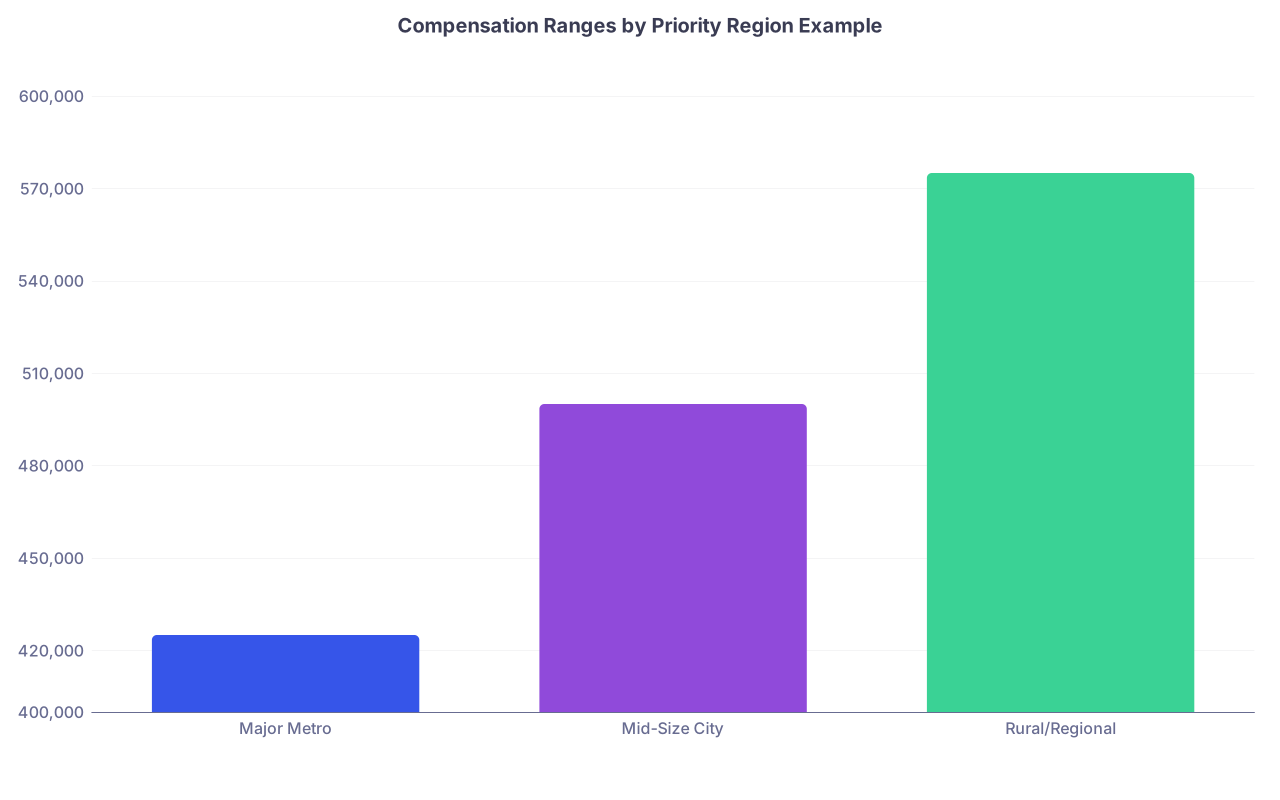
| Category | Value |
|---|---|
| Major Metro | 425000 |
| Mid-Size City | 500000 |
| Rural/Regional | 575000 |
These are just model numbers, but you should be building your own version using real data.
December: Start Talking to Real Decision‑Makers
Now you shift from generic recruiter noise to targeted conversations.
Right now you should:
Ask your mentors to connect you directly with groups.
Example email to your attending:
“I’m starting to look seriously at positions for next year, ideally high‑volume community groups with strong comp and clear partnership. Do you know any practices in [region] you’d trust your own family with?”Take 2–3 serious exploratory calls with hiring physicians, not just recruiters.
On these calls you’re probing:
- Case mix
- Actual schedule
- Culture (“How many people have left in the last 3 years and why?” again)
- What high performers in their group actually earn
Decide where you’d be willing to visit between January and March.
Rank possible sites into:- A‑list: Serious potential
- B‑list: Maybe, if A‑list does not work out
- Hard pass: Trash offers, toxic vibes
By New Year’s, you should have at least:
- 1–3 serious leads you’d consider
- A clear sense of pay ranges for your specialty in different regions
- A working sense of your leverage (niche skills, case volume, willingness to move)
January–February: Site Visits, First Offers, and Data‑Driven Positioning

January: Turn Interest Into On‑Site Interviews
At this point you should:
Schedule on‑site visits for your A‑list groups.
Do not cram them all into one month if you can avoid it. Aim for:- 1–2 visits in January
- 1–2 in February
Prepare a one‑page “value sheet” you keep in your head.
You will not hand this out, but you will speak from it:
- Annual case/shift volume
- Types of procedures you handle comfortably
- Any quality/improvement/efficiency wins
- Your interest in building specific high‑value service lines
On each visit, collect specific compensation info.
Do not leave with just “We’re competitive.” That’s recruiter‑speak for “we underpay.” Ask:- “What is base salary and for how many years?”
- “How do bonuses work? wRVU thresholds? Shift differentials?”
- “What did your last 3 new hires make in their second and third year?”
- “What percentage of physicians make partnership, and how long does it take?”
Document everything within 24 hours of each visit.
February: First Offers and Comparison Framework
By now you should be getting verbal or written offers.
Your job in February:
Turn every verbal offer into a written one.
“This sounds promising. Can you put the key terms in an email or term sheet so I can review and compare accurately?”Build a comparison grid.
Sample Physician Offer Comparison Grid Factor Offer A Offer B Offer C Base Salary Yr 1 $400k $360k $325k Bonus Potential Up to $50k RVU based, uncapped $25k Partnership Track 2 years None (employed) 3 years Call/Schedule 1:6 1:3 1:4 Location Mid-size city Major metro Rural/regional Calculate realistic Year‑3 and Year‑5 income.
High base with no growth can lose long‑term to lower base with real partnership or production.Example:
- Job A: $400k base forever, small RVU bonus, no partnership.
- Job B: $350k base for 2 years, then partnership with average partner income $650k–750k.
If you’re serious about “top salary,” you do not chase the biggest PGY+1 bump. You play for Year 3+.
Start drafting your negotiation playbook.
Based on data and offers, outline for each job:
- What you like (you’ll reinforce those in conversation)
- What you want to improve (base, bonus structure, non‑compete, call, partnership terms)
- Your walk‑away points (hard red lines)
March–April: Active Negotiation and Contract Surgery
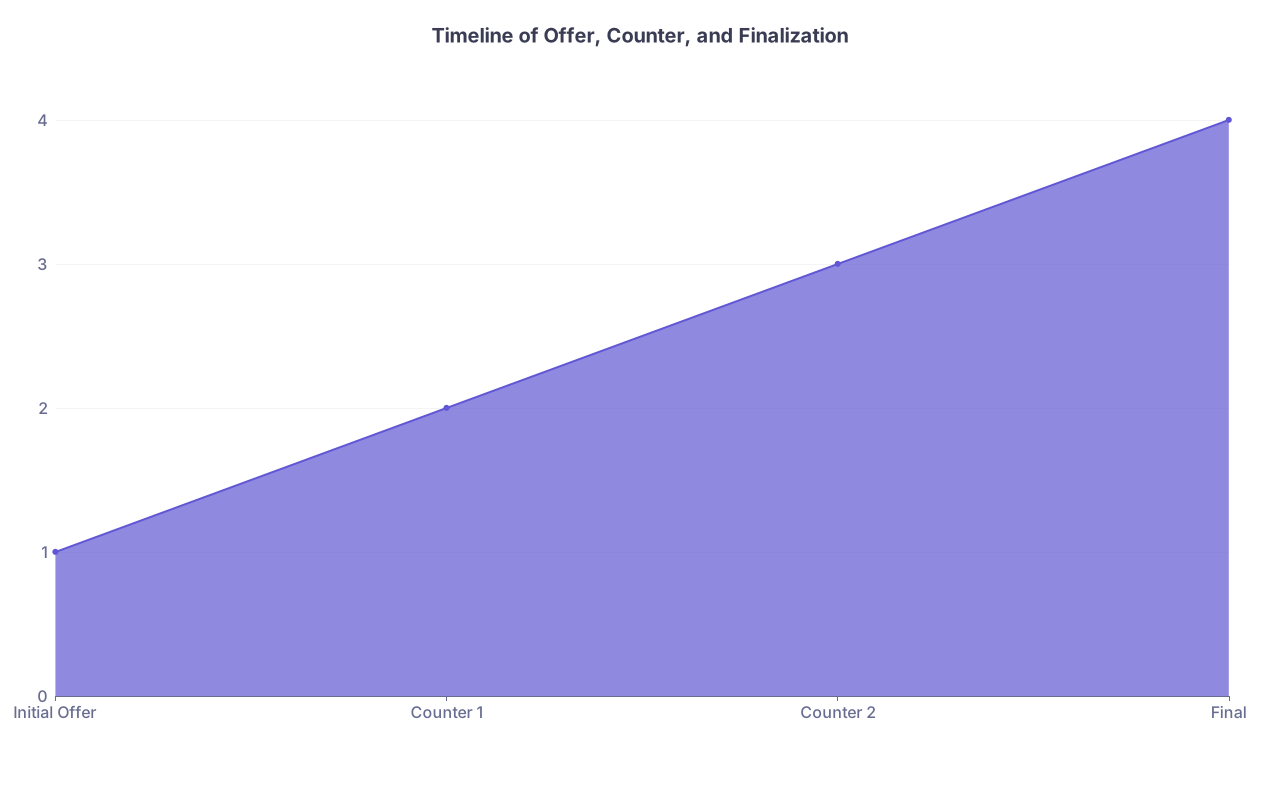
| Category | Value |
|---|---|
| Initial Offer | 1 |
| Counter 1 | 2 |
| Counter 2 | 3 |
| Final | 4 |
(Think of this as phases, not days. Most residents go through them over 4–8 weeks.)
March: Counter Offers With Actual Leverage, Not Vibes
At this point you should:
Get at least one other serious option before you negotiate your top choice.
You need optionality. If you have only one offer, your leverage is limited.Use clear, data‑backed counters.
Example for a high‑pay specialty:
“I appreciate the offer of $375k base with a $25k signing bonus. Based on MGMA data for our region and my case mix—[brief reminder of high‑value skills]—I’d be more comfortable with:
- $425k base,
- a wRVU bonus structure kicking in at [reasonable threshold], and
- a $50k signing bonus given the relocation and call burden.
Is there room to move in that direction?”
Negotiate the right things in the right order.
Priority (for top earnings) usually runs:
- Structure: Employed vs partnership. Partnership terms > small base increase.
- Non‑compete & tail coverage: Don’t trap yourself.
- Production/bonus thresholds and rates.
- Base salary.
- Signing bonus/relocation. (Nice, but often a distraction.)
Do not blow all your negotiating capital on an extra $10k of base while ignoring a 3‑year no‑cause termination clause plus brutal non‑compete.
April: Contract Review and Final Redlines
You should now have at least one contract you’re seriously considering, ideally 2.
Right now you should:
Pay for a physician‑side contract lawyer.
Not your cousin who “does law.” A real healthcare/physician contract attorney who’s seen hundreds of these, in your specialty, recently.Have them focus on:
- Non‑compete radius and duration
- Termination clauses
- Partnership details (buy‑in, governance, real numbers)
- Call requirements and how “extra” work is compensated
- Tail coverage for malpractice
Prepare 3–5 concrete contract redlines.
Do not shotgun 40 changes. Pick key issues that actually impact your income and freedom:- Reduce non‑compete radius/duration
- Clarify or improve bonus/wRVU structure
- Tighten partnership language and timeline
- Ensure tail coverage is employer‑paid or clearly defined
- Adjust unrealistic call expectations
Communicate your edits professionally but firmly.
“I’ve had a healthcare attorney review the contract. I’m very interested in joining, and I’d feel comfortable signing if we can address a few specific items my counsel flagged.”
Then list your top items. Short, clear, no apologies.
May–June: Lock It In and Set Up Your First‑Year Earnings

May: Final Decisions and Contingency Plan
By now you should:
Choose your job. Draw a hard line: by mid‑May, you are committed.
Negotiate your start logistics.
Things that affect year‑one income and sanity:
- Exact start date
- Orientation vs billable time plan
- Support for board prep if relevant
- Moving/relocation timing and reimbursement
- Any early leadership or niche role expectations
Confirm all compensation elements in writing.
Offer letter + final contract should clearly specify:- Base salary and duration of guarantee
- Bonus structure and thresholds
- Partnership track and expected partner compensation (if relevant)
- Call schedule and how extra work is paid
- Signing bonus, relocation, stipends—and repayment conditions
If it’s not written, assume it does not exist.
June: Transition From “Landing the Job” to “Maximizing Year‑One Income”
At this point you’re weeks from graduation. Do not mentally check out.
You should:
Clarify early volume expectations.
Email your future chair or group leader:“For my first 3–6 months, what case volume or shift load should I expect, and what are the realistic production targets for the bonus structure?”
Plan how you’ll ramp up quickly but safely.
Top salaries require top productivity—but you’re still new. Strategy:- Identify which cases/slots are most lucrative and appropriate for your skill.
- Ask what high performers in the group do differently.
- Make it clear you want to be busy once you’re competent and credentialed.
Set a reminder 6–9 months out to review your comp and productivity.
If your first job massively under‑delivers on what was promised (lower volume, bait‑and‑switch schedule), you want to know early so you can quietly plan.
One More Thing: If You’re Late to This Party
If you’re reading this and it’s already, say, February of your final year and you’ve done none of this:
Stop beating yourself up.
Compress the timeline:
- This week: Get your CV in shape, pull your case logs, talk to 1–2 mentors.
- Next 2–3 weeks: Take recruiter calls, schedule 1–2 site visits asap.
- Month after: Get offers, compare, hire a lawyer, negotiate hard.
You’ll be fine. But you cannot keep procrastinating and expect a top‑tier outcome.
Do This Today
Open a blank document and make a 3‑column table:
- Column 1: Your specialty’s realistic comp ranges in 3 regions you’d consider.
- Column 2: Your current quantified value (case volume, procedures, niches).
- Column 3: Names of 3 attendings you’ll email this week for 15‑minute “career and compensation” conversations.
Fill in at least one row in each column right now. That’s your first concrete move toward the salary you actually deserve, not the one you stumble into by default.