
The contracts that pay you the most are usually the ones most likely to trap you.
If you’re aiming for the highest paid specialties—orthopedics, neurosurgery, cardiology, dermatology, GI, radiology, anesthesia—your contract is a weapon. Or a cage. The same clauses that “protect the practice” are often designed to keep you stuck, underpaid relative to your production, and terrified to leave.
I’m going to walk through the contract landmines I see high earners step on over and over. You do not want to be the attending saying, “I didn’t realize my non‑compete meant I’d have to move my kids to another state.”
Read this before you sign anything.
The Non‑Compete That Quietly Owns Your Zip Code
Non‑competes aren’t always evil. But the way they’re written for high‑earning specialties often is.
The classic mistake? You skim it, see “10 miles,” and think, “Fine, I can live with that.”
You don’t read the rest of the sentence.
Typical traps:
- “10–25 miles from any location of Employer at any time during employment”
- “All locations in which Employer does business”
- “For a period of two (2) years following termination for any reason, whether voluntary or involuntary”
That “any location” language is where people get destroyed. You think you’re working at one clinic. They later open three satellites. Congratulations, your non‑compete just ballooned across half the state.
High earners feel this the hardest because your procedures depend on local referral networks and specific facilities. Losing your region = losing 90% of your professional equity.
- Radius measured from any current or future location, not your primary site
- Multi‑year restrictions (more than 12 months is already aggressive)
- Broad specialty definitions like “any practice of medicine” instead of “interventional cardiology”
- Restrictions that apply even if they fire you without cause
Do not accept “we never enforce that” as reassurance. I’ve watched groups say that during recruitment and then turn around and send cease‑and‑desist letters when someone leaves and becomes “too successful” nearby. Handshakes mean nothing. Only the contract matters.
Better versions you should push for:
- Radius measured only from your primary practice site (named in the contract)
- 6–12 months max
- Non‑compete only triggered if you leave voluntarily, or if you’re fired for cause
- Narrow scope: your actual subspecialty, not “any clinical work whatsoever”
If they refuse any reasonable limit and insist “this is standard,” that’s employer‑speak for: “We like our golden handcuffs just the way they are.”
Tail Coverage: The $80,000 Surprise on Your Way Out
Tail coverage is the quiet killer. Especially in high‑risk specialties like OB, anesthesia, neurosurgery, ortho, EM, GI.
Here’s the play: Your base looks okay. Your bonus potential seems good. You’re exhausted and just want to finish fellowship and sign something. Somewhere on page 17 is one line:
“Physician shall be solely responsible for the cost of tail coverage upon termination of employment for any reason.”
You leave after 3 years. Your malpractice carrier quotes you tail: 200–300% of your annual premium. For many high‑risk specialties, that’s $50,000–$120,000. Due immediately if you want to start your next job.
You know what that is? Leverage. They know you’ll hesitate to leave if walking away means writing a five‑figure check.
Common tail traps:
- You pay regardless of who terminates the contract
- You pay even if they fire you without cause
- You pay even if they breach the contract
- Vague language about “professional liability continuity” without clearly stating who pays
You should not sign a contract without crystal‑clear answers to:
- Who pays tail if you resign?
- Who pays tail if they terminate without cause?
- Who pays tail if they merge, sell, or dissolve?
- Is there any vesting (e.g., they pay if you stay X years)?
For many high‑earning roles, the minimum you should fight for:
- They pay tail if they terminate you without cause.
- You split tail or it’s forgiven after a certain number of years (e.g., 3–5 years).
- If they change ownership (buyout, merger), the successor assumes coverage or pays tail.
If they brush you off with “tail is usually not that much,” demand actual numbers. “What’s your current annual premium? What was your last attending’s tail invoice?”
If they won’t tell you? That’s not a good sign.
“For Cause” vs “Without Cause”: The Termination Trap You Don’t See Coming
Everyone focuses on salary and sign‑on. Almost nobody reads the termination clauses with the seriousness they deserve.
Here’s how this bites high earners:
You’re promised a huge bonus, partnership track, profit sharing—later. Early on, they can dump you for vague “cause,” stiff you on your bonus, and block your partnership, all while keeping your panel and referrals.
The nasty clauses show up in two places:
- “For cause” definition that’s ridiculously broad:
- “Failure to meet Employer’s expectations”
- “Disruptive behavior”
- “Failure to maintain satisfactory relationships with staff”
- “Any action deemed adverse to Employer’s interests”
These are not real standards; they’re weapons.
- “Without cause” notice periods that are too short on their side and too long on yours:
- 90 days’ notice if you resign
- 30 days’ notice if they let you go
Meanwhile, your bonus and partnership require you to stay through December 31. Guess when they could conveniently terminate you “without cause”? Right before that.
Insist on:
- Tight, objective “for cause” definitions: loss of license, exclusion from Medicare, felony conviction, verified fraud. Not vague personality judgments.
- Symmetric notice for “without cause” termination. If they want 90 days from you, they give 90 days too.
- Explicit language that earned RVU/bonus compensation up to the termination date will still be paid per the usual schedule.
If you’re in a very high‑earning procedural field, protecting your downstream bonus is just as important as protecting your base.
RVU Formulas That Look Generous but Actually Underpay You
Here’s the dirty secret: practices love RVU systems for high‑earning specialties because they can sound “eat what you kill” fair while being heavily tilted in the employer’s favor.
Common traps:
- High RVU thresholds before you see any bonus (“Productivity bonus begins after 8,000 wRVUs per year”) while your base is mediocre.
- Conversion factors that are lower than market, especially after year 1.
- Changing compensation “at Employer’s sole discretion” with a vague reference to “market conditions.”
And the killer: they never show you the current partners’ true numbers. You’re guessing blind.
Ask them straight:
- What’s the average RVU production for physicians in my specialty in this practice?
- How many RVUs do your top 25% earners produce?
- What’s the conversion factor now? Has it changed in the last 3 years? Up or down?
- Are there caps on bonus payouts?
Then look directly at the contract language. Do not rely on slide decks or verbal explanations.
| Aspect | Trap Version | Reasonable Version |
|---|---|---|
| Threshold | Bonus after 9,000 RVUs | Bonus after 5,000–6,000 RVUs |
| Conversion factor | $40 with right to change anytime | $60 fixed for term or tied to clear index |
| Notice of change | None | 90–180 days and mutual consent for major |
| Transparency | No partner data shared | Historical range and sample statements |
If they refuse to put specific numbers in the contract and keep everything “to be determined by Employer,” you’re volunteering to be underpaid once you’re already stuck in their system.
For high earners, the RVU setup can cost you hundreds of thousands over a few years. That’s not exaggeration. I’ve seen ortho and GI docs generating $1.5M+ in collections taking home $450k because the conversion factor and overhead games were stacked against them.
Partnership Tracks That Never Actually Arrive
Every high‑earning specialty has the same carrot: partnership.
This is how practices pull in ambitious fellows. “Our partners clear $800k–$1.2M. You’d be a great culture fit.” Then they hand you an employment contract that says almost nothing concrete about getting there.
The classic mistakes:
- Partnership described only in separate conversations, not in the contract.
- Language like: “Physician may be considered for partnership after 2–3 years based on mutual agreement.”
- Huge, undefined buy‑ins that you don’t see until you’ve already sacrificed years.
Let me translate “may be considered”: You have no rights. They can like you, work you to death, then decide, “We’re not adding partners this year,” indefinitely.
For high earners, partnership is often where the real money is: ancillaries, imaging, ASC ownership, real estate. If you let them keep that vague, you’re choosing to be long‑term mid‑tier compensation in a high‑tier field.
You should push for, at minimum:
- A defined timeline: e.g., “Physician will be eligible for partnership consideration after 24 months of continuous full‑time employment.”
- Objective criteria: production targets, quality metrics, behavioral standards.
- A written summary (even in an addendum) of:
- Typical buy‑in range
- What you’re buying into (ASC, building, practice only)
- How buy‑in is valued (formula, not “as determined by senior partners” alone)
If they say, “We don’t put partnership details in writing,” ask yourself why. Then ask a few former associates how many actually made partner. And how long it took.
Call Coverage: The Invisible Lifestyle Tax
You know this already: in high‑earning specialties, call is where dreams of balance go to die. But contracts turn that into something much nastier.
I see ugly patterns:
- “Physician shall take call as reasonably assigned by Employer.” That’s it. No cap. No ratio. No pay details.
- Call increases after you sign—because someone leaves—and you have no right to say no.
- Unpaid call that’s “part of the job” while partners quietly pay themselves for the same nights.
If you’re in ortho, neurosurgery, cardiology, EM, anesthesia, or trauma‑adjacent anything, call can make or break both your sanity and your income.
You need specifics:
- Maximum number of call shifts per month.
- Whether call requirements can be increased unilaterally.
- Payment for extra call beyond base expectation.
- Whether call is equal between partners and associates, or tiered.
A real red flag: senior partners with no in‑house call obligations while associates carry the burden. That’s not “mentorship.” That’s exploitation.
At least make sure the contract says that changes in call distribution will be equitable across similarly situated physicians. Better: spell out ratios.
Compensation Clawbacks Disguised as “Incentives”
Signing bonuses, relocation, training stipends—all great. Until you realize the repayment terms effectively lock you in.
Typical pattern:
- $50k signing bonus.
- $20k relocation.
- ~~“Just free money”
- Repayment requirement if you leave before 3 years—any reason.
The really toxic versions:
- You must repay gross amounts (no credit for taxes you already paid).
- Repayment due in full within 30 days of separation.
- Triggers even if they terminate you without cause.
Clawbacks are not inherently evil. But they become shackles when:
- The timeline is too long (more than 2 years is pushing it).
- They apply even if you’re pushed out.
- The repayment formula is not prorated.
You want:
- Clear proration: each month you work reduces the repayment obligation.
- No repayment if they terminate you without cause.
- Longer repayment windows or the ability to set up a payment plan, especially for large amounts.
And you absolutely need to run the numbers. If $70k in total incentives is tied to staying three full years, leaving at 2.5 means walking away from ~$12k (prorated)… or from the entire $70k (if the clause is bad). Those are very different realities.
Multi‑Site Assignments: The Monday Shuffle You Didn’t Sign Up For
High‑earning procedural specialties often get tied to hospitals, ASCs, outreach clinics. Contracts hide a lot of flexibility for the employer here.
The line that should make you nervous:
“Physician agrees to provide services at any location at which Employer conducts business, as assigned.”
This is how you end up:
- Driving 60+ miles between sites multiple times a week.
- Assigned primarily to low‑volume outreach locations while partners sit on the premium OR block time.
- Working in locations added after you signed, with no recourse.
Ask for:
- Designated primary practice site(s) in the contract.
- Limits on new sites: “No more than X miles from primary site unless mutually agreed.”
- Protection against excessive travel during a single day (yes, that happens; I’ve seen radiologists bouncing between hospitals an hour apart in one shift).
If they say, “We need this flexibility,” fine—then you need compensation for it, or written constraints. Otherwise, flexibility just means they’ll send you wherever is least desirable.
Arbitration and Venue Clauses That Strip Your Leverage
Most residents and fellows skip past the dispute resolution section like it’s boilerplate. It’s not. It’s the part that determines how painful it is to stand up for yourself.
Watch for:
- Mandatory binding arbitration in a venue far from where you actually work.
- Employer selects arbitration organization and rules unilaterally.
- You pay half (or more) of arbitration costs.
For high earners with large bonus disputes, partnership disagreements, or non‑compete fights, these details shape your options. Expensive arbitration in a different state is a fantastic way to make you give up rather than fight.
Ideally, you want:
- Venue in the state and county where you primarily practice.
- Clear fee‑sharing: employer shoulders administrative costs or at least does not saddle you with more than your share.
- No clauses that bar you from seeking injunctive or equitable relief in court when they breach (yes, contracts sometimes sneak that in).
Arbitration isn’t always bad, but one‑sided arbitration is.
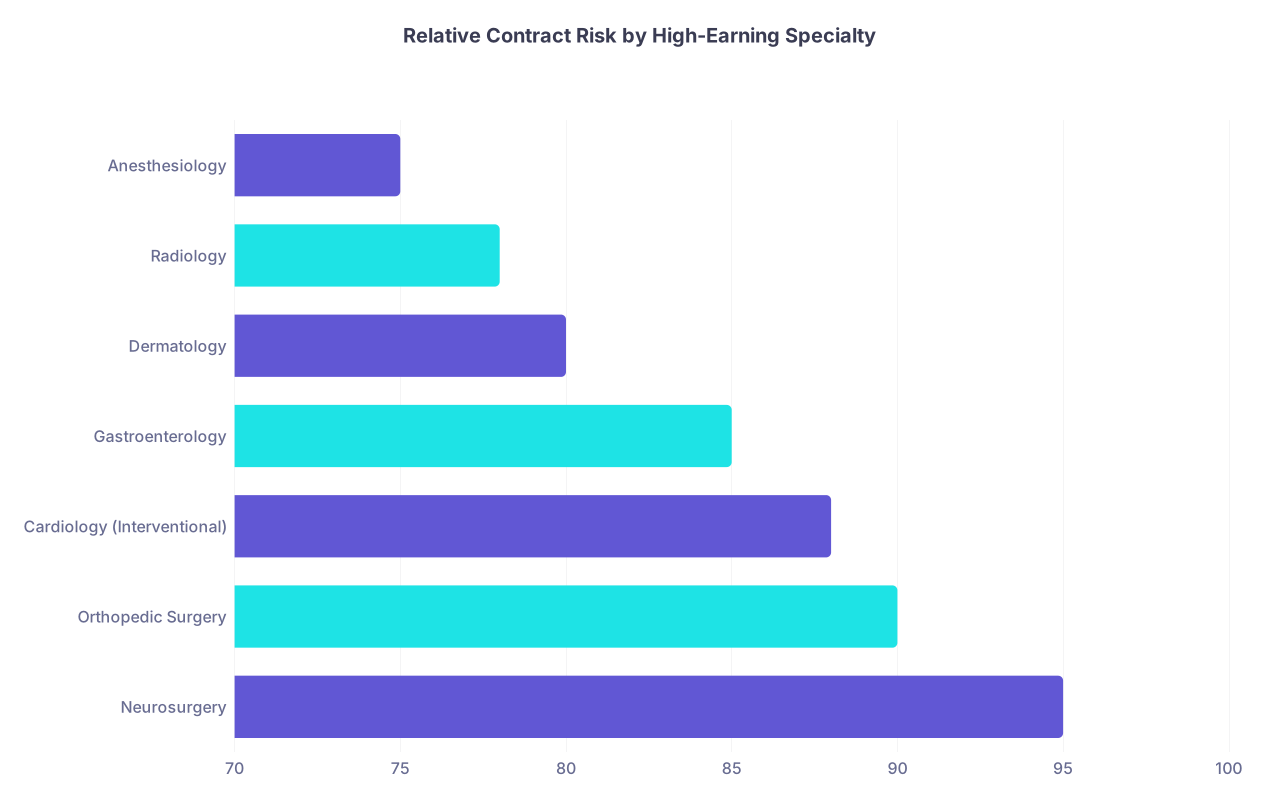
Specialty Snapshot: Who’s at Highest Contract Risk?
Let me be blunt: the more money you can make per hour, the more likely someone is trying to capture that value in writing.
| Category | Value |
|---|---|
| Neurosurgery | 95 |
| Orthopedic Surgery | 90 |
| Cardiology (Interventional) | 88 |
| Gastroenterology | 85 |
| Dermatology | 80 |
| Radiology | 78 |
| Anesthesiology | 75 |
This isn’t scientific, but it tracks with what I’ve seen:
- Neurosurgery / Ortho – Brutal non‑competes, massive tail exposure, heavy call, high‑stakes RVU games.
- Interventional Cardiology / GI – RVU conversion and ASC ownership games, call abuse, partnership mirages.
- Derm – Ancillary profit capture (cosmetics, products), non‑competes locking you out of affluent zip codes.
- Radiology / Anesthesia – Group contracts with hospitals, shift expectations, teleradiology and coverage clauses, restrictive exit terms.
The specialties where “top earners make seven figures” are the same specialties where a bad contract can quietly keep you in the low sixes while you generate seven for everyone else.
How to Actually Protect Yourself (Without Going Crazy)
You don’t have to become a contract lawyer. But you do need a process.
Here’s a sane flow:

| Step | Description |
|---|---|
| Step 1 | Receive Offer and Contract |
| Step 2 | Initial Read Through |
| Step 3 | Push for Clarifying Language |
| Step 4 | Hire Health Law Attorney |
| Step 5 | Attorney Review and Markup |
| Step 6 | Negotiation with Employer |
| Step 7 | Walk Away |
| Step 8 | Final Review and Sign |
| Step 9 | Major Red Flags? |
| Step 10 | Reasonable Revisions? |
Two non‑negotiables:
Get a physician contract attorney. Not your cousin who does real estate closings. Someone who routinely reviews physician contracts in your state and knows your specialty market. Yes, it costs money. So does an $80k tail bill.
Be willing to walk. If there’s zero chance you’ll walk, you have zero leverage. Employers can smell desperation. That’s when they stop “considering edits” and start saying “everyone signs this.”
And do not fall for the “we have many candidates; we can’t individualize contracts.” That’s a line. Call their bluff. High‑earning, hard‑to‑recruit subspecialists are not a dime a dozen.
Quick Comparison: Safer vs Dangerous Clauses
| Area | Dangerous Wording | Safer Wording |
|---|---|---|
| Non-compete | Any location Employer does business, 2 years, any practice | Primary site only, 6–12 months, limited to your specialty |
| Tail coverage | Physician solely responsible for all tail costs | Employer pays if they terminate, prorated after X years |
| Partnership | May be considered based on mutual agreement | Eligible after 2 years, criteria and buy-in method defined |
| Clawbacks | Full repayment if leave before 3 years, any reason | Prorated, waived if terminated without cause |
| Call | As reasonably assigned by Employer | Max X calls/month, extra call paid, equitable distribution |
Read your contract with this lens, and you’ll immediately see where you’re exposed.
FAQ (Exactly 3 Questions)
1. When should I start seriously reviewing contracts during residency or fellowship?
Do not wait until the last month of training. For competitive, high‑earning specialties, you should start reviewing real offers 9–12 months before finishing. That gives you time to compare multiple contracts, negotiate from a position of strength, and walk away from bad deals without panicking about where you’ll work. The worst mistakes I see are from people who signed the only offer they felt they had time to process.
2. Are non‑competes actually enforceable, or can I just ignore them?
In many states, yes, they’re enforceable—especially for physicians—and groups do enforce them when money is at stake. Even if you’d ultimately win in court, the cost, stress, and delay can wreck your life for a year. Do not sign a non‑compete you “plan to fight later.” Negotiate it now or do not sign. Assuming it won’t matter is how people end up moving their families across the country against their will.
3. Is it realistic to negotiate these clauses, or will I lose the offer?
You can negotiate more than you think. No, you won’t get everything you ask for. But you can often narrow non‑competes, clarify partnership, adjust tail responsibility, and fix ugly clawbacks. Employers expect some negotiation, especially from high‑value subspecialists. The real red flag is a group that refuses to change a single word and gets offended you even asked. That’s not a place that’s going to treat you fairly once you’re locked in.
Key points:
- The biggest financial risks for high earners are hidden in non‑competes, tail coverage, and vague partnership language—not just salary.
- Any clause that’s open‑ended, “as determined by Employer,” or “may be considered” is usually code for “we control everything.” Get specifics or walk.