
It is PGY-2 changeover month. You are in the call room at 2:15 a.m., scrolling Doximity’s salary explorer between consults. Your co-intern just told you an anesthesiologist in Texas is “easily clearing 900k.” Someone else swears dermatology is “basically three days a week for half a million.” You are exhausted, underpaid, and tempted to let those numbers push you toward a specialty you are not actually sure you like.
This is where a lot of people quietly blow up their future.
Not because money does not matter. It does. But because residents base career-defining decisions on compensation myths, half-truths, and cherry‑picked anecdotes that sound good at 3 a.m. and look terrible 5 years into attending life.
Let me walk through the biggest myths that push residents toward the wrong field, especially in the “highest paid specialties” club, and how to avoid being that attending who hates their job but feels trapped by their own choices.
Myth #1: “Just Pick the Highest Paid Specialty – Money Will Make Up for Everything Else”
This is the most common and the most dangerous.
The logic sounds simple:
Radiology, ortho, derm, GI, anesthesia, IR, certain surgical subspecialties = high pay.
Primary care, hospitalist work, pediatrics = lower pay.
So “obviously” you pick one from the first list if you can.
The problem is this:
You are not choosing a salary. You are choosing a life template. What you do all day. Who you work with. The problems you solve. What your call feels like at 2 a.m. How your body feels doing it at 55.
I have watched this play out:
- The med student who hated the OR but chased neurosurgery for the prestige and paycheck. PGY-3, miserable, chronic back pain, hates call, stuck because switching will feel like failure.
- The IM resident who liked talking to patients, but forced themselves into cardiology because “cards or GI are the only rational choices.” Now in a high-volume cath lab, resenting every weekend call.
- The anesthesia resident who liked procedures but was actually more drawn to longitudinal care, jumped at CRNA-heavy practice for the income, then felt like an interchangeable cog covering three rooms at a time.
Do not make the mistake of assuming:
- “I can tolerate anything for that pay.”
No. Day after day, year after year, you will not. - “I will get used to it.”
Sometimes. Sometimes you do not, and burnout plus golden handcuffs is a brutal combination. - “I can always cut back later.”
Maybe. After you build your life around that level of income, that “cut back later” becomes much harder.
Pay attention to what you enjoy on your worst days now:
- Do you tolerate long conversations and complex social dynamics?
- Do you like procedures enough to do them over and over and over?
- Does being in the OR drain you or energize you?
Ignoring that in favor of the compensation chart is how you end up in a high-paid specialty you quietly loathe.
Myth #2: “Top-Line Salary Numbers Are Reality”
You have seen the slides:
- Orthopedic surgeon: $600k+
- Interventional cardiologist: $650k–$800k
- Dermatologist: $450k+
- Radiologist: $450k–$550k
And you assume: “If I match into that specialty, that is what I will make.”
This is fantasy.
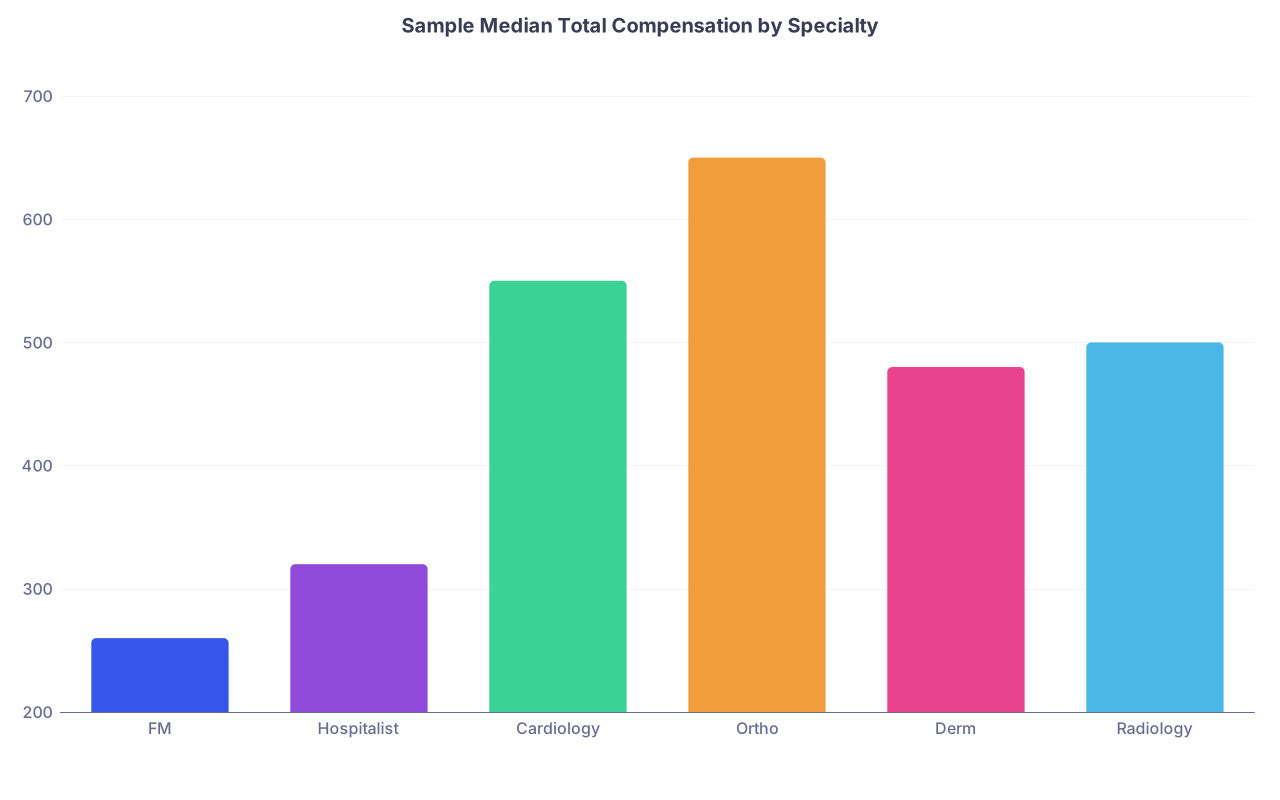
| Category | Value |
|---|---|
| FM | 260 |
| Hospitalist | 320 |
| Cardiology | 550 |
| Ortho | 650 |
| Derm | 480 |
| Radiology | 500 |
These median numbers hide more than they reveal. They ignore:
- Geographic variation
- Partnership vs employed models
- Call requirements
- Productivity expectations (RVUs)
- Ownership opportunities (ASC, imaging center, etc.)
- Payer mix (commercial vs Medicaid vs Medicare)
I have seen this exact bait-and-switch:
- Job ad: “Orthopedic surgeon – up to 850k, partnership track, light call.”
Reality: You hit that only if:- You accept graveyard call no one else wants
- You pump out massive RVU volume
- Partnership buy‑in is high six‑figures and not guaranteed
Or:
- “Derm – 500k+ potential, 4 days a week.”
Reality:- 4 days of clinic, 1 “admin” day that turns into unpaid catch‑up
- 30+ patients per day, mainly medical derm with lower reimbursement
- Cosmetic revenue heavily dependent on your own business skills, not residency training
The mistake: treating the top end of a range like the expected average.
Red flag phrases in salary conversations:
- “Up to”
- “Easily”
- “Our top performers earn…”
- “Uncapped potential”
Translation: you will likely earn less unless you are aggressively productive or willing to sacrifice lifestyle.
Myth #3: “All Jobs in a High-Paid Specialty Pay the Same”
You match radiology or anesthesiology and think: “I am set. Radiologists make X; anesthesiologists make Y.”
That is not how this works.
Within high‑paid specialties, compensation is wildly uneven. The spread between a low-paid and high-paid job in the same field can be hundreds of thousands.
| Role Type | Example Net Compensation (Approx) |
|---|---|
| Academic Radiologist | $330k–$420k |
| Community Hospital Employed | $450k–$550k |
| Private Practice Partner | $650k–$900k+ |
| Teleradiology Contractor | $400k–$700k (high variance) |
Same board certification. Completely different money.
Common misunderstandings:
- Academic vs community:
Residents underestimate how large that gap can be, especially over a career. - W2 employed vs partnership:
That “500k employed” vs “700k partner” is not just a salary difference. It is risk, buy‑in, governance, exit terms, and how screwed you are if the group sells. - Procedure mix:
IR doing mostly lines and paras vs IR doing complex interventions with ASC ownership. Not remotely the same financial picture.
Do not choose a field based on “average specialty income” without understanding:
- What portion of jobs in that specialty actually land near the median
- How many years it takes to reach that level (ramp-up time)
- How much call and volume is baked into that number
If you choose a field solely for pay, you are gambling your career on your ability to land and tolerate the top-paying subset of jobs in that field. That is a big bet.
Myth #4: “Loan Size Means I Must Chase the Max-Pay Specialty”
I hear this a lot:
- “I have $350k in loans. I cannot afford to do pediatrics.”
- “With this much debt, doing family medicine would be irresponsible.”
This is the myth that quietly erodes career satisfaction and mental health.
Debt matters. But the math most residents use is lazy and fear-driven.
Here is what people miss:
- Loan repayment options are flexible.
Income-driven repayment, PSLF, refinancing, side income, spousal income – all change the picture. - Lifestyle inflation dwarfs specialty differences over time.
A frugal family med doc vs a spend-happy interventional cardiologist often end up with very similar net worth trajectories after 10–15 years. - Burnout is expensive.
The high-paid specialist who cuts down to 0.7 FTE, leaves a practice, or takes early retirement because they hate their field can lose millions in lifetime earnings.
I have watched:
- A primary care doc at a PSLF-eligible clinic wipe out six figures of loans while living decently, then negotiate higher pay in a different role later.
- A high-paid subspecialist jump jobs three times in five years, each time losing income during transitions, because they never liked the work.
Do not make the mistake of letting loan anxiety push you into:
- A field you would never choose without debt
- The longest possible training path “for the better salary”
- A malignant culture you tell yourself you will “just endure for a while”
The financially sound move is:
- Choose a field you can stand doing full-time for 25+ years.
- Then optimize within that field using smart job selection and basic personal finance.
You cannot out-earn a career you hate.
Myth #5: “More Training = Automatically Much More Pay”
Another trap: assuming a longer and more competitive training path guarantees dramatically higher long-term income.
Reality: sometimes the delta is modest. Sometimes it is not there at all.
Examples I have seen:
- General IM hospitalist vs nephrology or ID:
Additional fellowship years. Modest or no significant long-term pay bump. Sometimes lower pay. - General surgery vs some surgical subspecialties in saturated markets:
Extra 1–3 years of training, complex call, and not always a proportionally higher salary.
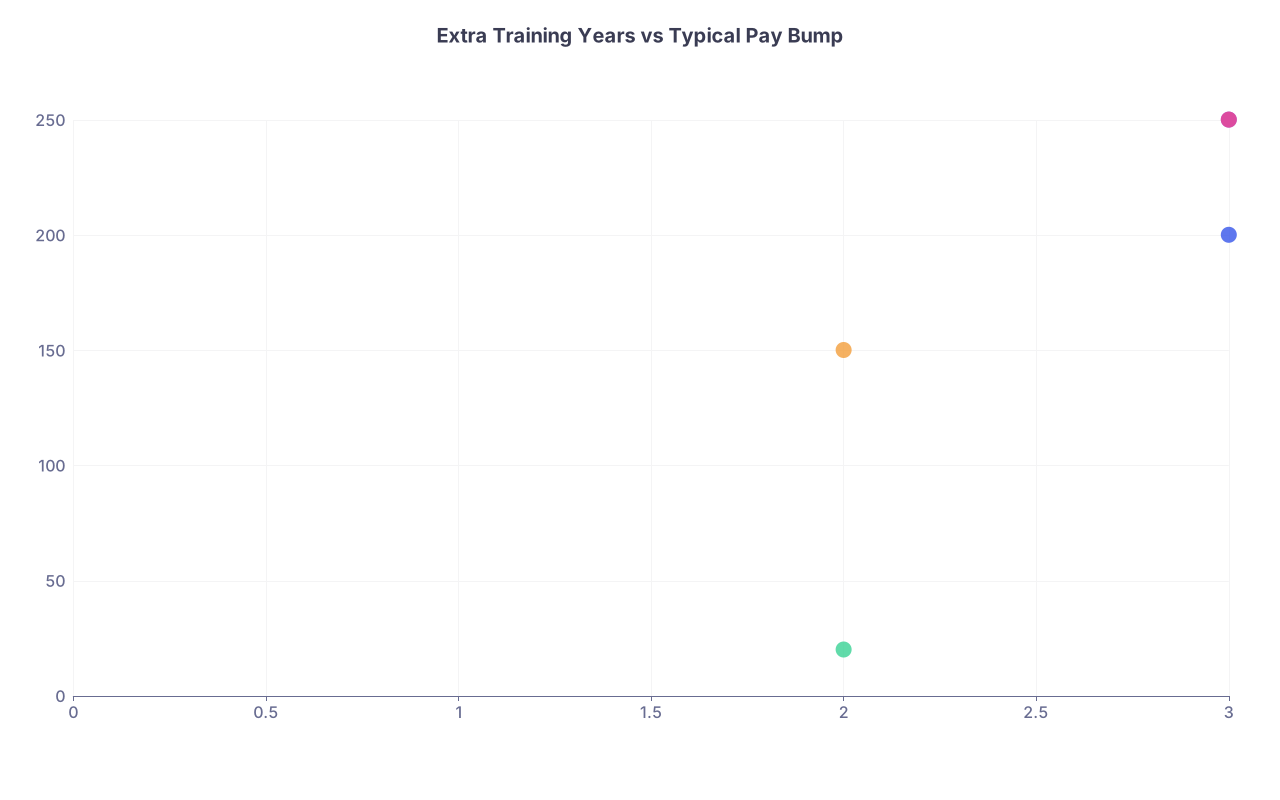
| Category | Value |
|---|---|
| Hosp vs Cards | 3,200 |
| Hosp vs GI | 3,250 |
| Hosp vs Nephro | 2,20 |
| Gen Surg vs Vascular | 2,150 |
| Gen Surg vs CT | 3,250 |
(x-axis = extra years of training, y-axis = approx pay bump in thousands)
You need to ask hard questions before tacking on extra years of fellowship solely “for the money”:
- What is the realistic average compensation in my target region for this fellowship-trained field?
- How many extra years of attending-level income am I giving up to train more?
- Does the schedule or call actually get better, or worse, after this fellowship?
A common mistake:
Doing a fellowship in a “supposedly high-paid subspecialty,” then taking an academic job you like for lifestyle reasons that pays almost the same as you would have earned as a hospitalist years earlier.
If you actually love the subspecialty work, great. If you are stacking training years on the assumption of massive pay increases, run the numbers honestly.
Myth #6: “High Income Always Buys Better Lifestyle”
Residents often believe the caricature version:
- Derm = half days, no call, all cash pay
- Ortho = money printer, some clinic, some OR, everyone happy
- Gas = chill lifestyle, home early, little charting
- Radiology = read from home for huge money
Sometimes you do see versions of this. More often, you do not. Or you trade one problem for another.
Patterns I have seen repeatedly:
- Dermatology:
- Medical derm in academic settings: high volume, RVU pressure, not all cosmetics
- Private cosmetic derm: great pay, but you are also a small business owner, constantly marketing, managing staff, dealing with clientele expectations
- Orthopedics:
- Constant OR time plus clinic, big call for trauma coverage if in certain markets
- Physical wear and tear – not a myth. Shoulders, back, hands.
- Anesthesia:
- Early mornings, uneven days, and in many markets, significant call and nights
- CRNA dynamics and “anesthesia care team” models introduce economic and political headaches
- Radiology:
- Telerad from home can mean brutal overnight shifts, isolation, and treadmill-level volume expectations
- Group politics and the constant fear of being replaced or undercut by larger corporate players
The mistake is assuming that high income = control of schedule. Often, in medicine, it is the opposite. More income comes from:
- More call
- More cases
- More locations covered
- Less autonomy over your day
Lifestyle is not defined by specialty alone. It is defined by:
- Group structure
- Call pool size
- Hospital coverage contracts
- Your own boundaries and willingness to say no
If you prioritize lifestyle, you need to be just as aggressive evaluating job structure as you are chasing compensation.
Myth #7: “You Can Always Switch Later if You Chose Wrong”
You hear this in the workroom:
- “I will do something competitive now; worst case I switch later.”
- “If I hate it, I’ll go do urgent care or something.”
Here is the problem: once you subspecialize heavily, your options narrow.
Examples:
- Interventional fields (cards, IR):
- If you burn out on call or procedures, pivoting to a non-procedural role is possible, but often at a major pay cut and with an identity hit.
- Highly niche surgical subspecialties:
- Switching out of the OR is harder than residents think. There is not always a smooth glide path into simple clinic-only jobs that pay well.
- Ultra-competitive lifestyle specialties (derm, ophtho):
- If you dislike the work, you have fewer “adjacent” clinical roles that fully use that training.
On top of that:
- The more you earn, the easier it is to inflate your lifestyle.
- The more you inflate your lifestyle, the harder it is to walk away from that income.
That is how the golden handcuffs close:
You hate your work, but your mortgage, school tuition, and spending are built for your current salary.
So no, you should not rely on “I can always switch” as a core part of your decision strategy. People do switch. But it is painful, expensive, and rarer than the call-room talk implies.
How to Evaluate Compensation Without Getting Trapped
Let us be practical. You do need to think about money. Just do it intelligently.
Use this checklist as you compare specialties and future jobs:
- Separate field choice from job choice.
- First: Could you tolerate the core work of this field across most job types?
- Then: Within that field, which practice models actually fit your goals?
- Look at full compensation packages, not headline salary.
- Base pay vs bonus vs RVUs
- Retirement match
- Health insurance and disability
- Partnership track details and buy‑in
- Adjust for cost of living.
- 400k in San Francisco is not the same as 400k in a medium-cost city.
- Do rough net calculations, not just gross salary comparisons.
- Ask about the inputs that produce that income.
- Average weekly hours
- Call schedule (weeknights, weekends, in-house vs home)
- Clinic or case volume expectations
- Talk to attendings 5–10 years out, not just the most successful 1–2.
- Ask: “What did you think this field would be like versus what it actually is?”
- And: “If you had to do it again, would you pick this specialty?”
If you are choosing a high-paid specialty, your standard should be:
“I would still choose this field even if the pay dropped by 20–30%.”
If your answer is no, you are probably chasing money more than you admit.
FAQs
1. Is it really a “mistake” to choose a specialty mainly for money if I am otherwise neutral?
If you are genuinely neutral between several fields and do not hate any of them, choosing the higher-paying one is reasonable. The mistake is pretending to be neutral when you are not. If you already know you dislike OR days, extubations, or staring at imaging for hours, do not kid yourself that you are “neutral” just because the salary spreadsheet looks good.
2. How much should debt actually factor into my specialty choice?
Debt should factor into your financial planning, not your whole identity. If you deeply prefer a lower-paying field, choose it, then aggressively optimize repayment: PSLF if it fits, careful cost of living choices, maybe locums or side work for a few years. Changing your entire career path solely to serve your loans is usually backwards. You can restructure debt. You cannot easily restructure a burned-out, misaligned career.
3. Are salary surveys like Medscape or Doximity useless then?
They are not useless, but they are often misused. Use them to understand relative pay between fields and to identify which specialties even have the potential for higher incomes. Do not use them as crystal balls for “what I will earn.” Always remember: those numbers are medians and means, distorted by outliers, specific markets, and selection bias.
4. What is the biggest red flag when someone talks to me about compensation during residency?
Any time someone uses sweeping phrases like “Everyone in X makes at least…” or “You will easily clear…” without specifying: location, practice type, call, and years in practice. Realistic compensation conversations are specific and a little boring. If it sounds like a sales pitch, treat it as one.
Key takeaways:
- Do not choose a specialty purely off the “highest paid specialties” list; you are choosing a life, not just a number.
- Salary myths, cherry-picked anecdotes, and ignoring practice variability are how residents trap themselves in lucrative but miserable careers.
- If you would not do the work for 20–30% less pay, think very carefully before you commit your entire professional life to it.