
The most dangerous time for your money is not when you are broke. It is the first 3–5 years you start making “specialist money” and assume that will fix everything.
For high-earning specialists—orthopedics, neurosurgery, derm, IR, plastics, cardiology, GI—that assumption destroys more balance sheets than bad investments ever will.
You are not “too smart” to mess this up. In fact, your intelligence and delayed gratification can make you more vulnerable, because you think you will simply out-earn your mistakes later.
You will not. Here is what actually trips people up.
1. Treating Loans Like a Math Problem Instead of a Career Risk Problem
Most early specialists make the same first mistake: they optimize for the “lowest total interest paid” without asking the more important question:
“What loan strategy gives me the most optionality if my life or career does not go according to plan?”
I have watched this play out too many times:
- PGY-6 neurosurgery resident: “As soon as I finish, I am refinancing everything to a 5-year variable. I will crush this debt.”
- Two years later: hand issue, can no longer operate full load, partial disability claim pending, still owes $300,000+ at a private lender with no federal protections.
The math was right. The risk management was terrible.
Here is the mistake pattern:
Only comparing interest rates (federal vs private)
Ignoring:
- Disability risk
- Burnout and career change
- Desire for part-time work or academic move
- Potential PSLF (Public Service Loan Forgiveness) via academic/VA employment
Assuming attending-level income is permanent and guaranteed
For high-earning specialists, the biggest hidden asset you have is not your salary. It is flexibility. And the wrong loan move can destroy that in one click.
Do not make this mistake:
- Locking everything into private refinance before you:
- Understand PSLF eligibility for your specialty jobs
- Price out true own-occupation disability coverage
- Have at least a minimal emergency fund (3–6 months of expenses)
Refinancing can absolutely be smart for many specialists. But doing it immediately and purely based on rate is how you take a survivable loan burden and turn it into a lifelong trap.
2. Chasing PSLF You Will Never Actually Earn
The flip side mistake is just as costly: clinging to PSLF because “everyone says it is amazing” when your specialty lifestyle and job preferences make it almost impossible to complete.
I see this a lot in:
- Orthopedic surgeons planning on private practice groups
- Dermatologists dreaming of cash-pay cosmetics
- Interventional cardiologists drawn to high-RVU private hospitals
Their plan:
“I will stay in academics long enough to hit the 10 years for PSLF, then switch.”
Reality:
- They last 2–4 years in academics
- Burn out on low pay, politics, or location
- Move to private practice with 40–70 qualifying PSLF payments made
- Lose the majority of the potential PSLF benefit
They spent years making minimum PSLF payments instead of aggressively paying down principal, and now they are stuck with large federal balances and no forgiveness in sight.
The core mistake:
Using PSLF as a default “safety plan” instead of a deliberate career-aligned strategy.
Ask yourself, honestly:
Does your specialty typically live inside PSLF-eligible employers long-term?
- University medical centers
- VA hospitals
- Larger non-profit systems
Do you personally value:
- Academic work, teaching, research
- Lower relative comp but more stable employment
- Often less geographic flexibility
If the answer is “Probably not,” stop half-committing to PSLF.
Do NOT:
- Sit in an academic job you hate for “maybe” forgiveness while lifestyle creep eats all the difference.
- Fail to refinance when you clearly are heading toward long-term private practice.
For many high-paid specialists, the right move is:
- Accept that PSLF is not your path
- Refinance strategically (once stable)
- Attack the debt with focused aggression
Half-chasing PSLF is worse than not chasing it at all.
3. Confusing “High Income” With “Invincible to Interest”
The next error is ego-based: assuming that once you are a $500k+ specialist, interest is “no big deal.”
I have heard versions of this line in attendings’ lounges more times than I like:
“Yeah, I owe like $450k at 7%, but I am making over $700k now. I will get to it later.”
Here is what “later” looks like.
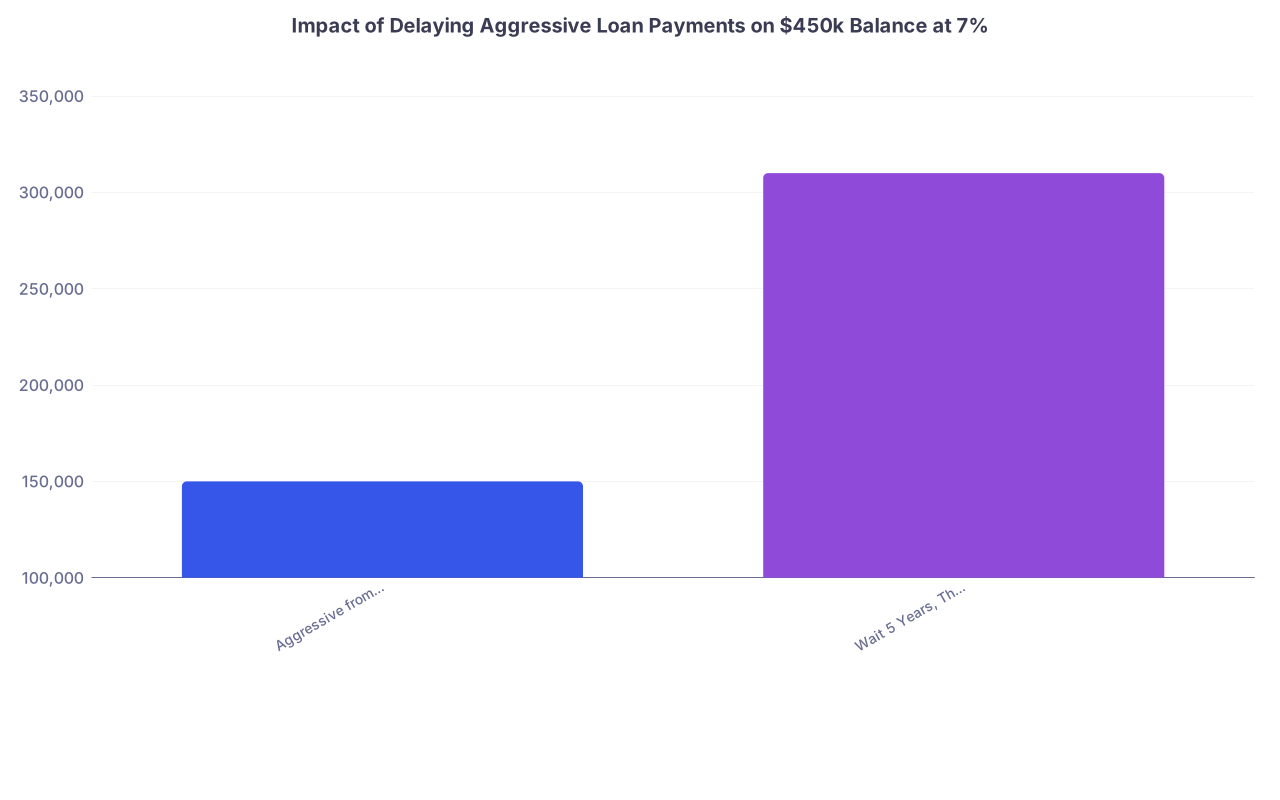
| Category | Value |
|---|---|
| Aggressive from Year 1 | 150000 |
| Wait 5 Years, Then Aggressive | 310000 |
Those values represent very rough total interest paid under:
- Aggressive payoff starting as an attending
- Five years of minimum-ish payments, then aggression
The mistake:
- Thinking your high income makes compounding irrelevant
- Underestimating how fast “temporary” lifestyle choices harden into permanent obligations (big house, private school, expensive car leases, family expectations)
Interest does not care that you are a surgeon. Or that you work 70 hours a week. Your student loan servicer will outlast your enthusiasm.
The protection move:
- Decide on a clear timeline to be rid of the debt if you are not doing forgiveness (e.g., “Gone in 3–7 years”)
- Build your spending around that commitment, not the other way around
If your loan payoff plan is, “I will pay more when the partnership/kicker/bonus arrives,” you do not have a strategy. You have a fantasy.
4. Going Variable-Rate Without Respecting Volatility
Variable interest rates look seductive when you first sign.
This is how the trap is set:
- You see:
- 5-year variable: 3.5%
- 5-year fixed: 5.0%
You think:
“I will just refinance again if rates go up. I am not an idiot.”
Then:
- You are in your second year as an attending
- Markets shift, rates spike
- Your payment jumps by $700–$1,200 per month
- You just bought a house, have daycare costs, maybe another car
- You are frankly too busy to shop multiple lenders, compare terms, and redo the paperwork
You end up stuck in a rate that is no longer good, with a payment that feels suffocating.
The mistake is not “variable is always bad.”
The mistake is choosing variable without:
- Running worst-case numbers
- Looking at your cash flow fragility
Ask yourself:
- If my rate increased by 2–3 percentage points, could I comfortably handle the new payment without:
- Cutting retirement savings to zero
- Racking up credit card debt
- Delaying disability/term insurance
If you cannot, you are gambling, not planning.
One rule I give high-earning specialists:
- Early attending with new financial obligations (house, kids, spouse not working): strongly favor fixed unless your payoff window is extremely short (under 3–5 years) and you are already aggressively attacking principal.
- If you pick variable, set a strict internal timeline:
- When your balance hits “X,” or
- When your rate crosses “Y%,”
You refinance again or convert to fixed. No excuses.
5. Ignoring Disability and Death Risk While Restructuring Loans
This one is uncomfortably common and frankly inexcusable.
You refinance $350k–$600k of loans to a private company.
Then you:
- Have no individual, own-occupation disability policy in place
- Have a spouse and kids depending on your future income
- Maybe have some anemic group coverage through the employer that:
- Is taxable
- Is not portable
- Might not even pay full benefit if you also earn in another capacity
Meanwhile, your federal safety net is gone:
- No Total and Permanent Disability (TPD) discharge under federal terms
- No death discharge for your spouse if they co-signed or hold private loans
This is exactly backward.
The correct order of operations for a specialist even thinking about private refinance:
- Get sufficient own-occupation disability insurance in place while still healthy.
- Get appropriate term life if someone depends on your earning ability.
- Then evaluate whether losing federal death/disability protections is tolerable.
Do not:
- Refinance first because you are anxious about rates
- Tell yourself you will “get around to” disability insurance next quarter
Busy specialists never “get around to it” unless they schedule it like a case or a clinic session. And a minor medical diagnosis can make coverage more expensive—or unavailable—overnight.
6. Building the Lifestyle First and Then “Seeing What’s Left” for Loans
This one is brutal because it feels emotionally justified. You waited. You sacrificed. Now you want to “live a little.”
Totally understandable. Also financially lethal if you mis-sequence it.
The pattern I see in high-paid fields:
First attending year:
- Buy a $1.2M house with 5–10% down
- New luxury car (or two)
- Private school for kids
- Costly vacations to “make up for lost time”
Only after all of that:
- “So… how much can we throw at the loans each month?”
You have just locked in fixed, non-negotiable overhead. Your loan payoff became the flexible line item. Which means it always loses.
A more protective sequence:
In the first 6–12 months as an attending, live on something closer to a modest attending income, not the max your specialty pays.
Use that temporary gap to:
- Build an emergency fund
- Establish your loan strategy (forgiveness vs aggressive payoff)
- Start retirement contributions (at least to any match)
THEN gradually dial up lifestyle, knowing what you can safely afford after loans and savings.
If your loans are >2x your gross attending income and you insist on full specialist lifestyle from day one, you are effectively choosing a 15–20 year loan horizon, even if your servicer says “10-year term.”
You will keep refinancing, stretching, and telling yourself, “We will pay more later.” You probably will not.
7. Not Matching Your Strategy to Your Actual Specialty Economics
Different high-earning specialties have very different realities:
- Ortho vs derm vs neurosurgery vs IR vs plastics vs GI.
- Academic vs private vs hybrid models.
- W2 vs 1099.
Yet residents and fellows often copy each other’s loan moves as if they are interchangeable.
You are not interchangeable.
Here is a brutally oversimplified comparison just to make the point:
| Specialty Type | Typical Pressure to Maximize PSLF Value | Typical Ability to Aggressively Pay Off Loans |
|---|---|---|
| Academic neurosurgery | High | Moderate |
| Private practice orthopedic surg | Low | Very High |
| Academic cardiology | Moderate-High | High |
| Cosmetic dermatology/plastics | Low | Very High |
| Mixed academic/community GI | Moderate | High |
If you are:
- Academic neurosurgery at a big university hospital making, say, $450k with good PSLF eligibility and research/teaching goals → PSLF might be a powerful lever.
- Private practice orthopedics with realistic comp of $700k–$1.2M → PSLF often makes no economic sense long-term; your power is aggressive payoff.
- Derm or plastics leaning heavily cosmetic/cash → same story as private ortho, usually.
The mistake is grabbing some generic “doctor loan advice” off a podcast or blog that is written for:
- Primary care at $220k
- Or a PSLF-perfect hospitalist track
And blindly applying it to your $600k specialist world.
You must match:
- Your specialty earning curve (fellowship, ramp years, partnership track)
- Your job type (academic vs private, PSLF eligible or not)
- Your tolerance for risk and call (burnout potential)
to your strategy. Copy-paste advice is where specialist incomes go to die.
8. Obsessing Over Interest Rate While Ignoring Tax and Retirement Consequences
Specialists love numbers. So they fixate on interest rate spreadsheets and completely ignore the tax and retirement side of the ledger.
Two common errors:
- Overpaying loans while underfunding tax-advantaged retirement accounts
- Ignoring how IDR (income-driven repayment) payments interact with pre-tax savings
Example:
- High-earning cardiologist, $450k income, $350k loans at 6.8%
- Decides: “I will knock this out in 3 years. I will live lean.”
- Pours $10k/month into loans
- Puts almost nothing into 401(k)/403(b) or backdoor Roth
- Ends three years debt-free… and three years behind on compounding, Roth space, and asset protection
For a physician with a career horizon of 25–30 years, missing the early retirement contributions is not a small mistake. It is a seven-figure mistake by the time you are 60+.
On the flip side:
- An academic GI doc on an IDR plan working at a PSLF-eligible hospital:
- Skipping pre-tax retirement contributions
- Paying higher IDR payments than necessary
- Losing both tax savings and PSLF optimization
You must think like this:
- “What combination of:
- Loan payments
- Pre-tax retirement contributions
- Any match or employer contribution
Gives me the best net worth outcome, not just the lowest debt balance?”
Sometimes the right move is:
- Maxing retirement accounts while doing a strong, but not insane, payoff plan (5–7 years)
- Or, in PSLF scenarios, deliberately lowering taxable income to reduce IDR while building investments.
Paying loans aggressively but ignoring tax-advantaged savings is a very physician-flavored version of “penny wise, pound foolish.”
9. Never Reassessing After Major Life and Career Changes
A lot of specialists set a loan plan early, then never revisit it, even as their world changes:
- You:
- Switch from academics to private practice
- Move from one hospital system to another
- Cut back to 0.7 FTE
- Add a partner track bonus
- Start doing more locums or 1099 work
And your loan strategy… stays exactly the same. For ten years.
That is lazy, and it is costly.
Loan strategies are not “set and forget.” They are living decisions that should be re-checked when:
- Your income materially changes (up or down)
- Your employer type changes (non-profit to for-profit or vice versa)
- Your family situation changes (marriage, kids, spouse income shifts)
- Your health changes in a way that affects career longevity
I have met:
- Interventional radiologists who left PSLF-eligible academic jobs to become contractors and still carried federal loans “just in case they ever went back.”
- Derm attendings doing mostly cosmetic cash-pay work who never refinanced out of fear-of-commitment, paying 6.8% while earning $800k+.
Your life changed, but your loan strategy did not. That is a completely avoidable mistake.
Set a recurring calendar reminder—yearly at minimum—to ask:
- Does my current loan plan still match my:
- Job type
- Income
- Career trajectory
- Family goals
If not, fix it. Not next year. Now.
10. Delegating the Entire Strategy to “Money People” Who Do Not Understand Physician Careers
The final, and often most expensive, mistake: outsourcing your loan thinking to people with partial understanding and conflicted incentives.
You will encounter:
- Hospital “financial counselors” who are PSLF maximalists even when it clearly makes no sense for your career arc
- Refinancing company reps whose job is to get your loans away from the federal system, not to evaluate your disability risk or academic interests
- Financial advisors who:
- Earn money on assets under management
- Have no upside when you crush your loans
- Are often unfamiliar with the actual day-to-day reality of your specialty training and practice
The danger signs:
- Anyone who tells you there is one obvious best plan for “doctors” as a group
- Anyone who waves off disability or life insurance planning as unimportant while discussing refinancing
- Anyone who ignores your stated desire to possibly do academics, or to go part-time after having kids, or to change subspecialties
You are allowed to ask blunt questions:
- “How are you paid?”
- “If I do PSLF instead of refinancing (or vice versa), do you personally earn more or less money?”
- “How many physicians in my actual specialty have you advised?”
If they cannot answer clearly and without defensiveness, do not let them steer the ship.
You can absolutely use experts. You probably should.
But if you let other people’s incentives substitute for your own clarity, you will become exactly the kind of high-income specialist who ends up with:
- Big house
- Fancy car
- Significant portfolio
…and a shocking six-figure student loan balance at age 45 that you keep telling yourself you will “top off next year.”
Your Next Step Today
Open your latest loan statement and last pay stub. Right now.
On one sheet of paper, write:
- Current total student loan balance
- Average interest rate (roughly is fine)
- Your actual post-tax monthly income
- Whether your current job is PSLF-eligible (yes/no)
Then answer this, in one sentence each:
- Am I truly on a PSLF path, or am I pretending to keep my options open?
- If I am not doing forgiveness, in what year do I plan to be free of student loans?
- Does my current payment size make that year even remotely realistic?
If your answers are vague, contradictory, or rely on phrases like “eventually,” “once things settle down,” or “after I make partner,” your loan strategy is not a strategy. It is a wish.
Start by fixing that. Today.