
You’re standing in a cramped workroom at 9:30 pm. Third consult of the night just paged. Your attending — a well-known interventional cardiologist — is muttering about RVUs while scrolling through an email.
You catch a glimpse of the screen: a recruiter pitch.
“$650,000 base. Signing bonus. Four-day workweek.”
Your attending snorts. “Yeah. Then you look closer. Middle of nowhere. No coverage. No partners. And after taxes and housing? Might as well be making half.”
Then they say the line I’ve heard variations of in almost every high-earning specialty:
“I didn’t understand geography when I signed my first contract. Cost me a fortune.”
This is where you are right now:
- You know your specialty is “high-paying” on paper (ortho, derm, ENT, GI, IR, neurosurg, anesthesia, urology, etc.).
- You also vaguely know that salary “varies by region.”
- But you’re probably underestimating how badly geography can wreck your actual take-home pay and quality of life.
Let me be blunt: the wrong geographic decision can effectively cut a high-earning specialist’s salary in half — and sometimes worse — without you realizing it until you’re buried in a mortgage and private school tuition.
Let’s walk through the mistakes that do that. So you don’t become the attending quietly telling residents, “Don’t do what I did.”
Mistake #1: Confusing “High Salary” With “High Take-Home”
The worst geography mistake is looking at headline salary and completely ignoring:
- Effective tax rate
- Cost of living (housing is the killer)
- Malpractice premiums
- Local payer mix (Medicare/Medicaid/commercial)
- Call burden and burnout risk
I’ve watched new pain attendings and GI docs chase “$600k+ offers” in coastal metros, only to discover they’re actually living like a $250k pediatrician in the Midwest.
Here’s what that looks like in real numbers.
| Scenario (Same Specialty) | Metro Coastal City | Mid-Sized Low-Cost City |
|---|---|---|
| Base Salary | $650,000 | $500,000 |
| State Income Tax | ~10% | 0–3% |
| Effective Total Tax | ~42% | ~33% |
| Annual Taxes Paid | ~$273,000 | ~$165,000 |
| Net After Tax | ~$377,000 | ~$335,000 |
| Typical Housing (Year) | $100k–$140k | $35k–$50k |
| Real Disposable Income | ~$240k | ~$285k–$300k |
You read that right: the lower salary can leave you more usable money and a better lifestyle.
The mistake is simple but deadly:
You compare gross salary numbers across cities as if every dollar is the same.
It is not. A $100,000 difference in salary can evaporate completely once you factor in tax brackets and housing.
How to avoid this mistake
Before you get romanced by a big number:
- Calculate after-tax income for that exact state (and city tax if applicable).
- Look up median home prices and realistic rent/mortgage where you’d actually live, not the cheapest listing 45 minutes away.
- Price out childcare and school (if you have or will have kids).
- Subtract those from net. That’s your real income.
If you’re not running these numbers, you’re guessing. And guessing is exactly how people end up “earning” $650k and feeling broke.
Mistake #2: Ignoring State Income Tax Like It’s Pocket Change
I’ve seen this multiple times with anesthesiology and ortho residents: they’ll shrug and say, “Yeah, California taxes are high, but the pay is huge. It balances out.”
No. Sometimes it doesn’t.
On a high specialist salary, state taxes are not “a little extra.” They’re six figures of pure drag. Every year.
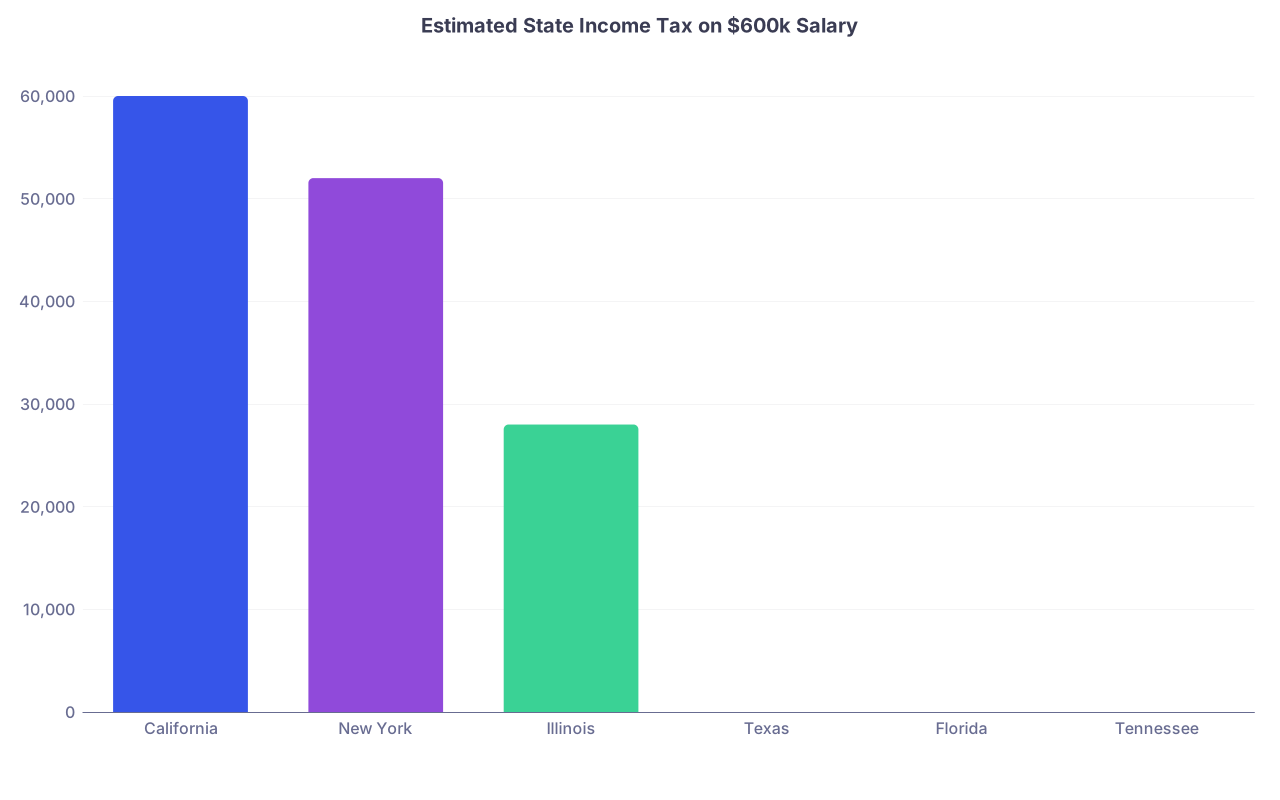
| Category | Value |
|---|---|
| California | 60000 |
| New York | 52000 |
| Illinois | 28000 |
| Texas | 0 |
| Florida | 0 |
| Tennessee | 0 |
Common bad assumptions:
- “No state tax states must pay less overall, so salaries are lower.” Sometimes. Not always. Plenty of Texas, Florida, Tennessee, and Nevada practices pay extremely well.
- “The difference is a few thousand.” Wrong bracket. At ~$500–800k, you’re losing a luxury car per year to state tax alone by choosing wrong.
For high-earning specialties — ortho, neurosurg, derm, GI, cards, ENT, IR, urology, anesthesia, plastics — choosing a high-tax vs no-tax state can easily be a $3–5 million lifetime mistake.
How to avoid this mistake
- When comparing two offers, calculate state tax dollars, not just rate:
- Estimate: state tax = (state rate) × (taxable income around your bracket), but you can use any high-income tax calculator online.
- Realize this:
If State A pays you $650k and State B pays $550k, but State A takes $60k in state tax and State B takes $5k, you’re essentially tied — before cost of living.
If you love a high-tax state for family or personal reasons? Fine. Just do not pretend it’s financially neutral.
Mistake #3: Chasing Prestige Metros and Ignoring Payer Mix
Here’s a mistake I watched a new GI attending make:
They had two offers:
- Rust Belt city, not glamorous, $550k base, mostly commercial insurance, strong referral base, modest Medicaid.
- Large, “sexy” coastal metro, $580k quoted, but heavy Medicaid and Medicare Advantage, plus serious competition.
They took the coastal job. Three years later, they were telling residents: “If I could rewind, I’d move to the Rust Belt.”
Why? Payer mix.
If 40–60% of your patients are:
- Medicaid (paying pennies on the dollar), or
- Low-paying Medicare Advantage plans,
your collections and bonus potential can be crushed, no matter how “high” your billed charges look.
This hits some specialties harder:
- Neurosurgery and Ortho in trauma-heavy safety-net hospitals: lots of poorly reimbursed or uncompensated care.
- Derm and Plastics in markets saturated with cash-pay competitors: more competition for the well-reimbursed cases.
- GI and Cards in systems with negotiated low commercial rates: RVU numbers look strong, paycheck doesn’t.
Red flags about payer mix by geography
- Inner-city hospitals in big coastal metros often have very high Medicaid/uninsured percentages.
- Some rural hospitals are mostly Medicare with low negotiated commercial rates.
- Academic-heavy cities can underpay you relative to your work, hiding behind “prestige.”
How to avoid this mistake
When you interview, do not skip these questions:
- “What’s the breakdown of payer mix in this practice? (Commercial / Medicare / Medicaid / Self-pay).”
- “What percentage of my schedule is likely to be poorly reimbursed cases?”
- “How do denied claims and underpaid visits affect RVU credit or bonus structure?”
- “What are your typical annual collections per full-time partner?”
If they dodge or hand-wave this, that’s your cue to walk carefully. Geography and local demographics shape payer mix; payer mix shapes your real income.
Ignore that chain, and your “high-earning” specialty can feel disturbingly middle-class.
Mistake #4: Assuming Rural = Always Better Pay (Without Seeing the Trap Doors)
There’s this simplistic narrative in residency:
“Big cities pay less. Rural pays more. So just go rural if you want money.”
Half-truth at best.
Yes, some rural or smaller-market jobs for ortho, anesthesia, EM, cards, and neurosurg pay extraordinarily well. But I’ve also seen:
- Rural surgeons with insane call (1:2 or 1:3, or basically “always”).
- Anesthesiologists doing solo coverage across three sites with unsafe backup.
- Rural practices with fragile finances that fold, leaving you scrambling.
There’s another thing: geography determines how trapped you are.
If you pick a rural region with:
- One hospital system
- Few private groups
- No competing employers nearby
Then if your job turns toxic, your only escape may be:
- Move your entire family
- Or accept a major pay cut for a narrower role
Your leverage is based on how many viable employers exist in a commutable radius. Geography dictates that.
Good rural / small-city signs
- Multiple specialties already built out: cards, GI, ortho, general surgery, OB, hospitalists.
- Group with more than 3–4 partners, actual vacation coverage, and not just “you’re the only one.”
- Evidence of stable systems: many physicians have >5–10 years there; low turnover.
Bad signs
- “We’ve been trying to recruit for years; no one stays.”
- “You’d be the only [insert your specialty] for 200 miles.”
- “We can’t really get locums. You’d just ‘own’ the service.”
Do some rural jobs make sense financially? Absolutely. I’ve seen GI docs, anesthesiologists, and ortho surgeons in mid-sized, “boring” metros quietly earning more and saving more than their peers in glamorous cities.
But rural + unstable + understaffed can chew you up.
Mistake #5: Letting Your Spouse/Partner’s Career Get Crushed by Geography
This one’s less obvious but just as expensive.
You’re focused on your $600k potential as a neurosurgeon or cardiac anesthesiologist. You pick a city purely based on your offer. Your partner is an engineer, attorney, or corporate professional.
You move to:
- A small town with one tiny employer in their field, or
- A city where their profession is oversaturated or underpaid.
End result: their earning power gets cut or erased.
Over 10–20 years, that’s easily seven figures gone.
I know a derm attending who picked a very rural job in a no-tax state, salary north of $500k. On paper, home run. In reality? Her spouse, who had been earning high six figures in tech, ended up with no local options and then a remote job at a much lower salary. Net household income. Crushed.
Your household earning power is a joint geography problem.
How to avoid this mistake
- Map out both careers:
- Where does your partner’s profession pay well and exist in real numbers?
- How many potential employers would they have within 30–60 minutes?
- Avoid single-employer traps for them, just like you should for yourself.
- Factor in childcare cost and logistics (impossible commutes, lack of daycare).
I’m not saying choose your partner’s job over yours automatically. I’m saying do not pretend their lost income is irrelevant when you’re calculating where to live.
Mistake #6: Not Understanding Hospital/Group Monopolies in a Region
Here’s a geography nuance residents usually miss: market concentration.
If one hospital system owns basically everything in town — the main hospital, the outpatient surgery centers, the large multi-specialty group — your leverage drops to near zero.
Geography + consolidation = they own you.
Symptoms of a monopolized market:
- “Everyone in town works for [single health system].”
- Private groups recently sold out to that system.
- Recruiter tells you, “If you don’t want this, there’s really not anywhere else locally.”
In those markets, they often:
- Underpay relative to your RVUs
- Overload you with call
- Use non-competes that make leaving incredibly painful (because anywhere else in reasonable driving distance is “restricted territory”)
Now pair that with:
- High cost of living
- High state tax
You’ve just cut your real earning power in half and reduced your freedom.
How to avoid this mistake
- Ask bluntly: “How many independent groups still exist in this region?”
- Look up market consolidation news: has this system been buying out everyone?
- Clarify non-compete: radius, duration, and which facilities are included.
Then ask yourself this:
If I hate this job in 2 years, how many other employers within 45 minutes could hire me without a legal fight?
If the answer is “one” or “none,” you are walking into a trap, no matter how good the starting salary looks.
Mistake #7: Underestimating How Lifestyle Geography Affects Burnout (Which Then Destroys Income)
Burnout isn’t just a wellness buzzword. It’s a financial nuke.
I’ve watched plenty of high-earning subspecialists:
- Cut clinic days
- Drop call
- Switch to part-time
- Leave high-paying procedural roles entirely
Because they burned out in cities with:
- Miserable commutes
- No support system
- Terrible weather they hated
- No way to decompress outside work
Your geography can either buffer you against stress or amplify it.
Some examples I’ve actually seen:
- An interventional cardiologist in LA spending 2 hours a day in traffic, constantly late to kid events. Switched to a lower paying job in a smaller city and was happier with less money but more sanity.
- Ortho attending in a miserable northern climate who hated winters, impulsively moved south even with a 20–25% pay cut. Still better off mentally, but years of savings lost.
The financial mistake is picking a location you barely tolerate because the salary is big, assuming you’ll power through for decades.
You won’t. Eventually your income will fall to match your happiness threshold.
How to avoid this mistake
Ask yourself, seriously:
- Do I see myself staying in this climate and city for 10–15 years?
- Outside of work, are there actual things here that I enjoy or care about?
- Do I already feel dread at the idea of living here, even with this money?
If you hate everything outside the hospital, your long-term earning potential in that geography is lower than you think, because you won’t stay.
Mistake #8: Not Running the “What If I Want Out?” Scenario For Each Location
You’re a resident. You assume:
- “I’ll always want to be full-throttle procedural.”
- “I’ll always tolerate 1:4 call.”
- “I’ll always be willing to work in this exact specialty configuration.”
You might not.
Geography determines:
- Whether you can pivot within your specialty (e.g., procedural-heavy to consult-heavy; hospital-based to outpatient).
- Whether you can shift to part-time, W-2 vs 1099, or locums easily.
- Whether academic, private, and employed roles all exist within one metro area.
If you lock yourself into:
- A tiny town
- With one hospital
- One group
- And no surrounding markets within an hour
Then your Plan B becomes:
- Move. Again. New house. New schools. New everything.
That’s expensive. Very.
How to avoid this mistake
For every geographic region you’re considering, answer:
- How many hospitals within 45 minutes?
- How many private groups in my specialty?
- Are there academic centers, community hospitals, and ASC-based practices to move between?
The best geographic setups for high-earning specialists:
- Have multiple practice models in a drivable radius.
- Provide options when your life or preferences change.
If you ignore that, you’re betting everything on your first contract working perfectly. It won’t.
Mistake #9: Believing “I Can Always Move Later” Without Accounting for Golden Handcuffs
You tell yourself: “I’ll just do 3–5 years in this high-tax, high-cost city, then move somewhere cheaper and bank tons of money.”
Almost nobody does that.
Why?
- You buy the expensive house.
- Your kids start school.
- Your spouse builds their network.
- You get used to the private school, the club, the lifestyle.
Then suddenly:
- Moving means pulling your 10-year-old out of school,
- Walking away from social support,
- And accepting you made a bad initial geography decision.
So you stay.
And those state taxes, housing costs, and inflated spending habits bleed you dry for decades.
This is how high-earning surgeons and proceduralists end up unable to retire on time.
Not because they didn’t earn enough — because they burned it into an expensive geographical setup that they felt too stuck to leave.
How to avoid this mistake
If your plan depends on:
“I’ll move later once I’ve saved enough,”
you need to literally:
- Define the dollar amount and timeline, in writing.
- Decide what life event triggers the move (before kids, before middle school, etc.).
- Run the numbers on how much that move will actually save you per year.
If you can’t answer those concretely, you’re probably not moving. You’re just rationalizing a bad geographic choice.
Mistake #10: Not Doing a Simple, Side-by-Side Comparison of Offers by Geography
Most residents stare at PDF contracts in isolation.
They don’t line them up.
They don’t normalize for taxes, cost of living, housing, and call.
So they pick wrong.
Here’s the kind of quick-and-dirty comparison you should be doing whenever geography differs:
| Factor | Big Coastal City | Mid-Sized No-Tax State | Smaller College Town |
|---|---|---|---|
| Base Salary | $650k | $550k | $520k |
| State Income Tax | High (~10%) | None | Low (~3–5%) |
| Median 4BR Home Price | $1.4M | $550k | $450k |
| Typical Commute | 45–60 min | 15–25 min | 10–20 min |
| Payer Mix | Medicaid-heavy | Mixed, decent | Mostly commercial |
| Employer Options Nearby | Many | Several | Few but some |
Now zoom out. Which one lets you:
- Keep the most money after tax and housing?
- Have backup employers if your first job sours?
- Maintain a life you actually want to live?
If you’re not doing this sort of comparison, you’re not “deciding.” You’re reacting to whichever offer sounds loudest.
What You Should Do Today
You don’t need a full contract yet to avoid these geography traps. You can start now.
Here’s your next step:
Pick two or three cities where you think you’d want to work as a high-earning specialist.
Then, for each city, do this today:
Look up:
- State income tax for your expected income bracket (say $500–700k).
- Median home prices in the neighborhoods you’d realistically live in.
Open a spreadsheet with these columns:
- City
- Hypothetical salary (pull typical numbers for your specialty from MGMA/online ranges)
- Estimated state tax dollars
- Estimated housing cost per year (mortgage or rent)
- Leftover (salary – tax – housing)
Highlight the city that looks “prestigious” but leaves you with the worst leftover number.
Then ask yourself: Am I really willing to trade hundreds of thousands of dollars and more stress just to say I live there?
Do that exercise. Today.
Because if you wait until contracts are in front of you, the geography mistake is much harder to see — and much more expensive to fix.