The fellowship letters on your CV matter almost as much as the specialty itself. And yes—specific “brands” absolutely buy you access to elite compensation tiers that your equally smart, equally trained peers will never see.
Let me tell you what really happens behind the scenes when groups decide who gets partnership, who gets the $1M+ offers, and who gets quietly routed to the mid‑tier community job.
It is not a level playing field.
The Ugly Truth: Fellowship Brand Is a Proxy for Risk
Here’s what private groups and hospital systems are actually thinking, though they’ll never say this in front of you:
“Can I sell this person to our referral base and justify paying them top-of-market?”
Your fellowship brand—the specific program name—acts as a shortcut answer.
When a cardiology group in Dallas is deciding between:
- Applicant A: Interventional cardiology, Mayo Clinic
- Applicant B: Interventional cardiology, Lower‑tier regional program you’ve never heard of
Same Step scores, similar CV, both seem normal humans.
They know from experience that if they email referring PCPs and surgeons: “We just recruited an interventional cardiologist from Mayo,” referrals spike. The physicians feel safer sending their complex stuff there. The hospital is happier putting that name on billboards. The payor negotiations slide a little easier because the system wants to market itself as “tertiary/quaternary level.”
So who gets the $900k+ starting package with wRVU upside and quick partnership track?
You already know the answer.
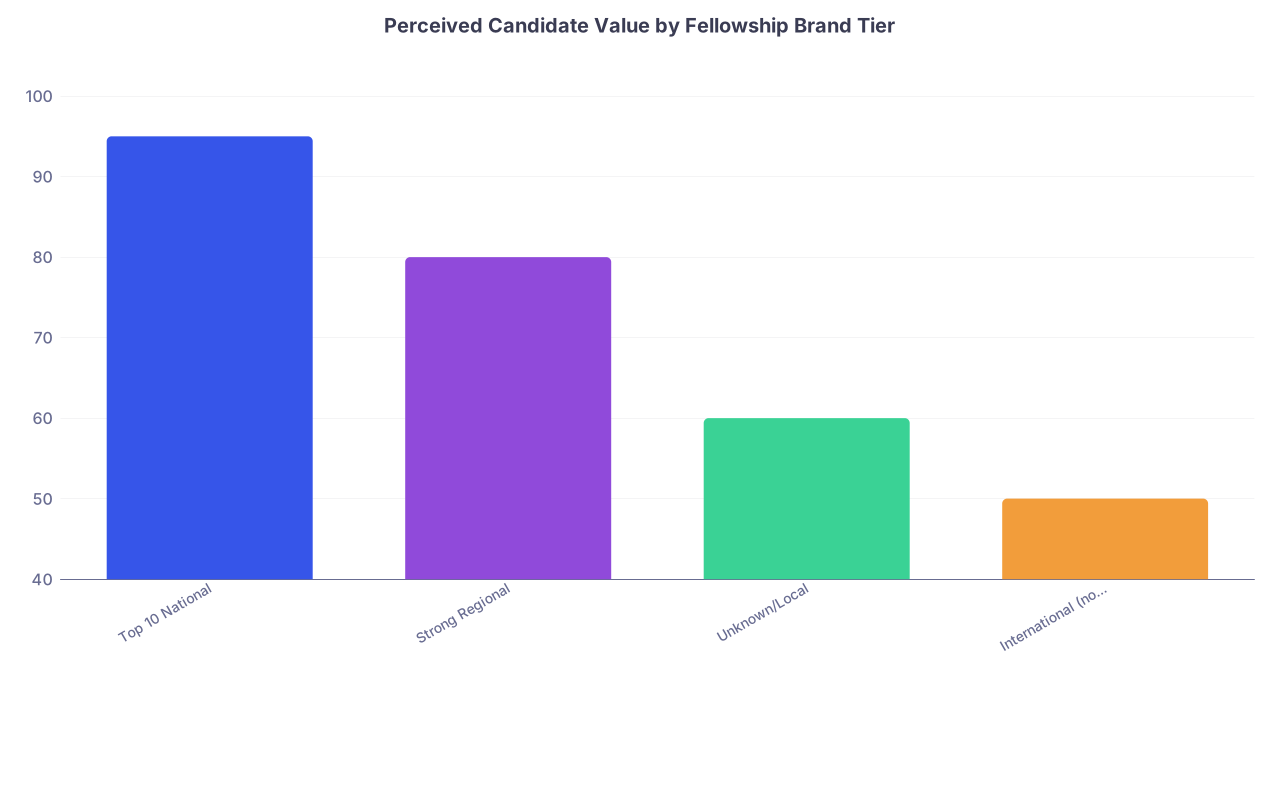
| Category | Value |
|---|---|
| Top 10 National | 95 |
| Strong Regional | 80 |
| Unknown/Local | 60 |
| International (non-elite) | 50 |
No one will tell you this as a resident. Faculty will say “fit matters more than name” because that’s how they’d like it to be. But when the money gets real, the brand on your fellowship certificate is a risk-reduction tool.
And in the highest paid specialties, groups are naturally risk‑averse.
Let’s walk through the key specialties where fellowship brand really opens doors to the true top tier of compensation—and precisely which “labels” carry disproportionate weight.
Cardiology: The King of Brand‑Driven Pay
Interventional and EP cardiology sit in a special category. These are procedurally heavy, high‑revenue subspecialties where one high‑volume operator can swing millions in downstream revenue.
So hiring committees obsess over fellowship pedigree. I’ve sat in on those meetings.
They do not pull out randomized controlled trials. They pull out their biases.
The “elite” interventional and EP brands that change how a private group views you include:
- Mayo Clinic (Rochester)
- Cleveland Clinic
- Massachusetts General / Brigham (Harvard)
- Mount Sinai (NYC, for Interventional especially)
- Texas Heart / Baylor Houston
- Cedars‑Sinai
- UCLA / Stanford
- Duke
- Emory
- University of Pennsylvania
Not a complete list, but you get the idea. These names are shorthand for “someone already vetted by a top‑tier, high‑volume environment.”
Here’s the part you do not hear:
When a large cardiology group in a medium‑sized city wants to bring on a new interventionalist, they often aim above their station. They’ll say out loud in hiring meetings:
“If we can get a Cleveland Clinic or Sinai person, it changes how our market sees us.”
They’re explicitly thinking about marketing, negotiation with the hospital, and future expansion—not just whether you can wire a CTO.
So what does this mean for your wallet?
- A generic interventional cardiology fellowship can get you $550k–750k starting with partnership in 3–5 years.
- A name brand fellowship—especially from top‑10 above—can start closer to $700k–900k with a more realistic path to $1M+ and better ancillaries/ASC ownership.
Same number of hours. Same procedures. Different label on your training.

Within cardiology, EP has a similar pattern. Certain EP fellowships (Cleveland, Mayo, Brigham, Texas Heart, a handful of others) effectively brand you as “safe to build a complex ablation program around.” Private groups love that because it gives them leverage with the hospital.
Bottom line: If you’re in IM residency and you want highest-tier compensation in cardiology, you do not just “do cardiology.” You strategically target fellowships whose names are currency.
Orthopedic Surgery: The Right Fellowship Makes You a Market Weapon
Orthopedics is where fellowship branding becomes almost comical.
Two sports surgeons. Same residency caliber. Same personality. Similar case logs.
- One did sports at Hospital for Special Surgery (HSS) or Steadman Clinic.
- One did sports at a small community program no one on the East Coast can name.
Guess who gets instant credibility walking into a pro team, high‑end private group, or wealthy suburb practice? The guy with “HSS” or “Steadman” on the CV.
There are three high‑income Ortho fellowship types where brand really swings the door open:
- Sports Medicine
- Spine
- Adult Reconstruction (joints)
Within each, there are “royalty tier” programs. Not always the nicest lifestyle. But the doors they open are different.
Spine:
- Twin Cities Spine
- Rothman
- Washington University (St. Louis)
- Some of the big academic flagships (UCLA, UCSF, HSS, etc.)
Sports:
- HSS
- Steadman
- Rush
- Kerlan‑Jobe (LA)
- Some of the big brand-name university programs tied to professional teams
Joints:
- HSS
- Mayo
- Cleveland Clinic
- Certain high‑volume regional joint powerhouses (less famous, but every ortho insider knows them)
Here’s what actually gets said in private group partner meetings when reviewing a candidate:
“If we tell the hospital we just brought in an HSS‑trained joints guy, we can push for a new block schedule/robot and renegotiate call subsidies.”
You’re not just a surgeon. You’re a business case.
In ortho, elite compensation usually means:
- A pathway to partnership with real ownership of imaging, ASC, PT, and ancillaries
- Strong payer mix, strong commercial base
- High case volume in a well-insured population
The big‑brand fellowships don’t automatically hand this to you, but they dramatically increase your invite rate to those groups. Less brand, more uphill convincing.
Radiology and IR: The Right Fellowship = Access to The “Good Groups”
Diagnostic radiology is brutally bifurcated now: telerads mill vs strong private group with real equity and seven‑figure upside. Fellowship brand plays a different role here.
For pure DR, brand is less critical. Though the traditional academic big names (Mass General, UCSF, Penn, etc.) still open doors.
For interventional radiology—where the highest compensation sits—fellowship pedigree is a much bigger deal.
Elite IR fellowships that quietly act as tickets to the serious seats at the table include:
- Penn
- UCSF
- Northwestern
- Michigan
- Brigham / MGH
- Miami
- A few big‑volume, semi‑academic private IR groups that take fellows
What the strongest private IR groups want is proof that you’ve done high‑end cases, managed complex complications, and can sit across from hospital admin without looking lost. The easier way to screen that?
Look for certain fellowship programs. It’s lazy but predictable.
| Fellowship Type | Typical First Look? | Ceiling Compensation Tier |
|---|---|---|
| Top academic IR brand | Always | Highest (mid 7-fig with equity) |
| Solid academic/regional IR | Likely | High (7-fig possible) |
| Generic community IR | Sometimes | Moderate-high |
| No dedicated IR fellowship | Rare | Limited |
Groups will never plaster this on their websites. But sit in enough hiring calls and you start hearing the same shorthand:
“We really should look for a Penn or UCSF‑type IR grad if we’re going to build this line.”
That comment alone can reshape the entire candidate pool—and who gets considered for the jobs with co‑ownership of OBLs and ASC‑based interventions, where the real money is.
Anesthesia & Pain: The Pain Medicine Brand Game
Anesthesia itself pays well but has been commoditized in many markets. Pain medicine is where the serious outlier incomes live—if you land in the right kind of practice.
And no surprise: certain pain fellowships are treated by private equity–backed and physician‑owned pain groups as golden seals of approval.
Think:
- MD Anderson
- Cleveland Clinic
- Mayo
- UCSF / Stanford / UCLA
- Beth Israel Deaconess / Brigham
- Some of the historically strong regional pain fellowships with heavy interventional exposure
Here’s the unspoken logic:
“If I’m betting a multimillion‑dollar interventional pain practice on a new partner, do I want the person trained doing real volume at a place like MD Anderson, or the person who only saw basic injections at a sleepy community program?”
Pain is high‑variance.
Right pain fellowship + good market = $800k–$1.5M+.
Wrong training + wrong market = stuck doing bread‑and‑butter injections with declining reimbursements.
I watched a pain group in a major Sun Belt city outright reject three otherwise solid candidates because they didn’t like the “pedigree noise.” Their words, not mine.
They ended up delaying the hire six months just to land someone from a Tier 1 academic pain fellowship—because they knew that name would impress referring surgeons and oncologists, and justify their expansion proposal to their PE backers.
Plastics & Aesthetic: Brand As Social Proof For High‑Net‑Worth Patients
Plastic surgery is weird because fellowship isn’t always mandatory for big money. But when you’re talking about the highest tiers—the seven‑figure+ aesthetic practices with zero call and cash‑pay only—the right extra training can become a weapon.
Cosmetic and aesthetic fellowship “brands” function as social proof for both patients and other surgeons:
- ASAPS‑recognized aesthetic fellowships at big‑name programs
- High‑volume facial plastics fellowships with heavy private practice exposure
- Well‑known breast/aesthetic fellowships with public reputations (surgeons on podcasts, YouTube, etc.)
We’re in a different world here. It’s not just what other doctors think—it’s what affluent patients perceive when they read your bio.
But there’s still an insider angle: high-end group practices and boutique surgery centers in wealthy metros (Beverly Hills, Manhattan, Dallas, Miami) absolutely screen for brand. A “UCLA plastics then high‑profile aesthetic fellowship” combo will get you invited into rooms that a purely community‑trained surgeon never hears about.
Those rooms are where:
- Private surgery center equity lives
- $5k–$20k per case cosmetic work stacks day after day
- Call is voluntary and hospital-based revenue is optional
No one truly needs that brand to build a strong plastics practice. But the path is shorter and the ceiling is higher if you have it.
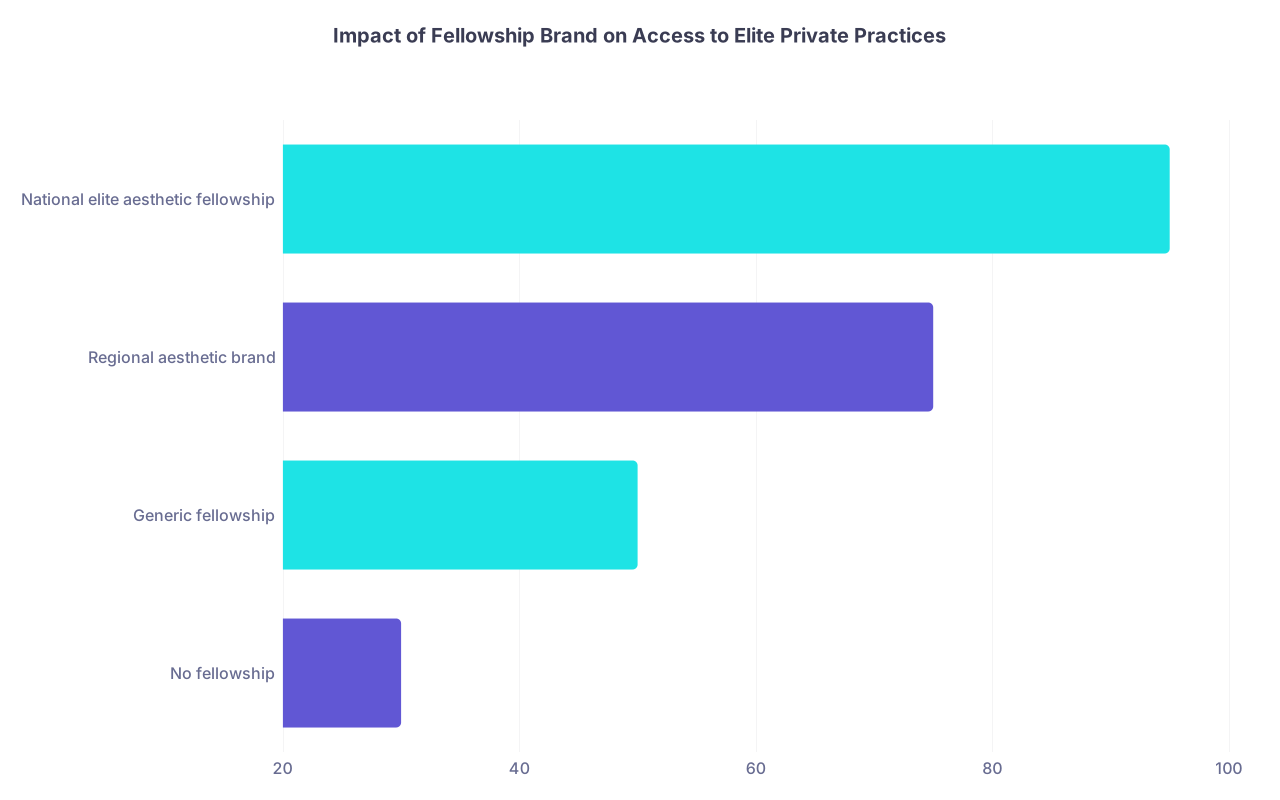
| Category | Value |
|---|---|
| No fellowship | 30 |
| Generic fellowship | 50 |
| Regional aesthetic brand | 75 |
| National elite aesthetic fellowship | 95 |
GI & Advanced Endoscopy: A Quiet but Powerful Brand Game
Gastroenterology is already well‑paid. But the very top of the GI income curve is loaded with people who either:
- Joined dominant regional private groups with strong ancillaries, or
- Built niche referral bases around advanced endoscopy or IBD/complex care that command higher volumes and better contracts.
Advanced endoscopy fellowships from certain places open doors to those top‑tier groups:
- Mayo
- Cleveland Clinic
- MD Anderson
- Massachusetts General / Brigham
- University of Colorado / Michigan / UNC / similar high‑volume centers
Here’s something you don’t see in public salary surveys:
When a big GI group negotiates with its hospital for ASC expansion or a new EUS/ERCP program, having a “Cleveland‑trained advanced endoscopist” gives them leverage to demand better terms.
So they actively look for that brand on CVs—even if they never spell it out to recruiters.
This is why you’ll sometimes see offers like:
- General GI fellowship, non‑brand program: $450k–600k starting
- Advanced endoscopy from big‑name place: $600k–750k+ with earlier partnership invite and access to the most lucrative cases
Same call burden. Same geography. Different upstream leverage.
Neurosurgery, ENT, and Others: Niche Brands, Outsized Pay
A few quick hits in other high‑earning areas where fellowship brand quietly matters more than your mentors let on:
Neurosurgery
Neurosurgery pay is high across the board, but for spine‑heavy, privately oriented neurosurgeons, certain spine fellowships (sometimes orthopaedic‑led) are seen as gold stamps. Groups building dominant spine service lines—especially in ASCs—love candidates with:
- Complex spine fellowships from major academic centers
- Ortho‑neuro combined spine programs with huge volume
Again, it’s not about pure surgical skill (plenty of great surgeons are from mid‑tier programs). It’s about who the hospital CEO feels safer betting their “Center for Spine Excellence” branding on.
ENT (Otolaryngology)
Sleep, rhinology, and facial plastics all have brand pockets. You’ll see certain ENT surgeons with extra fellowship training in facial plastics from very specific places walk into cash-heavy cosmetic niches faster, especially in affluent markets.
Those fellowships function as both peer validation and patient‑facing marketing fodder.
How Committees Actually Use Brand in Hiring
Let me pull back the curtain on how these decisions play out in real life.
You send your CV. It lands with:
- Senior partner(s) in the group
- Practice administrator or CEO
- Sometimes a hospital-employed physician leader
- Occasionally a recruiter pre-screens before it even gets to them
They have 30–60 seconds for first pass. Here’s what they’re really scanning:
- Fellowship program name
- Institution reputation in that subspecialty
- Any obvious red flags (gaps, geographic chaos, weird training path)
- Existing relationships (“Does someone here know anyone from that program?”)
If your fellowship is an elite brand in that subspecialty, the conversation starts at:
“We should get this person on the phone.”
If it’s unknown, the conversation can easily be:
“Let’s see who else applies first.”
That “let’s see” is death if you want the few top‑paying jobs that fill quickly and quietly from limited networks.
I’ve watched a stack of 40 CVs for an interventional cardiology job get narrowed to 6 for initial calls. Four of them were from “top 10” interventional fellowships. The other two got in because someone inside the group already knew them.
The rest? Never had a chance. And no, they never heard the real reason.
Practical Takeaways: Positioning Yourself For Elite Compensation
You cannot time the job market perfectly. You cannot force geography. But you can absolutely stack the deck before fellowship application.
If you’re still in residency (or early fellowship), here’s the blunt strategy if “highest paid specialties” and top compensation tiers are your target:
Decide early if you actually care about top‑decile income or just “very good money.” They’re not the same game.
If you want top‑decile:
- Choose specialties where private‑practice, procedure‑heavy work is still strong: Cardiology (interventional/EP), Ortho (sports/spine/joints), IR, Pain, certain GI tracks, some Plastics.
- In those specialties, identify the 5–10 “brand” fellowships that consistently produce high‑earning alumni in private practice. Not just famous—commercially valuable.
Align your residency:
- Being at a strong academic residency helps because those big fellowships trust their feeder programs.
- Even from a mid-tier residency, you can angle into top fellowships with serious hustle, research, and networking. I’ve seen it.
During fellowship interviews, ignore the fluff:
- Ask blunt questions about where their last 10 graduates work and what they actually earn.
- Look for programs whose alumni are partners in big private groups or have built strong referral bases, not just those who stay in academia.
Accept that the brand is a filter:
- You can overcome it with personality, hustle, and networking.
- But having it saves you years of selling yourself to people who don’t know you.

| Step | Description |
|---|---|
| Step 1 | Residency |
| Step 2 | Target Top Fellowship Brands |
| Step 3 | Good Income Ceiling |
| Step 4 | Match Prestigious Fellowship |
| Step 5 | Access to Elite Private Offers |
| Step 6 | Partnership and Equity |
| Step 7 | Elite Compensation Tier |
| Step 8 | Pick High-Yield Specialty |
This isn’t about worshipping prestige for its own sake. It’s about understanding how group economics, hospital politics, and human bias collide in the real world.
Fellowship brand isn’t everything. But in the highest paid specialties, it’s the difference between starting on third base versus outside the stadium trying to buy a ticket.
With that lens in place, you’re better prepared to choose where to train and how aggressively to chase the programs that actually move the needle for your future income.
What you do with that leverage—how you negotiate, pick markets, and build your referral base—that’s the next level of the game. And that’s a story for another day.