
58% of neurointerventionalists report they did not fully understand the earning trajectory difference between the neurology and neurosurgery pathways before committing to fellowship.
That gap in understanding costs people real money. And years of their life.
Let me walk you through how the money, training length, and career leverage actually differ between:
- Neurointerventional radiology from a neurology base
vs - Endovascular / neurointerventional from a neurosurgery base
Same angio suite. Same catheters. Very different career math.
1. The Three On-Ramps to Neurointervention (and Why Two Dominate)
We say “neurointerventional,” but there are really three core feeder specialties:
- Diagnostic & Interventional Neuroradiology (radiology base)
- Endovascular Surgical Neuroradiology (neurology base)
- Endovascular Neurosurgery (neurosurgery base)
This article is about #2 vs #3. But you cannot understand the earning patterns without at least acknowledging the radiology elephant in the room: radiology-trained neurointerventionalists often sit at or near the top of the pay heap because they:
- Control more of the imaging pipeline
- Often bill across more RVU-generating diagnostic work
- Sometimes shield themselves from call with big group structures
That said, for many residents, the actual choice in front of them is:
- “Do I do neurology → neurointerventional fellowship?”
or - “Do I bite the bullet and do neurosurgery, then endovascular?”
The earning patterns diverge mostly because of:
- Time in training (lost attending years)
- Procedural scope (what you are allowed / trained to bill for)
- Relative dependence on others’ referrals
- Call structure and group politics
Let me quantify that.
2. Training Length and Lost Earnings: The Hidden 7-Figure Delta
People obsess over “attendings make $X vs $Y,” but they ignore the compound effect of when you start at $X or $Y.
Typical pathways:
| Pathway | Residency Length | Fellowship Length | Total Training Years |
|---|---|---|---|
| Neurology → Neurointervention | 4 years | 2 years | 6 |
| Neurosurgery → Endovascular | 7 years | 1–2 years | 8–9 |
| Radiology → Neurointervention | 5–6 years | 1–2 years | 6–8 |
Neurology-based neurointervention:
- 4 years neurology
- Vascular neurology or stroke year (sometimes embedded)
- 1–2 years neurointerventional / endovascular surgical neuroradiology
Total: ~6 years, occasionally 7.
Neurosurgery-based endovascular path:
- 7-year neurosurgery residency (6 in rare programs, 7 is standard)
- 1–2 years endovascular neurosurgery fellowship
Total: 8–9 years.
So the neurosurgeon often becomes a fully trained endovascular attending 2–3 years later than the neurology-trained counterpart.
Now layer money on that.
Assume rough, realistic numbers (2024–2025 ranges for U.S., non-academic, non-coastal-extreme):
Neurology-based neurointerventionalist attending:
- Starting: $475–600k
- Mature partnership / high RVU practice: $650–850k
Neurosurgery-based endovascular neurosurgeon:
- Starting: $650–900k
- Mature with combined open + endovascular practice: $900k–1.5M+ (yes, really, in high-volume groups)
And resident salary: ~$65–80k per year.
The opportunity cost of doing 2–3 extra years of neurosurgery training instead of being a neurointerventional attending is massive.
Let us be specific. Say a neurology → neuroIR attending starts at year 6 post-MD with $525k. Neurosurgery → endovascular starts at year 8 with $750k.
For years 6–7:
- Neurologist pathway: attending income ≈ $525k, then $575k
- Neurosurgery pathway: PGY-6, PGY-7 making ≈ $70–75k
Difference over those 2 years is easily $900k–1M in gross earnings. Even if neurosurgery “catches up” later with higher annual compensation, the compound effect of investing or paying down loans earlier is not trivial. Over a career, you are easily playing with a seven-figure swing either way depending on:
- How long you work
- When pay peaks
- How much of that neurosurgery premium you actually realize
So anyone who tells you “neurosurgery always makes more, so just do that” has not done the full math. Or is ignoring the very real fact that half the residents who start neurosurgery never finish in the originally intended way.
3. Scope of Practice: Who Touches What (and Who Bills For It)
Now the core difference that drives billing patterns: scope.
A neurology-based neurointerventionalist:
- Typically does:
- Diagnostic cerebral and spinal angiography
- Mechanical thrombectomy for ischemic stroke
- Aneurysm coiling / stent-assisted coiling / WEB
- Flow diverters
- AVM / AVF embolizations (depending on comfort and institution)
- Tumor embolization
- Does not usually do:
- Open craniotomy for clipping tumors or AVMs
- Spine surgery
- Cranial trauma operations
So 100% of their procedural RVUs come from endovascular and diagnostic angiography work. All open neurosurgical referrals, billing, OR time? Goes elsewhere.
A neurosurgery-based endovascular specialist:
- Can split their workload across:
- Open vascular (clipping, bypass)
- General cranial (tumors, trauma, decompressions)
- Spine (if they choose to maintain that side)
- Endovascular (all the same procedures as above)
If they maintain a true dual practice (open + endovascular), they can access a bigger total RVU pool, especially in certain markets where complex cranial procedures still reimburse very well.
Put bluntly:
- Neurology-trained neurointerventionalist = hyper-focused proceduralist, high stroke and aneurysm volume, but narrow surgical scope.
- Neurosurgery-trained endovascular = hybrid surgeon, potential to combine OR and angio suite for very high total RVUs.
The critical word is “potential.” Many neurosurgeons end up so swamped with either open or endovascular that they effectively become one or the other. That undermines the theoretical earning edge.
4. Earning Patterns by Practice Setting
Let me break down the real-world patterns I have actually seen: midwestern community hospitals, coastal academic centers, and large private groups.
A. Academic Medical Centers
Academic neurology → neurointervention:
- Base salary often in the $350–500k range
- Incentive pay per RVU can push high-volume thrombectomy operators into the $550–700k territory
- Many are 100% endovascular or split with stroke service time
- Protected research time can trade off with clinical income
Academic neurosurgery → endovascular:
- Base often $450–600k
- High-end dual-practice neurosurgeons in major centers with heavy cranial + endovascular volume can hit $800–1M+, but that usually correlates with insane hours and near-constant call coverage
- Pressure to be “the everything person”: skull base, open vascular, IDE trials, device development
In academia, the gap narrows compared to community. Department politics, RVU capture structure, and chair priorities matter more than your base specialty. The neurosurgeon might make somewhat more, but the ratio difference is smaller.
B. Community / Private Practice – High-Volume Stroke Centers
This is where things get interesting financially.
Sizable community stroke center, 24/7 thrombectomy, some aneurysm volume:
Neurology neurointerventionist:
- Compensation often $600–900k depending on:
- Call burden (1:2 vs 1:4 vs 1:5)
- How stroke service time is valued
- Partnership track or employed model
- Heavy call usually = heavy bonus structure
- Compensation often $600–900k depending on:
Neurosurgery endovascular:
- If they do only endovascular: similar ranges to neurology, sometimes a 10–20% premium
- If they do open + endovascular and own a piece of the practice or ASC: totally different ballgame
- I have seen $1.2–1.7M total compensation in groups where:
- Stroke call is busy
- Spine/cranial cases are plentiful
- Professional + facility fees or ancillaries are captured by the group
- I have seen $1.2–1.7M total compensation in groups where:
In private practice, ownership is often more important than base specialty.
A neurology-trained neurointerventionalist with equity in a well-run group can absolutely out-earn a hospital-employed neurosurgeon who is salaried with modest RVU bonuses. The neurosurgery degree is not a magic ATM. The contract is.
C. Hybrid or Employment Models
Plenty of hospitals do not have the volume or political will to support both neurology-based and neurosurgery-based operators long term. They pick:
- One neurosurgeon who does most skull base and endovascular
- Or
- A neurointerventionalist from neurology or radiology who runs the stroke program
In many of these setups:
- Employed neurologist neuroIR: $500–750k, heavy call, modest bonuses
- Employed neurosurgery endovascular: $650–900k, but often pressured to add spine or general cranial to “justify” salary
This is where lifestyle starts to factor in hard. Which gets us to the non-monetary side that still indirectly affects money.
5. Call, Burnout, and the “Cost” of that Extra $150–250k
Everyone loves to quote top-line compensation, but they rarely add the denominator: hours, nights, and years of peak performance you can actually sustain.
Neurointervention has one particularly brutal reality:
- Stroke does not respect time zones.
- Neither do ruptured aneurysms.
Neurology-based neurointerventionalists often report:
- 1:2 to 1:4 call in smaller centers (read that again: 1:2)
- 1:5 to 1:7 in larger metropolitan stroke systems with multiple operators
- High “phone call” burden even when not scrubbed on every case
Neurosurgery-based endovascular specialists:
- Often on dual call: endovascular + open cranial trauma / emergency cases
- Trauma pager plus stroke pager is not exactly restful
- Relatively more OR days, longer cases (tumors, deformity, complex spine) drive up fatigue
So that shiny $250k neurosurgery premium some people throw around has to be weighed against:
- 2–3 additional training years
- More call types (trauma, tumor, spine, in addition to stroke)
- Shorter “tail” on your career if you burn out faster or cut back earlier
I have watched more than one neurosurgeon transition away from endovascular entirely in their 50s because call wrecked their sleep and cognitive stamina. At that point, your actual career earnings flatten relative to the initial theoretical model.
A neurology-based neurointerventionalist with:
- 6–8 call partners
- Strong hospital support
- Procedure-heavy daytime schedule
may sustain high productivity longer with fewer open cases stressing their body.
So you cannot treat the compensation as static. Trajectory and sustainability matter.
6. Reimbursement Nuances: Why Being “The Neurosurgeon” Helps (Sometimes)
One difference that does play quietly in the background: coding and referral patterns.
Neurosurgeons tend to capture:
- Pre-op and post-op global surgical packages on open cases
- A chunk of downstream imaging / follow-up
- Direct referrals for both “can this be coiled?” and “if not, can you clip it?”
Neurology-based neurointerventionalists:
- Reliant on:
- Stroke neurology colleagues
- Emergency medicine
- Neurosurgeons
- Interventional radiology colleagues (in some places)
- Seen as “the catheter person” rather than “the surgeon in charge of the whole cranial problem”
In some hospitals, that is no big deal. The neurointerventionalist runs the stroke program, is central to protocols, and has strong leverage. In others, the neurosurgery department quietly dominates resource allocation and case flow.
That translates financially into:
- More stable high-end compensation for neurosurgeons in politically powerful neurosurgery departments
- Slightly more vulnerability for neurology-based neuroIR if:
- A new neurosurgeon with endovascular skills is hired
- Or radiology decides they want those cases back
In other words: specialty ≠ guaranteed income, but specialty often predicts your political capital. And political capital determines case control.
7. Concrete Earning Scenarios: Neurology vs Neurosurgery
Let me give you some realistic, composite scenarios. These are stitched from real physicians with de-identified numbers.
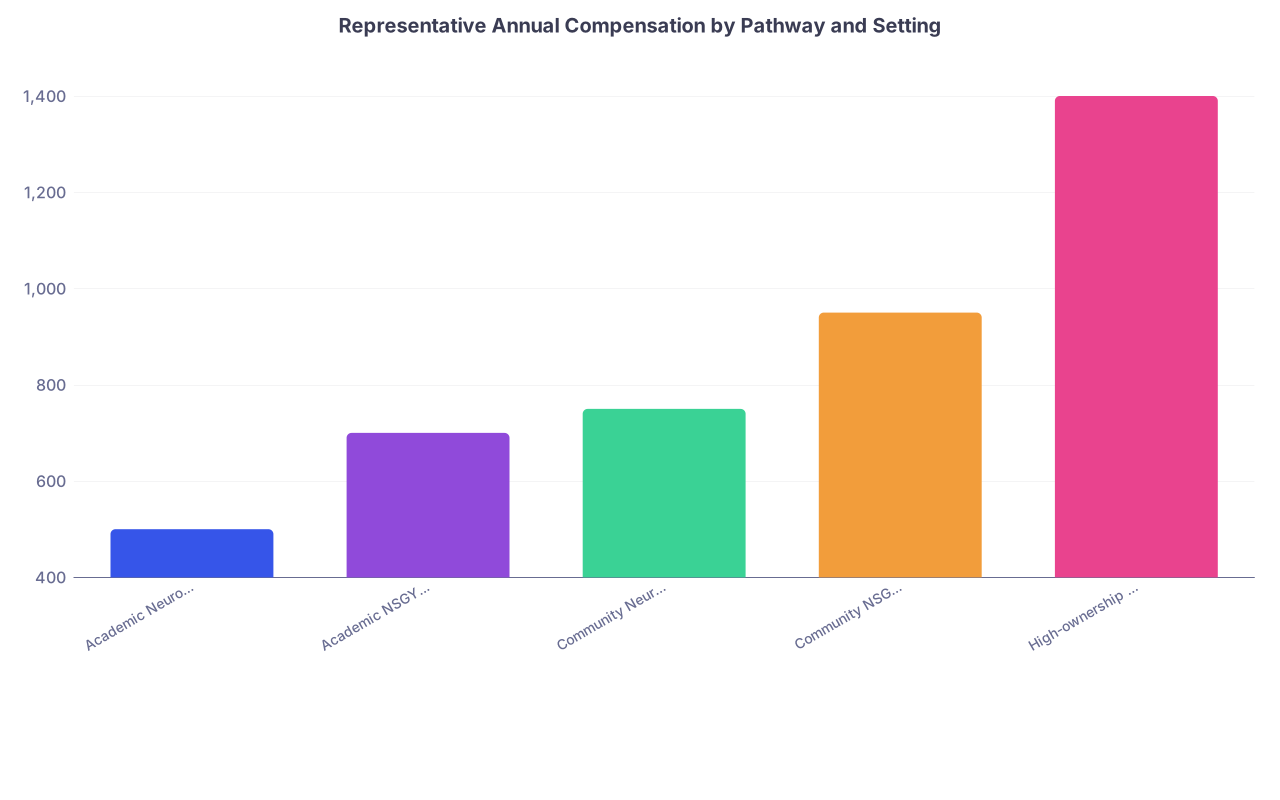
| Category | Value |
|---|---|
| Academic Neuro (Neuro-IR) | 500 |
| Academic NSGY (Endovascular) | 700 |
| Community Neuro-IR | 750 |
| Community NSGY Endovascular | 950 |
| High-ownership NSGY Hybrid | 1400 |
Scenario 1: Neurology → NeuroIR, Academic, Major Stroke Center
- PGY-1 to 4 neurology; 2-year neuroIR
- Joins university program as Assistant Professor
- Salary: $425k + RVU/bonus up to $550k
- 1:4 call, robust fellow coverage, participates in trials
- Realistic long-term: $550–650k with incremental academic raises
Net outcome: solid upper-middle to high compensation with strong intellectual environment but lower ceiling than top private practice.
Scenario 2: Neurology → NeuroIR, Community, Regional Stroke Hub
- Same training
- Joins hospital-employed neurointerventional neurology group
- Base $550k + call stipends and RVU bonuses, typically total $700–900k in busy programs
- 1:3 call initially, later recruits to 1:5
- No ownership but aggressive bonuses tied to thrombectomy volume
Net outcome: extremely strong compensation, especially given shorter training. Very good lifetime earnings vs training length ratio.
Scenario 3: Neurosurgery → Endovascular, Academic Tertiary Center
- 7-year neurosurgery, 1-year endovascular
- Starts at $550k base, builds dual practice in open vascular + endovascular
- Heavy call, trauma + stroke + complex cranial
- With time and promoted rank, ends around $800–1M if high volume and valued by department
Net outcome: High prestige, top 1–2% income for academia, but at the cost of longer training and more punishing workload.
Scenario 4: Neurosurgery → Endovascular, Private Practice Hybrid
- Joins large neurosurgery group with existing stroke contract
- Partner track with equity in practice and possibly ASC / imaging center
- Early years: $700–900k
- Mature partner doing open + endovascular + some spine: $1.2–1.7M (yes, these numbers exist)
- Massive call load initially; may offload spine or trauma later as younger partners join
Net outcome: Top-tier earning potential, but with very high personal and time cost. This is the “neurosurgery lottery” many residents dream about, and only a subset will realistically land.
8. Training Experience and Risk Profile: Not Just About Money
You are not just buying a future salary; you are buying a day-to-day work life and a residency experience.
Neurology pathway strengths:
- Shorter training (6–7 years total)
- More reasonable residency lifestyle relative to neurosurgery
- Earlier attending income and autonomy
- Lower physical strain than open cranial/spine long term
Weak points:
- Less political dominance in many hospitals
- No ability to convert complex aneurysm to open clipping yourself
- Perception (in some circles) of being a “non-surgeon” can limit certain leadership roles in surgical departments
Neurosurgery pathway strengths:
- You are the surgeon. The “buck stops here” for cranial pathology.
- Ability to handle both open and endovascular gives flexibility and leverage
- Access to extremely high-earning private practice models
- Stronger seat at the table for OR resources, ICU decisions, and system design in many institutions
Weak points:
- 7+ years of neurosurgery residency—brutal hours, real attrition
- Higher physical and emotional stress, especially with trauma and complex cranial
- Longer delay before big attending pay starts
- Real risk of burnout, especially if you try to stay “full dual practice” for decades
If you hate the idea of being in the OR for 10–12 hour tumor cases or decompressing spine at 3 a.m., neurosurgery is a bad financial bet no matter what the theoretical top range is. You will want out long before the ROI fully materializes.
9. Examining the Career ROI Head-to-Head
Put all of this side-by-side with realistic numbers.
| Factor | Neurology → NeuroIR | Neurosurgery → Endovascular |
|---|---|---|
| Total Training Years | ~6–7 | ~8–9 |
| Attending Start Age | 31–33 | 34–37 |
| Typical Academic Peak Compensation | $550–650k | $800–1,000k |
| Typical Community Peak Compensation | $700–900k | $900–1,500k+ |
| Call Scope | Stroke / ruptured aneurysm | Stroke + trauma + cranial + sometimes spine |
| Political Capital | Moderate to high if stroke director | High, especially in surgery-centric systems |
| Burnout Risk | Moderate, heavily call-dependent | High, especially with dual open + endovascular |
If you run a crude 30-year career model:
Neurology pathway:
- Start at $550k at age ~32, grow to $750k, average say $650k over 30 years
- Gross career earnings ≈ $19.5M (ignoring inflation, etc.)
Neurosurgery pathway:
- Start at $750k at age ~36, grow to $1.1M, average say $950k over 26–28 years (if they do not scale back early)
- Gross career earnings ≈ $24.7M (26 years) to $26.6M (28 years)
Subtract lost earning years in training, add in taxes, investment returns, and realistically you might see something like:
- Neurology neuroIR: financially fantastic with earlier comfort and less risk.
- Neurosurgery endovascular: higher ceiling, more variance, and steeper personal cost.
This is not an exact science, but the pattern is clear.
10. Where Each Pathway Wins – And For Whom
If you strip away ego and “surgeon” identity, the question becomes:
Where does the combination of training length, lifestyle, and income actually make sense for you?
Neurology → neurointerventional wins for:
- People who want:
- Earlier financial stability
- Shorter training
- Intense but more contained procedure scope
- Strong stroke-centric identity
- Those who tolerate high call but do not want to do open surgery
Neurosurgery → endovascular wins for:
- People who:
- Genuinely enjoy long OR days, complex cranial, and spine
- Want maximum control over the cranial disease spectrum
- Are aiming for the top income brackets and are willing to trade years and stress for it
- Can handle neurosurgery residency without imploding their life
The worst outcome is someone who:
- Chooses neurosurgery only for theoretical future money
- Realizes midway they do not actually like open surgery
- Bails to a narrower or non-operative role later with burned years and diminished enthusiasm
I have seen that. It is ugly.
11. Strategic Considerations If You Are Still Deciding
A few deeply practical points, beyond the usual “follow your passion” fluff.
Talk to actual attendings in both tracks.
Ask specific questions:- “How many nights a week do you truly sleep?”
- “What was your W-2 last year?” (if they are comfortable sharing ranges)
- “If you had to do it again, would you do the same base specialty?”
Pay attention to your tolerance for residency lifestyle now.
If 24+ hour calls currently wreck you for 2 days, neurosurgery is going to be a very poor trade for cash.Look at market saturation.
Some regions already have powerful neurosurgery groups doing all endovascular work. Trying to wedge in as a neurology-based neuroIR there will be swimming upstream.Think in decades, not just first job.
Could you still comfortably do what your neurosurgery mentor does at 55? 60? If the honest answer is no, the top-line salary they quote you is not your actual likely endpoint.Do the math with a real spreadsheet.
Plug in:- Years in training
- Expected starting salaries
- Growth curves
- Savings rate and investment return assumptions
The difference between “I feel neurosurgery pays more” and “This is the 30-year NPV of each path for me” is eye-opening.
12. The Bottom Line: Money vs Control vs Time
Neurology-based neurointerventionalists and neurosurgery-based endovascular surgeons often stand side by side, scrubbed at the same angiography table, pushing the same wire through the same carotid.
But their careers are built on very different trade-offs:
Neurology buys you time.
- Earlier attending years, shorter residency, strong income that is already in the top tier of medicine.
- Less surgical breadth, slightly less institutional dominance, but a safer financial and lifestyle profile for many.
Neurosurgery buys you maximum control.
- The ability to own the cranial domain, combine open and endovascular, and push into truly elite earning strata—if you survive the training and the long-term workload.
- At the cost of extra years, higher stress, and a narrower margin for error in terms of burnout.
You do not choose between “poor neurology” and “rich neurosurgery.” Both paths land you in a rarefied income bracket. You are choosing how you want to earn that money, how long you want to be in training, and how much of your life you want to trade to chase the very top of the curve.
With that frame, you can stop asking “Which pays more?” and start asking the better question:
“Given who I am and the life I want, which earning pattern is actually worth it for me?”
Once you answer that honestly, the pathway usually becomes obvious. And with that decision made, you can focus less on hypothetical future income and more on becoming the kind of neurointerventionalist whose skills will always command top-tier value—whichever door you walked through to get there.
From here, the next step is not another salary chart. It is a hard look at your own tolerance for training, call, and responsibility. Once you have that clarity, you are ready to map out specific programs and mentors that fit your chosen path. But that is a conversation for your next phase.