
The most misunderstood pay gap in modern medicine is the one inside radiology—between interventional and diagnostic tracks.
People toss around numbers like “IR makes way more” or “DR is cushy but pays less” without ever dissecting where the money actually comes from, how it flows, and what residents should watch for when they sign away their future in a training track.
Let me break this down specifically.
1. The Core Reality: How IR and DR Actually Make Money
At a high level:
- Diagnostic radiology (DR) income is volume-driven and RVU-based.
- Interventional radiology (IR) income is procedure- and acuity-driven, but constrained by time, call, and hospital politics.
If you do not understand RVUs and site-of-service differentials, you are guessing. And guesses are how people end up shocked five years out of training.
Where Diagnostic Radiology Money Comes From
Diagnostic radiologists are paid primarily for:
- Reading studies (CT, MRI, X-ray, US, mammo, etc.)
- Generating RVUs (work RVUs, wRVUs) by the sheer number of studies interpreted per hour/day
- Occasionally value-add work (consults, tumor boards), but this is often poorly compensated directly
Key points:
- Scalability: A fast diagnostic radiologist can dramatically increase income simply by reading more, especially in private practice or productivity-based comp models.
- Teleradiology: Remote DR work allows high volumes, extended hours, and sometimes night differential pay without the hospital overhead of staff, techs, and procedural supplies.
- Overhead: DR overhead per physician is relatively low (PACS, workstations, malpractice, admin). The group or corporate entity keeps a sizeable margin.
Where Interventional Radiology Money Comes From
Interventional radiology appears “richer” on paper because:
- Procedures carry high wRVUs (embolizations, TIPS, complex venous work, etc.)
- Facility fees for IR procedures are huge for the hospital
- IR can bill both professional and sometimes limited E/M services (clinic, inpatient consults)
But there are frictions:
- Time cost: A single TIPS or complex PAD case can consume hours that could otherwise be filled with high-throughput reads or smaller procedures.
- Call burden: Emergent procedures (trauma, GI bleed, stroke thrombectomy in some setups) add income but crush lifestyle.
- Infrastructure: You depend on hospital-controlled space (IR labs), staff, block time, and referrals. If those are poorly managed or politically constrained, your high-wRVU potential evaporates.
IR often generates more value for the system per hour, but the system does not automatically share that with you.
2. The Numbers: Typical Income Ranges and What Skews Them
Let us put some structure on the income spread. These are broad, realistic ballparks in the U.S. post-training, excluding extreme outliers.
| Role / Setting | Diagnostic Radiology | Interventional Radiology |
|---|---|---|
| Academic early-career | $350k–$450k | $400k–$550k |
| Academic mid-career w/admin | $400k–$550k | $450k–650k |
| Private practice partnership track | $450k–$650k | $550k–$800k |
| Established partner (non-metro) | $600k–$800k | $700k–$1M+ |
| Corporate / employed (DR heavy) | $400k–$550k | $450k–650k (if IR heavy) |
These numbers assume:
- Full-time work (not 0.7–0.8 FTE)
- Realistic call (not insane 1:2 every week)
- U.S. markets, post-2023 compensation climate
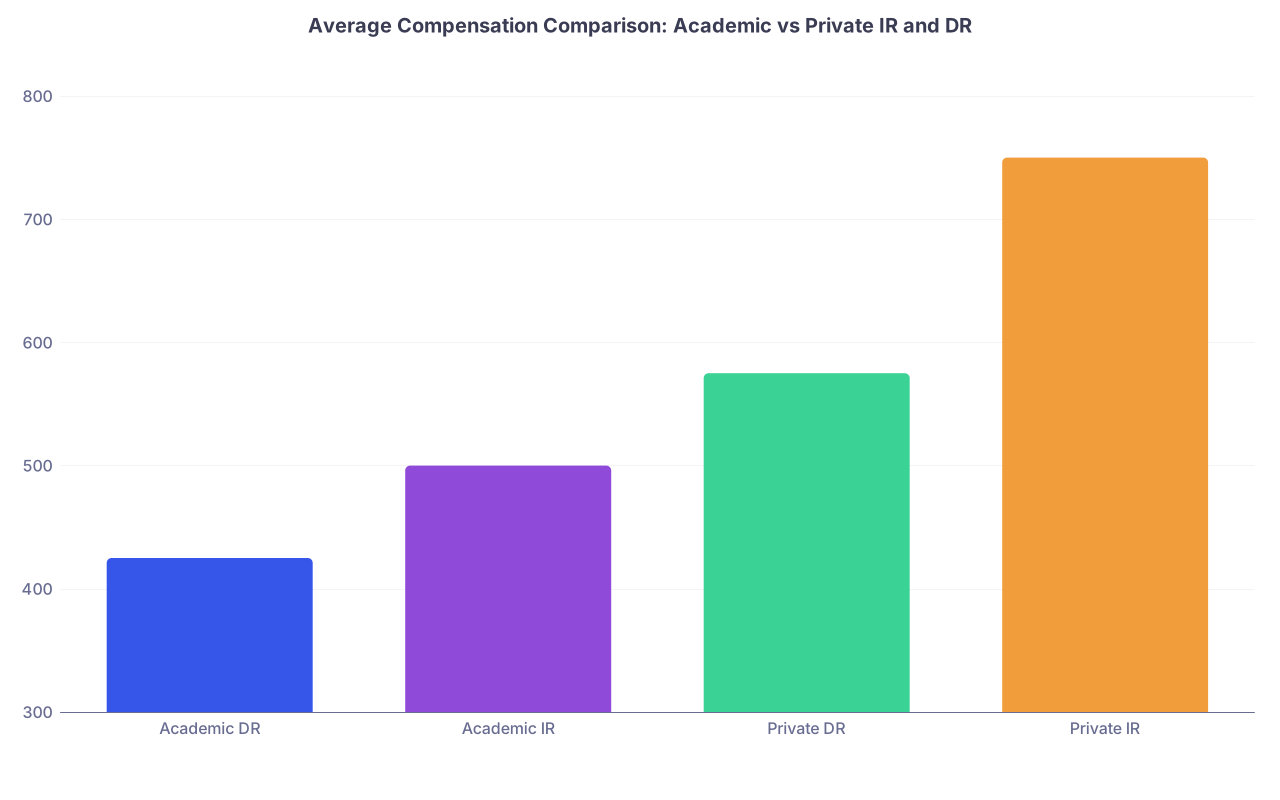
| Category | Value |
|---|---|
| Academic DR | 425 |
| Academic IR | 500 |
| Private DR | 575 |
| Private IR | 750 |
The median IR doc in private practice generally earns more than the median DR doc, especially once partnership is reached. But the gap is very context-dependent.
3. Training Pathways: How the Track You Choose Locks in Future Options
You cannot talk about income without talking about how locked-in you become during training. The pathway you pick affects both your earning timeline and your flexibility.
Diagnostic Radiology Pathway (DR → IR-leaning or pure DR)
- 1 year: Internship (prelim med/surg/traditional)
- 4 years: DR residency
- Optional: 1 year IR fellowship (legacy pathway, fading)
- Or: ESIR (Early Specialization in IR) during DR, then 1 extra IR year
Income implications:
- DR-only finishing after PGY-5 can start earning full attending pay sooner.
- DR → IR fellowship adds an extra year at resident/fellow pay (~$65k–$80k) instead of $400k–$600k.
- If you later decide IR lifestyle is not worth it, DR background gives a clean off-ramp to high-paying, lower-call work.
Independent IR Pathway is Almost Gone
The old DR → IR fellowship route is shrinking. The American Board of Radiology has pushed hard toward the Integrated IR/DR residency model, which is its own beast economically.
Integrated IR/DR Pathway
- 1 year: Internship
- 5 years: Integrated IR/DR (6-year total)
- Outcome: Double-boarded in IR and DR
This sounds sexy on a brochure. In practice:
- You lose a year of attending income compared with a standard DR resident who finishes PGY-5 and goes straight into DR attending work.
- You pick up IR skills and credentials that can command higher pay but also higher call and risk.
- You are more “pigeonholed” into IR-heavy roles. Moving back to pure DR is possible but politically and emotionally harder.
For pure finances, that extra lost year of attending pay early in your career, when compounding and debt repayment matter, is not trivial.
4. Revenue Mechanics: Why IR Does Not Always Out-earn DR
I have seen residents genuinely confused by this: “IR procedures pay so much more; how could IR not always out-earn DR?” Because income ≠ theoretical RVU rate × posted reimbursement.
Here is what actually matters:
1. Time per Revenue Unit
Think in wRVUs per hour, not per case.
- A CT abdomen/pelvis may be ~1.5–2.0 wRVUs and takes a few minutes to read in a high-volume environment.
- A complex IR case may be 20–30+ wRVUs but may consume 2–4 hours of lab time, pre/post care, and documentation.
If a productive DR radiologist reads 20–25 RVUs/hour, and a busy IR doing heavy procedures nets 15–25 RVUs/hour (after all friction), their hourly revenue can be surprisingly similar.
In some dysfunctional systems, IR gets boxed into low-complexity, undercoded, or poorly scheduled work and ends up at lower RVUs/hour than a high-octane DR colleague.
2. Payer Mix and Denials
IR procedures:
- Higher chance of pre-auth problems.
- Higher denial risk for “elective” vein procedures, MSK interventions, or certain oncologic therapies.
- Greater sensitivity to payer mix (Medicaid, uninsured, underinsured).
DR imaging:
- More standardized coding.
- More predictable approvals.
- Easier to scale across payers.
The hospital loves IR because of facility fees. You only get paid professional fees. That facility–professional fee imbalance is a constant source of frustration for IR docs who see the hospital making multiples of their professional income off the same case.
3. Compensation Models
Interventional radiologists can be trapped by bad structures:
- Same base salary as DR with “protected IR time,” but no meaningful productivity bonus tied to procedural work.
- Hospital-employed IR with poor RVU conversion factor; the hospital shrugs because they are making bank on facility fees.
- Group models where partners reading DR get similar or higher distributions because IR’s downtime, clinic, and call are not fully recognized.
Diagnostic radiologists have cleaner alignment: more reads = more RVUs = more money (in a decent PP or productivity model).
5. Lifestyle Tax: Call, Burnout, and “Soft Costs” of IR vs DR
Money has to be weighed against what you give up. IR pays more on average because:
- It is harder to recruit and retain.
- The work intensely intertwines with emergencies.
- There is procedure risk (complications, middle-of-the-night disaster cases, angry surgeons, ICU chaos).
Call Burden
IR call often includes:
- Trauma: embolizations, urgent angiography.
- GI bleeds.
- Organ ischemia, limb ischemia.
- Nephrostomy tubes, biliary drains, abscess drains in septic patients.
- Sometimes stroke work, depending on local structure.
This is not “phone call from home.” This is scrub in, get to hospital, do real work at 2:30 a.m.
Diagnostic call:
- Night reads, maybe teleradiology. Tough but you are at a workstation. Often compensated with differential or schedule flexibility.
- No consent forms. No family discussions about high-risk procedures. No bleeding patient on the table.
So yes, IR median comp is higher. But you pay in:
- Sleep.
- Emotional bandwidth.
- Medicolegal exposure from high-risk invasive procedures.
Some IRs are fine with this. Some, after 10–15 years, are absolutely not.
6. Academic vs Private Practice: How the Gap Changes
In academic centers, the IR vs DR income difference is often modest.
Why?
- Salaries are compressed by institutional scales.
- RVU productivity bonuses are weaker or capped.
- IR is “mission critical” but not always proportionally rewarded.
So you might see:
- Academic DR: $350k–$450k
- Academic IR: $400k–$550k
The IR doc may also have clinic, research, program building, resident training, and heavy call layered on top. From a pure ROI perspective, many academic IRs are underpaid relative to their value.
In private practice, especially independent groups:
- IR can be a major profit center if they control their own patients, referrals, and outpatient lab/office space.
- Partners can do office-based labs (OBLs), PAD work, vein centers, dialysis access centers, etc.
There, IR incomes can hit:
- $700k–$1M+ in strong markets with OBL ownership or high outpatient IR volume.
But that is not guaranteed. It depends on:
- State regulatory climate (CON laws).
- Payer environment for PAD/vein/dialysis work.
- Hospital vs OBL dynamics.
- How the practice distributes technical vs professional revenue.
7. Hybrid Roles, DR-Heavy IR, and IR-Heavy DR
Here is where residents get confused: the lines between “IR” and “DR” in practice are increasingly blurred.
DR with Procedures (Non-IR, but Hands-On)
In many community groups:
- “Diagnostic” radiologists do a mix: US-guided biopsies, paracenteses, thoracenteses, basic drainages, joint injections, maybe some simple vascular access.
- They bill procedural codes, but at lower wRVUs and shorter case times than complex IR.
Result: Small bump in pay for some procedural work, without full IR call or IR depth.
IR-Heavy but Still Reading DR
Plenty of “IR” jobs:
- 40–60% IR procedures (2–3 days/week).
- 40–60% diagnostic (especially on call, off-hours, or to maintain coverage).
Income here typically lands between pure DR and pure IR:
- More than DR-only colleagues if comp is fair.
- Less than a fully procedural IR partner in a high-volume IR practice.
The Misleading Phrase: “Dedicated IR Position”
Groups will advertise “100% IR” jobs that quietly include:
- 1–2 hours of DR readout daily.
- Full DR call with IR call.
- DR weekend shifts “for fairness.”
You must drill into the contract and actual schedule. Otherwise, your predicted IR-heavy income vs DR effort balance will be fantasy.
8. Malpractice, Risk, and Long-Term Earning Stability
Interventional radiologists operate in a higher-risk environment:
- Procedural complications (bleeds, ischemia, embolic events).
- On-the-spot family discussions about catastrophic outcomes.
- ICU-level patients who decompensate on the table.
Malpractice premiums for IR are typically somewhat higher than DR, though both remain lower than surgical fields like neurosurgery or OB/GYN.
Economic implications:
- Groups may withhold more overhead or adjust buy-in for IR exposure.
- Some IR docs in their 50s–60s deliberately shift toward DR-heavy roles to reduce stress and risk.
- Long-term sustainability for a 30-year career is trickier in full-intensity IR than in DR.
DR, on the other hand:
- More shielded from direct patient interaction.
- Lower immediate complication rates.
- Risk comes from interpretive errors, which are real, but the daily acute pressure feels different.
That difference in “stress per dollar” matters more with age than most residents realize.
9. Resident-Level Decisions: How to Align Track with Financial Reality
If you are in medical school or early residency trying to decide IR vs DR, here is how to think clearly about the income nuances.
Question 1: How much does autonomy over your schedule matter?
- DR offers unmatched flexibility: teleradiology, part-time, nights, shifts, remote work, etc.
- IR ties you to a lab, hospital, staff, block time, and procedural schedule.
If you see yourself wanting:
- 0.7–0.8 FTE.
- Earlier retirement.
- Geographic flexibility or remote living.
Then pure DR has a strong economic and lifestyle edge.
Question 2: How willing are you to grind for the upper tail of IR income?
The best-paid IRs usually:
- Own or co-own outpatient labs/centers.
- Build referral networks aggressively.
- Accept heavy call, expanded hours, and often some business risk.
If you just want “comfortable high income with low chaos,” then high-volume DR in a solid group often beats IR on a risk-adjusted basis.

| Step | Description |
|---|---|
| Step 1 | Start - Choosing Track |
| Step 2 | Leaning DR |
| Step 3 | Leaning IR |
| Step 4 | DR with limited procedures |
| Step 5 | High-volume DR or telerad |
| Step 6 | Traditional group DR |
| Step 7 | IR with OBL/ownership |
| Step 8 | Hospital-based IR job |
| Step 9 | Procedural passion? |
| Step 10 | Ok with heavy call and emergencies? |
| Step 11 | Value remote work and flexibility? |
| Step 12 | Want business/risk for max income? |
Question 3: How do you feel about seeing patients longitudinally?
IR increasingly behaves like a clinical specialty:
- Clinic days.
- Follow-ups for oncologic procedures, PAD, venous disease.
- Continuity and patient relationships.
If you hate clinic and love staying anonymous behind a screen, DR fits you better. IR will feel like a bait-and-switch.
But that clinic is also where IR can create defensible referrals and higher-value work that justifies top-tier pay.
10. Future Trends: What Might Happen to IR vs DR Income
You are not entering a static market. Pay structures are shifting under your feet.
DR Trends
- Telerad and corporate consolidation put pressure on per-RVU rates but expand job availability.
- AI will erode low-complexity volume over 10–20 years (chest X-rays, screening studies), but probably augment rather than replace radiologists in complex reads.
- High-volume subspecialty DR (neuro, MSK, body) remains highly paid.
Result: DR salaries likely remain strong but with increasing variability depending on practice type and geography.
IR Trends
- IR is drifting toward a more independent, clinic-heavy, vascular- and oncology-oriented model in some markets.
- Stroke thrombectomy and structural heart work have become competitive battlegrounds with neurology, neurosurgery, and cardiology. Turf fights affect income potential.
- Payers are scrutinizing PAD and vein interventions, which have been abused in some settings.
Result: IR income has high upside but also higher policy and regulatory risk. The best IR setups will continue to pay extremely well; mediocre or constrained ones may lag behind high-powered DR jobs.
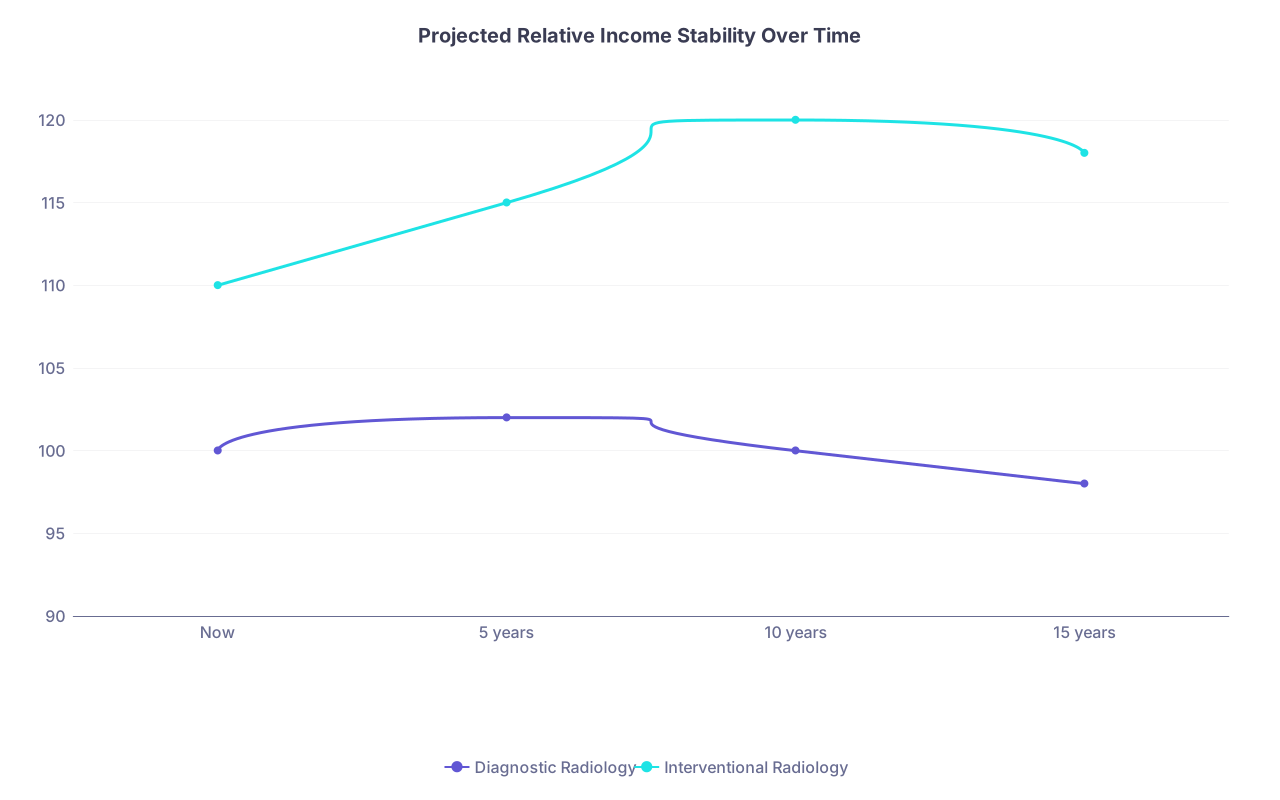
| Category | Diagnostic Radiology | Interventional Radiology |
|---|---|---|
| Now | 100 | 110 |
| 5 years | 102 | 115 |
| 10 years | 100 | 120 |
| 15 years | 98 | 118 |
11. Practical Scenarios: How This Plays Out in Real Life
Let me give you three realistic composites I have seen repeatedly.
Scenario A: High-Volume DR Partner
- Community private group, non-coastal city.
- 10–12 weeks nights per year, some weekend coverage.
- 20–25 RVUs/hour, ~8–9-hour days on average.
- Total comp: ~$650k–$750k, steadily, with reasonable vacation.
Lifestyle: Predictable. Hard days, but no emergent procedures at 3 a.m. Option to do telerad in future and downshift if needed.
Scenario B: Balanced IR/DR in Private Practice
- ~50% IR, 50% DR.
- 1:4 IR call plus DR call contribution.
- Has clinic 1 day/week.
- Some ownership of outpatient IR lab; moderate PAD, oncologic, venous load.
Total comp: $750k–$900k, heavier weeks when IR is busy, burnout risk if group does not protect staffing and block time.
Lifestyle: Rewarding but intense. Harder to downshift without income dropping sharply or shifting to DR-heavy role.
Scenario C: Academic IR, Big Center
- 70–80% IR.
- Heavy weekday procedures, high complexity, teaching, tumor boards.
- 1:3–1:5 call; many nights in the lab; robust ICU interactions.
Total comp: $450k–$550k.
Lifestyle: Intellectually satisfying. Not financially maximized relative to value provided. Burnout possible if call and admin duties stack without compensation recognition.
12. What Residents Should Actually Do With This Information
Do not pick IR solely because “it pays more.” That is a shallow analysis that ignores:
- The extra training year(s) and opportunity cost.
- The emotional and physical load of IR call.
- The fact that badly structured IR jobs pay suspiciously close to DR for much more pain.
But also do not avoid IR purely on lifestyle horror stories. Done right, IR is one of the most satisfying, well-compensated hybrid specialties in medicine.
Here is the bottom line:
- IR has a higher income ceiling and higher lifestyle cost.
- DR has a more stable floor and greater flexibility with still very high median pay.
For “highest paid specialties” conversations, IR clearly belongs in the top tier alongside ortho, neurosurgery, and cardiology in its best setups. DR belongs just one notch under that but with a far more favorable stress-to-pay ratio for many people.

FAQ (Exactly 6 Questions)
1. Does interventional radiology always pay more than diagnostic radiology?
No. In some academic centers and hospital-employed jobs, the pay difference is small, sometimes only $25k–$75k, despite IR having much higher call and procedural intensity. In well-structured private practices, IR usually earns more, but efficient high-volume DR partners can match or exceed poorly structured IR jobs.
2. How much more does an integrated IR/DR pathway cost me in lost income?
Roughly 1 extra year of training compared to a straight DR path. If you could earn $450k as a new DR attending and instead spend that year at $70k–$80k fellow-equivalent income, you are effectively “spending” ~$370k–$400k in opportunity cost for that extra IR credential year, not counting compounding or debt payments.
3. Can an interventional radiologist switch to mostly diagnostic work later?
Yes, technically. IR/DR board certification allows it. Practically, it depends on local job markets and group politics. Some IRs in their 40s–50s negotiate transitions into DR-heavy roles or purely diagnostic seats, often taking a short-term pay haircut but gaining lifestyle and reduced call.
4. Are outpatient-based labs (OBLs) really a game-changer for IR income?
They can be. When IRs have ownership stake in OBLs or ambulatory surgery centers and build strong PAD/vein/oncology practices, total income can exceed $1M. But this comes with regulatory scrutiny, business risk, and the need to manage referrals, operations, and payer relationships. It is not “free money.”
5. How does AI affect the income outlook for IR versus DR?
AI will likely impact DR first, trimming low-complexity work and changing how groups price RVUs. That said, complex imaging and subspecialty reads will remain in demand. IR is less directly threatened, since procedures and real-time decision-making cannot be automated easily. Net effect: DR income may get more stratified; IR retains high demand for technically strong operators.
6. If I care mostly about money with reasonable lifestyle, which track is better?
For most people in that category, high-volume DR in a solid private group is the ideal balance: $600k–$800k potential, strong schedule control, and the option for telerad or partial FTE later. IR can out-earn this in the right setup but usually costs more in call, stress, and complexity. If you truly love procedures and patient interaction, IR’s extra income can be worth it. If you are indifferent, DR wins.
Key points:
Interventional radiology usually has a higher income ceiling but demands more call, risk, and political navigation. Diagnostic radiology offers a more stable, flexible, and still highly paid path, with fewer hidden lifestyle taxes. The smart move is not chasing maximum theoretical dollars—it is aligning your tolerance for chaos with the compensation structure of the track you choose.