
Most anesthesia residents are making six‑figure mistakes because they do not understand how they are actually paid.
Not “salary versus RVU.” Not “partnership versus employed.” I mean the real mechanics: hospital-based vs office-based groups, how money enters the system, how it is sliced, and who consistently walks away with more.
Let me break this down specifically.
1. The Core Money Flows: Hospital vs Office
Forget the buzzwords for a moment. Anesthesia income is driven by three main revenue streams:
- Professional billing (ASA units, modifiers, concurrency, etc.)
- Facility and technical fees (paid to hospitals, ASCs, offices – not to you)
- Subsidies / stipends (usually hospitals paying groups to cover unprofitable time)
Everything we will discuss is some combination of those three.
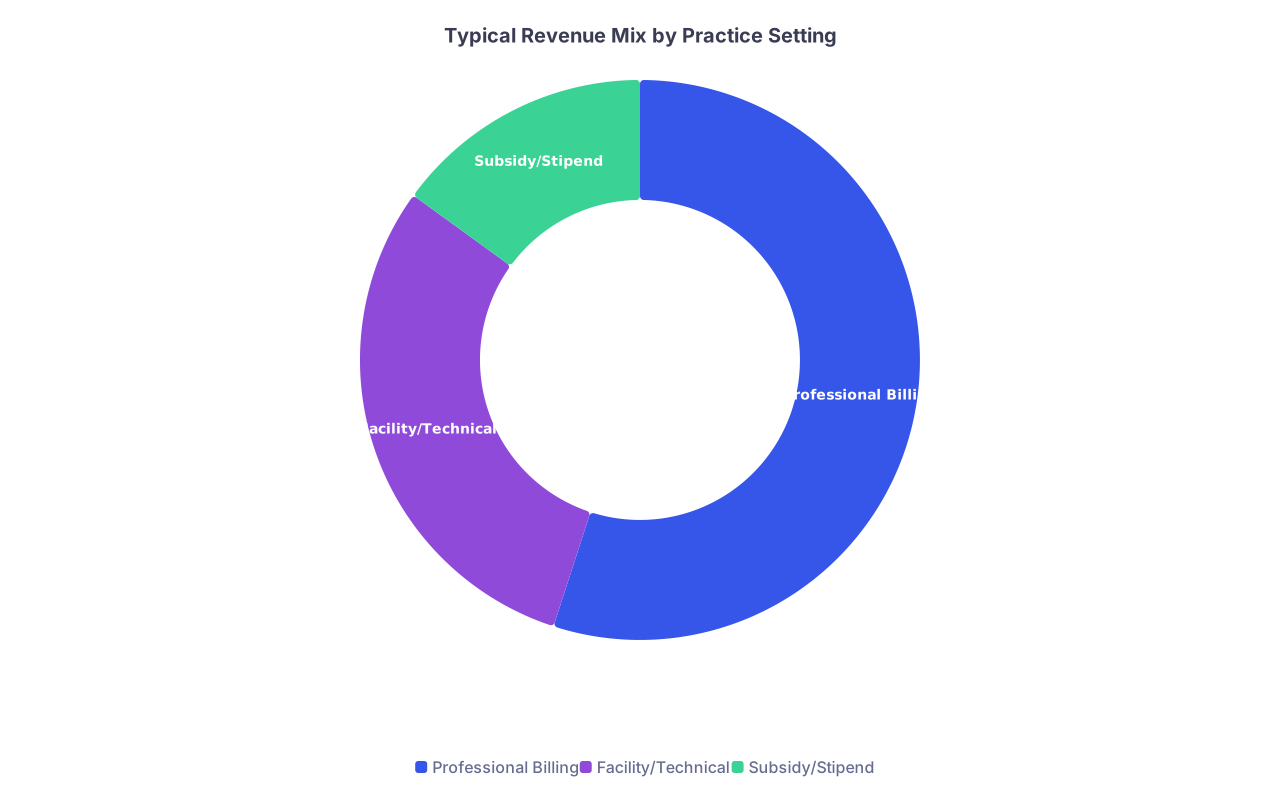
| Category | Value |
|---|---|
| Professional Billing | 55 |
| Facility/Technical | 30 |
| Subsidy/Stipend | 15 |
Now, the crucial distinction:
Hospital-based anesthesia groups
Work in big ORs, procedural areas (GI, IR, cath lab), L&D, sometimes ICUs. Revenue from:- Insurer / Medicare payment for your anesthesia services
- Hospital subsidy to guarantee coverage (call, nights, low-pay cases)
Office-based anesthesia groups (OBA)
Work in surgeon/dentist offices or office-based procedural suites. No hospital. No facility fee you control. Revenue from:- Professional billing (often higher collections per case because of payer mix)
- Sometimes per-case or per diem contracts with surgeons / offices
Broad pattern:
Hospital-based = higher total revenue pool but more mouths to feed, more overhead, more coverage obligations.
Office-based = lower total volume, but better payer mix, lean overhead, profit per anesthesiologist can spike.
But whether you see that money depends entirely on pay structure.
2. How the Work Itself Differs (Because That Drives Pay)
This is not only about dollars. The structure of the day dictates what pay models are even possible.

| Step | Description |
|---|---|
| Step 1 | Hospital AM |
| Step 2 | 7 am first cases in 10 ORs |
| Step 3 | Emergent add-ons |
| Step 4 | Late room relief decisions |
| Step 5 | Night call or home |
| Step 6 | Office-Based AM |
| Step 7 | Single room or 2 rooms |
| Step 8 | Mostly elective cases |
| Step 9 | Done when schedule done |
Hospital-based group typical reality
You know this from rotations:
- 8–30 ORs, plus OB, GI, IR, cath, EP
- Multi-layered staffing: MD-only in some rooms, CRNA supervision in others, sometimes residents or AAs
- Call: in-house or home call, usually Q4–Q8 depending on size
- Unpredictable day: trauma cases, ruptured AAA at 4 pm, unplanned c-sections at 3 am
- Political ecosystem: surgeons, hospital admin, nursing leadership, anesthesia leadership all pulling
Bottom line: you are being paid not only for “work done” but for availability and coverage. That is why subsidies exist at all.
Office-based anesthesia reality
Very different vibe:
- 1–3 rooms in a procedure suite or office
- Almost exclusively elective cases, few true emergencies
- Payer mix: heavy commercial insurance and cash-pay (cosmetics, dental, GI, pain, plastics)
- Hours: typically 7–3, 8–4, sometimes 4-day weeks; call is rare
- Staff model: often MD-only or very light CRNA support
Here you are paid almost entirely for cases you do, not “coverage”. If the surgeons are not working, you are not earning. But when they are working, margins are high.
That difference drives the pay structures.
3. Hospital-Based Pay Structures: What Actually Happens
In hospital-based groups, you will typically see one of five structures:
- Hospital-employed anesthesiologist
- Physician-only private group (no or limited CRNAs)
- Anesthesia care team (ACT) group – MD + CRNA / AA
- Large national/mega-group (private equity backed or corporate)
- Academic department (yes, that is its own animal)
Let us go through them precisely.
| Model Type | Annual Comp Range (W2) | Common Structure |
|---|---|---|
| Hospital-Employed | $400k–$650k | Base + RVU + stipend share |
| Physician-Only Private | $500k–$800k+ | Collections pool, equal shares/production |
| ACT Private Group | $500k–$900k+ | Supervisory model, subsidy support |
| National Corporate | $375k–$650k | Salary + small bonus, less upside |
| Academic | $325k–$500k | Salary + minimal incentive |
Numbers assume full-time, typical call, non-California unicorn scenarios.
3.1 Hospital-employed anesthesia
You are an employee of the health system. Usually W2 with benefits, 403(b), PTO, CME.
Common pay mechanics:
- Base salary for expected workload (e.g., $425–$550k for 1.0 FTE)
- RVU or “productivity” bonus above a threshold (for groups pretending this is private practice)
- Stipend/coverage component buried in the base; you often never see the raw subsidy numbers
- Quality / committee bonuses for checking boxes
Upside: stability, simpler politics, better benefits, less worry about collections.
Downside: the hospital captures the subsidy and any upside in efficiency; you are capped.
I have seen hospital-employed anesthesiologists working in sites where the hospital is paying a $5–8M annual subsidy to keep coverage going. The docs get a “competitive” salary in the $500–600k range while the C-suite smiles. You are not sharing proportionally in that subsidy.
3.2 Physician-only private group (hospital-based)
Less common now, but still out there in small to mid-size hospitals, some rural, some high-end.
Mechanics:
- Group bills professional fees directly
- Group negotiates subsidy with the hospital
- Overhead (billing, admin, malpractice, etc.) taken off the top
- Remaining profit divided by some model:
- Pure equal shares (“eat what the group kills”)
- Hybrid: small base + production component by collections or ASA units
- Seniority or partnership track multipliers
In good markets with strong payer mix and reasonable call, these groups can hit:
- Senior partners: $700–900k+
- New partners: $500–700k
- Pre-partners (employees): often $350–500k with track to partnership in 1–3 years
Risk: partner-heavy groups sometimes use long tracks and below-market pre-partner pay as a margin engine. That is where you hear about 3–5 year partnerships with mysterious “buy-ins.”
3.3 Anesthesia Care Team (ACT) groups – MD + CRNA
This is where the money can really jump, for better or worse.
Revenue streams:
- Multiple rooms billed with MD direction (QK) + CRNA services (QX)
- Higher concurrency allows one MD to legally bill services in 3–4 rooms at once
- Subsidy often larger because of expanded coverage footprint
Pay mechanics:
- Group bills professional fees for MD and CRNA work
- Pays CRNAs salary or per diem (e.g., $180–260k regionally; higher in hot markets)
- Overhead and subsidy handled at group level
- Remaining margin often very substantial if payer mix is decent
If the group is physician-owned and not absurdly top-heavy, MD comp in high-functioning ACT models regularly hits $700–1M+, especially in places like Texas, Florida, and certain Midwest markets.
You need to ask:
Who actually controls staffing ratios, CRNA pay negotiations, and the hospital contract? If it is the physicians, upside stays with you. If it is a corporate parent, you are an interchangeable widget.
3.4 National / corporate groups
Think NorthStar, NAPA, USAP (pre and post PE waves), Envision, etc.
Common patterns:
- You are technically “private practice” but do not own the contract
- W2 or 1099 as a “contractor” with little true autonomy
- Salary plus limited incentive; true margin goes to the corporate entity and investors
Typical compensation:
- $375–650k depending on region, call burden, staffing model
- Often more generous on recruitment bonuses / sign-ons to mask mediocre base
I have seen this repeatedly: same hospital, same payer mix, same OR volume. Independent group partners were making $800k. Corporate took over; new hires get $550k “market competitive” with no ownership path.
You can live well on $550k, sure. But do not confuse that with maximizing what the site could actually generate.
3.5 Academic hospital anesthesia
You know this story.
- Salary-driven, often lockstep by rank and years out
- Occasional clinical incentive for extra shifts / call
- Magnitude: $325–500k for most faculty; some high-call or “clinical track” roles can climb to $550–600k
- Subsidies from hospital largely diverted to department budgets, not directly to you
Academic anesthesia is a different conversation: lifestyle (sometimes), prestige, complexity of cases, teaching, research. If your primary objective is top-end income, this is not the maximal path. You already know that.
4. Office-Based Anesthesia: How the Money Really Works
Office-based anesthesia sits in the psychological blind spot of many residents. You rarely rotate there, yet some of the highest per-hour incomes in anesthesia live here.
There are three broad OBA models:
- Independent anesthesia group contracting with multiple offices
- Surgeon-owned or dentist-owned anesthesia company (you are the worker)
- Hybrid: ASC / office-based suites with some hospital overlap
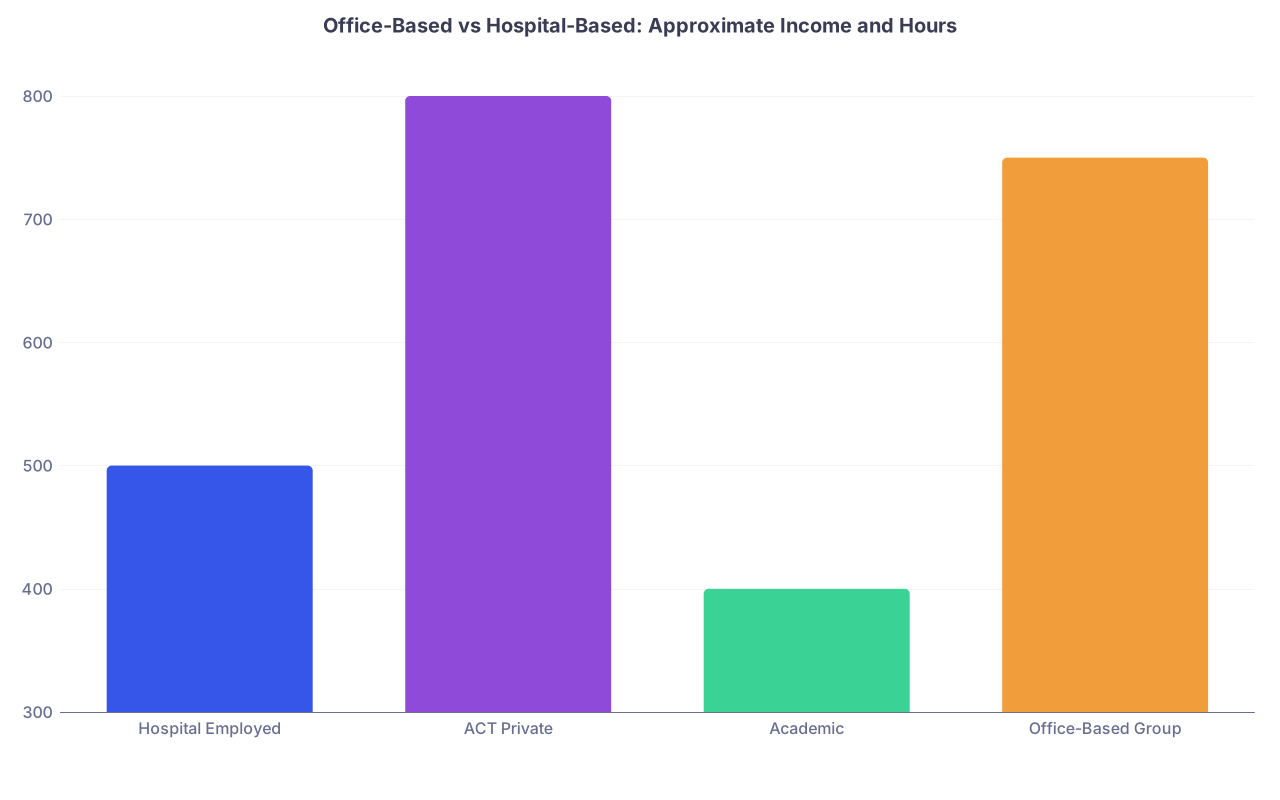
| Category | Value |
|---|---|
| Hospital Employed | 500 |
| ACT Private | 800 |
| Academic | 400 |
| Office-Based Group | 750 |
(Values in thousands; illustrative midpoints.)
4.1 Independent OBA group
This is the most interesting financially.
Revenue mechanics:
- Group bills professional anesthesia fees for cases performed in offices
- Payer mix often skewed heavily toward commercial and cash-pay
- No night call, minimal weekend work (unless cosmetic marathons)
- Overhead: lean – a few admin staff, billing, malpractice, maybe some monitoring equipment costs
Common pay structures:
1099 independent contractor daily rate:
Example: $2,000–3,500 per day for single-room coverage, sometimes more for heavy-case days or advanced procedures.
You may work 180–220 days per year.Percentage of collections:
Example: 50–70% of collections after billing fees; group retains rest.
Highly variable but can yield $700k+ if the volume and payer mix are strong.Hybrid: modest daily guarantee + percentage upside above a certain threshold.
Office-based income often looks deceptively modest on paper until you convert it to hourly:
- Hospital MD in ACT group: $750k for 55–65 hrs/week with call
- OBA doc: $650k for 40 hrs/week, no call, mostly predictable days
Hourly, the OBA doc is usually winning. And not getting called in at 2 am for a ruptured ectopic.
4.2 Surgeon- or dentist-owned anesthesia entity
Now we get into the “you are the help” structure.
Mechanics:
- The surgeons / dentists (often oral surgeons, pain physicians, plastics) own the anesthesia company or “management entity”
- They contract with insurers or bundle fees with their own charges
- You are hired as:
- W2 or 1099 anesthesiologist for a daily rate or salary
- Sometimes underpaid relative to what the service actually generates
I have seen dental anesthesia setups where anesthesia collections were $4–5k per day per room. The anesthesiologist was paid $1,800 per day. The practice owners pocketed the difference.
You can still do well here. But do not kid yourself: you are not sharing properly in profits unless the contract is structured to give you a percentage of collections or a true partnership.
4.3 Hybrid ASC / office-based arrangements
These sit between true hospital-based and pure office-based.
- You might cover a physician-owned ASC on Mon–Thu and a hospital site on Fridays
- Or rotate between a cosmetic surgery center and a community hospital
Pay structures here vary wildly. Some groups treat the ASC/office days as premium (higher share of collections) and the hospital coverage as baseline. Others lump everything together.
5. Core Pay Structure Mechanics You Need To Recognize
Let us strip away labels and talk about how you will actually be paid, regardless of setting.
5.1 Salary-only (or near-salary-only)
Common in:
- Hospital-employed gigs
- Academic centers
- Some corporate setups
- Surgeon-owned OBA where they want predictable cost
Pros: stability, you can roughly predict your paycheck, less drama around volume.
Cons: you never see true upside. If the group becomes more efficient or captures more subsidy, you do not benefit correspondingly.
This is fine if your goals are stability and simplicity. It is mediocre if your main priority is the highest possible earnings.
5.2 Base + productivity / RVU bonus
Very popular HR trick to make employed jobs seem “like private practice.”
Mechanics:
- Base covers “expected” workload (e.g., 10,000 RVUs or X ASA units)
- Above threshold, you earn some rate per RVU / unit
- Problem: hospitals or corporate set the thresholds and rates; they win twice – once on the base discount, again on the sliver they pay for your extra work.
In practice, very few anesthesiologists meaningfully exceed thresholds unless the group is severely understaffed.
5.3 Pure productivity / collections models
True private practice.
You get:
- A share of group net collections proportional to your production (ASA units, dollars, or some blended metric)
- Or a “draw” (monthly stipend) reconciled at year-end against your actual share
Upside: direct linkage between what you do and what you earn.
Downside: variability, plus the usual partnership-game politics.
In both hospital-based ACT and office-based groups, this is where the top 5–10% of earners live.
5.4 Daily rate / shift-based 1099
Common in:
- Office-based groups
- Locums at hospitals or ASCs
- Some corporate stopgaps during staffing crises
You are essentially selling time, not directly sharing in collections.
Here the devil is in:
- How many hours does a “day” actually run? A “$3,000 day” means something very different if you are always out by 3 pm versus regularly staying until 7 pm.
- Is there call associated? In-house? Stipend?
- Who covers malpractice, tail, and benefits? Your effective take-home will be different as 1099.
This model can be extremely lucrative if you stack high daily rates with efficient schedules and minimal downtime.
6. Pay Structure Comparison: Where The Real Upside Lives
Let me be blunt. If your single metric is “highest realistic anesthesiologist compensation over a career,” the hierarchy usually looks like this:
| Model | Income Ceiling | Lifestyle Predictability |
|---|---|---|
| OBA Independent Group | Very High | High (no call) |
| Hospital ACT Private (MD-owned) | Very High | Moderate |
| Physician-only Private Group | High | Moderate |
| Hospital Employed | Moderate | High |
| Corporate / National | Moderate | Moderate |
| Academic | Low–Moderate | Variable |
Why independent OBA and physician-owned ACT groups lead:
- Lean overhead relative to revenue
- Favorable payer mixes or operating leverage (multiple rooms per MD)
- Physicians actually control contracts and staffing
Where hospital-based groups can still win:
- Large subsidies + efficient ACT models + strong commercial payer mix
- Partners who are not siphoning disproportionate margins via complicated seniority games
Where you routinely leave money on the table:
- Corporate / PE-backed setups where EBITDA is the goal, not your income
- Surgeon-owned anesthesia shells that underpay anesthesiologists relative to collections
- Employed models that cap upside and absorb big subsidies centrally
7. Specific Red Flags and Green Flags for Residents
You are not going to see the full pro forma of these practices. But you can ask targeted questions that expose the pay structure.
Hospital-based role — questions that matter
Red flags if they dodge or equivocate on these:
- “How much is the hospital anesthesia subsidy annually, roughly?”
- “How is that subsidy used – does it go to the group directly, or does the hospital retain it and pay us a flat rate?”
- “For partners, what was average W2 or K-1 compensation last year and the year before?”
- “How many ORs per anesthesiologist on a typical day? What is the ACT ratio?”
- “What percentage of revenue comes from Medicaid / uninsured?”
If every partner is mysteriously “making about the same” but nobody can give real numbers, assume there is either chaos or something to hide.
Office-based role — questions that separate good from bad
You must be very specific here:
- “Do I get a percentage of collections, or a fixed daily rate?”
- “What were actual average collections per anesthesia day last year, per provider?”
- “Who owns the anesthesia company or entity that bills for services?”
- “Who pays for malpractice? Is tail covered if I leave?”
- “What is the real schedule – first case start, typical end time, frequency of late days?”
If ownership is exclusively in the hands of surgeons / dentists and they will not talk collections, assume you are being underpaid.
8. Lifestyle, Risk, and Long-Term Play
Money is not the only variable. Two quick realities:
Hospital-based groups expose you to:
- Contract instability (hospital swaps groups, brings in corporate, etc.)
- Night/weekend call, emergencies, more medico-legal risk
- But also: broader case exposure, trauma, hearts, neuro, etc., if you want that
Office-based anesthesia exposes you to:
- Narrower case mix (sedation, low-risk outpatients, cosmetics, dental)
- Volume risk if a major referral surgeon leaves
- But far more predictable days and lower acute stress
Many anesthesiologists do a hybrid over their careers: start hospital-based, gain skills and financial cushion, then migrate toward OBA or ASC-heavy roles as they age or burn out on 2 am add-ons.
9. Strategy for Residents: How To Position Yourself
You do not need to decide your forever job in CA-2. But you do need to avoid being boxed in.
A clear plan:
- Get strong training across subspecialties. Even if you think you want OBA, the best-paying groups respect deep skillsets.
- Learn to read basic pro formas and understand how collections roughly map to your pay. If a group cannot explain this, walk.
- Do not overvalue signing bonuses. They are frequently used to distract you from structurally underpowered compensation.
- Try to see at least one high-functioning private ACT group and one OBA practice during residency or via away rotations / moonlighting in CA-3. You need mental reference points.
You are entering one of the highest paid specialties. But the spread between the 25th and 90th percentile in anesthesia is enormous. The difference is not talent; it is structure and leverage.
FAQ (Exactly 6 Questions)
1. Are hospital-based anesthesia jobs always lower paying than office-based jobs?
No. A well-run, physician-owned hospital ACT group with strong subsidies and favorable payer mix can absolutely out-earn most office-based setups. However, on a per-hour and predictability basis, many office-based roles quietly beat average hospital-employed and corporate positions. The key is not “hospital vs office”; it is who owns the contract and how profits are distributed.
2. How do I compare a $550k hospital-employed offer to a $2,800/day office-based 1099 offer?
Normalize everything to an annual and hourly figure, then subtract realistic costs. For the 1099 role, estimate working days (say 200/year): 200 × $2,800 = $560k. Then account for unpaid benefits (health insurance, retirement, malpractice, CME, taxes). If the 1099 schedule is 8-hour predictable days with no call and the hospital-employed job is 55–60 hours/week with call, the 1099 job is almost certainly superior on an hourly basis even if the W2 numbers look similar.
3. Do anesthesia subsidies from hospitals really matter for my pay?
Yes, massively. In many markets, professional collections alone would not support current compensation levels and coverage requirements. The subsidy fills the gap. If your group sees little or none of that subsidy in your comp while the hospital or corporate parent “manages” it, you are leaving money on the table. Good private groups negotiate those subsidies aggressively and pass them through to physicians.
4. Is joining a large national anesthesia company always a bad idea financially?
Not always, but you should assume the ceiling is lower. These groups often stabilize contracts and may offer geographic flexibility, but they exist to generate profits for owners/investors, not maximize your income. If your goals are moderate income, less business responsibility, and you like a particular location that only has corporate groups, it can be acceptable. Just do not confuse it with top-quartile earning potential.
5. How risky is office-based anesthesia from a medico-legal standpoint?
Different, not necessarily riskier. Cases are usually lower acuity, but you often work with less backup and more constrained resources. The biggest risks: inadequate patient selection, poor rescue infrastructure (no rapid transfer pathway), and weak protocols. High-quality OBA groups mitigate this with strict inclusion/exclusion criteria, robust emergency plans, and strong monitoring standards. From a malpractice premium standpoint, many OBA anesthesiologists pay similar or slightly lower rates than hospital-based peers.
6. What should I prioritize in my first job out of residency: money, case mix, or lifestyle?
In the first 3–5 years, prioritize skillset and optionality, then money. If you can get strong experience in complex cases while also being reasonably paid, that is ideal. Do not lock yourself into a narrow, low-acuity niche too early if you think you might later want a high-end private group or academic role that values advanced skills. Once you are clinically versatile and financially stable, you can pivot more aggressively toward either maximal income (high-yield private/OBA) or maximal lifestyle (lower call, academic, or light OBA).
Key points:
- Pay is driven less by “hospital vs office” and more by who owns the contract, who controls staffing, and how collections plus subsidies are split.
- The highest earners cluster in physician-owned ACT and independent office-based groups where anesthesiologists actually participate in profits, not just salaries.
- Your leverage comes from understanding these structures, asking the right questions, and refusing to trade long-term upside for a shiny signing bonus and vague promises.