
Most people talking about “high-paying specialties” do not understand how radiation oncology actually makes its money.
They quote MGMA medians and shrug. That is lazy. Radiation oncology compensation lives and dies on two things: technology deployment and billing structure. If you do not understand those, you do not understand your own paycheck.
Let me break this down specifically.
1. How Radiation Oncology Actually Generates Revenue
Radiation oncology is not like outpatient neurology or rheumatology. It is closer to running a small factory bolted to the side of a hospital.
You make money through two broad streams:
- Professional revenue – what you bill as a physician
- Technical revenue – what the machine, staff, and facility bill
In private practice or joint ventures, you may touch both. In hospital employment, you usually see only the professional side while the hospital captures the technical.
The professional side: what you personally “own”
Professional revenue comes from:
- New consultations
- Follow‐up visits (on‐treatment visits and long‐term follow‐up)
- Treatment planning and management codes
- Special procedures (e.g., brachytherapy planning, stereotactic radiosurgery planning)
Translation: you get paid for thinking, documenting, supervising, and taking liability.
Typical high-yield professional codes (US context, CPT-based):
- Consultation / new patient: 99204–99205 (or facility E/M equivalents)
- Weekly treatment management: 77427 (per course, in weekly blocks)
- Simulation: 77280–77290
- 3D planning: 77295
- IMRT planning: 77301
- SRS / SBRT planning: 77300, 77334, 77372, 77373 depending on modality
- Special physics consults / special dosimetry: 77300, 77370
- Brachytherapy planning: 77761–77763, 77778, 77799 etc.
You do not need to memorize the numbers; you must understand the pattern:
- More complex, image-guided, conformal treatments rely on higher-complexity planning codes.
- Failure to document complexity or special procedures correctly leaves money on the table. Every single year.
The technical side: the “machine money”
Technical revenue is where the real dollars live.
Think about:
- Linear accelerator (linac) – IMRT, VMAT, SRS, SBRT
- CT simulator
- HDR brachytherapy afterloader
- Gamma Knife / CyberKnife / MR-Linac
- Treatment planning systems and QA equipment
Each fraction (treatment session) produces technical charges:
- Treatment delivery code(s)
- Image guidance code(s)
- Portal imaging / CBCT
- Immobilization devices
- Physics QA
If you are in a practice structure where you share in technical revenue (classic private practice, radiation oncology group owning the equipment, or joint-venture with hospital), your income is tied to:
- Machine throughput
- Payer mix
- Case mix (IMRT/SBRT/SRS vs simple 3D)
- Capital investment and debt service
- Contracting and negotiations
If you are hospital-employed, your W2 is negotiated against the background of this technical revenue, but you do not directly bill it.
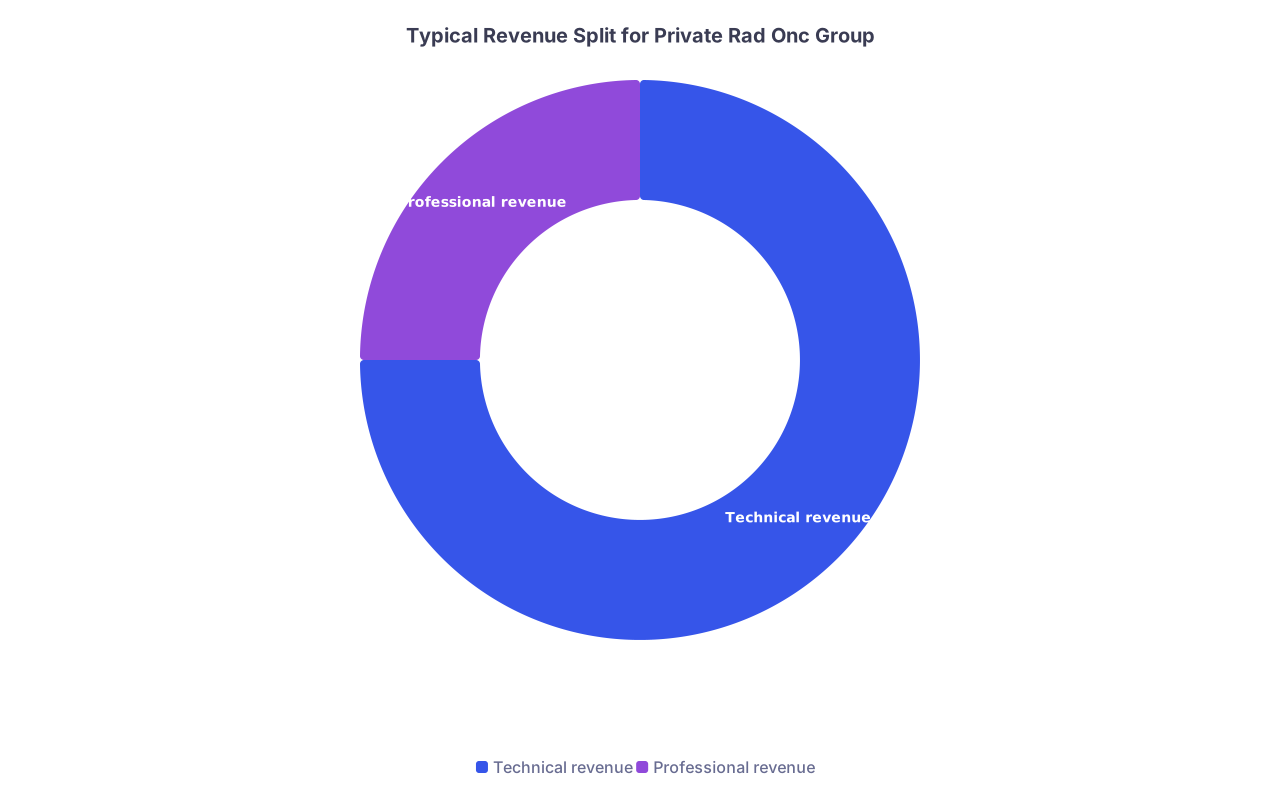
| Category | Value |
|---|---|
| Technical revenue | 75 |
| Professional revenue | 25 |
In many mature private groups, 70–80% of the revenue is technical. Miss that, and you misread the specialty.
2. Compensation Structures: Where the High Pay Actually Comes From
Radiation oncology is considered one of the higher-paying specialties. That is true if you land in the right structure and avoid obvious traps.
Let us compare broad models.
| Model | Typical Total Comp Range | Who Keeps Technical Revenue? | Risk Level |
|---|---|---|---|
| Hospital-employed (salary+RVU) | $350k–$600k | Hospital | Low |
| Academic (tenure/non-tenure) | $280k–$450k | Hospital / institution | Low |
| Private practice – no equity | $400k–$650k | Group owners | Medium |
| Private practice – partner | $600k–$1M+ | Shared among partners | High |
| Multi-specialty group / ACO | $350k–$650k | Group or hospital | Medium |
These are directional numbers, not contracts. Geography, payer mix, call, and case mix push them around.
Hospital-employed: the “stable but capped” path
Common structure:
- Base salary pegged to percentile of MGMA or AAMC (often 50th–75th percentile for radiation oncology)
- RVU-based bonus above a threshold
- Usually no direct share of technical revenue
Upside:
- Predictable
- Protected from capital risk (if the MR-Linac breaks, that is the hospital’s problem)
- Strong benefits, retirement match, often loan repayment or sign-on in rural markets
Downside:
- You feel the throughput grind but do not fully share in the upside.
- When a hospital adds a second linac or pushes IMRT/SBRT volumes, you do more work, but the marginal money goes to the institution.
If your contract uses wRVUs, your leverage is in:
- Understanding wRVU values for planning and management codes (IMRT vs 3D, SRS vs standard)
- Negotiating realistic thresholds based on volume and support staff
Academic: prestige discount, but still decent
Common pattern:
- Lower base salary than community/hospital employed
- Protected research and teaching time
- Bonus tied to RVUs, grants, or departmental performance
You give up some compensation in exchange for:
- Complex cases
- Clinical trials
- Name-brand institution
- Tenure or promotion track
For some, that is worth a $50–150k delta compared with community jobs. For others, absolutely not.
Private practice with equity: where the big numbers live
Here is where radiation oncology moves into “highest paid specialties” territory.
Mature partners in volume-heavy, well-run private practices with good payer mix can see:
- $700k–$1.2M+ in very strong markets
- Often 2–3 years as an associate before partnership
- Buy-in for ownership in equipment, building, or professional corporation
The math is brutal and simple:
- One busy linac can gross several million dollars per year in technical revenue.
- A group with 3–5 partners, 2–3 linacs, and decent commercial coverage can support strong partner incomes once debt and overhead are handled.
But do not romanticize it. The risks are real:
- Capital risk (new linac: $3M+; building: multi-millions)
- Market risk (hospital hires competing group, system shifts to employment model, ACOs squeeze rates)
- Regulatory risk (Stark, anti-kickback, freestanding center vs hospital outpatient department, site-neutral payments)
If you want the upside, you must read the contracts and the local politics. This is not a lifestyle choice; it is a business choice.
3. Tech Advances That Actually Move the Needle on Compensation
Residents hear breathless pitches about cool technologies. MR-Linac, proton therapy, adaptive planning, AI contouring. Most of that is either:
- Clinically useful but financially neutral
- Or financially attractive but constrained by reimbursement and capital
Let us separate what meaningfully affects compensation from what is just shiny.
IMRT / VMAT: the backbone of modern billing
The real financial revolution in radiation oncology was not proton therapy or MR-Linac. It was IMRT.
Key point: IMRT planning and delivery codes carry higher reimbursement than simple 3D conformal.
From a compensation viewpoint, IMRT did three things:
- Increased the value per fraction delivered
- Allowed escalation of complexity-based planning codes
- Justified investments in better planning systems and physicist FTEs, which in turn supported higher throughput
Residents often underestimate the importance of correct IMRT documentation:
- Clear physician intent for IMRT
- Documentation of medical necessity (e.g., sparing critical structures, complex targets)
- Properly coded simulators, immobilization devices, and image guidance
If a department under-documents or defaults to 3D because “we have always done it this way,” they are quietly cutting their own revenue.
SRS / SBRT: low volume, high yield
Stereotactic radiosurgery (brain) and stereotactic body radiation therapy (lung, spine, liver, etc.) are high-value treatments per course.
Each course may:
- Bill specialized planning codes
- Use higher-valued delivery codes
- Justify enhanced image guidance and physics charges
In centers that built strong SRS/SBRT programs, compensation benefits from:
- Increased revenue per patient
- Referral capture (from neurosurgery, pulmonology, GI, ortho spine)
- Markedly visible clinical impact, which can be leveraged to negotiate with hospitals and payers
Important nuance: you cannot just flip everything to SBRT and watch the money roll in. Payers increasingly require documentation and sometimes prior authorization for SBRT indications. Some markets have very tight utilization review.
Proton therapy: massive capital, complex politics
Proton therapy is often marketed as the ultimate high-tech growth engine. Financial reality:
- Build cost: tens of millions of dollars
- Very limited number of centers
- Reimbursement under payer scrutiny
For a resident, the critical point is this: proton therapy will not automatically make you rich. It can:
- Give you a niche skill set, especially pediatric and CNS proton
- Tie you to large academic or multi-institution systems
- Offer research and prestige
Income-wise, attending salaries at proton centers often approximate standard academic or high-end hospital-employed ranges. The profit, if any, accrues at the system level, not through your paycheck.
MR-Linac and adaptive therapy: clinically exciting, operationally demanding
MR-Linac is perfect for conference slides. Adaptive planning, online reoptimization, daily imaging. It is also:
- Expensive
- Heavy on staff time (physicists, dosimetrists, therapists, you)
- Slower throughput per treatment slot
Unless payers assign significantly higher reimbursement to adaptive sessions (which is still evolving), the financial ROI is not guaranteed.
As an attending, your personal compensation will hinge more on:
- Overall departmental productivity
- Case mix
- How your contract handles RVUs for adaptive sessions and complex planning
Not on simply “we have an MR-Linac.”
4. Billing Nuances Residents Constantly Miss (And Pay for Later)
Compensation in radiation oncology is not only about what you treat. It is about what you code and how you document.
A few billing nuances that directly change the revenue profile:
1. Initial consults versus simulation / planning
Revenue sequence for a new patient often looks like:
- Consult (history, exam, decision to treat or not)
- Simulation (CT sim with or without contrast, 3D vs IMRT intent)
- Planning codes (77295, 77301, special dosimetry, etc.)
- Daily treatment + image guidance
- Weekly treatment management
If you skip or underdocument the consult (or convert everything to “on-treatment visit” style documentation), you are:
- Undervaluing your cognitive work
- Creating potential compliance problems
Proper new patient documentation supports higher-level E/M codes and justifies the planning that follows.
2. Image guidance and immobilization
From a clinical standpoint, daily CBCT, complex immobilization devices, and frequent imaging supervision are standard of care for many sites.
From a billing standpoint, each of these:
- Has associated CPT codes
- Requires physician supervision (direct or general, depending on service and local rules)
- Needs documentation of review and use in clinical decision making
Residents often sign off on CBCTs or portal films as an afterthought. In practice, that:
- Is a billable event
- Must be documented as such to capture proper revenue
- Should be tracked for auditing and compliance
3. Special procedures and planning complexity
If you are doing:
- Multiple target volumes with complex dose gradients
- Re-irradiation with modified fields
- Adaptive re-planning mid-course
- Combined brachytherapy + external beam
There are often additional billing opportunities:
- Special physics consult
- Special dosimetry
- Complex treatment devices
- Boost fields as separate planning events
I have seen entire departments systematically fail to bill special dosimetry because “we do it for everyone anyway.” That is exactly backwards. If you do it for everyone because it is necessary, then document and bill it appropriately.
4. Brachytherapy: underused clinical tool, misunderstood revenue source
HDR and LDR brachytherapy remain financially meaningful when done at scale:
- GYN HDR
- Prostate HDR or LDR seeds
- Breast interstitial / APBI
- Skin brachytherapy in selected centers
But brachy is:
- Labor-intensive
- Dependent on trained nurses, physicists, OR or procedure room logistics
- Vulnerable to institutional priorities (OR time, anesthesia coverage)
From a revenue perspective, a well-run brachy program can generate significant professional and technical income per case. If you are in a center where brachy is slowly dying “because it is hard,” recognize that this has both clinical and financial implications down the line.
5. Where Residents Fit Into This: Training, Moonlighting, and First Contracts
Let me be blunt: most radiation oncology residents graduate functionally illiterate about the business they are walking into. That is a mistake.
During residency: what you should actually be paying attention to
You do not have to become a coder, but you should:
- Sit with your billing office or administrator for an hour a few times a year.
- Explicitly review how a few typical cases are coded:
- Early-stage breast
- Prostate IMRT
- Lung SBRT
- Brain SRS
- Understand which parts of your daily workflow correspond to professional and technical charges.
Ask ugly questions:
- Who owns the linac here? Hospital or group?
- What is the payer mix?
- What percentage of patients get IMRT vs 3D? SBRT/SRS?
- Are you getting paid for special procedures you routinely perform?
Moonlighting: small preview of the real economics
In some programs, residents moonlight:
- In on-treatment visit clinics
- Covering after-hours emergent radiation (spine cord compression, SVC syndrome)
- In remote or satellite clinics under attending supervision
Even if the hourly rate is modest, this is a chance to see:
- How volume, complexity, and documentation affect revenue
- How payers respond to emergent versus elective work
- What overhead looks like for satellite centers
Do not just chase the extra dollars. Extract data and pattern recognition.
First job: red flags and green flags in offers
When you get actual offers, read them with compensation structure in mind, not just raw number.
Green flags:
- Transparent breakdown of base salary, RVU bonus, and any share of technical revenue
- Clear partnership track with written terms (timing, buy-in amount, voting rights)
- Data on prior years’ actual compensation for people in the role
- Explanation of how new tech (e.g., SBRT program expansion) is expected to affect your compensation
Red flags:
- “Partnership after 2–3 years” with no written details
- “We have a proton center so you will do very well” with no income history and vague promises
- RVU targets that are inflated compared with documented historical volumes
- Heavy call or multi-site coverage with no adjusted compensation
If they will not give you the pro forma or prior income data for your role, assume the worst.
6. Future Pressures: Will Radiation Oncology Stay a “Highest Paid Specialty”?
Let us be honest. Radiation oncology has had a rough few years in the match. Declining applicants, talk of “oversupply,” consolidation of practices. People ask if the compensation will hold.
Here is how I see it.
Downward pressures
- Reimbursement tightening: CMS and private payers constantly scrutinize IMRT, SBRT, and proton utilization. Cuts to radiation oncology bundles or specific codes hit both technical and professional revenue.
- Consolidation: Hospital systems buying private practices and centralizing decisions generally flatten compensation curves.
- Utilization changes: For some cancers, systemic therapy, surgery, or novel agents may reduce radiation fractions (e.g., hypofractionation, omission studies).
Upward/stabilizing factors
- Demographics: Aging population, more cancer overall.
- Hypofractionation: Fewer fractions per course, but still high-value treatment that reduces burden on patients and may preserve per-course revenue even with fewer visits.
- Complexity of care: More nuanced planning, re-irradiation, and multi-modality care increases the value of specialized cognitive work.
- Non-commodity sites: CNS, spine, re-irradiation, brachy, peds, and complex thoracic remain highly specialized.
My take: radiation oncology will remain in the upper compensation tier relative to many cognitive specialties and a fair number of procedure-based ones. Ultra-high partner incomes in freestanding centers may compress over time, but the specialty is not about to become family medicine.
7. Practical Playbook for Residents Who Care About Money (And You Should)
If you want to align your career with strong compensation without selling your soul, here is a realistic path:
Learn the billing language now.
Know the difference between 3D, IMRT, SRS, SBRT, brachy billing patterns. Watch how your attendings document.Prioritize training in high-value modalities.
Get real experience with:- SBRT (lung, spine, liver, oligometastatic)
- SRS (single and multi-fraction)
- GYN brachy and, if possible, prostate HDR or LDR
You become more valuable to practices that want to grow these lines.
Understand practice models before rank lists and job searches.
During residency interviews and later job interviews:- Ask who owns the machines
- Ask about payer mix and case mix
- Ask about the last 5 years of volume trends
Decide how much business risk you actually want.
If you are conflict-averse, prefer predictability, and do not want to think about capital budgets, hospital-employed or academic roles are appropriate—and still well paid.
If you want the upside and can tolerate politics and risk, target private practice with transparent partnership track.Keep an eye on tech that genuinely affects revenue.
Focus less on buzzwords, more on:- Throughput
- Case complexity
- What payers are actively reimbursing at higher levels
- Local competition (if there are already three proton centers in your city, do not expect a fourth to mint money)
With these pieces in place, you will not just be a radiation oncologist who happens to be well paid. You will be one of the few who actually understands why.
FAQ: Radiation Oncology Compensation, Tech, and Billing
1. Is radiation oncology still one of the highest paid specialties for new grads?
For new attendings, radiation oncology generally sits in the upper-middle to upper tier of specialties. Starting offers in many non-academic settings fall in the $400k–$600k range, which is competitive with several procedure-heavy fields and higher than most general internal medicine and pediatrics-based specialties. The outlier seven-figure incomes are usually partner-level, high-volume private practice positions with strong technical revenue share, not typical first jobs.
2. Does learning proton therapy in residency help my compensation later?
It gives you a niche skill set and can make you more competitive for positions at proton centers, which are typically large academic or tertiary care systems. However, those jobs often pay similar to or slightly above standard academic/hospital-employed roles, not dramatically higher. Proton expertise is more about career options and case mix than guaranteed higher salary.
3. How much does SBRT/SRS experience matter for earning potential?
A lot. Practices looking to grow SBRT/SRS programs value attendings who can independently plan, contour, and manage these patients with confidence. Because these treatments are high-reimbursement per course, expanding SBRT/SRS volume can support stronger departmental or group revenue, which indirectly supports higher compensation. If you can walk into a community group and build or expand an SBRT/SRS program, you have leverage.
4. As a resident, what is the single most high-yield thing I can do to understand radiation oncology compensation?
Spend half a day with your department administrator or billing manager walking through the full billing chain for three or four representative cases (breast, prostate IMRT, lung SBRT, brain SRS). See every code used, how it is justified in the note, and how it translates to professional and technical revenue. That one exercise will teach you more about your financial future than a year of vague “practice management” lectures.
5. How worried should I be about future reimbursement cuts ruining radiation oncology incomes?
You should be aware, not paralyzed. Reimbursement will tighten in specific areas over time, and some extreme outlier incomes may compress. But cancer is not going away, and complex radiation planning and delivery will remain essential. Practices and individuals who understand billing nuances, invest in appropriate technologies (not just shiny ones), and maintain efficient, high-quality operations will likely stay in the top earning brackets relative to most specialties. The key is to choose practice settings with realistic business models rather than chasing hype.
With the financial and technical landscape mapped out, the next challenge is more personal: matching these realities to your priorities on location, lifestyle, and clinical interests. That is where specialty-specific job hunting and negotiation skills come in—but that is a story for another day.