
What do you do when you landed the prelim you needed… but the categorical spot in your dream high-paying specialty went to someone else?
You’re not unmatched. But you’re not where you want to be either. You’re sitting on a prelim in medicine or surgery, watching friends flash “PGY-1 Dermatology” or “Integrated Plastics” on Instagram, and your NRMP results feel like a consolation prize.
This is the “almost but not quite” hell a lot of people fall into.
Let’s talk about what to do next—specifically if you were chasing high-income fields like dermatology, plastics, ortho, neurosurgery, radiology, anesthesia, radiation oncology, or similar, and ended up with only a prelim year.
I’m going to walk you through concrete plays, not vibes:
- How to use your prelim year to give yourself a real shot at reapplying
- When to pivot to another lucrative but more attainable specialty
- How not to get trapped in “perpetual PGY-1” mode
- What to say to programs and to yourself
Step 1: Get Completely Clear on Your Actual Situation
First, strip away the emotion and look at your reality like a program director would.
You’re probably in one of these buckets:
| Scenario | Example |
|---|---|
| Prelim IM, missed Derm/Diag Rad | Matched Prelim IM, no Derm spot |
| Prelim Surgery, missed Ortho/Plastics/Neurosurg | Matched Prelim Surg, no advanced |
| Transitional Year, missed Anesthesia/Rad Onc/DR | TY only, no advanced |
| Prelim in weaker hospital, applied to very competitive specialties | Lower-tier prelim, aimed for ultra-top programs |
| Prelim plus weak scores/application | Marginal Step scores, limited research, only prelim result |
Now ask yourself 5 blunt questions:
What specialty did you actually miss?
Derm is very different from Anesthesia. Ortho is different from Radiology. Competitiveness, re-entry paths, and backup options vary.How strong was your application on paper?
- Step 1 (if numeric) / Step 2 CK
- Class rank / AOA / school reputation
- Research (especially in your specialty)
- Letters from people who actually matter in that field
What honest feedback did you get—if any—from advisors or PDs?
If everyone warned you your chances were low, that matters. If multiple people said, “You’re borderline but possible,” that matters differently.Where is your prelim?
- Big-name academic vs community
- Presence of your desired specialty at your prelim hospital
- Reputation of the prelim program in your chosen field
Are you willing to accept a delayed route?
Meaning: one or more years of uncertainty, research years, or reapplying while working as a prelim or PGY-2 in something else.
If you’re not brutally honest here, you’ll waste years chasing a fantasy.
Step 2: Decide Your Primary Goal for This Year
You can’t do everything at once. Your prelim year is exhausting. You cannot simultaneously be a superstar intern, full-time researcher, and full-time reapplicant unless you pick your battles.
Your main options:
- Use prelim year as a launchpad to reapply to the same specialty.
- Pivot to a different but still high-paying specialty that’s more feasible.
- Secure a categorical spot in a related core specialty (IM/Gen Surg) and then sub-specialize into a lucrative niche.
Let’s be specific.
If You Missed: Dermatology, Integrated Plastics, Neurosurgery
These are brutally competitive. Re-entries are rare but not impossible. Strategy usually looks like:
- Strong research year(s) in that exact specialty
- Tightly connected mentors willing to go to war for you
- A story that explains why this time is different (more than “I want it more”)
If you don’t have at least two of those, you probably need a Plan B.
Reasonable pivot options that can still be well-paid:
- From Derm → Radiology, Radiation Oncology, or later Cosmetic/Procedural Internal Medicine (if you go IM then aesthetic practice)
- From Plastics/Neurosurg → General Surgery with later Vascular/Trauma/HPB/CT, or Ortho if your profile is closer to that
- From any of those → Anesthesia (often more open to strong prelims with good exam scores)
If You Missed: Diagnostic Radiology, Anesthesia, Rad Onc
These are competitive but more forgiving than Derm/Plastics/Neurosurg.
Here, a reapplication after a strong prelim or TY and targeted networking can genuinely work—especially if your Step 2 is strong, and you can stack some specialty-specific letters.
Pivot options that still pay well:
- From DR → Anesthesia, IM → Cards/GI/Pulm-CC, or even EM in some markets
- From Anesthesia → DR, or IM → Critical Care
- From Rad Onc → DR or IM → Heme/Onc
So your first decision: Am I going to war for this same specialty one more time, or am I intentionally pivoting to a different path to financial/security stability?
Make that decision by the end of your first 2 months of prelim. Waiting longer just delays every other move.
Step 3: Turn Your Prelim Year into a Weapon, Not a Holding Pattern
A prelim year can either be:
- A random one-off line on your CV that screams “failed applicant,” or
- A demonstration that you’re a high-functioning resident who programs can trust with a categorical spot
You want the second.
Minimum non-negotiables during prelim
Be clinically solid.
You cannot have:- Failed rotations
- Serious professionalism dings
- PDs who describe you as “fine, I guess”
Get at least two letters from your prelim year.
- For Derm/Rad/Anesthesia/etc, one should be from someone in that specialty if it exists at your hospital.
- The other from your prelim PD or a big-name faculty who works closely with you.
Do not be the intern always “trying to leave early for research.”
Residents smell that resentment. PDs hear about it. You want the opposite reputation: “Works hard, never complains, good team player.”
Specialty-specific plays
Now the more tactical part.
If you were targeting Derm / Plastics / Neurosurg:
- Identify the closest related specialty presence at your hospital (Derm dept, Plastics faculty, Neurosurg attending).
- Ask, early: “I’m very interested in this specialty. Is there a way I could get involved in small projects or help with data collection?”
- Take any low-glamour work they give you and finish it quickly. Reliability comes before brilliance.
If you were targeting Radiology or Anesthesia:
- Get on good terms with the chief resident or fellowship director in that department.
- Ask to be looped into conferences, M&M, journal clubs if feasible with your call schedule.
- Offer to help with QI projects, retrospective chart reviews, etc. These can turn into posters or quick pubs—a currency that actually moves reapplications.
If you were targeting Rad Onc:
- This field is in flux, but academic connections matter a lot.
- Push hard for a research tie-in, even remotely, with your med school or previous mentors if your prelim hospital doesn’t have Rad Onc.
Step 4: Build a Reapplication or Pivot Strategy by Month
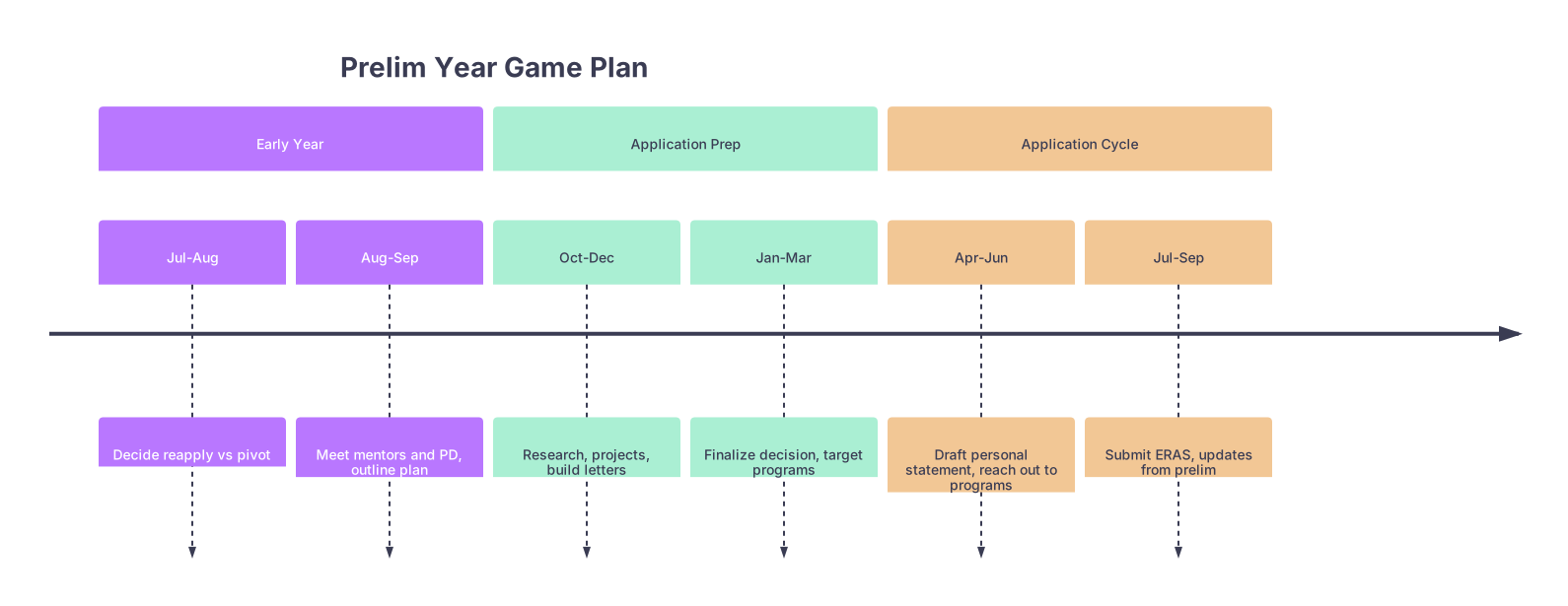
You can’t “kind of” reapply. The timeline is rigid. Here’s a rough framework for an intern year (July start):
| Period | Event |
|---|---|
| Early Year - Jul-Aug | Decide reapply vs pivot |
| Early Year - Aug-Sep | Meet mentors and PD, outline plan |
| Application Prep - Oct-Dec | Research, projects, build letters |
| Application Prep - Jan-Mar | Finalize decision, target programs |
| Application Cycle - Apr-Jun | Draft personal statement, reach out to programs |
| Application Cycle - Jul-Sep | Submit ERAS, updates from prelim |
July–August: Reality check and decision
- Meet with your prelim PD or associate PD. Be honest:
“I matched to a prelim spot because I was targeting X. I’m considering reapplying or pivoting to Y. What do you see from where you sit?” - Meet with someone in your target or backup specialty, preferably a program director or a senior faculty. Ask:
“If you saw my file again, what would need to be different for you to rank me?”
By end of August, you should:
- Know whether you’re reapplying to the same specialty, switching, or aiming for a categorical IM / Gen Surg or other core field.
- Know your major weaknesses: scores, research, letters, late application, poor geographic strategy, etc.
September–December: Build the missing pieces
If you’re reapplying:
- Lock in at least one strong new letter from this year. Ask early so they can watch you with that in mind.
- Have at least one tangible project in the specialty: poster, abstract, case report, QI project. It doesn’t have to be NEJM-level, but it must exist.
- Make a list of programs that:
- Have taken reapplicants
- Like prelims from your hospital
- Have close ties to any of your mentors
If you’re pivoting:
- Learn the application norms and competitiveness of the new field.
- Start working clinical shifts/electives aligned with that field as much as your schedule allows.
- Get at least one letter from someone in the new specialty.
Step 5: Consider a Strategic Pivot That Still Leads to High Income
This is where people either save their career or get stuck.
You might not get Derm. That does not mean you are doomed to a lifetime of $180k outpatient IM in a saturated urban market.
Look at realistic high-income tracks that are more open to latecomers or re-trainers.
| Original Target | More Attainable High-Income Paths |
|---|---|
| Derm | Diagnostic Radiology, Rad Onc, IM → GI/Cards, Procedural IM (aesthetics) |
| Plastics | Gen Surg → Vascular/CT/HPB, Ortho (if feasible early), ENT in rare cases |
| Ortho | PM&R → Pain, Anesthesia → Pain, Gen Surg → Trauma/Acute Care |
| Neurosurg | Gen Surg → Vascular/HPB, Neurology → Neuro IR (very long road) |
| DR | Anesthesia, IM → Cards, EM (locums-heavy careers) |
| Anesthesia | DR, IM → CC, Pain, EM in some regions |
| Rad Onc | DR, IM → Heme/Onc or Palliative with good comp |
Here’s the harsh truth: if your end goal is financial security and lifestyle, there are multiple routes. If your end goal is “I must be a dermatologist or life is meaningless,” that’s a different mental health problem, not a career planning issue.
Be very honest:
- Is it the field you love, or the money + lifestyle image?
- Could you be satisfied (not ecstatic, just not miserable) in a different but similar-comp field?
If you can accept a pivot, you open up a lot more doors.
Step 6: Hunt for Categorical or Advanced Spots Outside the Normal Match
Do not underestimate the chaos of residency attrition. People quit, fail, get sick, change fields. Positions open.
Two main avenues:
- Off-cycle PGY-2 categorical spots
- Supplemental Offer and Acceptance Programs (SOAP) or post-match vacancies in the next cycle
Off-cycle and PGY-2 spots
These are often not well-advertised, and this is where hustle matters.
You:
- Check FREIDA and program websites regularly for “Open Positions” / “Vacant Positions.”
- Join specialty-specific listservs, forums, and resident groups where people post these openings.
- Email program coordinators directly when you see any hints of openings.
Your email is not a generic spam. It’s short, specific, and respectful:
Dear Dr. X,
I am a current PGY-1 preliminary internal medicine resident at [Hospital]. I initially applied in [specialty] and remain very interested in pursuing this field. I noticed that your program previously listed an open PGY-2 position and wanted to inquire whether you anticipate any vacancies for the upcoming year.I would be happy to forward my CV and letters if there is any potential fit.
Sincerely,
[Name]
You will be ignored a lot. That’s fine. You only need one yes.
SOAP and the next match
If your prelim is one year only and you have no secured PGY-2+, you must plan for:
- SOAP during your prelim year
- Or reapplying in ERAS for a different or same specialty with a categorical track
For lucrative but less insane fields like Anesthesia, DR, EM, or IM with competitive fellowships, SOAP + broad applications can absolutely work if your application is reasonably strong and your letters say you’re a safe bet.
Step 7: Manage the Psychology Without Sugarcoating It
Let me be blunt: watching your peers stride into their categorical dream programs while you “just have a prelim” messes with your head.
Three things you need to keep straight:
Your prelim year is not a failure. It’s a paid clinical year with a real PGY-1 salary and actual responsibility.
You’re ahead of your unmatched classmates in at least one critical way: you are in the system.Comparison will eat your focus.
You do not see how many of those golden children are going to burn out, switch fields, or be miserable in five years. You just see glamorous Match graphics.Hopelessness is dangerous because it makes you passive.
The worst move is shrugging and saying, “I guess I’ll just see what happens.” Nothing “just happens” that benefits you in this environment. Programs are not coming to rescue you.
Find one or two people (faculty, senior residents, or a mentor from med school) who understand competitiveness in your target fields and are willing to give you unfiltered advice. Run your plans by them, not by your classmates who barely know how NRMP scoring works.
Step 8: Very Concrete Moves by Specialty
Let’s go even narrower. You’re in one of these boats? Here’s exactly what I’d tell you.
Scenario A: Prelim IM, Missed Derm
Reality: Derm reentry is brutal. Not impossible, but you’re climbing a cliff.
Your best odds:
- One or two dedicated research years in Derm at a major academic center after prelim
- Multiple Derm publications, posters, and presentations
- Letters from well-known dermatologists who will pick up the phone
Parallel plan:
- While doing Derm research, quietly keep your mind open to DR, Rad Onc, or IM → GI/Cards.
- Tell mentors you are interested in Derm as Plan A but willing to consider X/Y as Plan B. Many will respect that honesty.
If you’re not willing to do 1–2 research years and delayed income, I’d tell you to pivot now.
Scenario B: Prelim Surgery, Missed Ortho or Plastics
For Ortho:
- Strong Step 2 and surgical performance help, but the window is narrow.
- If your prelim hospital has Ortho, get on their radar early. Ask to help with research. Ask if they’ve ever taken a prelim into a categorical Ortho spot.
- If they give you even a 10% chance, and you want it badly, go all-in for one more cycle while having Gen Surg as a backup.
For Plastics:
- Integrated Plastics is one of the most closed doors.
- Realistic path may be: Gen Surg categorical → Independent Plastics track later (long and not guaranteed, but exists).
- Focus this year on proving yourself to Gen Surg faculty and grabbing a categorical GS spot somewhere, then reassess Plastics from that vantage point.
Scenario C: TY or Prelim, Missed Anesthesia or Diagnostic Radiology
This is one of the more salvageable situations.
You should:
- Get Anesthesia/DR electives if at all possible during prelim.
- Collect a real letter from that department: “We would be happy to train this resident.”
- Reapply to Anesthesia/DR broadly, including community and mid-tier university programs, not just the shiny ones.
Program directors in these fields will absolutely consider strong prelims who:
- Have solid scores
- Have good letters
- Have proven they’re not disasters in clinical practice
If you can stomach a wider net (different states, less glamorous cities), your odds are decent.
Step 9: Money Reality vs. Fantasy
Since this whole article sits under “Highest Paid Specialties,” let’s not dodge the money question.
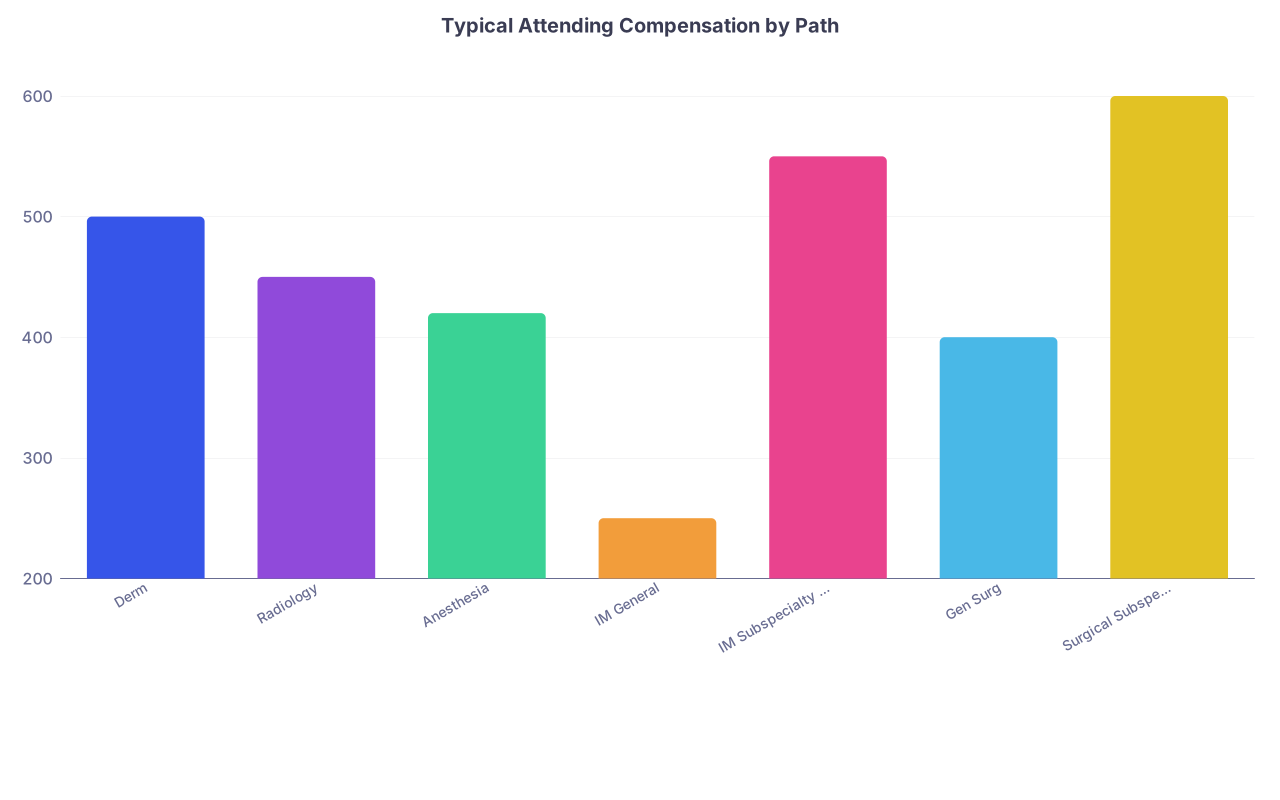
| Category | Value |
|---|---|
| Derm | 500 |
| Radiology | 450 |
| Anesthesia | 420 |
| IM General | 250 |
| IM Subspecialty (Cards/GI) | 550 |
| Gen Surg | 400 |
| Surgical Subspecialty | 600 |
Numbers vary by region, but broad strokes:
- Yes, Derm/Plastics/Ortho/Neurosurg can hit the very top of the distribution.
- But DR, Anesthesia, Cards, GI, some surgical subspecialties, and even EM in certain markets are still extremely well-paid compared to average incomes.
- Long-term, your practice setting, business sense, and burnout level will change your income more than whether you got absolute top 1% competitive specialty.
Do not throw away 3–5 years of your life chasing a very low-probability transition if you could be happy and financially solid in a slightly less glamorous but still high-paying field. That’s not “giving up.” That’s playing a long game.
Step 10: How to Talk About This in Applications and Interviews
You need a tight, non-whiny explanation for:
- Why you only matched prelim
- Why you’re reapplying or pivoting
- Why this is not going to be an ongoing saga
Bad version:
“I was really disappointed I didn’t match dermatology. I hope to try again.”
Better version:
“I initially applied to dermatology and matched to a preliminary internal medicine year. That experience has clarified for me that I want a residency where I can combine strong clinical medicine with [X aspect of new specialty]. During my prelim year, I’ve focused on becoming a reliable, team-oriented resident while also engaging in [specific projects] related to this field. I’m looking for a program where I can commit fully and grow long-term.”
For same-specialty reapplication:
- Emphasize growth and input from mentors.
- Show concrete changes: more research, stronger letters, better clinical evaluations.
- Do not sound entitled. You are not owed a spot because you “tried hard.”
For pivot:
- Frame it as a positive evolution of your interests, not a downgrade.
- Highlight aspects of the new field that match what you actually enjoy in your prelim year.
Step 11: Guardrails So You Don’t Waste Years
A few hard rules I’ve seen save people:
- If you strike out two full cycles in a hyper-competitive specialty (Derm/Plastics/Neurosurg/Integrated Ortho) even after meaningful upgrades, you pivot.
- If multiple honest mentors in that specialty tell you the odds are extremely low, listen. One outlier cheerleader doesn’t override consensus.
- If you find yourself clinging to a dream mostly for ego or optics, that’s your red flag to re-evaluate.
- Do not stay in “temporary” research or limbo roles beyond 2–3 years unless there’s a very clear path and buy-in from a PD who has actually placed people like you before.
Your future self will thank you for choosing a stable, fulfilling trajectory over endless purgatory.
Where This All Leaves You
Right now, you’re tired, a bit angry, and looking at a prelim contract that doesn’t feel like what you worked for in med school.
Fine. Feel that. Then convert it into something useful.
Your job over the next 6–12 months is not to magically manifest Derm or Ortho out of thin air. It’s to:
- Make your prelim year proof that you’re a strong, reliable resident
- Decide—early and honestly—whether you’ll take one more hard swing at your original target or pivot to a realistic, still-lucrative alternative
- Line up letters, projects, and off-cycle opportunities with intention, not desperation
You are not stuck. But you are on a clock.
Handle this year with clarity and aggression, and you can emerge either in the specialty you aimed for or in a different one that still gives you the income, stability, and life you want.
Once you’ve secured that next step—categorical spot, advanced position, or deliberate pivot—then the real game begins: turning residency into the career and lifestyle you actually want. That’s the next situation to handle.