
The idea that your specialty permanently caps your income is exaggerated—and often just lazy thinking.
If you are in pediatrics, family medicine, psychiatry, or another “lower-paid” field and you’re frustrated, you are not stuck. You are constrained. Different thing. Constraints you can work with.
This is the playbook I wish more residents and attendings in these specialties actually used instead of just complaining in the workroom about radiology salaries.
We’ll assume two things:
- You like (or at least can tolerate) your specialty.
- You do not want to retrain in ortho, derm, or rad onc.
Good. Here’s what you can actually do.
Step 1: Get Real About Your Current Income Ceiling
First, stop using vague language like “low paid.” Anchor it.
| Tier | Example Specialties | Typical Base Range |
|---|---|---|
| Lower | Peds, FM, Psych, Endo | $180k–$260k |
| Mid | Gen IM, Hospitalist, EM | $250k–$350k |
| Higher | GI, Cards, Heme/Onc | $400k–$700k |
| Top | Ortho, Derm, Rad, Gas | $600k–$1M+ |
If you’re making:
- $200k–230k as employed outpatient peds or FM, you’re not “underpaid,” you’re standard.
- $260k–280k in the same field, you’re already above median for many markets.
This matters because your strategy changes depending on whether you’re:
- Underpaid for your specialty and model, or
- Paid fairly, but in a lower-paying specialty eco-system.
Your first move: pull real data, not gossip.
Use:
- MGMA / AMGA benchmarks (often via your admin or local group)
- Doximity compensation reports
- Specialty societies (e.g., AAP, AAFP, APA) surveys
Then compare:
- Your base salary
- RVU rate (if RVU-based)
- Total RVUs produced
- Benefits and call pay
You’re looking for this simple question:
Am I earning close to the 50th–75th percentile for my specialty and region?
If not, your first income boost may come from fixing your current job before adding side hustles or certifications.
Step 2: Squeeze More Out of Your Current Job (Without Burning Out)
Most physicians leave money on the table inside their existing role. They chase a second job before they’ve tuned the first one.
A. Fix your compensation structure
Common problems I see:
- RVU rate below market
- No credit for non-visit work (telehealth, care coordination, certain procedures)
- Terrible bonus structure that’s basically unattainable
Your objective: get paid fairly per unit of work.
You negotiate around:
- RVU rate adjustment to local median
- More realistic RVU targets for bonus
- Incentives for access (same-day visits, extended hours)
- Adding productivity-based component if you’re purely salaried and already busy
You do not walk into your director’s office saying “I want more money.” You walk in with specific, data-backed asks like: “Our RVU rate is $40, regional benchmark is $50–52. I’d like to discuss bringing ours in line with local norms over the next contract cycle.”
B. Optimize your clinical mix
Some visit types and services are just more lucrative per minute than others.
- Short, high-throughput visits can beat long complex ones if your system rewards volume.
- Procedures and certain add-ons (e.g., EKG, injections, ultrasound, joint injections, IUDs, biopsies) often add meaningful margin with minimal extra time once you’re efficient.
- For psychiatrists, long 60-minute therapy visits often pay worse per hour than 30-minute med management + 15-minute add-on visits.
Your move:
- Pull your last 3–6 months of billing data.
- Sort by CPT codes and relative reimbursement.
- Identify visit types that pay best per minute.
- Adjust your schedule templates and preferences accordingly.
You do not see only “what’s interesting.” You see a balanced mix that supports your income goals and maintains sanity.
C. Stop doing unpaid work
Unpaid work is the death of low-paid specialties.
Look for:
- Long inbox sessions without compensation or protected time
- Forms, letters, portal novels disguised as messages
- Extra “leadership lite” tasks that sound important but pay nothing
You either:
- Get protected, scheduled, counted time for this work, or
- You narrow the funnel: stricter message policies, better MAs/RNs doing pre-work, templates, smart-phrases, care coordinators.
You may not have full control, but I’ve watched multiple attendings quietly claw back 2–4 hours/week of unpaid nonsense just by turning off the hero complex and saying “No” more often.
Step 3: Add High-Yield Skills Within Your Specialty
If you refuse to switch specialties, then you become a more valuable version of your current specialty.
This means focused upskilling, not random certificates.
A. Learn billable procedures relevant to your field
Examples:
Family Med / Internal Med:
- Joint injections
- Skin biopsies, cryotherapy
- Nexplanon/IUD insertion and removal
- Point-of-care ultrasound (POCUS) for certain indications
- Simple laceration repair, abscess I&D
Pediatrics:
- Circumcisions (huge one in some markets)
- Simple derm procedures
- POCUS for lungs, abdomen in urgent care settings
- ADHD and developmental evaluations with proper coding
Psychiatry:
- TMS (if you’re willing to join or build a service)
- ECT (more niche, but highly billable in certain settings)
- Esketamine clinics
- Collaborative care model (properly billed)
Endocrine / Rheum / Others:
- Ultrasound-guided joint injections
- Thyroid biopsies
- Diabetes group visits (if your system understands how to bill them)
You want at least one or two skills that:
- Are in demand locally.
- Have clear, stronger reimbursement.
- Fit your interest enough that you won’t hate your life.
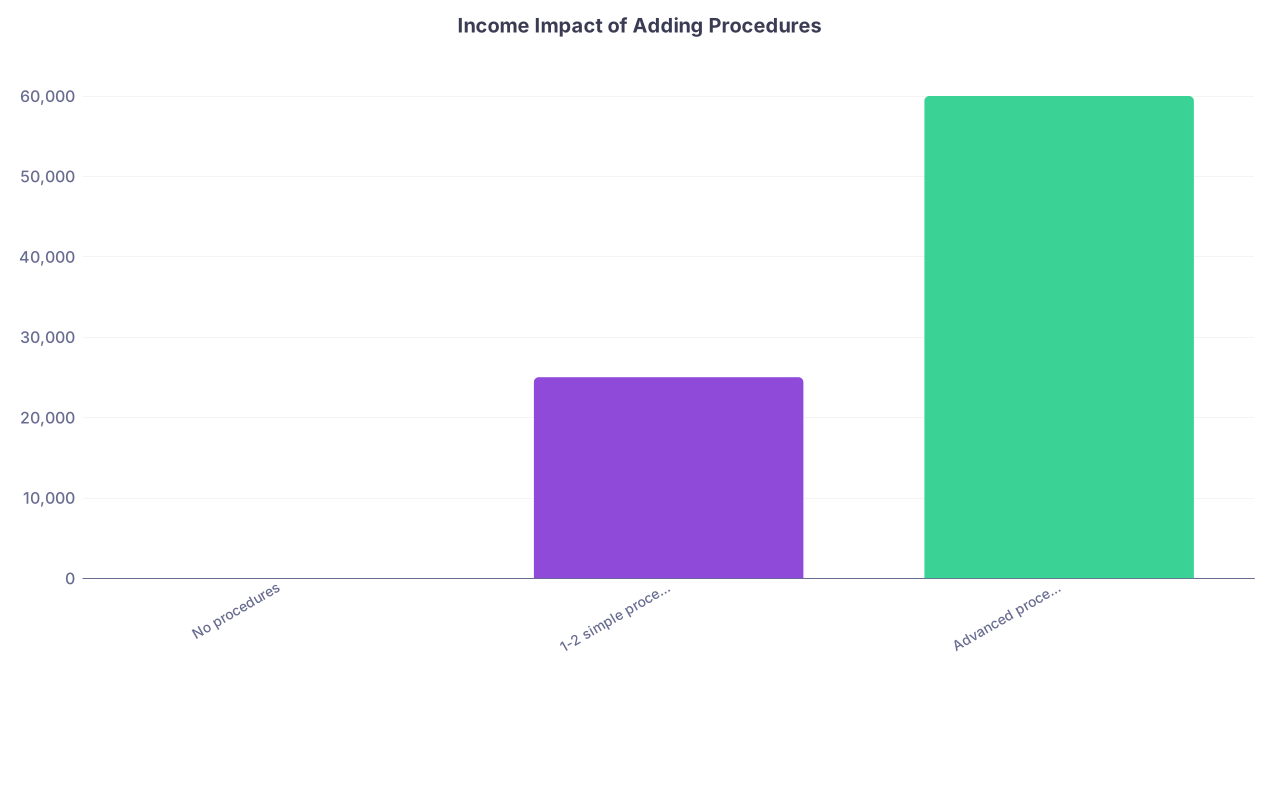
| Category | Value |
|---|---|
| No procedures | 0 |
| 1-2 simple procedures | 25000 |
| Advanced procedural focus | 60000 |
Those numbers are conservative. A family doc who starts doing vasectomies and IUDs in a high-volume setting can add $50–100k once established.
B. Subspecialize without switching fields
You can become “the” person for:
- ADHD / autism evals in pediatrics
- Women’s health in family med
- Metabolic/obesity medicine in IM or FM
- Perinatal psychiatry
- Sports medicine (with a fellowship, yes, but still same core field)
- Sleep medicine (for psych, IM, neuro, FM)
Most of these:
- Increase referral volume.
- Increase complexity codes (higher-paying E&M).
- Make you harder to replace, which improves your negotiation power.
Pick subspecialization based on:
- Reimbursement patterns, and
- Actual market demand, not just what sounds cool on paper.
Step 4: Leverage Alternative Practice Models
If you stay purely in a standard employed RVU treadmill, your upside is limited. You may have to partially or fully step outside that structure.
A. Direct primary care / concierge lite
For FM, IM, sometimes peds and psych:
You can:
- Start hybrid: 0.6–0.8 FTE employed, 0.2–0.4 FTE DPC/concierge
- Move slowly over 2–3 years as your panel grows
- Offer niche: chronic disease management, high-touch mental health, executive-style primary care
Numbers vary widely, but I’ve seen:
- 300–600 patient panels at $80–150/month
That’s: - $28,800 to $108,000 per year in membership fees alone, before any add-on services.
DPC is not magic. It’s a small business. But the math can absolutely out-compete a mid-level-employed salary if you run it well.
B. Telemedicine strategically (not as $30/hr grunt work)
Telehealth can be low-paid grind… unless you:
- Work in high-paying niches (sleep, ADHD med management, weight loss, tele-psych)
- Negotiate revenue share instead of flat hourly
- Build your own micro-practice using telehealth infrastructure (out-of-pocket or hybrid billing)
The mistake people make: They sign up for the lowest common denominator gig (direct-to-consumer urgent care apps) and then conclude all telemed is trash. It is not. But you have to be selective.
C. Part-time locums for leverage and cash
Locums is not only for hospitalists and EM. It exists for:
- Psych
- Peds (especially subspecialty and hospitalist)
- FM/IM in rural areas
- Various outpatient clinics desperate for coverage
It gives you:
- A second, higher-rate income stream
- Real-time market data on what your time is worth
- Negotiating leverage with your primary employer (you can credibly say, “My time command $X per day on the market.”)
Use locums for:
- 1–2 weeks a quarter
- One recurring weekend a month
- Bridge periods when you’re shifting jobs / models
Step 5: Build Income Outside of Patient Care (Still As a Physician)
You have a license and credibility. That’s leverage beyond the exam room.
A. Clinical leadership roles that actually pay
Not the $5k “medical director lite” roles. Real ones.
Look for:
- Medical director of service lines (behavioral health, primary care, telehealth, urgent care)
- Quality / safety leadership with defined FTE and stipend
- Program director / associate PD roles in residency programs (these can be 0.1–0.5 FTE equivalents)
You ask:
“What’s the protected time, and what’s the dollar amount associated with that time?”
If they say “0.1 FTE” and you’re 1.0 FTE already, understand they are sneaking in more work unless they reduce clinical load.
B. Consulting work that uses your expertise
Higher-yield than moonlighting if you land the right clients.
Examples:
- Working with digital health startups (clinical advisor)
- Pharma advisory boards
- Guideline/policy writing for payers or agencies
- Chart review for insurance companies or legal firms
Rates:
- Commonly $200–400/hr for specialty-specific advisory work
- Sometimes more, sometimes less, but nearly always more per hour than your clinic time
The real barrier isn’t “no one will hire me.” It’s “I’ve never sent an email that says: ‘Here is what I do and how I can help your company.’”
You fix that.
C. Educational content and niche courses
This is not “become a medical influencer.” That’s a full-time separate life.
This is:
- CME talks (local/regional)
- Short, paid workshops for therapists, NPs, school staff, or other professionals
- Paid webinars on precise, in-demand topics (e.g., managing pediatric ADHD meds safely; obesity treatment basics for PCPs)
Start small:
- One 60–90 minute workshop, $500–1500
- Repeat and refine
- Turn it into asynchronous content if you’re motivated
No, this will not replace your full-time income in one year. But it absolutely becomes a real 5–20% supplement that can grow.
Step 6: Consider Geography and Employment Type as Levers
If you’re determined to stay in a low-paid specialty and in an expensive metro, and in the safest generic employed job with no side work… then yes, your income will be capped.
You may not like this, but it’s true.
So you can play with three levers:
Geography
- Rural and smaller cities often pay significantly more for the same work.
- Some places offer sign-on bonuses, loan repayment, and higher base for “undesirable” locations.
Employment model
- Hospital-employed vs large multispecialty group vs independent practice.
- In many fields, private groups that eat risk and manage their own operations can pay better than giant systems that keep the margin.
Risk tolerance
- The more you’re willing to tolerate income variability (e.g., partial fee-for-service, small business), the higher your potential upside.
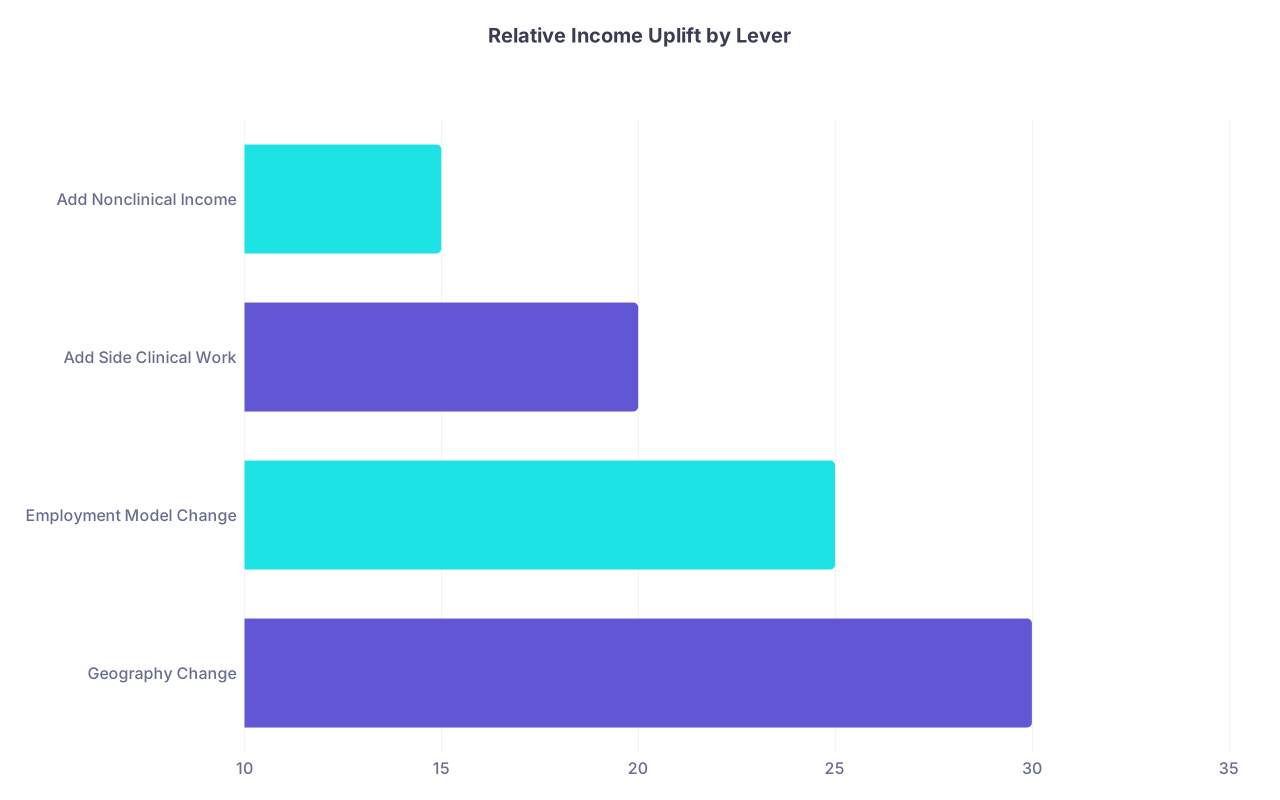
| Category | Value |
|---|---|
| Geography Change | 30 |
| Employment Model Change | 25 |
| Add Side Clinical Work | 20 |
| Add Nonclinical Income | 15 |
Those percentages are rough, but directionally correct. Moving from urban coastal academic peds to rural community peds can literally be a 30–50% increase off the bat.
Step 7: Construct a Realistic 3-Year Income Plan
You’re a physician, not a YouTuber. You should not expect a 300% income jump in 6 months.
But doubling your take-home over 3–7 years is often realistic if you’re deliberate.
Here’s a model 3-year arc for, say, a 2nd year attending in outpatient peds making $210k:
Year 1:
- Renegotiate RVU rate + bonus to move from $210k → $235k potential
- Add basic procedures (circumcisions where appropriate, derm basics) targeting +$10–20k
- One locums week = +$5–8k
Target: $250–260k total
Year 2:
- Start 0.2 FTE tele-peds or urgent care telemed: +$20–30k
- Offer one recurring ADHD clinic or weight clinic with higher complexity billing: +$10–15k
- A second locums week or ongoing weekend gig: +$5–10k
Target: $280–300k
Year 3:
- Move to higher-paying geography or group with your new skill set (+$20–40k base)
- Layer in one small consulting or teaching stream: +$5–15k
Target: $320–360k
None of this requires derm or radiology. It does require treating your career as an evolving business, not a static job.
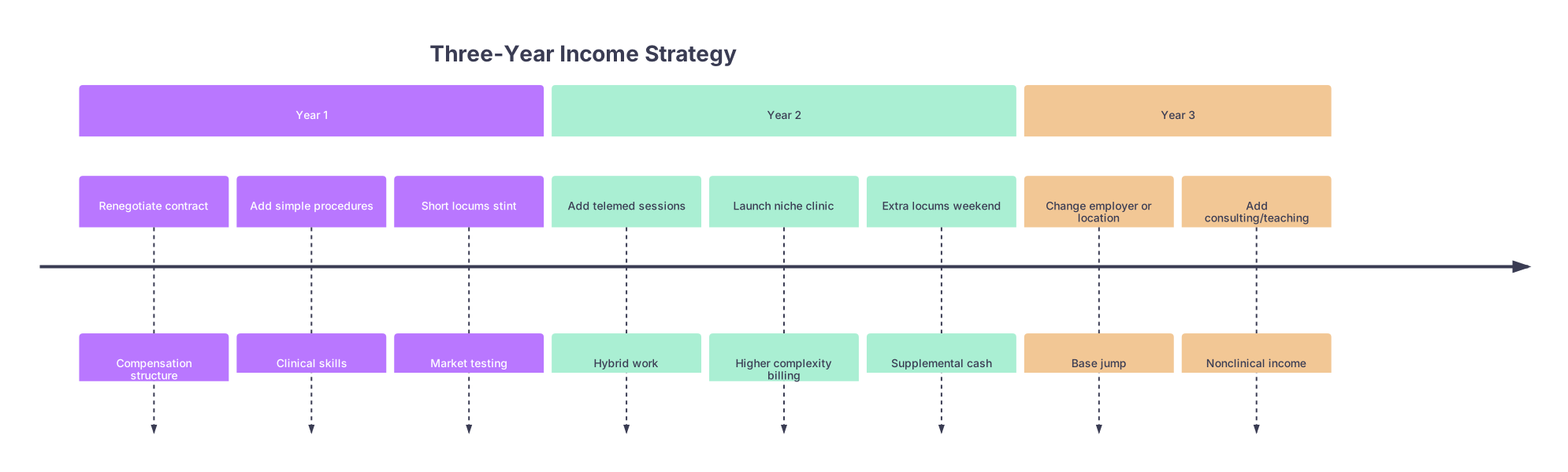
| Period | Event |
|---|---|
| Year 1 - Renegotiate contract | Compensation structure |
| Year 1 - Add simple procedures | Clinical skills |
| Year 1 - Short locums stint | Market testing |
| Year 2 - Add telemed sessions | Hybrid work |
| Year 2 - Launch niche clinic | Higher complexity billing |
| Year 2 - Extra locums weekend | Supplemental cash |
| Year 3 - Change employer or location | Base jump |
| Year 3 - Add consulting/teaching | Nonclinical income |
Step 8: Avoid the Two Big Traps
Two patterns will sabotage this entire thing.
Trap 1: Emotional resentment without action
“I should be paid like cardiology.”
No, you should be paid fairly for your work and smart about how you structure that work. Endless specialty comparison is mental junk food.
You either:
- Accept your specialty’s general band and optimize within it, or
- Leave.
Staying while constantly resentful and passive is the worst of both worlds.
Trap 2: Scattered side hustles with no compounding
Doing:
- A little bit of low-paid tele urgent care
- A little bit of random survey sites
- A little bit of half-baked YouTube channel
- A little bit of poorly negotiated consulting
…with no coherent strategy is just trading your scarce free time for burnout.
Pick 1–2 primary levers and work them hard:
- One main clinical practice optimization
- One serious “second engine” (locums, DPC/concierge, consulting, or tele in a solid niche)
FAQ (Exactly 5 Questions)
1. I’m still in residency in a lower-paid specialty. What should I do now to set this up?
Three things. First, get brutally clear about the real compensation landscape for your field—talk to recent grads, not just faculty in academics. Second, seek rotations or electives that expose you to procedural or niche skills (POCUS, women’s health, ADHD clinics, sleep, obesity medicine). Third, network intentionally with attendings who have non-traditional setups—DPC, tele-psych, hybrid models—and ask very specific questions about their numbers and paths. Do not wait until PGY-3 to start thinking about this.
2. Is moonlighting worth it, or will it just burn me out more?
It depends on the rate and your intent. If you’re doing $80/hr shifts that feel like your day job, it’s often not worth the fatigue. If you can secure $150–300/hr work that’s less cognitively exhausting (e.g., overnight tele-psych, low-volume rural call with decent backing), it can be a powerful short-term accelerator for debt payoff or building savings. Use moonlighting as a time-limited tool, not a permanent lifestyle.
3. I’m an employed doc and my contract has a non-compete. Can I still build side income?
Usually yes, but you need to read the actual language. Non-competes often apply to in-person clinical practice within a radius, not to telemedicine across state lines, consulting, teaching, or other nonclinical work. Some contracts do try to bar all “outside medical work” without written approval. In that case, either negotiate explicit carve-outs (telemed limited hours, consulting) or accept that this job is an income cap and start planning your exit timeline.
4. How do I know if a leadership role is actually worth it financially?
Do simple math. Translate what they’re offering into an hourly rate and compare it to your clinical rate. Example: 0.1 FTE leadership (4 hrs/week) with a $10k stipend per year works out to ~$48/hr before tax. If your clinical time effectively generates $200/hr, then this role only makes sense if it offers non-monetary benefits you value (future opportunities, schedule control) or if your clinical rate is artificially low. Many “prestige” roles are financially insulting; do not take them just for the title.
5. I’m already exhausted. Is it realistic to add more work on top of my current job?
Not if you do it the way most people try: keep the same broken schedule, then pile extra shifts on evenings and weekends. The first move has to be reclaiming time and energy inside your current job—fixing inbox chaos, trimming uncompensated work, tightening visit flow, possibly reducing FTE slightly if you can afford it. You create bandwidth first, then add higher-yield work in a controlled way. This is a multi-year restructuring project, not a 30-day challenge.
With these levers clear and a plan that respects both your time and your sanity, you can turn a “lower-paid” specialty into a financially solid, even abundant, career. The next step after that? Making sure your growing income actually builds wealth, not just a more expensive lifestyle. But that’s a separate conversation.