
What if your current attending job is comfortable… but you cannot stop thinking, “If I bite the bullet and do fellowship now, will it really pay off?”
You are not a typical trainee. You have a mortgage. Maybe kids. Maybe you are already a partner. And yet you keep pulling up salary reports for interventional cardiology, GI, IR, anesthesia pain, ortho sports, plastics, derm, neurosurgery subspecialties.
You are asking yourself the question most people are too embarrassed to say out loud:
“If I walk away from my attending income and go back into training for 1–3 years, will this fellowship actually be worth it financially and lifestyle‑wise?”
Let’s handle this like adults. No “follow your passion” fluff. Numbers, politics, logistics, and real risk.
1. First, run the cold math (not the fantasy math)
Before you email a program director or tell your chair anything, you need to know if this makes financial sense in your specific case. Not in generic Medscape charts. For you.
Step 1: Define your current baseline
Write down four numbers. On paper. Not in your head.
- Current pre‑tax income as an attending
- Realistic “fellow” income in your target specialty and region
- Remaining years to your planned retirement age
- Current debt (student loans, mortgage, business loans, etc.)
Now we do the simple (slightly brutal) comparison.
Let’s use a typical example:
- You are a 38‑year‑old general internist making $260k in a community hospital
- You are eyeing GI, interventional cards, or cardiology EP in a large academic center
- Local GI fellow salary: ~$70–75k plus maybe a $5–10k moonlighting bump if you are aggressive
- Expected starting GI salary in your region: $550–650k with RVU incentives
- Time to retirement: say 62, so 24 years left
You are giving up:
- ~$260k x 3 years = $780k gross attending income
- And you will likely add some cost: potential relocation, childcare gaps, maybe selling a house at a bad time
Now, assume on the other side:
- Post‑fellowship, your pay jump is $350–400k/year higher (GI vs primary care)
- Even conservatively, that’s an extra $350k x 20 years = $7 million gross
- Subtract that ~$800k opportunity cost of fellowship years + maybe $200–300k of extra friction costs
Net, you are still up several million over a career. Financially? GI would be a no‑brainer in that scenario.
But now let’s flip it:
- You are a 45‑year‑old hospitalist earning $320k with heavy shifts
- You want a 1‑year palliative care fellowship at $70k
- Post‑fellowship pay: maybe $250–280k in many markets, some higher, some lower
- You just delayed earning $320k for a year and potentially cut your future earning power
In that scenario, you might still do it for lifestyle or values. But strictly money? It is a loss.
You need to build your own version of this, with real numbers, not vibes.
A quick comparison cheat table
| Scenario | Years of Fellowship | Income Loss During Training | Typical Post-Fellowship Gain | Likely Financial Outcome |
|---|---|---|---|---|
| IM → GI at 38 | 3 | High | Very high | Strongly positive |
| Hospitalist → Pulm/CC at 40 | 2–3 | High | Moderate–high | Usually positive |
| EM → Anesthesia Pain at 39 | 1 | Moderate | High | Often strongly positive |
| IM → Cardiology EP at 37 | 3 | High | Very high | Strongly positive |
| Hospitalist → Palliative at 45 | 1 | Moderate | Low–moderate | Often neutral/negative |
This is not gospel. It is a rough frame. You are trying to answer: “Am I solving a money problem, or am I about to create one and call it ‘growth’?”
2. Age, competitiveness, and the unspoken bias problem
Programs will not write this on their websites, but you need to hear it straight: being mid‑career can absolutely hurt you in the match for some lucrative fellowships.
I have seen:
- A 41‑year‑old hospitalist with strong letters get quietly passed over for PCCM at a big‑name place, while multiple PGY‑3s from the same institution matched
- A 39‑year‑old EM physician land a regional pain fellowship after explicitly targeting community‑based programs and not wasting time on top‑10 academic giants
- A 45‑year‑old OB/GYN told directly, “We worry about the return on training investment,” for an REI fellowship
So what are you up against?
Programs like the pipeline
They love taking their own residents or recent grads. It keeps their culture stable, and they get three cheap years of labor in fields like GI, cards, IR, ortho.Concerns they may never say out loud
- “Will this person be flexible or set in their ways?”
- “Will they push back on call schedules and weekend coverage?”
- “Will they retire or cut back soon after training?”
Visa and licensing friction
If you trained long ago, re‑doing licensure, background checks, USMLE recency issues, and credentialing can make you “more work” than a clean PGY‑3 candidate.
So you do two things:
- Stop aiming only at top‑tier academic fellowship programs if you are older or coming from a non‑traditional path. Many high‑earning subspecialists trained at solid but not famous fellowships.
- Aggressively fix your narrative on paper and in person. You cannot show up as “I’m bored with my current job and want more money.” That reads as a risk, not an asset.
3. How to build a persuasive story as a mid‑career applicant
Your pitch cannot be: “I want to make $800k in interventional radiology.” Even if that’s part of your truth. You need a story that satisfies:
- Clinical depth
- Commitment to the subspecialty
- Realistic expectations about lifestyle and call
- Evidence that you play well as a trainee again
Here’s how you build that.
Step 1: Re‑immerse in the field now, as an attending
You should already be halfway living like a future fellow before you apply:
- If you’re aiming for GI: do inpatient GI co‑management, QI projects in colonoscopy quality metrics, or IBS care pathways.
- For cards: join cardiology rounds, help with chest pain pathways, work on heart failure readmission projects.
- For pain: start collaborating with anesthesia or PM&R pain clinics, chronic opioid stewardship teams, or spine surgeons.
You want recency. Not “I liked cardiology in residency 10 years ago.” That is weak.
Step 2: Get the right letters (not just big names)
Programs want to know: “Has this person recently performed at a high level in situations that look like fellowship?”
Target:
- 1 strong letter from current department leadership (chair, chief, service line director)
- 1–2 strong letters from subspecialists in your target field who have worked directly with you for at least 6–12 months
- Optional: a prior residency PD if they still know you well (but not at the expense of current, relevant letters)
If you have a crusty, half‑hearted letter from a famous cardiologist who barely remembers you versus an on‑fire letter from the local interventional cardiology director who supervised you on a QI project? Take the second one every time.
Step 3: Rewrite your CV like a future fellow, not a generic attending
Your CV should not look like a generic “hospitalist attending for 8 years.” Reorganize it so the subspecialty‑relevant parts are impossible to miss:
- Separate section: “Cardiology‑related clinical and QI activities”
- Brief bullet points under each job: focus on work relevant to the fellowship’s procedural, diagnostic, or research focus
- Highlight teaching or leadership that shows you can take feedback and work in teams (fellowship directors are allergic to lone wolves who think they are above training)
Then your personal statement connects the dots:
- Where you started, what you have learned in practice, what gap you now see that requires subspecialty training, and what you plan to do with that training long term (specific practice model, patient population, maybe a geographic niche).
4. The lifestyle trade: reality, not brochure talk
You already know fellowship is lower pay and more call. You lived through residency. But mid‑career, it hits differently.
Let me just say it: going from $300–400k and relative autonomy back to $70–80k and someone pimping you on basic physiology at 3 a.m.? That can break people who thought they were ready.
So test yourself honestly on a few things.
Can your life absorb the income drop without panic?
Typical mid‑career traps I see:
- Two car leases, private school for 2 kids, jumbo mortgage, spouse not working
- Extended family partially financially dependent on your current salary
- No real cash buffer, just a fat 401(k) you do not want to raid
You need to:
- Build a 6–12 month cash buffer before you even send applications
- Pre‑negotiate changes in your cost structure (refinance, adjust schooling, move to cheaper area if needed)
- Explore moonlighting options during fellowship ahead of time (and ask explicitly about program policy… some are flexible, others will shut it down)
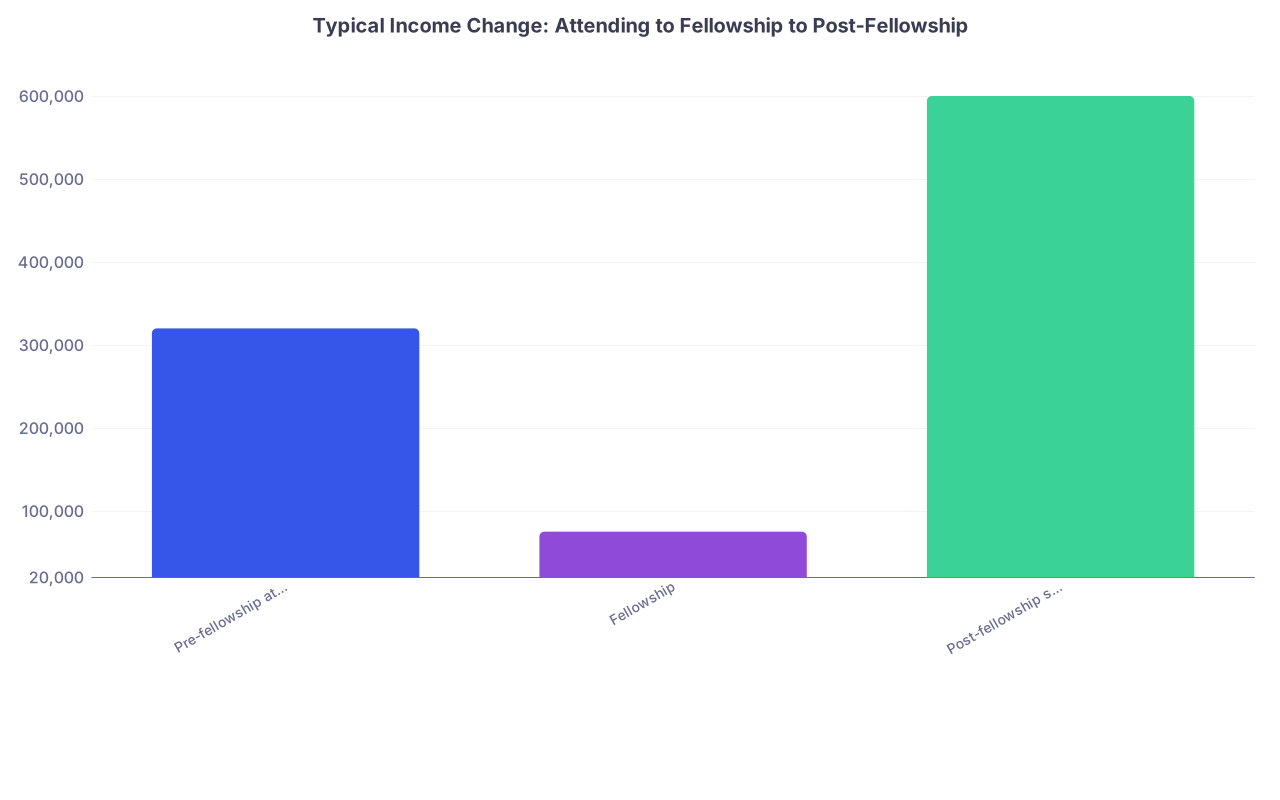
| Category | Value |
|---|---|
| Pre-fellowship attending | 320000 |
| Fellowship | 75000 |
| Post-fellowship subspecialist | 600000 |
Numbers vary wildly by specialty and region, but the shape is similar: down, then (hopefully) way up. You need to survive the valley.
Are you ready to accept less control again?
Fellowship means:
- Rotations you did not pick
- Call schedules you did not design
- Procedural log quotas
- Feedback on your notes, your approach, sometimes your attitude
If you have been the final‑say attending for 5–10 years, swallowing this again is not trivial. If you are already cynical and burnt out, it can go badly.
You want to be the mid‑career fellow who says: “I bring experience, but I am here to learn a new craft,” not the one muttering, “At my last hospital we did it differently,” five times a day.
5. Choosing the right kind of program as a mid‑career applicant
You are not just trying to “match somewhere.” You are trying to match somewhere that will not make your life and family implode.
A few patterns I have seen work better for mid‑career people:
Community‑affiliated fellowships with strong private practice pipelines
These may not be the big‑name academic centers, but they often produce the highest‑earning grads: GI, cards, IR, anesthesia pain, ortho subspecialties tied to real‑world practice groups.Programs that have already taken non‑traditional candidates
Ask directly: “Have you had fellows join after years in practice?” If they say yes and can name them, you are in a safer lane.Geographically stable options
Moving your entire family twice in three years (to fellowship then to first job) is brutal. If you can, target fellowships in the region you want to end up in—those local practice groups will be watching you.Programs realistic about moonlighting
Not the ones that promise the moon but deliver bureaucracy. Ask:- Which services can fellows moonlight on?
- Average monthly moonlighting hours among current fellows?
- Any hospital policies that block it?
6. How to actually sequence the transition without blowing up your current job
You cannot just wake up and announce, “I’m leaving for fellowship,” without thought. You have contracts, partners, and professional reputations.
Timeline wise:
Quiet phase (12–18 months before fellowship start)
- Research specialties and programs
- Marry the money math with interest and aptitude
- Start doing subspecialty‑relevant work and building relationships discreetly
- Clean up any performance or professionalism issues where you are now (yes, they will follow you)
Application phase (12 months out)
Depending on specialty and whether it uses ERAS, SF Match, NRMP, or direct applications, you’ll:- Gather letters
- Write your personal statement
- Apply widely enough (do not be precious—cast a broad net)
- Prep a clear, confident explanation for interviewers: why now, why this field, what you bring
Disclosure phase (after you have real traction)
Once you have interviews or a strong indication of a match, talk to:- Department leadership: “I am exploring a fellowship starting in [year]. I value my time here, want to be transparent, and will ensure a smooth transition if it works out.”
- Partners: align timelines around partnership track, buy‑in, and exit provisions
- Contract: review any non‑compete or repayment clauses (e.g., sign‑on bonuses, relocation paybacks)
Exit phase (3–6 months pre‑fellowship)
- Lock in housing and schooling if you are moving
- Plan your final date in current role with generous overlap for them to recruit or rearrange coverage
- Do not torch bridges; a surprising number of mid‑career fellows end up back in their original region or even system, now as subspecialists
7. Which lucrative fellowships actually make sense mid‑career?
Let’s be blunt. Some of the “highest paid specialties” pair very well with a mid‑career pivot. Others are fantasy once you’re past a certain age or stage.
Here’s where I would at least consider a serious look if you still have 15–20+ working years left and roots in internal medicine, anesthesia, EM, or surgery:
- GI (from IM)
- Cardiology → especially interventional or EP (from IM)
- Pulm/CC (from IM), less raw pay than GI/cards but still strong in many markets
- Interventional radiology (from DR, more complicated from scratch)
- Anesthesia pain (from anesthesia, PM&R, sometimes EM, FM depending on program)
- Some ortho subspecialties (sports, spine, hand, joints) if you are already ortho trained
- Certain neurosurgery and spine fellowships (if you are already in the surgical family)
On the flip side, if you are thinking:
- Plastics from scratch at 40+ with no surgical residency?
- Derm starting with no prelim or categorical spot?
- ENT or ortho from a non‑surgical background mid‑career?
You are mostly in wishful thinking territory. The pipeline is too rigid.
8. Red flags that mean “Do not do this for the money”
Let me end the main body with a few patterns I have learned to distrust.
You probably should not do a mid‑career fellowship if:
You hate being on call and want out of nights and weekends
Many high‑income subspecialties are more call heavy, not less. Cardiology, IR, GI bleed nights, neurosurgery—none are quiet.Your marriage or family situation is already fragile
Adding low pay, relocation, and odd hours rarely improves that.You are chasing prestige more than actual day‑to‑day work you enjoy
If what excites you is “I’d be a cardiologist” rather than “I actually like complex cardiac physiology and procedures,” it will show. And you will be miserable.You are trying to outrun burnout
Burnout from an unhealthy system will follow you into a new subspecialty if you do not change how you set boundaries and what you tolerate.

| Step | Description |
|---|---|
| Step 1 | Mid career attending |
| Step 2 | Do not pursue for money |
| Step 3 | Delay and restructure finances |
| Step 4 | Stop - wrong motivation |
| Step 5 | Target realistic programs |
| Step 6 | Build subspecialty profile |
| Step 7 | Apply and interview |
| Step 8 | Reassess plan |
| Step 9 | Transition to fellowship |
| Step 10 | Is fellowship financially positive? |
| Step 11 | Can life absorb income drop? |
| Step 12 | Real interest in subspecialty? |
| Step 13 | Match? |
FAQs
1. Am I “too old” to go back for a fellowship in my early 40s?
Not automatically. I have seen people match GI, cards, and pain in their early 40s and do very well. But your odds drop as you move further from residency. You need a clean record, recent subspecialty engagement, strong letters, and you should target realistic, often community‑affiliated programs rather than only the national powerhouses.
2. How many years of working life should I have left for a lucrative fellowship to make financial sense?
As a rough rule, if you have fewer than 10–12 years left before you realistically downshift or retire, it is hard for a high‑earning fellowship to fully amortize the loss of attending income during training. With 15–20+ years left, the math often works out for high‑comp specialties like GI, interventional cards, and some pain practices, assuming you actually land the job types you are targeting.
3. Should I quit my current job early to “prepare” for fellowship applications?
Generally no. Programs like to see continuous clinical work, and you need the income. Prepare while employed: take on subspecialty‑aligned projects, build relationships, study up, and use off‑time for interviews. The only time stepping away makes sense is if your current job is toxic enough to threaten your performance, or if you are switching countries or systems with licensure issues that force a gap.
4. Can I keep moonlighting at my old hospital while in fellowship?
Sometimes. It depends on your fellowship program rules, your contract, and your old hospital’s medical staff policies. Some mid‑career fellows do one or two attending shifts a month as hospitalists or in ED fast track to stabilize finances, but programs may cap hours or restrict work that competes with training. You need explicit written approval from your PD before you promise anything to your old group.
5. How early should I start planning if I want to begin fellowship in 2–3 years?
If you are mid‑career, treat it like a 18–24 month process. In year one, fix your finances, re‑immerse in the target field, build relationships, and clean up your CV. In the 12 months before fellowship start, you handle applications, interviews, contract review, and household logistics. Rushing this in 6 months while working full‑time and managing a family is how details get missed and bridges get burned.
Key points: run your actual numbers, not fantasy ones; build a specific, credible subspecialty story as a mid‑career doctor; and only walk back into training if both your wallet and your life can survive the dip on the way to the upside.