
The usual advice about “follow your passion, the money will come” is useless if you have mouths to feed and you cannot live in the hospital.
You’re not choosing in a vacuum. You’re choosing with an aging parent who needs rides to dialysis. A partner who works days and cannot be solo for 24-hour stretches. A toddler who does not care that your attending “needs you to stay until the case is done.”
So let’s be blunt: some of the highest paid specialties will absolutely wreck your family life if you have limited call flexibility. Others look brutal on paper but can be engineered into a high-pay, low-call setup if you’re deliberate.
This is the “you have real obligations, not theoretical ones” guide to picking something that actually works.
Step 1: Get Honest About What “Limited Call” Really Means
“Limited call” is vague. Programs and attendings will spin it however they like.
You need to define it for yourself in hard terms. Something like:
- “I cannot safely do in-house 24-hour calls more than X times per month.”
- “I need to be reliably home by 6–7 pm at least Y weekdays per week.”
- “I cannot have call where I must respond in under 30 minutes more than Z times per month.”
- “I must be able to schedule and consistently attend recurring obligations (kid pickups, weekly chemo runs, religious obligations).”
Write your constraints down. Literally. I’ve watched people “forget” them when they get seduced by prestige and pay.
Then translate them into what matters for a specialty:
- In-house vs home call
- Frequency of nights and weekends
- Response time expectations (stat vs “within an hour”)
- Whether call is shared among many or few (7-person group is not 2-person group)
Now hold every specialty against that list. If it obviously breaks 2–3 of those, stop trying to force it.
Step 2: Understand Which High-Pay Specialties Are Actually Compatible
You’re not choosing between “chill lifestyle peds” and “grind yourself into the ground ortho.” There’s nuance.
Here’s a simplified reality check for the attending phase, assuming an average urban or suburban market and a reasonably sized group:
| Specialty | Typical Attending Pay Range | Call Intensity (Avg Group) | Realistic With Strict Family Obligations? |
|---|---|---|---|
| Radiology | $450k–$700k+ | Low–Moderate | Yes, especially subspecialty/outpatient |
| Dermatology | $400k–$600k+ | Minimal | Yes, top choice if you can match |
| Anesthesiology | $350k–$600k+ | Moderate–High | Maybe, depends on group model |
| PM&R (Pain) | $350k–$600k+ | Low | Yes, with outpatient pain focus |
| Pathology | $300k–500k+ | Very low | Yes, highly compatible |
| Radi Onc | $350k–500k+ | Very low | Yes, but market-sensitive |
| Orthopedics | $500k–800k+ | Moderate–High | Hard with strict limits |
| General Surgery | $350k–600k+ | High | Usually no if you need tight boundaries |
Those are generic numbers, but the patterns are real:
- Procedure-heavy EMERGENT fields (trauma surgery, neurosurgery, OB) = bad match for rigid constraints.
- High-tech, consultative, or scheduled procedure fields (radiology, derm, path, rad onc, outpatient pain) = much better.
Let’s go specialty by specialty in a practical way. Not theory. “What does your life look like?” level.
Step 3: The High-Pay Fields That Actually Pair Well With Limited Call
1. Diagnostic Radiology: The Quiet Workhorse With Options
If you want six figures, high-five figures per month level income, and the ability to shape your hours over time, radiology is one of your best bets.
Resident reality:
Call in radiology residency isn’t nothing. You will have nights, evenings, weekends. But:
- It’s usually home-call or night float in many programs.
- You’re often in a reading room, not running between crashing patients.
- It’s predictable compared to surgical fields.
Attending reality:
- Daytime 8–5 jobs at hospitals, private practices, and telerad groups are common.
- Many practices have night coverage via teleradiology, so call can be minimal.
- You can move into subspecialties with more predictable schedules: breast, outpatient MSK, neuro in certain settings.
The big upside:
As you gain seniority, you can negotiate:
- More days, less call, lower RVUs (still high pay)
- Or higher pay with some evenings or weekends from home
If you have a partner who works days and a kid with a fixed daycare pickup, radiology plus a mostly day-shift job is extremely workable.
- Training is competitive, especially at good programs.
- You’re not “off the grid” – you’re still needed, but it’s rarely a drop-everything, run-to-the-OR type of urgency.
2. Dermatology: The Poster Child for High Pay + Low Call
Derm is the cliché for a reason. It pays extremely well with rare life-or-death emergencies.
Resident reality:
- Call is usually home call.
- True dermatologic emergencies are rare.
- Even busy programs are more lifestyle-friendly than almost any surgical field.
Attending reality:
- Outpatient clinic-based.
- Mostly weekday hours, predictable days.
- Optional cosmetics/procedures can push income over $600k in certain markets.
If you have significant family obligations, dermatology is close to ideal. High pay, low acute stress, controllable schedule.
The giant problem you already know: matching derm is brutally competitive. You need:
- High board scores
- Strong clinical evals
- Research, often multiple projects
- Networking and mentorship
If you’re a strong student, absolutely go for it. But do not emotionally attach to derm as the only path. Have realistic parallel plans.
3. Pathology: High Control, Lower Visibility, Solid Pay
Path is under-discussed but checks a lot of boxes for someone with family limits.
Resident reality:
- Call exists but is usually light.
- You’re not being paged every 10 minutes by an intern who cannot manage fluids.
- Hours are more regular than most clinical specialties.
Attending reality:
- Call is often home call for frozen sections, blood bank, etc.
- Overnight path emergencies are limited.
- A lot of work is daytime, weekday.
Income can absolutely land in the mid to high $300k–$500k+ range in many private groups, higher as senior partner in strong markets.
If you need:
- Minimal nights
- Almost no true “drop everything” emergencies
- The ability to protect evenings and weekends
Pathology is more aligned than almost anything else.
Downsides:
- Less patient interaction. If you need direct patient care to stay sane, this may be a problem.
- Market can be tight in some regions; big coastal academic cities are more saturated.
4. Radiation Oncology: Scheduled, Predictable, Quiet Call
Rad onc has a very particular feel. If you like oncology and technology, it’s surprisingly compatible with family obligations.
Resident reality:
- Hours can be busy but are usually quite reasonable.
- Call is often very light and mostly about inpatient issues (“Can we treat this?”) rather than middle-of-the-night emergent bleeds.
Attending reality:
- Almost all care is outpatient and scheduled.
- Call is usually phone-based, rarely life-and-death urgent.
- Most work is weekdays; limited weekends if any.
Compensation is solid: commonly in the $350k–$500k range, sometimes higher in rural markets.
Caveats:
- Job market is more constrained than it used to be. You have to think geographically flexible or network hard.
- You’ll see a lot of serious disease. Emotional load can be high, even if call is not.
For someone with a fragile home setup who also wants meaningful ongoing patient relationships, rad onc can be a smart compromise.
5. PM&R With Pain/Subspecialty Focus: The “Procedure but Not Trauma” Route
Plain vanilla inpatient PM&R is not a top-earning field. But PM&R used as a springboard into pain medicine or interventional spine can pay very well with little to no in-house call.
Resident reality (PM&R):
- Calls are generally lighter than surgery or medicine.
- Coverage is often rehab units, consults; still work, but not OR-level crazy.
Attending reality, if you structure it right:
- Outpatient interventional pain/spine clinics
- Procedures scheduled during business hours
- Nuisance call at most, often shared across large groups
Some pain physicians in the right markets clear $500k–$700k+ with aggressive procedure volumes and ancillary income. Realistically, many land in $350k–$500k with decent balance.
Reality check:
- The pain world can be ethically messy. Over-prescription, over-proceduring, questionable clinics. You need a spine (no pun intended).
- Fellowship required and can be competitive, but less insane than derm or ortho.
If your non-negotiable is “I must be home most nights” but you still want to do procedures and earn well, this is worth serious thought.
Step 4: The “Maybe, But Be Very Careful” High-Pay Fields
These can work for someone with family obligations, but only if you get very intentional about the practice model.
Anesthesiology: The Group Determines Your Life
Anesthesia can be either a golden job or a nonstop pager.
Resident reality:
- Expect early mornings, long days, nights, weekends, and sick coverage.
- Hard if you’re the primary caregiver or have rigid obligations. You may need extended family, partner, or paid help.
Attending reality depends heavily on:
- Size of group
- Number of hospitals/ASCs covered
- Whether there is a dedicated call team vs pooled call
Outpatient-focused anesthesia (ASC-heavy, GI centers, ortho centers) can mean:
- Early starts, but home most evenings
- Limited or no in-house overnight call
- High pay if volume is strong
On the other hand, a small group covering OB, trauma, and all nights in a community hospital? Misery if you can’t flex at home.
If you go anesthesia with family obligations:
- Target large groups, hospital-employed or mega-groups with dedicated night teams.
- Favor jobs with heavy outpatient surgery centers and minimal OB.
- Get specific call numbers in writing during job negotiations: “How many nights per month? Are they in-house or beeper? Average cases after midnight?”
Anesthesia can absolutely work. But you cannot just “see how it goes.”
Orthopedics and Other Surgical Subspecialties: Narrow Path to Reasonable Lifestyles
Let me be blunt: if your life cannot tolerate frequent emergencies and late cases for years, surgery is a bad bet.
But there are pockets where it can work down the line:
- Outpatient-heavy ortho in a mature group, with junior partners taking more call.
- Sports or hand practices that are mostly elective.
- Spine in a large market with robust nighttime hospitalist/ED support.
None of that applies during residency and early attendinghood. As a resident:
- You will have nights, weekends, trauma call, consults at 2 am.
- There is no way to “opt out” when the pager goes off.
If your family obligations are mild now but will explode in 7–8 years, you could roll the dice. But if you already have a fragile situation (single parent, disabled partner, dependent family with no backup), surgery is usually the wrong battlefield.
Step 5: Red-Flag Fields For Strict Family Limits (Even if Pay Is Great)
Let’s be clear: these fields are not “bad.” They’re just a poor fit if you must fiercely protect nights and weekends.
- Obstetrics and Gynecology: Babies come when they want. Labor doesn’t respect your daycare pickup. Even in laborist models, residency will be brutal.
- Trauma/Acute Care Surgery: Nights, weekends, nonstop consults. High adrenaline, low predictability.
- Neurosurgery: Not even a discussion. It will dominate your life for a decade or more.
- Emergency Medicine: Shift-based sounds nice until you realize you’re working a lot of nights, weekends, and holidays. Swapping shifts due to family emergencies is possible, but chaotic.
If you are the stable pillar at home, choose something where your absence is predictable, not random and life-or-death.
Step 6: How To Vet Programs and Jobs When You Have Non-Negotiable Family Needs
People lie. Schedules get “reinterpreted.” If you have real constraints, you cannot rely on the rosy brochure version.
During residency interviews (or away rotations):
- Ask residents privately: “How often are you actually getting out on time?”
- “What does a bad week look like here?”
- “How easy is it to get coverage if you have a family emergency or childcare disaster?”
- “Who has kids here? How are they coping?”
Watch for:
- Residents with children looking exhausted, resentful, or mysteriously absent from interview day.
- Programs that brag only about case volume, not about support.
- Hand-wavy answers like “We’re a family here, we cover for each other” without specifics.
For attending jobs:
You’re not just asking “what’s my salary?” You’re interrogating the call structure.
Concrete questions:
- “How many in-house calls per month for a new hire? How many home calls?”
- “Average number of nights per month you get physically called in from home last year?”
- “Who does weekends? Is it equal shares, or tiered by seniority?”
- “Is there a dedicated night/telerad service? What exactly do they cover?”
Get numbers, not vibes.
Step 7: Strategies to Protect Income and Home Life Within a Specialty
Even within a field, there is huge variation. Here’s how you stack the deck.
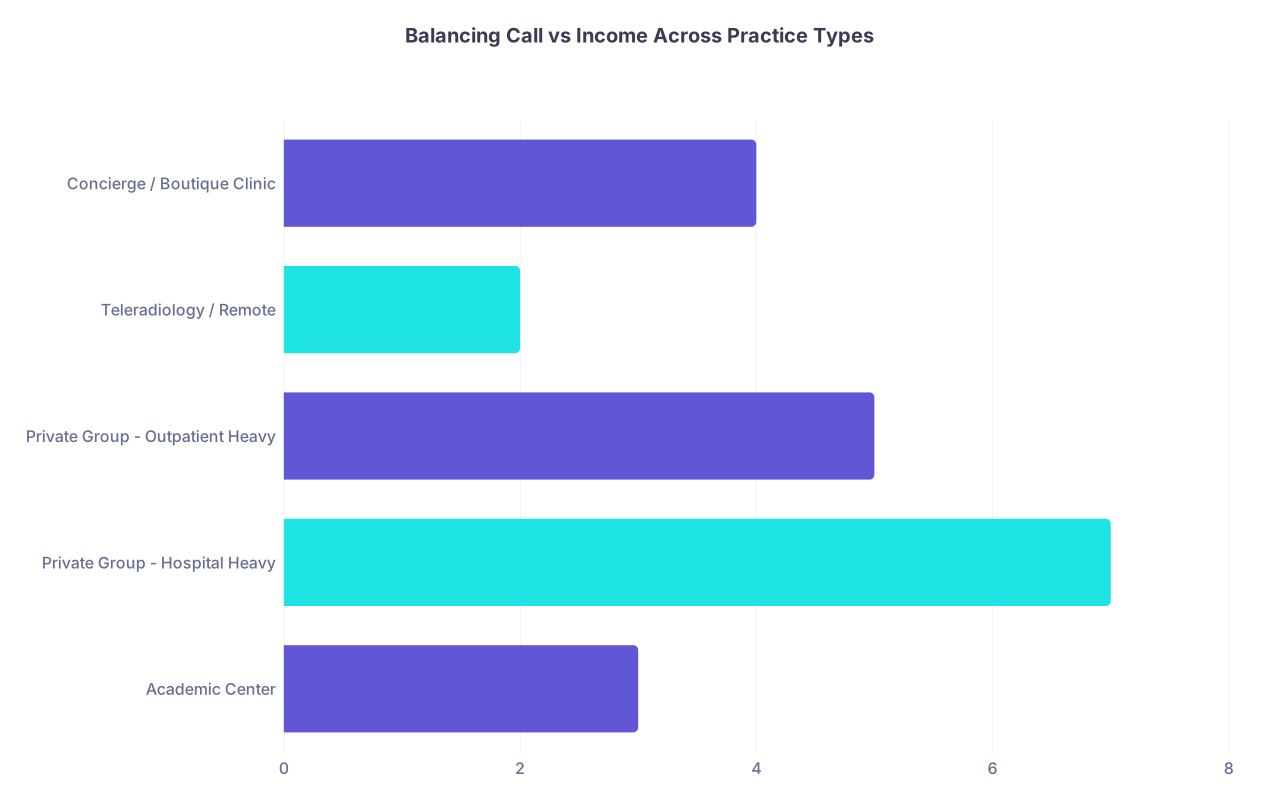
| Category | Value |
|---|---|
| Academic Center | 3 |
| Private Group - Hospital Heavy | 7 |
| Private Group - Outpatient Heavy | 5 |
| Teleradiology / Remote | 2 |
| Concierge / Boutique Clinic | 4 |
(Scale 1 = lowest call/most control, 10 = highest call/least control; rough and symbolic.)
A few high-yield levers:
Favor outpatient-heavy practices
- Outpatient radiology, derm, pain, rad onc, path groups attached mostly to elective work.
- These settings align income with schedule rather than with emergencies.
Trade some income for control
- Take 0.7–0.8 FTE clinical load if offered, as long as base pay still meets your family’s needs.
- Some groups allow “no call” tracks at lower pay. That may still be more than enough.
Use geography strategically
- A derm or radiology job in a mid-size city often pays more and is more flexible than the “name-brand” coastal academic center.
- If family obligations tether you geographically, you’ll need to network harder but you can still prioritize call-light roles.
Exploit night differential smartly (for radiology/anesthesia especially)
- A few concentrated stretches of nights or evenings (if your home support system can flex those weeks) may allow you to preserve most other nights and weekends.
Step 8: What If You’re Already Deep in a Poor-Fit Path?
This is where people get stuck. You’re PGY-2 in general surgery, your partner just got diagnosed with cancer, and suddenly your life plan collapses.
You have moves. None are painless, but they exist.
Options:
- Internal transfer to a less call-heavy specialty in the same institution (IM → path, surgery → radiology, etc.). This requires courage and honest conversations, but I’ve watched people pull it off.
- Take an extra research year or chief year pause to stabilize family situation, then reapply to another field.
- Post-residency pivot: e.g., from IM -> outpatient-only primary care with heavy procedure focus in a high-paying system; from EM -> urgent care leadership or telemedicine roles; from general surgery -> wound care, outpatient vein centers, non-OR practices.
If you’re already in a brutal field, ask yourself honestly:
- Is this survivable for my family for the next 3–5 years?
- Am I keeping this because I want it, or because I’m afraid of stepping off the prestige track?
You’re allowed to change course when reality punches you in the mouth.
Step 9: Map Your Constraints to a Shortlist
Let’s make this stupidly practical. Say your situation looks like one of these:
Scenario A: Single parent with one school-age child, no local family support
Non-negotiables: Must be able to handle school pickup/aftercare most days, limited nights/weekends, cannot disappear for 30 hours.
Realistic high-pay options to target:
- Dermatology
- Radiology (target outpatient-focused jobs long term)
- Pathology
- Radiation oncology
- PM&R with future outpatient pain/spine
Surgery, EM, OB, neurosurgery? Off the table if you want to stay sane.
Scenario B: Partner with chronic illness + elderly parent at home
Non-negotiables: Unpredictable home emergencies, need ability to leave or be home certain days; nights possible if planned, but not constant.
Better fits:
- Radiology with flexible scheduling and telerad options
- Derm with stable clinic hours
- Path or rad onc in a collegial group where coverage trades are realistic
- Anesthesia only in a large group with protected nights or ASC-heavy practice
Scenario C: Two-physician household with kids, both want ambitious careers
Here, you can stretch further if:
- You stagger call-heavy phases.
- You live near family or invest in significant childcare.
Balanced pairings that can still hit high income:
- One in radiology/path/derm/rad onc, the other in a more intense specialty.
- Both in moderate fields but at call-light practices, using nannies/au pairs to bridge.
The point: you don’t pick a specialty in isolation. You pick it in the context of your actual village (or lack of one).
Step 10: Do Not Apologize For Designing Around Family
Medicine culture loves martyrdom. “Back in my day, I took Q2 call, my kids barely knew my name, and look at me, I turned out fine.”
A lot of them did not turn out fine. Look closely.
You’re allowed to say:
- “My family situation means I cannot safely be on call that often.”
- “I want a high income and want to see my kids while they’re awake.”
- “I will choose a field and practice model that doesn’t destroy my home life.”
The people who matter—your partner, your kids, your aging parents—do not care if you’re the world’s best trauma surgeon if you’re never there.
You can be an excellent physician in radiology, derm, path, rad onc, PM&R/pain, and certain anesthesia setups—and still be present at home.

Two Things To Walk Away With
High pay and limited call are not mutually exclusive—but you have to be ruthless and realistic about which specialties and practice models actually fit your life. Radiology, derm, path, rad onc, and outpatient-focused PM&R/pain are your core options.
Do not let prestige, culture, or other people’s expectations bully you into a specialty that your real life cannot sustain. Your obligations are not a moral failing. They’re design constraints. Choose like an engineer, not a romantic.