
It’s January of your PGY-2 year. You’re in anesthesia; your partner is in radiology. You’re both on Q4 call, trying to finalize fellowship plans, and the conversation keeps circling back to the same three questions:
- Where are we going to live?
- How do we both land top-paying jobs in the same place?
- Are we about to leave a lot of money on the table just to be together?
You’re not alone. Dual-physician couples in high-paying specialties walk a tightrope: income potential vs. geography vs. lifestyle vs. training timeline. The “just go where you’re happy” advice stops being cute when one of you has a $700k+ earning ceiling in a rural area and the other has three jobs total within reasonable driving distance.
Let’s be concrete. If you’re in (or aiming for) the highest-paid specialties—orthopedic surgery, neurosurgery, cardiology, GI, radiology, anesthesia, dermatology, EM, some surgical subspecialties—you have leverage. But leverage only works if you know how to use it as a unit, not just as two random applicants.
This is how to actually coordinate lucrative careers and locations as a dual-physician couple, from MS3/4 through fellowship and early attending life.
Step 1: Get Uncomfortably Clear on Priorities (As Early As Possible)
You can’t optimize what you haven’t defined. Most couples skip this and then “discover” their misalignment halfway through fellowship applications.
Have one brutal, honest conversation and answer these, in writing, separately first, then together:
Rank these from 1–5 for yourself:
- Maximize total household income
- Live in/near a specific city or region (e.g., NYC, SoCal, Midwest, etc.)
- Maximize schedule predictability / controllable hours
- Be near family
- Prestige / academic career trajectory
Non-negotiables:
- “I will not live more than X hours from my parents / kids / [whatever].”
- “I will not work more than X nights/weekends long-term.”
- “I must be able to do X type of practice (e.g., advanced GI, IR-heavy, spine-heavy ortho, complex congenital, etc.).”
Money floor:
- “Below $___ per year, long-term, I’ll resent this.”
- Answer this individually, then add them: that’s your household floor.
You’ll see patterns right away:
- Both of you are money-maximizers? You have more flexibility location-wise.
- One is prestige/academic focused, the other is private-practice-minded? You’ll likely compromise income for one person and geography for the other.
- One is locked into “must be near family,” the other “I don’t care where”? That’s your anchor point.
Do this before:
- You choose away rotations.
- You commit to very niche fellowships that exist in 10 places nationwide.
- You start signing early fellowship contracts without asking what that does to your spouse’s options.
Step 2: Understand How Your Specialty Pairing Shapes Your Map
Some specialty pairs are easy to place almost anywhere. Some are a nightmare.
Here’s the blunt version:
| Pairing Type | Location Flexibility | Income Optimization Potential |
|---|---|---|
| Anesthesia + Ortho | High | Very high in smaller cities/rural |
| Radiology + EM | High | High, especially community settings |
| Derm + Any Surgical | Moderate | Very high if flexible on mid-size cities |
| GI + Cards | Moderate | Very high, but usually in larger systems |
| Neurosurg + Niche Subspecialty | Low | Very high but in few metro centers |
| Two academic-only subspecialists | Low | Moderate to high, mostly coastal metros |
If you’re both in highest-paid, relatively “portable” specialties (anesthesia, radiology, EM, ortho, general surgery headed to a common fellowship, etc.), you can often:
- Target mid-size cities (500k–1.5M metro)
- Negotiate aggressively
- Still have 2–3 options per person
If one or both of you are in geographically constrained niches (pediatric neurosurgery, transplant hepatology, advanced structural cardiology, microvascular plastics), your map shrinks fast. Now you’re operating inside a limited set of metro areas (think: Boston, NYC, Chicago, Houston, LA, a few others).
The rule:
The more constrained the niche, the earlier you have to coordinate your moves.
Step 3: Use Training Phases Intelligently (Med School → Residency → Fellowship)
You don’t get many big moves. You get maybe 2–3 major relocations in a 10–15 year span. Use them strategically.
During Med School / Couples Matching for Residency
If you’re both still in med school:
- Decide: “Are we trying to land long-term in this region or just training here?”
- Apply broadly enough that your couples match pairs won’t trap one of you in a dead zone for your future specialty (north-central states with no tertiary centers, for example).
If you already know you’re both heading for high-paying but somewhat niche fields (e.g., ortho + GI), prioritize bigger academic centers or metro regions with robust private practice scenes for residency. Those places have:
- More fellowship options
- More networking
- More eventual job paths in surrounding areas
If your goal is money over prestige, but you still care about living together:
Favor large community programs in mid-size cities over hyper-competitive big-name locations that are saturated and pay less later.
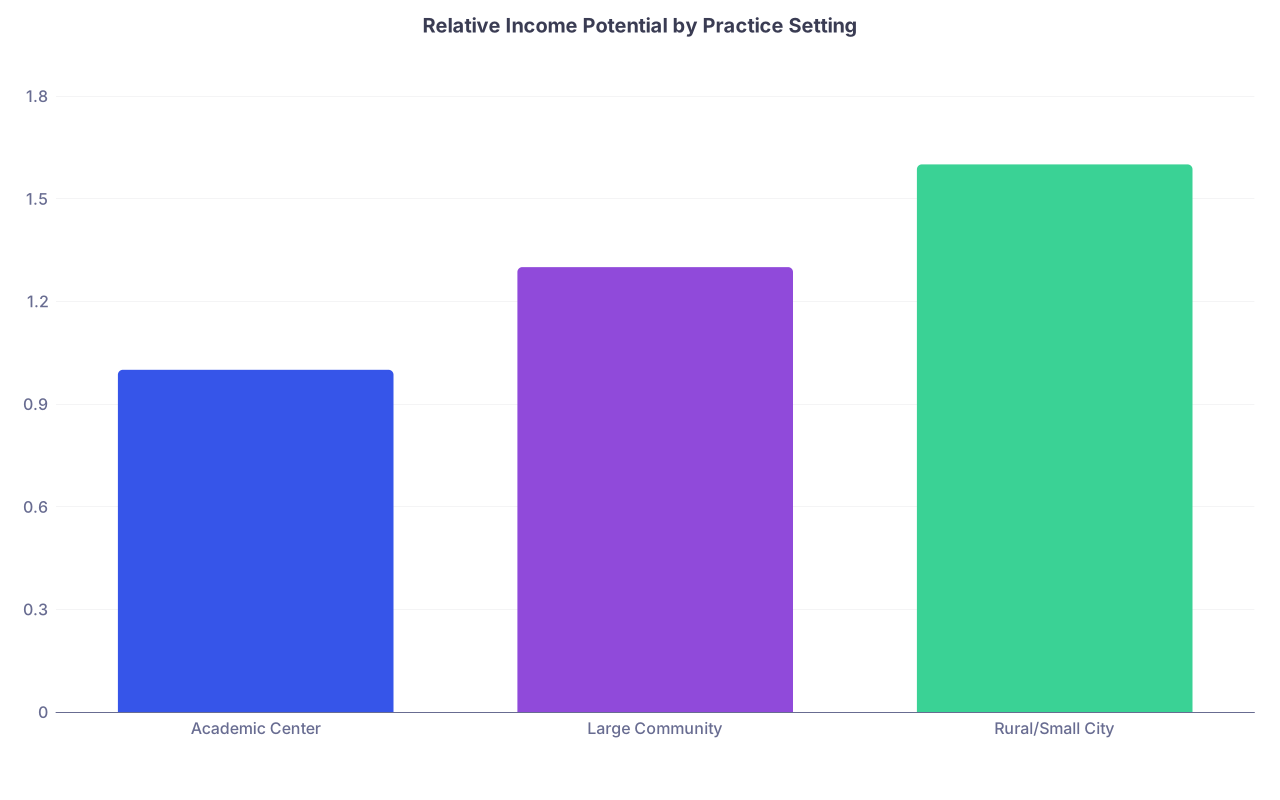
| Category | Value |
|---|---|
| Academic Center | 1 |
| Large Community | 1.3 |
| Rural/Small City | 1.6 |
(This is a rough pattern I’ve seen over and over: the same specialty can often earn ~60% more in the right rural/small city setting versus academic.)
Fellowship Phase: This Is Where Most Couples Screw Up
By fellowship, your options narrow.
Here’s how to avoid getting stuck:
Time alignment:
Try to sync fellowship lengths if possible. If you’re anesthesia (1-year fellowship) and your partner is cardiology (3-year fellowship), plan ahead so you’re not locked into different cities for 2–3 extra years unless it’s strategically beneficial (e.g., one person builds a foothold in the target city).Target the region, not just a program:
If you want to end up in the Pacific Northwest, both of you doing fellowship somewhere between Seattle–Portland–Vancouver region makes more sense than one in Boston, one in LA.Use fellowship for reconnaissance:
While in fellowship, you should both:- Identify 3–5 systems/groups in your final target metro
- Start low-key networking with faculty, alumni, locums agencies
- Understand where the money actually is (private group A vs hospital B vs academic C)
Fellowship is not just extra training. It’s your intel-gathering phase.
Step 4: Map Your Realistic Job Market, Not the Fantasy Version
Before you get to job-search season, build an honest map of where both of you can actually land good jobs.
I don’t mean “jobs exist.” I mean:
- Fair compensation
- Reasonable call/schedule
- Path for partnership or salary growth
- Full utilization of your skill set
Concrete steps:
Make a short list of 5–10 regions:
Example: “Houston, DFW, Austin–San Antonio, Phoenix, Denver, Raleigh–Durham, Nashville.”For each region, research:
- Number of hospitals/systems with your specialty
- Presence of private groups vs employed hospital vs academic
- Degree saturation: “5 derm groups and zero openings in years” vs “2 new hospital expansions”
Talk to real humans:
- Recent grads from your specialty’s group chat
- Fellows 1–3 years ahead of you
- Recruiters (not for truth, but for patterns)
Build a quick comparison:
| Region | Your Specialty Openings | Partner Openings | Typical Pay vs National Median |
|---|---|---|---|
| Houston | High | High | +10–20% |
| Boston | Moderate | Low | -10–20% |
| Phoenix | High | Moderate | +20–30% |
| NYC Metro | Moderate | Low | -20–30% |
Patterns are predictable:
- Coasts: More academic, more prestige, more competition, lower pay.
- South/Midwest smaller cities: More jobs, higher pay, less glamour, better leverage.
- Booming metros (Austin, Nashville, Raleigh, Denver-ish): Middle ground—decent pay, growing, but becoming more competitive every year.
Step 5: Decide Your Strategy: Money-Max, Balance, or Prestige-Anchor
This is the fork in the road. As a dual-physician couple in high-paying specialties, you usually end up choosing one of three overarching strategies.
1. Money-Max Strategy
Core idea: “We’ll move where the money and leverage are best for both of us.”
Typical setup:
- Both in high-paying, community-friendly specialties (ortho, rads, anesthesia, EM, GI, cards).
- Willing to live in mid-size city or small city with strong regional hospital.
- Less attached to academia or coastal metros.
Result:
- Combined incomes often $1M–$1.5M+
- Faster debt payoff, earlier financial independence
- Ability to later “trade down” to more desirable city with strong savings cushion
This is the couple that does 5–10 years in a high-paying region, lives well below means, then optionally moves to a more saturated/prestigious city with financial freedom.
2. Balance Strategy
Core idea: “We want decent income for both of us in a city/region we actually like.”
Typical setup:
- One specialty is more location-flexible (anesthesia, EM, rads), the other is more constrained (advanced subspecialty, very niche).
- Target mid/large growing metros where both can do well, though maybe not at max pay.
Result:
- Combined income still very high by normal standards ($700k–$1.2M), but lower than pure money-max.
- Decent schools, amenities, airports, culture.
- Reasonable shot at academic-affiliated roles if you want hybrid practice.
3. Prestige-Anchor Strategy
Core idea: “We’re anchoring to a prestige or family region, accept that one or both of us will earn less.”
Typical setup:
- One partner deeply tied to academics (wants NIH funding, big-name center).
- Or family/location non-negotiable (must be in SF Bay, Boston, NYC, etc.).
- The other makes peace with suboptimal pay and/or job fit.
Result:
- Combined income can still easily be $500k–$900k, but you’re giving up 20–50% of what you could earn elsewhere.
- Trade-off: brand name, family support, and big-city perks vs wealth trajectory.
None of these is “right.” What’s dumb is pretending you’ve chosen one when your actions match another. Be explicit about which play you’re running as a couple.
Step 6: Practical Tactics for Job Hunting as a Dual-Physician Unit
Once you’re 12–18 months from finishing training, switch into execution mode.
Coordinate Your Timelines
You want your job search windows to overlap by at least 6–9 months.
If one of you finishes earlier:
- They can do a 3–12 month locums stint in the target region.
- Or take a 1-year “bridge” job that is explicitly temporary.
- Or extend fellowship by a year for extra training if it meaningfully improves marketability.
Locums is underused here. One partner does locums in the desired area, gets to know the market and decision-makers, and you both hit full-time offers together later.
Approach Systems as a Package Deal (But Not Desperately)
When you’re both in high-paying specialties, you actually have leverage as a pair:
Hospitals love:
- Being able to fill two high-value positions at once.
- The narrative of recruiting a “dual-physician couple” to the area.
How to do it without sounding needy:
- Reach out separately but mention the partner naturally.
- Once you have an interested system, say something like:
“My spouse is a [specialty] finishing at [program]. We’re ideally looking for a situation where both of us can practice in the area long-term. Is there someone on your team who handles [spouse specialty] recruitment as well?”
If a system can potentially hire you both, you now have:
- More negotiation space on schedule, call, and support.
- A stronger ask on signing bonus or relocation because they’re effectively making two hires.
Use Data in Negotiation
You’re not just begging for a job—you’re bringing revenue engines.
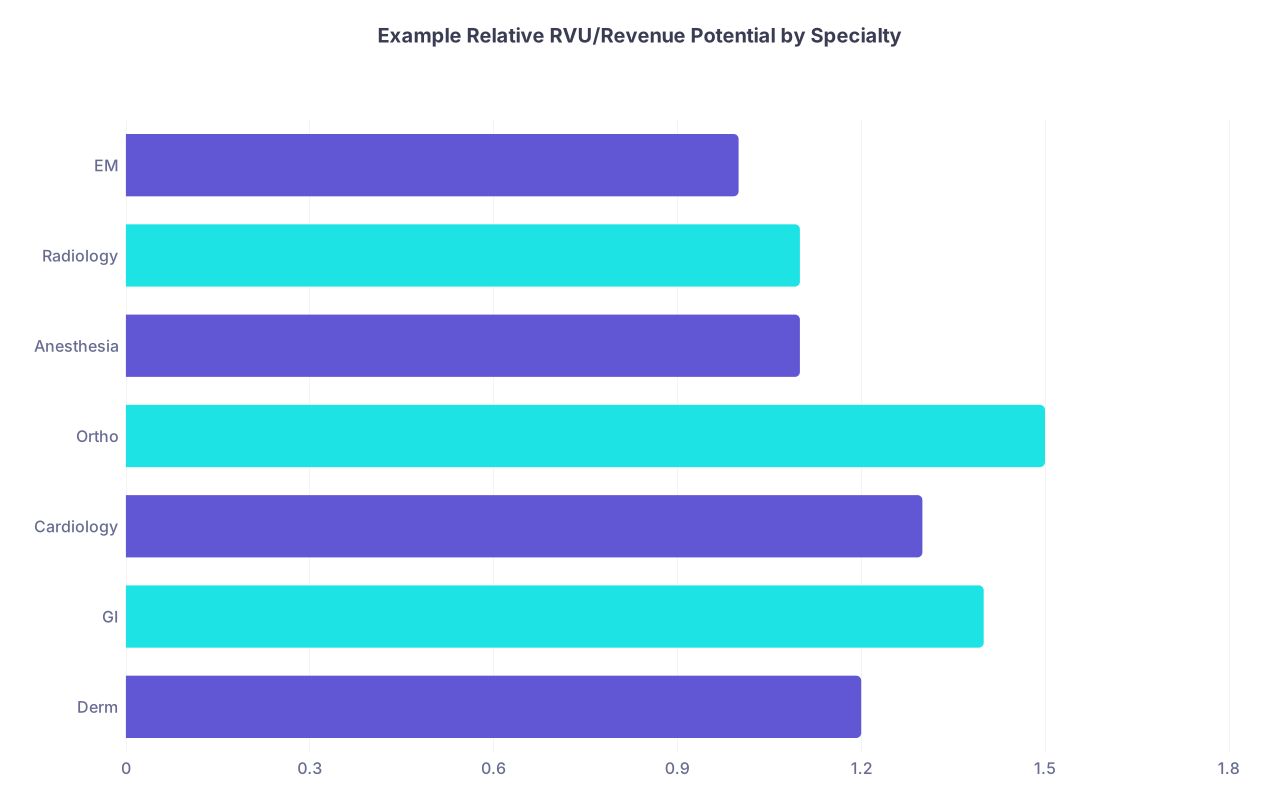
| Category | Value |
|---|---|
| Derm | 1.2 |
| GI | 1.4 |
| Cardiology | 1.3 |
| Ortho | 1.5 |
| Anesthesia | 1.1 |
| Radiology | 1.1 |
| EM | 1 |
(Again, conceptual—but the point is: these fields throw off a lot of billable work.)
You negotiate better when you:
- Know median MGMA numbers for your specialty and region.
- Understand partnership track norms.
- Have at least 2–3 serious conversations in different markets to compare.
As a dual-physician pair, you can split tactics:
- One of you focuses on reading contracts / comp structure.
- The other does more of the culture/schedule/fit investigation.
Step 7: Income vs Lifestyle Trades: Common Scenarios and How to Handle Them
Let me walk through a few very real patterns I’ve seen.
Scenario A: One Job is Perfect, the Other is “Fine but Meh”
Example: You land a dream ortho job in a thriving private group with partnership at 2 years and strong buy-in terms. Your spouse in radiology gets an employed hospital job with okay pay, mediocre schedule, little autonomy.
How to think about it:
- If combined income is still excellent and the “meh” partner has tolerable hours, you often accept this as a 3–5 year phase.
- The “meh” partner should immediately start quietly scouting alternative groups in the region; don’t assume your first job is your last.
Money-wise, it can still be a win if:
- Household savings rate is high.
- You view the first 5 years as an acceleration phase, not final form.
Scenario B: Big-City Academic vs Mid-City Community
You both get offers:
- City 1 (prestige coastal academic center):
- You: $380k academic attending, heavy teaching/research.
- Partner: $350k academic, lots of call, pay ceiling.
- City 2 (mid-size Southern/Midwest city, strong community system):
- You: $650k+ with partnership upside.
- Partner: $600k+ with better lifestyle.
This is where couples split. Here’s the blunt test:
- Are you both truly academic-career people? If yes, maybe City 1 is right.
- If one of you is academic and one is just prestige-chasing, that’s a red flag. You’ll likely regret the income/power tradeoff.
Run the numbers:
- 10-year difference in combined pre-tax income between City 1 and City 2 can easily be $3–5 million.
- With compounding, that’s “we never worry about money again” vs “we’re comfortable high earners.”
Be adults about it. Know what you’re choosing.
Step 8: Money Infrastructure as a Dual High-Earning Household
You’re not just trying to land jobs—you’re building a machine.
Once you’re both attending level, do three things fast:
-
- Student loans: usually gone within 3–7 years if you’re serious.
- Do not upgrade lifestyle at the same pace as your combined income.
Build buffers for geographic flexibility
- Save 6–12 months of joint living expenses.
- That gives you freedom to leave a toxic job or move for a better joint opportunity.
Align on long-term goals
- Financial independence age target? (e.g., 50)
- Kids / schools / stability vs job-hopping for higher pay.
This is where being a dual-physician couple really pays off. You can:
- Choose more lifestyle-friendly positions later.
- Take academic or part-time roles without stress.
- Move closer to family without being hostage to the best-paying jobs.
Step 9: Long-Distance as a Last-Resort Tool (Not Plan A)
Sometimes, despite all the smart planning, you hit a wall:
- One life-changing opportunity appears for one partner.
- Visa/immigration constraints affect options.
- Family emergencies anchor one person temporarily.
Long-distance can be survivable short-term if:
- There’s a defined endpoint (12–24 months).
- Both of you treat it like a mission, not a vague “we’ll see.”
- You have regular in-person time and aligned financial goals.
But as a strategy? It’s a bad one long-term. The whole point of dual lucrative careers is building a shared life, not separate hotel existences with matching W-2s.
Visualizing the Path
Sometimes it helps to see the stages.
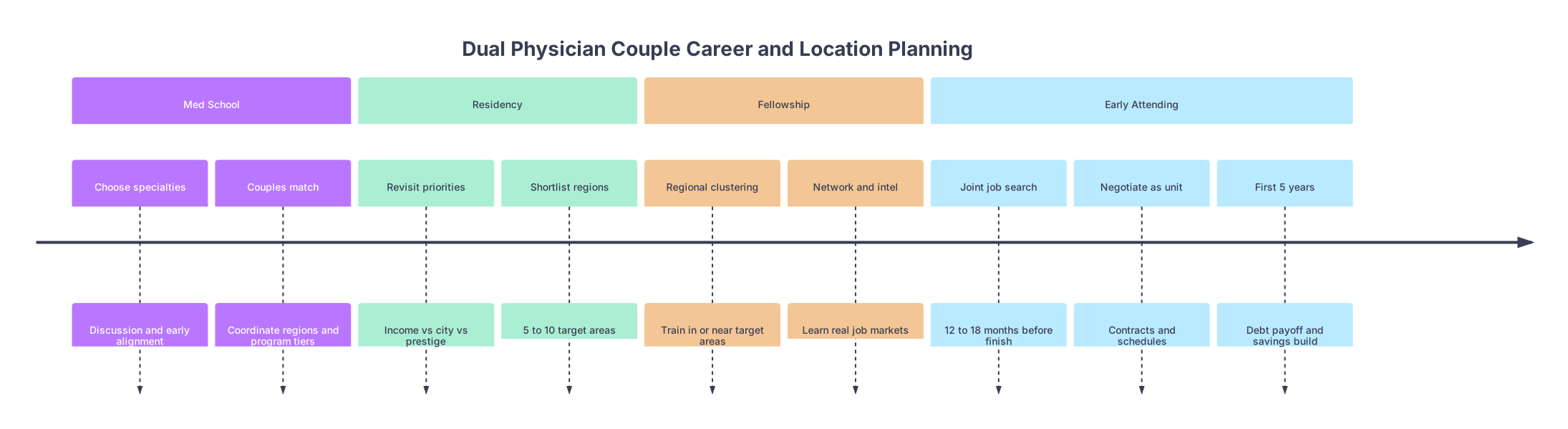
| Period | Event |
|---|---|
| Med School - Choose specialties | Discussion and early alignment |
| Med School - Couples match | Coordinate regions and program tiers |
| Residency - Revisit priorities | Income vs city vs prestige |
| Residency - Shortlist regions | 5 to 10 target areas |
| Fellowship - Regional clustering | Train in or near target areas |
| Fellowship - Network and intel | Learn real job markets |
| Early Attending - Joint job search | 12 to 18 months before finish |
| Early Attending - Negotiate as unit | Contracts and schedules |
| Early Attending - First 5 years | Debt payoff and savings build |
Key Takeaways
- You and your partner are a package—start acting like it early. Get brutally clear on your priority stack: money, location, lifestyle, prestige, family. Write it down.
- Your specialties shape your map. Some pairs can go almost anywhere and print money; others are locked to a few cities. Adjust early—especially when choosing fellowships and target regions.
- Use your combined leverage. Approach systems as a two-physician hire, align your timelines, and be deliberate about trading prestige or location for income (or vice versa). Don’t just drift into a default path.