
It’s 3:17 a.m. You’re on call again. The pager just went off for the 5th time this hour. You’re sitting in a dark reading room / call room / empty clinic office, doing the math in your head: “If I just quit, how long could I live on savings? What else could I even do? And how do I walk away from this salary when I’m still drowning in loans / childcare / mortgage?”
You’re not fantasizing about a beach. You’re fantasizing about not checking the EMR on Sunday. About not waking up with your chest tight before your first case. But you’re in one of the highest paid specialties—orthopedics, derm, GI, IR, radiology, anesthesia, EM, cardiology, neurosurg—and that income is not optional. It’s baked into your life.
You feel trapped between two bad options:
- Keep going and grind yourself into the floor.
- Blow up your finances and life stability.
Let’s not do either of those.
This is the playbook I’d use if you came to me post-call and said, “I’m burned out, but I cannot afford a major income drop.” I’m going to assume:
- You’re already in or past residency/fellowship in a competitive, high-paying field.
- You have real financial obligations you can’t just “budget away.”
- You don’t want Instagram-coach nonsense. You want tactical moves.
We’ll work through three levels:
- Fix what you can inside your current job.
- Shift to a better version of your specialty that still pays.
- Build an exit or partial-exit strategy that doesn’t wreck your finances.
Step 1: Get Clinical About Your Burnout
Before changing anything, you need a clean diagnosis of what is burning you out. “Everything” isn’t specific enough.
Ask yourself, very concretely, for a 2–4 week window:
- Which days are worst?
- Which hours are worst?
- Which tasks drain you the most?
- Which people/interactions spike your stress?
Make a short, brutal list. No essays. Just labels.
Examples I’ve seen from high-earning fields:
- Ortho attending: “Clinic volume / OR turnover / endless messages.”
- EM doc: “Night shifts / boarding / hostile admin.”
- IR: “Middle of the night emergent cases and impossible add-ons.”
- Anesthesia: “Early starts, no control over assignment, constant pressure for turnover.”
- Derm: “Overbooked cosmetics + medical derm + charting after kids go to bed.”
- Radiology: “RVU treadmill and never-ending overnight reads.”
Then separate two categories:
- Structural problems: schedule, shift pattern, call, RVU expectations, admin culture, documentation load.
- Internal problems: perfectionism, boundary issues, saying yes to everything, inability to tolerate dissatisfaction, personal life chaos.
You need both on your radar. But if your structure is toxic, no amount of “mindset work” fixes that. So we start by attacking structural stuff you can change without tanking your income.
Step 2: Do the “Same Job, But Less Miserable” Adjustment
You’re not choosing between 100% this job or 0%. There’s a lot in between.
Here are levers you can pull inside your specialty without walking away from the salary tier.
1. Attack Your Schedule First
I’ve yet to meet a burned-out high-earning specialist whose schedule isn’t at least 50% of the problem.
Your goal is not “perfect” hours. Your goal is: change two to three high-impact schedule variables without losing your paycheck.
Common levers:
- Fewer nights / weekends.
- Less call, or different call structure.
- Different mix of clinic vs procedures vs reading vs OR.
- Fewer total shifts, but more efficient / higher RVU ones.
This is where you get strategic.

| Step | Description |
|---|---|
| Step 1 | Identify worst shifts |
| Step 2 | Ask to drop or swap |
| Step 3 | Negotiate replacement duties |
| Step 4 | Increase pay elsewhere to offset |
| Step 5 | Trial for 3 months |
| Step 6 | Reassess burnout level |
| Step 7 | Revenue impact? |
Concrete examples by specialty:
EM: Drop one night shift per month and pick up one fast-track or telehealth shift that pays slightly less but lets you survive. Or move from 1.0 FTE to 0.8 with heavy shift concentration on days/evenings. Many docs keep 90% of prior income because they were never fully collecting all potential bonus anyway.
Anesthesia: Negotiate out of hearts/complex cases or trauma call and accept more bread-and-butter OR days. Or shift to an ambulatory surgery center two days a week while staying in the group.
Ortho / General Surgery: Compress clinic. Many surgeons are destroyed by 4–5 half-days of clinic instead of 1–2 brutally efficient full days. You don’t need to be in clinic every day to bill well.
Radiology: Move from 7-on/7-off nights to mixed days/eves. Or go from 1.2 FTE worth of work (which a ton of rads are doing) down to actual 1.0 FTE with firm RVU caps.
Cards / GI: Offload some low-yield clinic to advanced practice providers and protect half-days for procedures you like that also pay.
Your first move is not “I’m burned out, I need to go 0.6 FTE.” That’s a financial punch in the face. Your first move is to remove the worst 15–20% of your schedule.
Script you can actually use with leadership:
“I’m getting close to a sustainable edge here. I want to stay long-term and keep my productivity up, but I need to adjust the mix. Here’s what I propose: I give up X, and in exchange I increase Y, which is actually higher-yield revenue-wise.”
Speak in revenue and coverage. Not vibes.
2. Offload What Isn’t MD-Only Work
High-earning burnout is often “I’m doing three people’s jobs.”
Look hard at:
- Inbox messages.
- Routine refills and paperwork.
- Low-acuity follow-ups.
- Pre-charting, prior auths, referrals.
- Patient education that can be templated or delegated.
In a lot of settings, you can push this off. Nobody hands you that permission—you take it and then formalize it.
Examples:
Create strict inbox protocols for staff. MA or RN handles first pass on everything that is not: med change, new serious symptom, results needing complex interpretation, new diagnosis, or conflict.
Build template responses for 80% of common questions. Plug and chug instead of crafting bespoke novels.
Use APPs for certain visit types (post-op checks, stable chronic f/u, cosmetic consults you don’t want, low-risk procedural follow-up).
Protect one half-day per week as admin only and schedule it like you would patients. Doors closed. EMR, calls, messages. No exceptions. This is not a luxury; it’s survival.
You’ll get pushback in some environments:
- “Everyone’s inbox is crazy.”
- “We can’t hire more staff.”
- “We need the access.”
That’s noise. Your job is to protect your ability to function safely and long-term.
Step 3: Don’t Let Golden Handcuffs Get Tighter
You “need the income.” Fine. But you may be making that worse every month without realizing it.
Quick financial triage. No fluff.
| Priority Level | Focus Area |
|---|---|
| 1 | Emergency fund |
| 2 | High-interest debt |
| 3 | Minimum retirement save |
| 4 | Lifestyle fixed costs |
| 5 | Nice-to-have spending |
If you’re serious about wanting options in 2–5 years, you need to:
- Stop expanding fixed lifestyle costs.
- Shorten your “runway to change.”
That means:
- Stop increasing your mortgage, car payments, private school commitments, etc. Freeze lifestyle for 12–24 months.
- Take any extra money (bonus, OT, moonlighting) and throw it at:
- High-interest consumer debt first.
- Then building 6–12 months of living expenses (not including retirement contributions) in cash equivalents.
I’m not telling you to live like a resident again. I am telling you: if you hate your job, you cannot also keep inflating your monthly nut. That is how you become permanently stuck.
The mental shift is this: optionality is now your primary luxury purchase. Not the Tesla. Not the kitchen remodel. The ability to say “no” to a terrible schedule in three years.
Step 4: Move to a Better Version of Your Specialty (Same Skill, Different Game)
Sometimes the problem isn’t “I’m in cardiology” or “I’m in EM.” The problem is where and how you’re doing it.
Almost every high-paid specialty has multiple practice environments with different burnout profiles and different pay structures.
| Specialty | High-Burnout Setting | Lower-Burnout Alternative |
|---|---|---|
| EM | Urban Level 1 trauma | Suburban community / tele-EM |
| Anesthesia | Academic tertiary | ASC / community hospital |
| Radiology | 24/7 in-house nights | Day-only teleradiology |
| Cards | Cath-heavy, no support | Imaging, clinic-focus, groups |
| Ortho | Trauma-heavy academic | Elective joints / private ASC |
A few real-world examples I’ve seen:
EM doc leaving a high-volume inner-city shop to join a suburban group with slightly lower pay but highly predictable scheduling. Burnout drops by 70%, income drops by maybe 10–15%. Worth it.
IR doc shifting from full hospital-based IR (tons of emergent cases and consults) to a mixed clinic + outpatient IR practice, still procedural and lucrative but with sane hours.
Radiologist going from partnership track in a grind-heavy group to remote teleradiology days, same or slightly better income, loss of “prestige” but far better life.
Ortho surgeon leaving academics (RVU pressure + research expectations + teaching) for a group where they can focus on 1–2 procedure types and stack their OR days.
Notice what’s happening: they’re not “quitting medicine.” They’re switching how they sell their skills.
Key things to look for when scouting better setups:
- Who controls your schedule?
- How are you paid? Pure RVU, salary + bonus, partnership distributions?
- How much call? Nights? Weekends?
- How much autonomy over your day?
If you don’t know how your current pay model really works, ask a partner you trust to walk you through it. Half the time, people are working 1.3 FTE for 1.0 FTE pay and haven’t realized it.
Step 5: Explore Partial Clinical + Nonclinical Hybrid Options
You want to keep the income band, but you’d love to decrease the pure patient/OR/ED grind. The answer can be a hybrid.
High-earning docs are uniquely positioned to make hybrids work because:
- Your base rate is high.
- Even 0.5–0.7 clinical FTE still pays very well.
Potential hybrids:
- 0.6–0.8 clinical + 0.2 industry (pharma, med device, consulting).
- Clinical + informatics / utilization review / quality roles.
- Clinical 3–4 days/week + teaching, administration, or telehealth.
These are not overnight moves. But you can start laying track now:
- Get on the EMR optimization committee.
- Take on a small quality project and get your name attached.
- Start doing occasional medico-legal reviews or case reviews.
- Connect with previous grads doing industry work and ask what their path looked like.
Burnout often drops dramatically when you’re not 100% in the hardest part of the work. I’ve seen GI docs who cut back on scoping days and add one day of admin/quality and feel dramatically more human.
Step 6: Build a Medium-Term Exit Option You May or May Not Use
Even if you never fully leave, having an exit plan changes how trapped you feel right now.
You don’t need to know exactly what you’ll do. You only need to move in a direction that opens nonclinical or lower-clinical doors in 3–7 years.
Think of it like this:
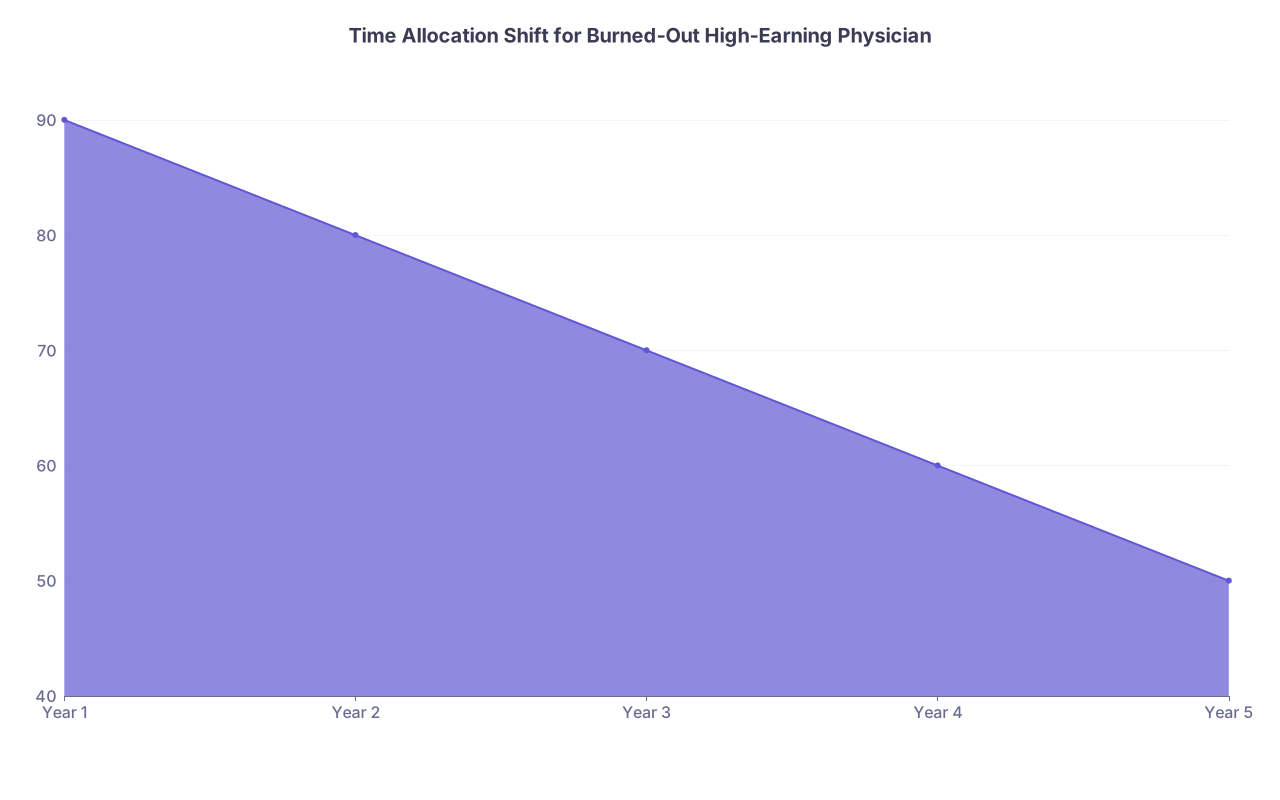
| Category | Value |
|---|---|
| Year 1 | 90 |
| Year 2 | 80 |
| Year 3 | 70 |
| Year 4 | 60 |
| Year 5 | 50 |
That line is “percentage of income from your current grind.” The missing percentage over time is from new sources: different clinical configuration, side consulting, part-time nonclinical work, etc.
Practical steps:
Pick a plausible lane:
- Leadership/administration.
- Informatics / data / quality.
- Pharma / med device / clinical research.
- Med education / coaching / niche consulting.
- Telehealth / remote reading / lower-intensity clinical.
Give that lane 2–4 hours a week.
- One course.
- One project.
- One regular meeting or committee.
- One small side gig.
Say no to extra shifts you only take out of guilt. Redirect that energy. Yes, you lose some short-term money. You gain long-term options.
I’ve watched more than one anesthesiologist quietly stack informatics projects on the side, then, 4–5 years later, step into a high-paying CMIO or regional medical director role at 0.8 FTE.
This does not happen by magic. It happens because five years earlier, they said:
- “Okay, I’m going to build non-OR value for the system and get paid for it eventually.”
Step 7: Protect Your Minimum Viable Self Outside Work
I’m not going to tell you to become a wellness influencer. But if your body and brain are falling apart, every shift is 2x harder.
Set a ridiculously low bar for self-maintenance. Then actually hit it.
I’ve seen this bare-minimum package move the needle:
Sleep: One protected block of 7+ hours at least 4 nights a week, non-negotiable. That might mean fighting like hell to avoid ridiculous post-call obligations.
Movement: 2–3 simple workouts a week that don’t require a commute or gear—a 20-minute walk, bodyweight at home, short run. You’re not training for a marathon. You’re trying to keep your CNS from failing.
Food: Systems, not willpower. Meal delivery, healthy frozen stuff, whatever. Decision fatigue is real. Remove decisions.
One “no-medicine” block weekly: 2–3 hours where you do not talk, read, or think about work. No charts. No peer texts about cases. Real disconnection.
If you’re thinking “I have no time for that,” that’s the problem. Not because of “balance,” but because your brain is a piece of hardware; if you keep overheating it, it crashes. Burnout is often the crash.
Step 8: Decide What You’re Willing to Trade
Hard truth: You cannot have everything at once—max income, minimal hours, zero stress, rapid loan payoff, private school, giant house, and robust exit options. That’s not a real menu.
You can decide which one you’re least willing to sacrifice.
I’d put it this way:
If your primary non-negotiable is:
- “I will not destroy my marriage/health/kids for this,” then you must sacrifice some income and/or speed of debt payoff.
If your primary non-negotiable is:
- “I will not put my family at financial risk,” then you must sacrifice some schedule and comfort in the short term, but aggressively build a 3–5 year plan to move to a sustainable role.
Most people try to act like both are equally non-negotiable, so they make no decisions. And stay stuck in the worst possible combo: a miserable job + no exit runway.
You’re in a high-earning field. Your income gives you tools. Use them:
- Buy time (cleaning help, childcare, delivery).
- Buy options (debt reduction, cash runway).
- Buy skills (courses, certifications for your future pivot).
Stop buying only shiny things that make you more trapped.
FAQ (Exactly 5 Questions)
1. How do I know if I’m “burned out enough” to make changes, versus just tired?
If you’re repeatedly fantasizing about quitting mid-shift, dreading work on your days off, feeling emotionally numb with patients, or making more errors/oversights than usual, you’re past “just tired.” You don’t need a burnout score to justify making your life more sustainable. If you’re asking this question, you’re likely already overdue for changes.
2. I’m in a partnership track at a lucrative group. Should I just “push through” until I make partner?
Not automatically. Do the math. If “pushing through” means 3–5 more years of unsustainable workload and you’re already breaking, that partnership might cost you more than it pays. Sometimes the right move is to change the way you reach partnership (renegotiate hours/role), or accept a slightly longer path rather than sprinting and flaming out. I’ve seen people become partner and then leave 2 years later because they assumed partnership would magically fix burnout. It rarely does.
3. Is going part-time in a high-paying specialty a smart move, or career suicide?
Done strategically, part-time can be one of the highest-ROI moves you make. If 0.6–0.8 FTE still covers your fixed costs, you’ve just bought 1–2 days a week for recovery, family, and building nonclinical options. The “career suicide” narrative mostly comes from older partners who built their identity on grinding. If you keep your skills current, maintain good relationships, and stay reliable on the days you do work, part-time is not a death sentence—and it might be the only way you last 20 more years.
4. What if my group/hospital won’t budge on schedule, call, or RVU expectations?
Then you have your answer: this place is willing to burn you out to maintain its current model. In that case, stop trying to fix them and start planning your exit, even if it takes 1–3 years. Quietly gather data on other jobs, track your finances, pay down enough debt to move, and when you can, leave. I’ve watched too many people waste 5–7 years trying to “advocate for change” in systems that were never going to change.
5. How do I talk to my spouse/partner about this without freaking them out?
Be specific and concrete. Don’t just say “I hate my job.” Say: “If I keep this exact schedule for 5 more years, I’m legitimately worried about my health and our life. Here are 2–3 options I’m considering that would reduce my hours by X but keep Y% of my income. Here’s what it would mean for our budget and timeline.” People get scared by vague doom. They’re more open when you bring an honest description of your limits plus tangible plans, not just complaints.
Key takeaways:
- You’re not choosing between “this exact misery forever” and “financial ruin.” There is a wide middle ground: targeted schedule changes, different practice settings, and hybrid roles that keep your income in the same ballpark.
- Use your high income to buy options, not just lifestyle. Kill bad debt, shrink fixed costs, and slowly build nonclinical or lower-intensity clinical paths so you’re not trapped five years from now.