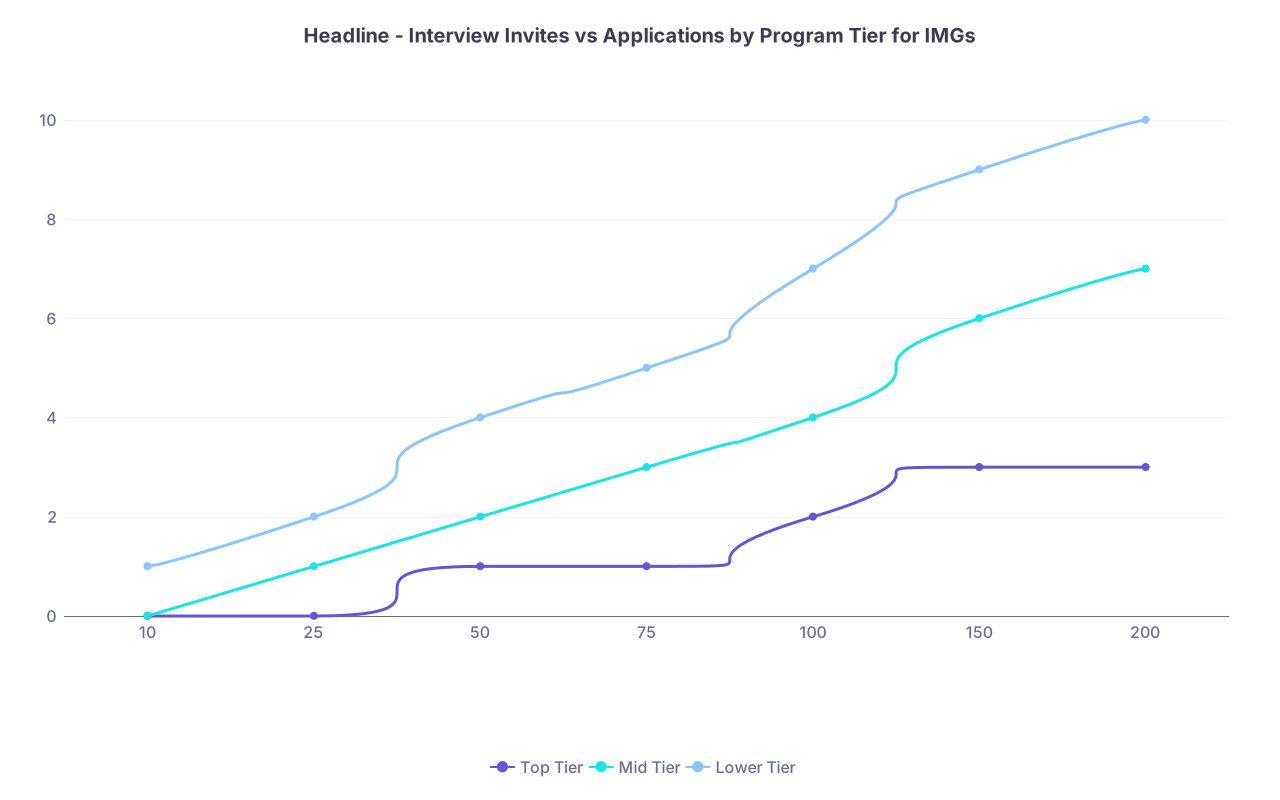
You’d think residency programs would reward the obvious: strong scores, solid research, good letters, and a coherent story. That’s the myth. The reality is uglier and much more mechanical. If you’re an IMG without a U.S. core rotation, a lot of programs won’t get far enough into your file to appreciate any of that.
That doesn’t mean you’re less capable. It means the system is lazy.
I’ve seen this happen over and over. An IMG has excellent exam performance, publications, maybe even stronger raw clinical experience than some U.S. graduates—and still gets filtered out early because one familiar credential is missing. Not because the program proved the applicant would struggle. Because the program didn’t want to spend time finding out.
That’s the core problem: screening is built around familiarity, not pure merit. A U.S. core rotation functions as a comfort signal. Remove it, and uncertainty spikes before a faculty member has even read your personal statement.
So let’s stop pretending this is mysterious. It isn’t. Below, I’ll separate myth from mechanism, then show you what actually reduces your screening risk if you don’t have that rotation.
Why Programs Screen Out IMGs Early: The Real Mechanics Behind the Filter
Programs love to talk about holistic review. Cute idea. In practice, most applications hit a triage system first.
There are too many files, not enough time, and very little appetite for uncertainty. So coordinators and software lean on shortcuts: visa status, graduation year, exam attempts, score thresholds, U.S. clinical experience, and whether your letters come from people the faculty can interpret quickly.
That’s not always fair. It is absolutely real.
Here’s what a U.S. core rotation signals in one line item:
- You’ve worked in a U.S. clinical environment
- You’ve been observed by U.S.-based supervisors
- You’ve likely seen how notes, sign-out, and team workflows actually function
- Someone local may be able to vouch for you in language the program understands
That last part matters more than people admit.
A lot of IMG applicants think screening is mainly about “competitiveness.” As if programs are carefully ranking everyone by merit and then choosing the very strongest. No. Often they’re screening for friction. For onboarding burden. For the chance that an intern will need more adaptation in July than the program wants to provide.
That’s the part applicants hate hearing, but it’s the truth.
A missing U.S. core rotation raises silent questions: Can this person document in the style we expect? Will they function smoothly on rounds? Do they understand escalation culture, handoffs, patient communication norms, and interdisciplinary team habits? Will the letter writer’s praise translate to our setting?
None of those questions proves you’d fail. But screening isn’t a courtroom. It’s risk management with a time shortage.
And IMGs get hit hardest because they’re often judged by proxies rather than direct familiarity. A U.S. MD applicant can be average and still benefit from institutional legibility. An IMG may be excellent and still get treated like an unknown variable. That’s not meritocracy. That’s administrative behavior dressed up as selectivity.
What a U.S. Core Rotation Actually Proves — and What It Does Not
Let’s kill another myth: a U.S. core rotation does not prove you’re a better doctor.
It doesn’t prove deeper clinical reasoning. It doesn’t prove superior work ethic. It doesn’t prove more compassion, intelligence, or technical skill. Plenty of outstanding physicians never had the luxury of a clean U.S. training pathway.
What it does prove is much narrower—and much more useful to programs.
It shows recent exposure to U.S. workflows. It shows you’ve been watched in a system they recognize. It gives programs evidence, however imperfect, that you can function inside their clinical culture without requiring a massive adjustment period.
That hidden value is why it carries so much weight:
- real-time observation by U.S. attendings
- standardized expectations for notes and presentations
- visible team behavior
- a reference letter written in terms faculty can decode quickly
That’s it. Not magic. Not a moral victory. A proxy.
And because screening systems are built on proxies, this one is extremely efficient. It collapses several unknowns into a single reassuring signal.
That’s why lacking it can hurt even when your CV is otherwise excellent. Programs don’t necessarily think you’re weak. They think you’re harder to interpret. In a crowded application cycle, “harder to interpret” often becomes “easy to reject.”
Brutal? Yes. Irrational? Not entirely. Predictable? Absolutely.
How to Compensate If You Don’t Have a U.S. Core Rotation
You can’t whine your way around this. You have to replace one missing signal with multiple credible ones.
Start with substitute evidence. Not fluff. Evidence.
The strongest alternatives usually include a mix of:
- U.S. observerships with meaningful faculty exposure
- sub-internship–like experiences, where available to you
- research collaboration with U.S. faculty who can speak to your reliability and communication
- U.S. letters that comment on concrete behaviors, not generic praise
- recent clinical work that shows you’re active, current, and not detached from patient care
- telehealth or systems-based exposure, if legitimate and clearly described
None of these fully equals a true U.S. core rotation. Don’t kid yourself. But layered together, they can lower uncertainty enough to keep your file alive.
Your application narrative matters too. A lot.
Too many IMGs submit impressive but poorly translated applications. The CV is full of achievements, but the reviewer still can’t answer the question: Can this person function here, now, with our patients and teams?
So make that answer obvious.
In your ERAS materials, signal:
- understanding of team-based care
- comfort with structured presentations
- familiarity with EMR-style documentation
- patient-centered communication
- dependability in supervised clinical environments
If you’ve done something relevant, name it plainly. Don’t bury it in vague language. “Participated in patient management” is weak. “Presented daily assessments, documented progress notes under supervision, and coordinated with nursing and consulting teams” is better because it sounds real. Because it is.
Your personal statement shouldn’t just admire the specialty from a distance. It should reduce uncertainty. Show readiness, not just ambition.
And if you get interviews, address the missing U.S. core rotation directly—but don’t sound defensive. I’ve heard applicants ramble for two minutes trying to justify why they didn’t have one. Bad move. Better approach:
- acknowledge it briefly
- state what you did instead
- show what those experiences taught you
- pivot to how you’re ready now
Simple. Factual. Forward-looking.
Something like:
“I didn’t have a formal U.S. core rotation, so I intentionally built equivalent exposure through a supervised observership, U.S.-based research collaboration, and recent clinical work where I strengthened presentation, documentation, and team communication skills.”
That works because it sounds like an adult solved a problem.
What Actually Works: A Triage Plan for Getting Past the Screen
You do not need a perfect application. You need one that survives first contact.
That means strategy.
First, target programs that already take IMGs seriously. Look at:
- known IMG-friendly programs
- larger residency classes
- community and university-affiliated programs with a track record of international graduates
- places that explicitly mention visa sponsorship or international applicant review
Stop wasting energy on fantasy applications to programs that have no practical history of taking people like you. Hope is not a strategy.
Second, strengthen the first 10 seconds of review. That’s where files live or die.
Your application should make these things immediately clear:
- specialty fit
- visa status
- recent clinical activity
- U.S. exposure, if any
- one crisp indicator of readiness for U.S.-style training
Third, use networking intelligently. Not spam. Not desperate LinkedIn messages to strangers.
What helps is a warm introduction from:
- a faculty collaborator
- a mentor with U.S. contacts
- an alum from your school now in the U.S.
- an attending who can email a program and say, “This applicant is worth a close look.”
That kind of nudge won’t rescue a weak file. But it can move you from invisible to reviewed, which is half the battle.
Finally, set realistic expectations. No substitute perfectly replaces a U.S. core rotation. Anyone telling you otherwise is selling something. But layered signals absolutely can reduce rejection risk in a material way. I’ve seen applicants do it successfully when they stop chasing prestige and start building interpretability.
Bottom Line: The Screen Is Not Fair, But It Is Predictable
Here’s the myth: IMGs without a U.S. core rotation get screened out because they’re not competitive enough.
Wrong.
More often, they get screened out because programs use cheap, familiar proxies for readiness. A missing U.S. core rotation creates uncertainty, and uncertainty gets cut early.
So don’t moralize about fairness. Understand the machine.
If you lack that rotation, your job is to replace the missing signal with several others: U.S. exposure, credible letters, recent clinical activity, clear specialty fit, visa transparency, and a narrative that shows you can function in the environment you’re applying to.
That’s what the data of real screening behavior shows. Not the fantasy version. Not the “holistic review” brochure version.
The good news? Predictable systems can be gamed—ethically—by applicants who understand them. Build the evidence. Make your readiness easy to verify. And give programs fewer excuses to screen you out before the real review even begins.
Key takeaways
- Lack of a U.S. core rotation is usually treated as a proxy for uncertainty, not proof of incompetence.
- Programs screen IMGs with risk-reduction shortcuts, so you need to replace one missing signal with several strong ones.
- The winning move isn’t begging for exceptions. It’s building a U.S.-readiness story that is concrete, credible, and easy to verify.