
Community programs do not “love” IMGs. They tolerate some of you, compete for a smaller subset of you, and quietly screen out a huge chunk of you. The blanket advice that “just apply to community IM programs, they take IMGs” is lazy, outdated, and dangerous.
Let’s dismantle this properly.
Where the “Community = IMG-Friendly” Myth Comes From
I’ve heard this line so many times:
“Don’t worry, if you’re an IMG, just apply to community internal medicine programs. They love IMGs.”
People say it on WhatsApp groups. On Reddit. In prep courses. Sometimes even from junior residents who matched once and now think they’re NRMP analysts.
The myth comes from a few half-true observations:
- A lot of community internal medicine programs have a high percentage of IMGs.
- They’re usually less “name brand” than big university hospitals.
- IMGs see those rosters, see familiar foreign school names, and think: jackpot.
The problem? People stop there. No one looks under the hood.
Here’s what’s actually going on: many community programs do have high IMG representation, but they’re not “IMG-friendly” in the sense that they’re open arms to any IMG with a pulse. They are selective, fragmented, and heavily filtered.
And quite a few community programs have quietly drifted away from IMGs altogether.
What the Data Actually Shows (Not the WhatsApp Version)
Let’s anchor this in numbers, not vibes.
The NRMP’s Charting Outcomes and program director surveys are unsexy PDFs everyone claims to “know” but almost no one reads beyond one screenshot. So let’s translate.
There are three separate realities:
- University programs that rarely take IMGs
- Hybrid “university-affiliated community” programs
- Pure community programs, many in smaller cities or underserved areas
The IMG distribution is not uniform across those.
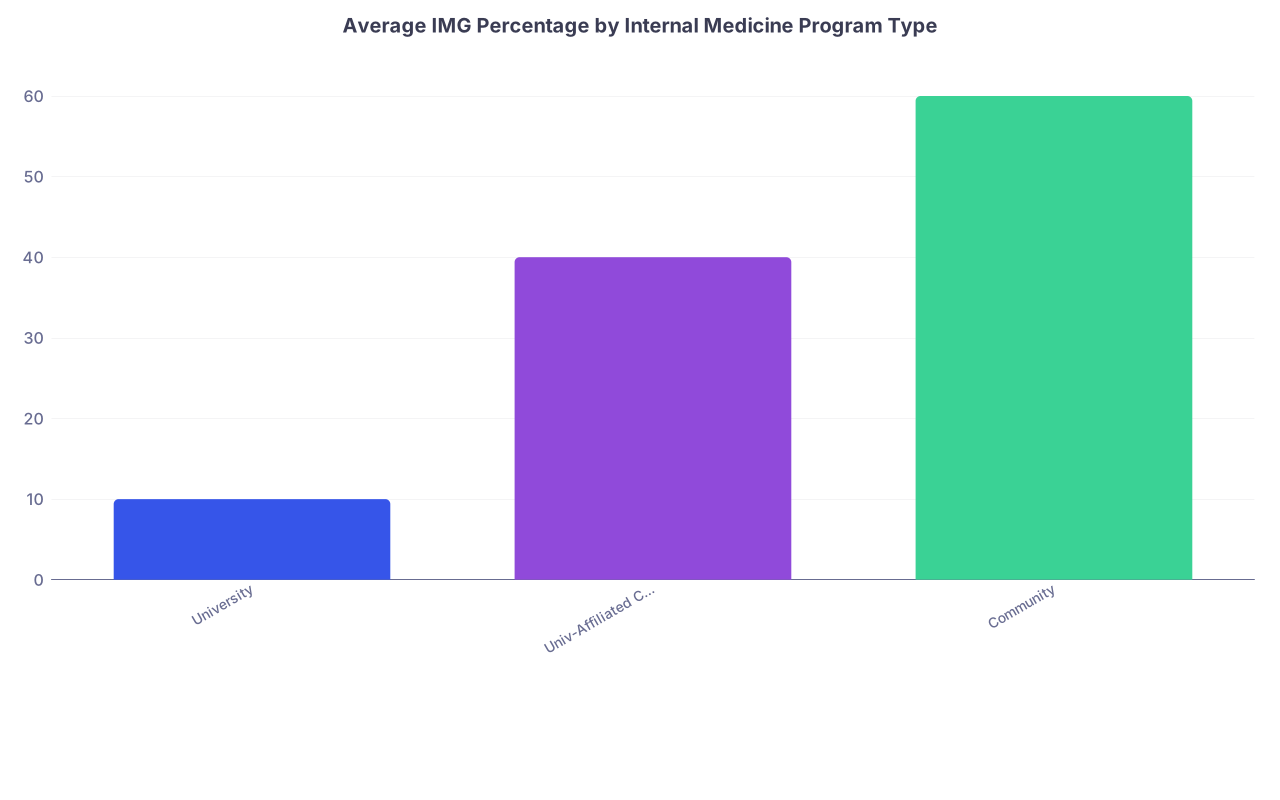
| Category | Value |
|---|---|
| University | 10 |
| Univ-Affiliated Community | 40 |
| Community | 60 |
Those numbers are illustrative but directionally accurate in many regions: university programs have fewer IMGs on average; community programs often have more. That’s where the myth is born.
But here’s the catch that never makes the meme:
– A “community” program with 60% IMGs is not taking 60% of all IMGs who apply.
– They’re taking 60% of their matched class from a brutal pile of applications, most of which they auto-screen.
Community programs are drowning in applications, just like university programs. Many get 3,000+ apps for 20–30 spots. And yes, a lot of those are IMGs. They’re not reading all your PSs by candlelight with empathy. They’re running filters.
| Filter Type | Typical Threshold |
|---|---|
| USMLE Step 1 | Pass on first attempt (often required) |
| USMLE Step 2 CK | 220–230+ common; 235+ preferred at stronger sites |
| Attempts | No failures, or max 1 failure at some programs |
| YOG (Year of Graduation) | Often within 3–5 years |
| US Clinical Experience | At least 1–2 US LORs, often hands-on |
Does this look like “we love all IMGs”? No. It looks like “we will consider a subset of competitive IMGs who meet our cold, hard filters.”
“But Their Residents Are All IMGs, So It Must Be Easier”
This is the biggest misread I see.
You open a program’s current residents page.
PGY-1: India, Pakistan, Nigeria, Caribbean, Egypt.
PGY-2: similar mix.
PGY-3: same.
Your brain: “Perfect. They love IMGs. I’m in.”
Reality: High IMG proportion tells you who they like once you’re filtered in, not how easy it is to get in.
Let me spell this out with a common scenario I’ve seen up close.
Program A – midwestern community IM, 24 categorical spots.
Receives 4,000 applications. 70% IMGs. That’s 2,800 IMG applications.
They interview ~300 candidates total. Maybe 200 of them are IMGs.
They end up matching ~18 IMGs and ~6 AMGs.
Your odds as a random IMG in that pool? Dismal.
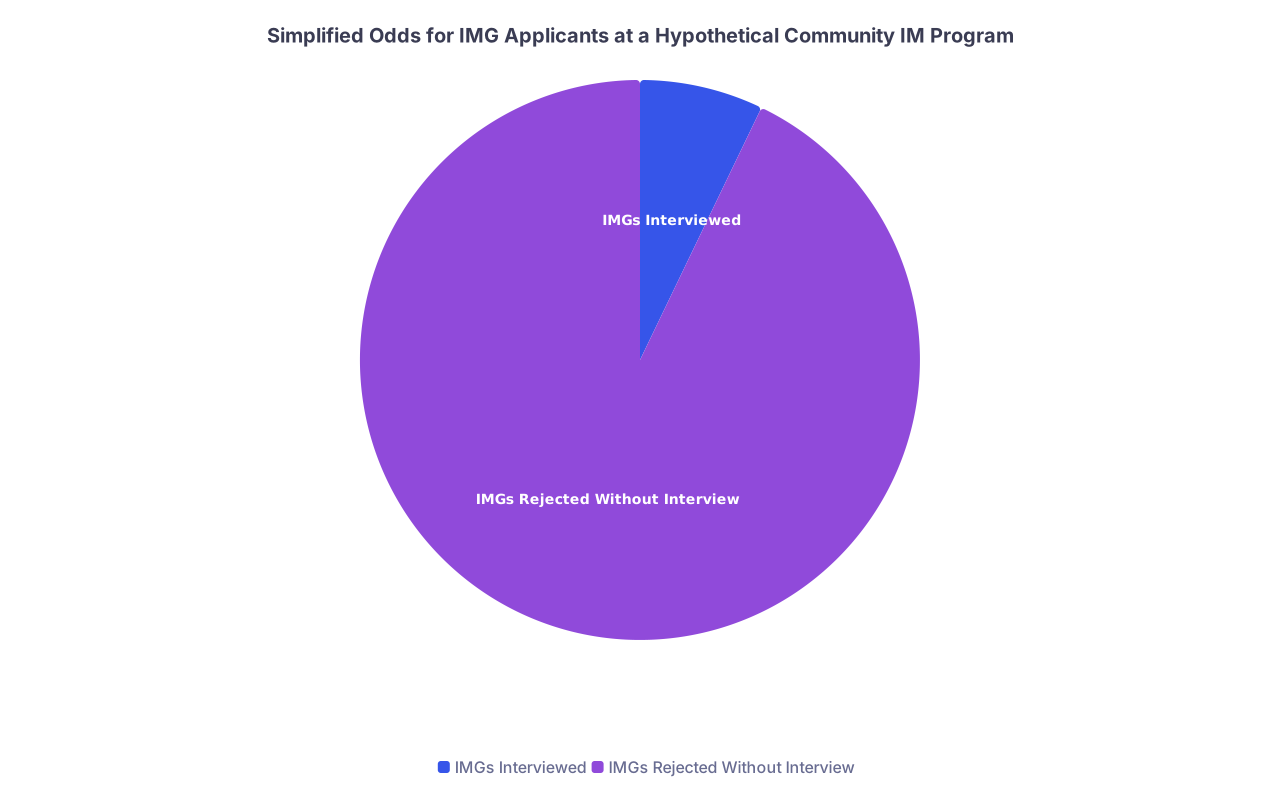
| Category | Value |
|---|---|
| IMGs Interviewed | 200 |
| IMGs Rejected Without Interview | 2600 |
Are IMGs well represented in the final matched class? Yes.
Are they favored over other IMGs? Obviously not. The majority still get silently discarded.
The “community = easy” thinking confuses composition with accessibility.
The Quiet Shift: Not All Community Programs Want You Anymore
Here’s something most IMGs don’t realize because they’re looking at outdated match lists and hearsay: a non-trivial number of community programs have been moving away from IMGs.
I’ve seen this pattern over about the last decade:
– Some community programs that used to be ~80–90% IMGs are now majority US grads.
– Some new community programs launched under big hospital systems and immediately decided: “We’ll take only US MD/DO for the first few years.”
– Some older programs started writing in their ERAS filters: “We do not sponsor visas” or “We prefer US grads” and then quietly enforce it.
Look at the residents’ pages year by year. You’ll notice shifts:
Year 1: almost all IMGs.
Year 3: suddenly more US DOs.
Year 5: 40–50% US grads, fewer visas, fewer offshore schools.
So when someone tells you, “X community program is IMG-friendly, my cousin matched there,” and that cousin started in 2018… check the 2024 class before you believe it. Programs evolve. Fast.
The Real Divide: Visa, Scores, and Recency, Not “Community vs University”
Another lazy simplification: “University programs don’t want IMGs, but community programs do.”
The truth is more surgical. The big divides are:
– Do they sponsor visas (and which ones)?
– What is their score and attempt tolerance?
– How old a graduate will they consider?
– How much US experience do they demand?
Those factors often matter more than the university vs community label.
A strong community program in a nice city with lots of applicants may behave just like a mid-tier academic program: high Step cutoffs, limited or no visa sponsorship, recent YOG preference.
Meanwhile, a smaller university-affiliated community program in a less popular location might quietly take solid IMGs with 225–230 and a 5-year YOG, as long as visa needs are manageable and LORs are strong.
“Community” is not a personality trait. It’s just a funding/ownership structure. Their “friendliness” to you is driven by pipeline, competition, and risk tolerance, not charity.
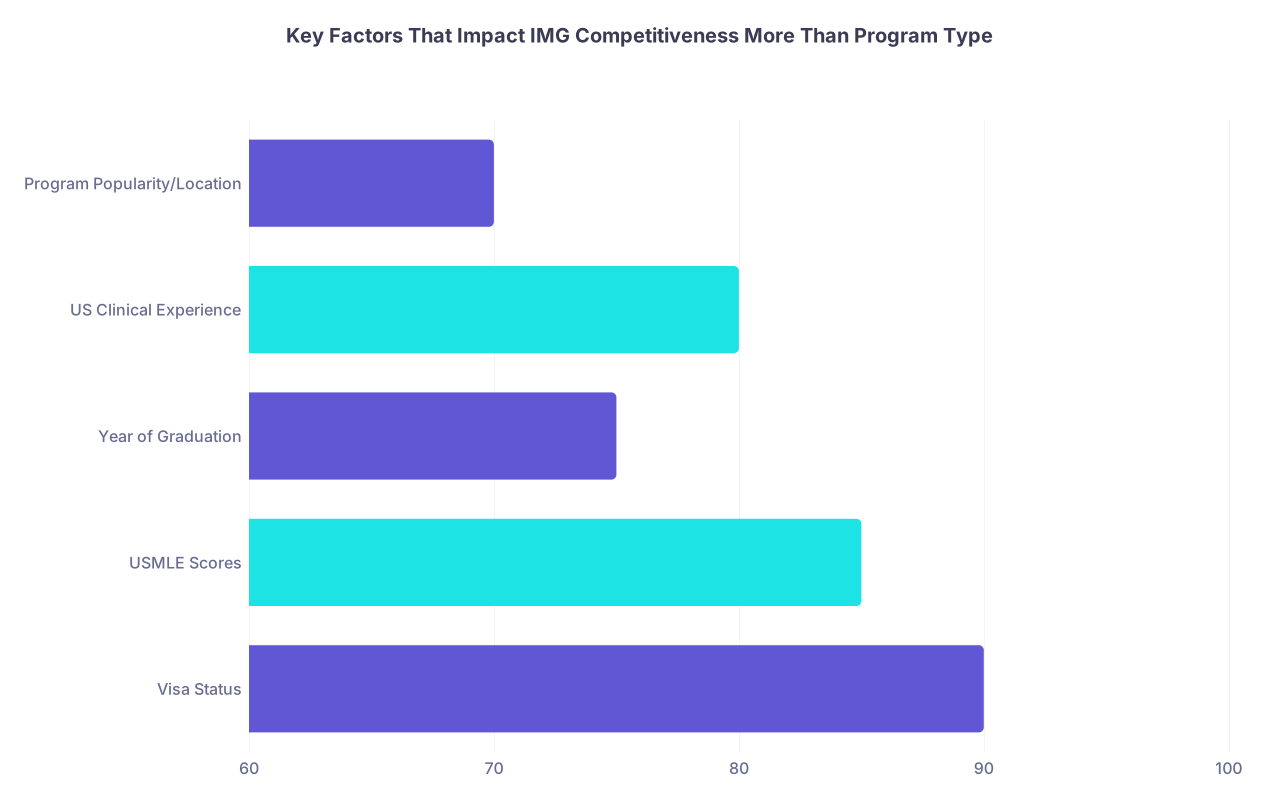
| Category | Value |
|---|---|
| Visa Status | 90 |
| USMLE Scores | 85 |
| Year of Graduation | 75 |
| US Clinical Experience | 80 |
| Program Popularity/Location | 70 |
The Harsh Reality: Many IMGs Are Aiming at the Wrong “Community” Programs
Here’s where people get burned.
They hear “community loves IMGs,” open ERAS, and shotgun-apply to:
– Big-name community affiliates near major cities
– High-volume programs tied to popular hospital systems
– Programs that used to be IMG-heavy 7–10 years ago
– Programs with “friendly” reputations based on anecdote
Then March comes, and they go unmatched.
When I look at their lists, a pattern jumps out: they applied to community programs that are already drowning in applications, located in competitive metro areas, with average USMLE scores of current residents hovering in the 230s–240s. Those are not “safety” places for an IMG with a 218 and one attempt.
This is the part most advisors gloss over because it sounds harsh: a lot of IMGs are not just underqualified for the “top” university programs. They’re underqualified for the better community programs too.
And no, the presence of 2–3 offshore grads in a current class does not mean they’re taking anyone with a Caribbean diploma and a hopeful personal statement.
The Exceptions: When Community Programs Really Do Compete Hard for IMGs
Let’s be fair. There are community hospitals where IMGs are genuinely valued and recruited aggressively.
Common features I’ve seen:
– Geographically less popular areas (smaller towns, rust belt, deep South, rural-ish settings).
– Programs with trouble filling in previous years.
– Heavy service burden where residents are the workforce.
– Limited local pipeline of US MD/DO applicants.
In those places, a strong IMG is not a backup option. They’re the lifeline of the residency.
If you show up with:
– Solid Step 2 CK (230+ or higher, depending on their usual range)
– No attempts
– Recent graduation
– Real US clinical experience with sharp LORs
– Ability to work without visa delay (or at least a clear visa plan they support)
Then yes, those programs can feel very “IMG-friendly.” You will sense it on interview day. Faculty will openly say, “Our program is built by IMGs. We want you here.” That’s real.
But again, they’re not doing this out of abstract love for “IMGs” as a category. They’re solving a staffing and pipeline problem. You happen to be the solution—if you clear their minimum bar.
“IMG-Friendly” Lists Are Overrated, Sometimes Dangerous
I know everyone loves the “Top 100 IMG-Friendly Programs” PDFs. They circulate like contraband. People swear by them.
Most of those lists use one dumb metric: percentage of IMGs in the program.
That’s it. No filter behavior. No visa info. No recent changes. No score expectations. No fill history. Nothing about how many IMGs they ghost every year.
So you get a list that might be:
– Five years outdated
– Centered on older match data
– Full of programs that no longer take visas
– Full of programs that are now trending DO/USMD-heavy
And then hundreds of IMGs all pile onto the same places because they saw those names in some Telegram group.
If you really want to know whether a community program is viable for you, you need to stop chasing “IMG-friendly” as a label and start matching their behavior to your profile:
– Do current residents resemble you in scores, school type, visa needs, and YOG?
– Do you see your kind of applicant in the most recent PGY-1 class, not the 2017 class?
– Can you find any signals from PD videos, website FAQs, or social media about filters and visa policies?
That’s a much better predictor than some generic “IMG percentage” ranking.
So What Should an IMG Actually Do with This?
I’m not going to insult you with clichés like “be strategic.” Let’s be blunt.
If you’re an IMG aiming at internal medicine, family medicine, psych, peds—specialties where community programs are dominant—you need to:
- Accept that “community = friendly” is half-myth. There is no automatic welcome mat.
- Identify which community programs are actually accessible to someone with your numbers and profile, not just “to IMGs in general.”
- Stop assuming that any non-university label means lower standards. Some community sites are cutthroat.
And you should absolutely stop comforting yourself with: “It’s okay, I’ll just go for community.” That’s as vague as saying, “It’s okay, I’ll just go for cardiology.” Details matter.
The Bottom Line: How True Is the “Community Programs Love IMGs” Story?
Short answer: it’s a distorted half-truth.
- Many community programs do have high IMG representation, but they still screen and reject the majority of IMG applicants; “lots of IMGs there” does not mean “easy for you.”
- Program type (community vs university) matters less than visa policy, score/YOG filters, and fill pressure; plenty of community programs are now quietly drifting toward US grads only.
- The smart IMG doesn’t chase the myth; they study recent resident profiles, current policies, and program trends, and then target the subset of community programs where their profile actually fits—not just where “IMGs have matched before.”