The belief that observerships “unlock” residency interviews for IMGs is wildly overstated. They help—sometimes. But they don’t do what people keep promising you they do.
Let me be blunt: a 4‑week observership at a US hospital will not magically compensate for a 214 on Step 2, six-year graduation gap, no research, and generic letters. Yet I routinely see applicants spending thousands of dollars and months of anxiety as if that single line—“Clinical observership, XYZ Hospital”—is the golden ticket.
It is not.
Let’s dismantle this myth and replace it with what actually moves the needle.
The Observership Myth vs. What Programs Actually Screen
The unspoken sales pitch you hear (from consultants, older IMGs, and especially predatory “USCE” brokers) goes like this:
- “Programs just want to see any USCE.”
- “If you get an observership at a big-name place, they’ll definitely interview you.”
- “One or two observerships are enough to prove you can work in the US system.”
This is fantasy-level thinking.
Here’s what most US residency programs actually do first: they screen you on metrics long before anyone looks at your observership section.
| Priority for Programs (Typical) | Priority for IMGs (Typical) |
|---|---|
| Step 2 CK score | Observership brand name |
| Number of attempts / exam failures | Length of observership |
| Year of graduation | Number of LORs from observership |
| Visa status | “Hands-on vs observership” |
| Medical school reputation (rough) | Which city/state it's in |
By the time your application makes it to the “holistic review” stage where USCE might matter, a large chunk of IMG applications have already been filtered out based on scores, attempts, YOG, and sometimes country of graduation.
So no, your 1-month observership does not “guarantee” anything if your core stats are uncompetitive for that program’s baseline screen.
What Observerships Actually Do (When They Work)
Observerships can help. But not in the magical way people describe.
They’re primarily useful in three specific ways:
- They can generate US-style letters of recommendation.
- They can signal familiarity with the US system to some programs.
- They can create human connections—and occasionally, that one champion who pushes for your interview.
That’s it. Everything else people promise is noise.
Let’s break those down.
1. Observerships as a Gateway to LORs
The biggest realistic value: US letters.
Not all observerships give usable letters. I’ve seen enough “To whom it may concern, this candidate observed in my clinic for four weeks” fluff to know many of these are basically decorative.
The letters that help are:
- From US faculty who write comparative letters (“She is in the top X% of students I’ve taught”).
- That mention specific behaviors: your clinical reasoning, reliability, communication, willingness to read and follow up.
- That sound like the author actually knows you, not your name pasted into a template.
If your observership limits you to standing in the corner with no real interaction, the attending doesn’t see your thinking process, your follow-through, or your reliability. You’ll get a polite but useless letter.
So if the observership structure doesn’t let you:
- Present your own assessment and plan informally to the attending (even if you’re not writing notes),
- Follow up on patients across days,
- Ask at least semi-intelligent questions,
then don’t expect a letter that changes anything.
2. “USCE” Signaling Is Overrated—and Programs Know It
Programs like to say, “We prefer US clinical experience.” What many IMGs hear is, “Any USCE will make them love me.”
Reality check: the phrase “USCE” now covers everything from full sub‑internships with note-writing and call to glorified shadowing positions you paid $3,000 for that ban you from even speaking to patients.
Program directors know this.
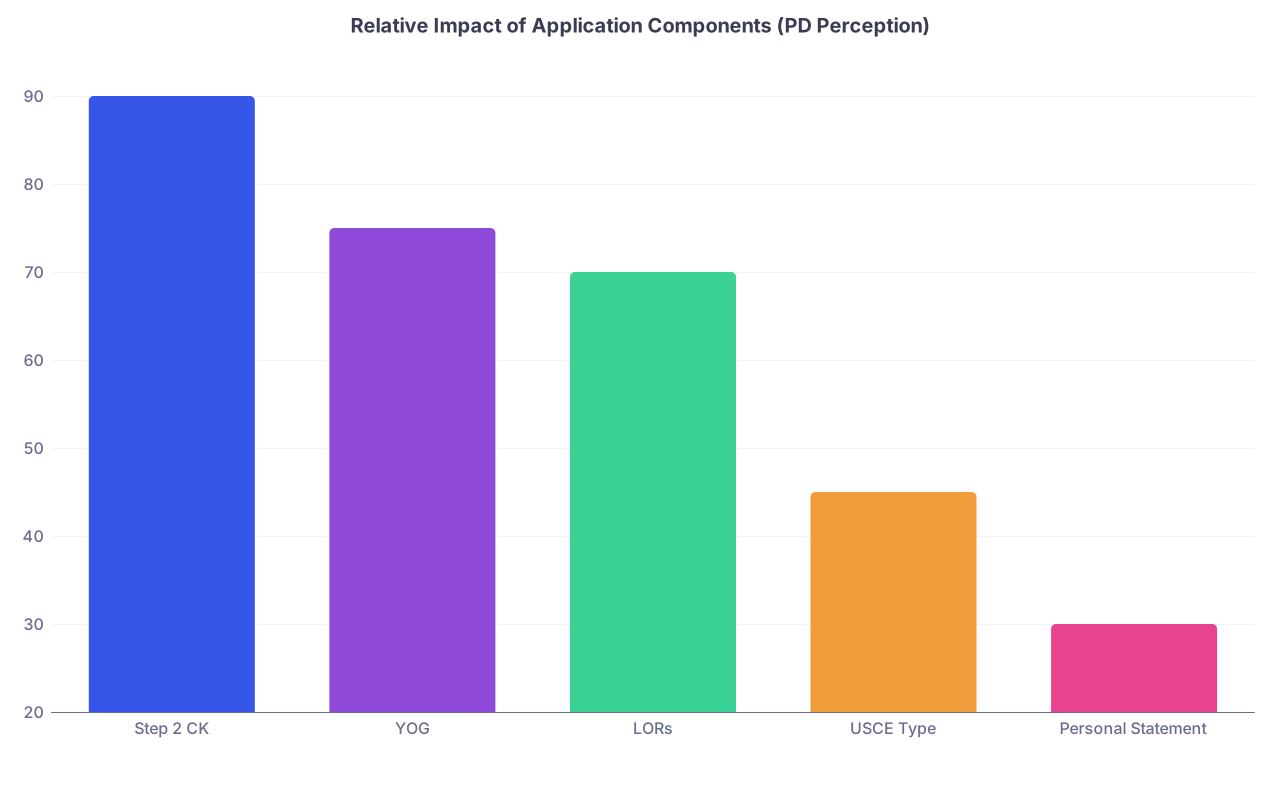
| Category | Value |
|---|---|
| Step 2 CK | 90 |
| YOG | 75 |
| LORs | 70 |
| USCE Type | 45 |
| Personal Statement | 30 |
Numbers are illustrative, but this matches what repetitive NRMP PD Surveys show: exams, graduation year, and letters top the list; generic “USCE” is middle of the pack. And within “USCE,” hands-on electives / sub‑Is matter far more than quiet observerships.
So a non-hands-on, heavily restricted observership? It’s a small plus at best. A checkbox. Not a lever.
If your application is competitive otherwise, that small plus can push you over the edge. If your application is weak, it won’t save you.
3. Connections: Where Observerships Sometimes Punch Above Their Weight
The high-yield outcome of an observership is not the bullet point. It’s the human who’s willing to put their reputation on the line for you.
I’ve seen cases like this:
- IMG with decent Step 2 (240s), 5 years out of graduation, internal medicine observership at a mid-tier community program. Worked their tail off: read on patients, showed up early, stayed late, asked for feedback. The attending personally emailed the PD: “We should interview this guy; I’d be comfortable having him as an intern.” That email is what got him past the screen.
Notice what mattered:
- Solid underlying metrics.
- Consistently strong performance.
- A faculty advocate who cared enough to intervene.
That’s rare. Most observerships don’t create that kind of bond because the structure doesn’t really support it, or the observer treats it like a box to tick instead of a four-week audition.
Why Observerships Often Do Nothing For You
Let me walk through the uncomfortable truths.
Problem 1: Oversupply and Commoditization
The IMG world is flooded with observership certificates. Everyone has them.
Programs get CVs with:
- 3–4 observerships,
- 2 US LORs from observers,
- A paragraph in the personal statement about “learning the US healthcare system.”
The marginal value of one more generic observership in this environment is tiny. You stand out less than you think.
Problem 2: Observership ≠ Proof of Clinical Competence
You’re not writing notes. You’re not entering orders. You’re not taking call. You’re not managing pages at 2 a.m.
From a PD’s perspective, your observership doesn’t prove:
- You can handle EMR chaos,
- You can prioritize tasks for multiple sick patients,
- You can staff efficiently with a senior and attending,
- You can respond to a nurse calling about a destabilizing patient.
So it’s inherently weaker than a proper US elective or sub‑internship, where evaluators actually see you function in something closer to an intern role.
Many IMGs know this and try to “talk up” observerships in their PS. PDs have read those lines a thousand times. The inflation is obvious.
Problem 3: Bad Cost–Benefit Ratio
The financial reality is ugly. Travel, housing, maybe program fees:
- $2,000–$6,000 is common for a month if you’re paying a broker or private “observership program.”
Now ask something blunt: if you took that same money and used it for:
- An extra exam attempt to raise your Step 2 from 226 to 245 (if allowed and realistic),
- Or extending research for 6 months at a real academic center to get on a paper or two,
- Or funding away rotations / in-person electives that are actually hands-on,
which would move your application more?
For many, the answer is: not the observership.
Is an observership ever worth it? Yes—if:
- You can get it at a place that realistically interviews IMGs,
- You’re allowed to build real relationships and get deep letters,
- The cost is not destroying your finances,
- And your other metrics aren’t fundamentally disqualifying.
If any of those are missing, you’re paying a premium for a low-yield CV line.
Problem 4: Complete Misalignment With Target Programs
Here’s another pattern I see: someone does an observership at an elite academic center that does not realistically take IMGs in their preferred specialty.
Example:
- Observership: 4 weeks at a prestigious university hospital’s cardiology service.
- Target: internal medicine residency, mostly community programs, many with heavy IMG presence.
- Result: zero interviews from that academic center, generic LOR with no internal pull, community programs barely care.
You’d have been better off doing a smaller community hospital observership where:
- IMGs historically match,
- The PD actually reads LORs from local faculty,
- People are willing to say, “We know this person; let’s interview them.”
Brand chasing is a classic IMG trap. Observerships at big-name places feel high-status. But unless that program (or its affiliates) genuinely interview and rank IMGs, that “prestige” is mainly psychological comfort, not match leverage.
When Observerships Do Help: Very Specific Scenarios
Let me give you situations where an observership might materially increase your interview chances.
Scenario 1: You’re already competitive and need a nudge
You have:
- Step 2 in a respectable range for IM (say 235–250+),
- Recent graduation,
- No exam failures,
- Decent home-clinical evaluations.
For you, an observership can:
- Provide US-specific LORs that round out the file,
- Show you understand US rounding structure and chart etiquette,
- Let a faculty member say, “This person will integrate smoothly into our workflow.”
In this context, an observership can be the last 5–10% that tips you toward interviews at select programs. Not because it’s magical, but because your base is already strong.
Scenario 2: You’re targeting that specific program or network
You do an observership at a community program that:
- Routinely takes 50–80% IMGs,
- Historically matches observers or rotators into their residency.
You work like it’s an audition month. Faculty know the PD personally. They walk into the office and say, “We should seriously look at this applicant.”
Now the observership is functioning as it should: a structured in-person audition for a realistic job.
That’s completely different from a “prestige” shadowing month at an academic giant that does not take IMGs in your specialty.
Scenario 3: You have a red flag but strong current performance
Maybe:
- You’re 5–7 years out from graduation, but actively practicing abroad,
- You had an old Step failure, but have a strong Step 2 on second attempt.
Here, an observership done well can help a letter writer say:
“Despite being a 2017 graduate, she performed at the level of our current US 4th years, adapted quickly to our system, and demonstrated up-to-date knowledge.”
That doesn’t erase the red flag. But it gives programs updated, credible reassurance that you’re not rusty, and that the “old” exam blot isn’t who you are now.
A Hard Question: Should You Even Do One?
You should not reflexively accept that “every IMG must have observerships.”
Here’s a more rational decision filter:

| Step | Description |
|---|---|
| Step 1 | Consider Observership |
| Step 2 | Fix exams/strategy first |
| Step 3 | Low-yield prestige, reconsider |
| Step 4 | Expect weak LOR, low impact |
| Step 5 | High potential value |
| Step 6 | USMLE Scores Reasonable? |
| Step 7 | Program/Network IMG-Friendly? |
| Step 8 | Hands-on interaction allowed? |
If your scores are weak or you have multiple exam failures, you don’t have an observership problem. You have a data problem. Fixing the numbers (or changing specialty / country strategy) will always matter more.
If the site is not IMG-friendly, stop pretending the brand name will override their actual match patterns.
If the structure is pure shadowing with no feedback, no presentations, no responsibility—you already know what kind of letter you’ll get: generic and ignorable.
What You Should Focus On More Than Observerships
If your goal is interviews, not Instagram-bragging rights, your real levers are:
- Step 2 CK performance. This is still, for IMGs, the primary hard screen in many specialties.
- Strategic program list: lots of true IMG‑friendly community programs, not 80% academic reach.
- Smart use of geography: places with historical IMG presence vs oversaturated hotspots.
- Strong, specific LORs—even if only one or two are US-based.
- Any truly hands-on US electives or sub‑Is you can secure, which beat observerships every time.
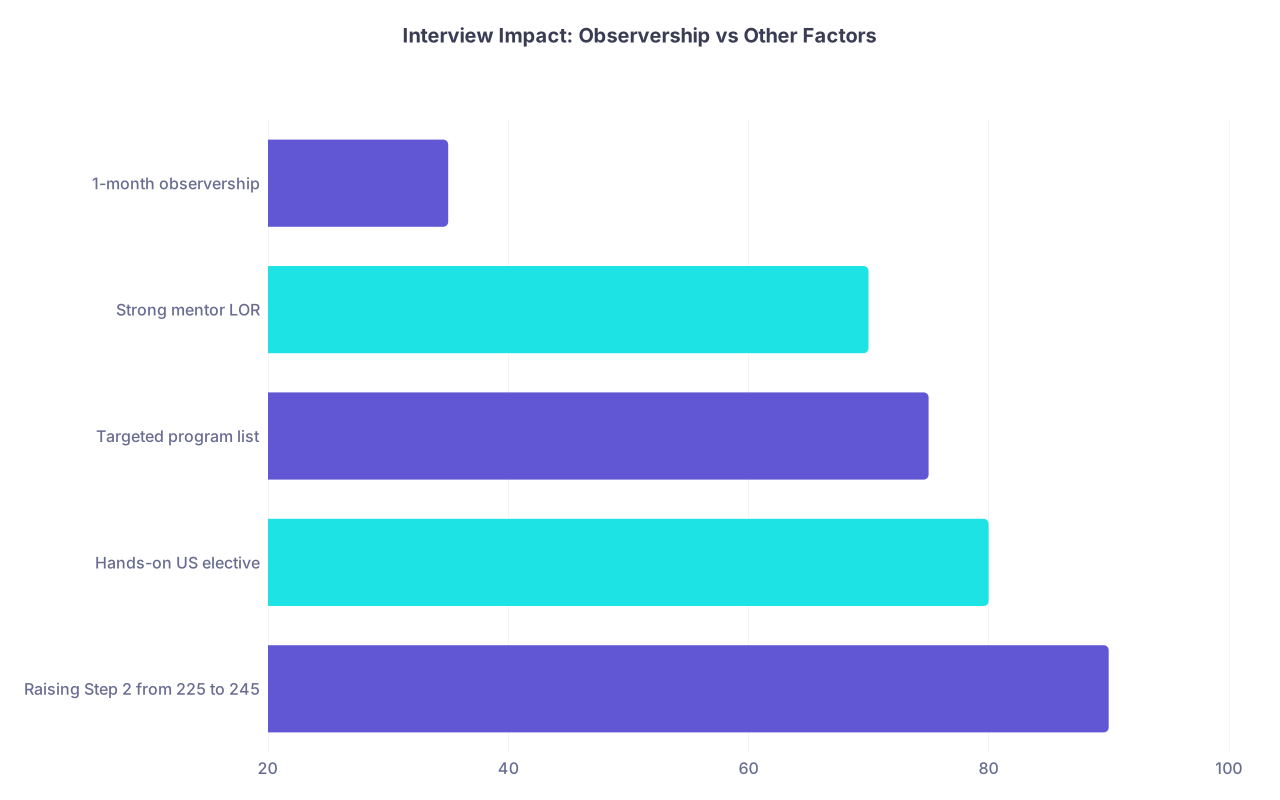
| Category | Value |
|---|---|
| Raising Step 2 from 225 to 245 | 90 |
| Hands-on US elective | 80 |
| Targeted program list | 75 |
| Strong mentor LOR | 70 |
| 1-month observership | 35 |
Again, those numbers aren’t from a single study; they represent realistic relative influence from program director survey data and what actually changes outcomes in practice. The bottom line is the same: observerships are a secondary amplifier, not a primary engine.
How to Extract Maximum Value If You Do One
If you decide an observership still makes sense for you, treat it like an audition, not tourism.
Concrete moves:
- Before you start, email the attending: ask what they value in observers, what’s allowed, how you can be useful without crossing boundaries.
- Day 1–2: learn the workflow, EMR watch patterns, and team expectations. Don’t slow them down with constant basic questions.
- Week 1: identify 1–2 patients to follow more closely. Read around their conditions, come back with concise, targeted questions or suggestions.
- Week 2–3: ask for feedback: “What could I be doing better to function more like a future intern here?” Then actually adjust.
- Final week: if you’ve built a real rapport and see them noticing your work, directly but respectfully ask if they’re comfortable writing you a strong letter and if they see you as a good fit for their program.
If the observership doesn’t let you do any of that? Temper your expectations. You’re probably doing it for a small checkbox, not a game-changer.
The Bottom Line: Observerships Are Tools, Not Guarantees
Strip away the marketing and survivor-bias success stories, and you’re left with three blunt truths:
Observerships don’t guarantee interviews. They’re a modest plus that only matters if your underlying application is already within a competitive range for that program.
The type and context of the observership matter more than the name. IMG-friendly, networked, relationship-building environments beat “famous hospital” pure shadowing almost every time.
They’re often overbought and underleveraged. Many IMGs would be better served by improving scores, securing true hands-on experience, doing serious research, or choosing smarter program lists rather than chasing expensive, low-yield observership lines.
Use observerships for what they actually are: a possible bridge to US letters and relationships. Not a miracle cure for a weak application.