
You are 38 years old, board‑certified in internal medicine and cardiology in your home country. You are doing night calls in a community hospital somewhere far from the US, and on your phone during a quiet moment you are scrolling through NRMP match data and Reddit threads that make you feel simultaneously hopeful and sick.
You keep seeing the same sentence: “US programs prefer fresh graduates.” You look at your CV with 8–10 years of specialist practice and think, “So this is… a liability now?”
Let me be blunt: most programs will initially see your prior specialist training as noise. At best, irrelevant. At worst, “too senior,” “too set in their ways,” or “will not adapt to US training structure.” If you do nothing intentional, your prior training will hurt you more than it helps.
The goal is to flip that. To turn all those years into a US‑focused asset that programs can understand, value, and sell to their committees without having to work hard.
I will walk you through exactly how.
1. How Program Directors Actually View Prior Specialist Training
Forget what forums say. Focus on what PDs worry about when they see an established foreign specialist applying for residency.
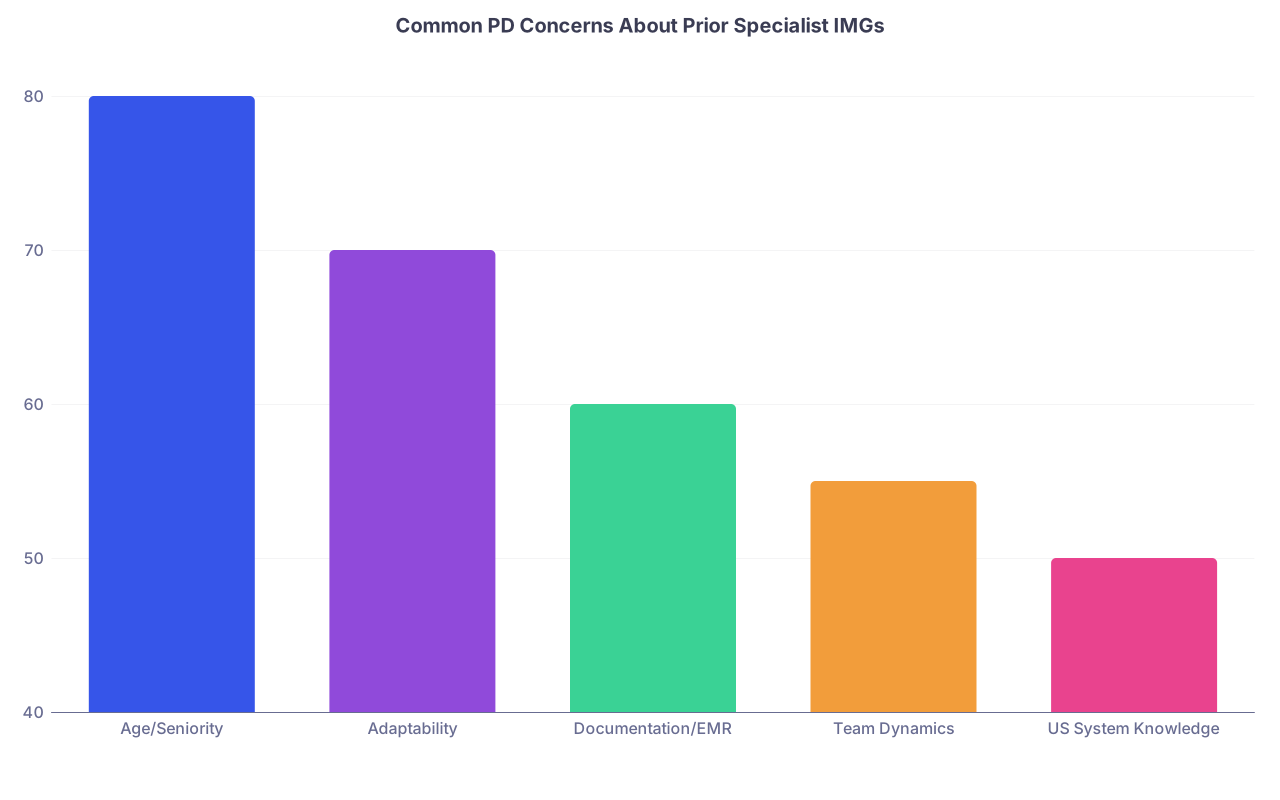
| Category | Value |
|---|---|
| Age/Seniority | 80 |
| Adaptability | 70 |
| Documentation/EMR | 60 |
| Team Dynamics | 55 |
| US System Knowledge | 50 |
These numbers are not from a published study; they reflect what I have seen again and again in PD discussions and selection committee meetings.
The implicit concerns:
“Will they tolerate being an intern again?”
A cardiologist taking orders from a PGY‑3 in their late 20s. Huge red flag if the PD senses ego, resentment, or “I am here to get the credential only.”“Will they adapt to US medicine, or keep saying ‘back home we do X’?”
No PD wants daily arguments about antibiotic choices based on local resistance patterns from somewhere 8,000 miles away.“Will they struggle with documentation, EMR, and compliance?”
Advanced clinical judgment is useless if your notes are bad, your coding is sloppy, and your orders do not meet US standards.“Will nursing staff, juniors, and consultants find them difficult?”
Older, more experienced foreign physicians can act paternalistic without noticing. Nurses will complain. PDs know this.“Are they a retention risk?”
“Will this person leave after PGY‑1 if they get a job or fellowship? Are they really committed to 3+ years?”
Your task is not to shout “But I have so much experience!” Your task is to pre‑empt these fears in a structured, explicit way across every part of your application.
2. Pick a US Storyline and Stick to It
You cannot be “open to anything.” That is death for a mid‑career IMG.
You need a tight, believable narrative that answers:
“Why is this person — with this much prior training — applying now, to this specialty, in this system, and for this duration?”
The right storyline will vary, but notice the pattern: past ➝ pivot point ➝ US‑specific future.

Example narratives that actually work
From foreign cardiologist to US internist
“I trained and practiced as a cardiologist in India for 7 years. Over time my work shifted toward chronic disease management, heart failure clinics, and multidisciplinary care, which made me realize that my long‑term interests align more with comprehensive internal medicine and outpatient continuity care. To practice internal medicine safely and effectively in the US system, I need full residency training, not a shortcut observership.”From foreign general surgeon to US hospitalist
“After 10 years in general surgery, I became increasingly focused on peri‑operative medicine, ICU co‑management, and complex internal medicine. I recognize that continuing as a surgeon in the US would require repeating an extensive training path. Instead, I am intentionally transitioning to a hospitalist‑focused internal medicine career and am committed to completing a full IM residency.”From foreign OB‑GYN to US family medicine
“I loved obstetrics and women’s health, but in my community I increasingly became the default primary care physician for women and their families. Over time I realized that the full‑spectrum, continuity‑of‑care model of US family medicine fits my strengths and interests better than a pure surgical specialty. I am not trying to replicate my prior OB surgical practice; I am aiming for outpatient, continuity‑focused family medicine.”
The wrong narrative sounds like this:
- “I am open to IM, FM, neurology, psychiatry, and maybe radiology.”
- “I will see what I match into and then decide.”
- “I just want to work in the US; any specialty is fine.”
That tells the PD: “No plan. No insight. High risk.”
Choose one primary specialty and, at most, one very closely aligned backup (for example, IM + prelim medicine, or FM + IM, not IM + pathology + psych).
3. Translating Foreign Specialist Work into US‑Readable Value
Your CV is full of titles, procedures, and roles that mean everything in your country and almost nothing on ERAS.
You need to translate. Ruthlessly.
Step 1: Strip prestige, keep functions
Do not write:
“Senior Consultant Cardiologist, Tertiary Care Center, X City”
Instead, break it into recognizable functions:
- “Equivalent to attending physician / consultant in cardiology, supervising 2–3 junior doctors”
- “Responsible for independent management of inpatient and ICU cardiology patients”
- “Primary operator for diagnostic coronary angiograms and TOE”
Then, reframe with US language and outcomes:
- “Independently managed 15–20 inpatients daily as primary cardiologist in a 300‑bed tertiary hospital”
- “Supervised and taught junior doctors (equivalent to residents) on cardiology wards and CCU”
- “Led multidisciplinary rounds with nursing, pharmacy, and physiotherapy teams”
Step 2: Decide what not to emphasize
If you are applying to internal medicine, going hard on procedural volume for PCI, complex surgeries, or advanced OB procedures is often counterproductive. It screams “I really want to be the thing I used to be.”
Use procedures to establish clinical depth, not nostalgia.
Better emphasis for IM / FM / psych applications:
- Longitudinal patient care
- Multidisciplinary coordination
- Complexity, not just technical skill
- Teaching and leadership that did not rely on hierarchy alone
Step 3: Rework your ERAS experience entries
Do not copy‑paste your foreign CV. Build each role like a US resident job:
- Scope of responsibility
- Number and type of patients
- Team structure
- Systems and processes (rounds, handoffs, quality initiatives)
- Outcomes or improvements (audit, protocol changes)
4. Letters of Recommendation: Turning “Big Titles” into Credible US Support
Your letter from “Professor X, Chief of Cardiology, National Institute of…” will not help if it sounds like:
“He is very hardworking, honest, and sincere. He did many angioplasties. I recommend him for any suitable post.”
US PDs want:
- Specific behaviors observed
- Clear comparison group (“among the best 5% of fellows I have supervised”)
- Evidence of adaptability, humility, and team function
- Direct comment on your transition potential to US training
| Aspect | Strong US-usable letter | Weak / Harmful letter |
|---|---|---|
| Tone | Specific, behavior-based | Generic praise, clichés |
| Comparison | Ranks you vs peers clearly | No comparison, just “excellent” |
| US relevance | Mentions EMR, guideline use, team work | Only discusses prestige and title |
| Transition potential | Explicitly states you can adapt to US training level | Suggests you are “too senior for training” |
If your referees do not understand US expectations, you must coach them. Write them a one‑page brief with:
- What specialty you are applying to
- What PDs worry about (adaptability, team dynamics)
- 3–4 concrete episodes they saw that show those traits
- A request to comment explicitly on your ability to work at the level of a US resident, not as an attending
And at least 2 letters should be from US physicians who have seen you recently in a clinical setting (observership, research, hybrid roles). This is non‑negotiable for most programs once you are >5 years from graduation.
5. Pre‑empting the “Overqualified / Will You Tolerate Intern Year?” Problem
This is the number one quiet objection.
You must answer it head‑on in your:
- Personal statement
- Interviews
- Conversations with faculty during observerships
How to frame it convincingly
Bad framing:
“I know I am overqualified but I am willing to start again.”
Better framing:
“I see residency not as ‘repeating’ my prior training, but as a complete retraining in a new health system, legal environment, and clinical culture. I expect to have strengths and gaps that are different from a new graduate. I am comfortable being supervised, taking feedback, and aligning with US practice patterns even when they differ from what I did previously.”
Concrete ways to show this is not just talk:
- Describe a time you adopted a new protocol that conflicted with your previous training and why you changed
- Mention specific US guidelines (ACP, ACC/AHA, IDSA, ACOG) you already follow in your home practice
- Give an example where you deferred to a junior in a domain where they had more up‑to‑date knowledge (e.g., EMR workflows, quality initiatives)
PDs are fine with you having more knowledge. They are terrified of you refusing to act like a trainee when needed.
6. Choosing the Right Specialty and Programs for Your Profile
Certain combinations of “prior specialist + US target specialty” are much easier to sell than others.
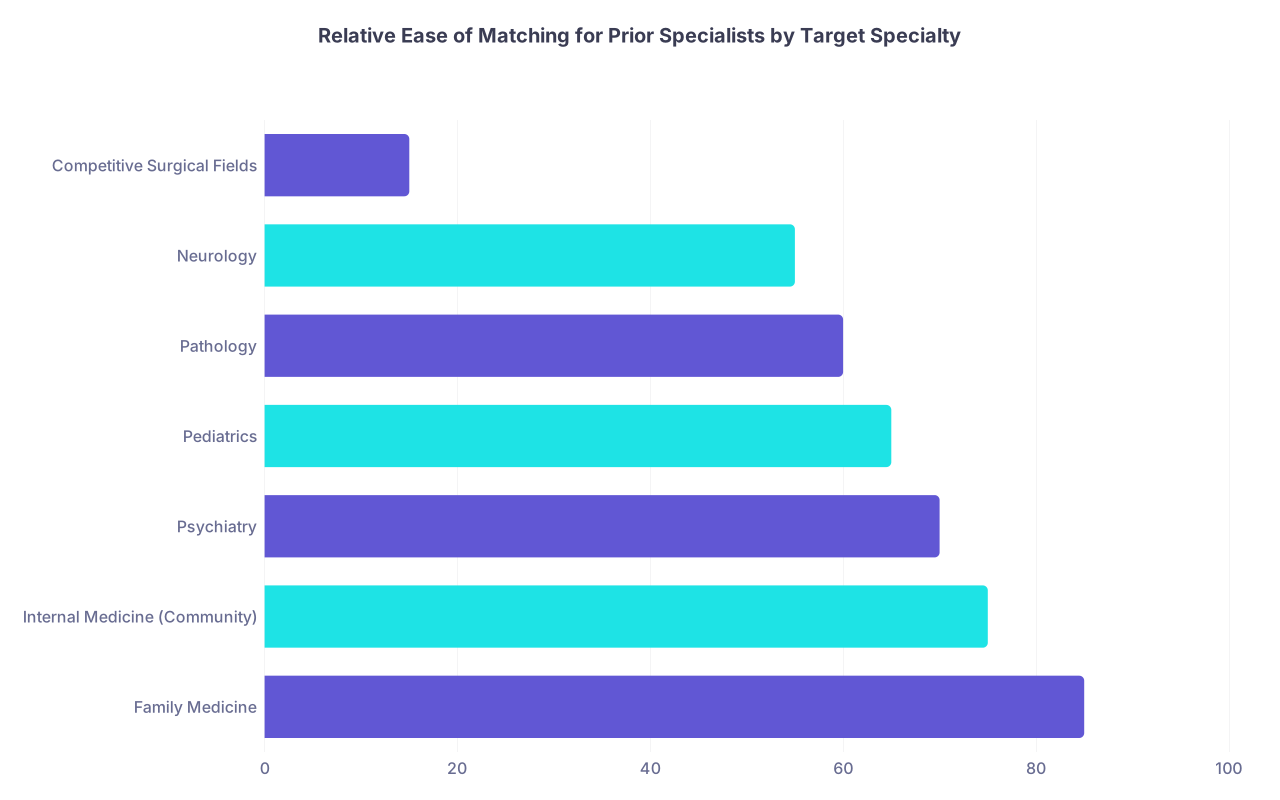
| Category | Value |
|---|---|
| Family Medicine | 85 |
| Internal Medicine (Community) | 75 |
| Psychiatry | 70 |
| Pediatrics | 65 |
| Pathology | 60 |
| Neurology | 55 |
| Competitive Surgical Fields | 15 |
Again, these are conceptual, not NRMP‑published numbers, but they match what I see.
Generally more receptive:
- Family medicine
- Community internal medicine programs
- Psychiatry
- Some pediatrics and neurology programs
- Pathology (if your story lines up)
Generally much harder:
- Competitive surgical subspecialties (ortho, ENT, urology)
- Dermatology, radiology, ophthalmology
- Top‑tier university programs in any field
If you were a foreign neurosurgeon aiming now for US neurology, that is narratively salvageable. If you were an orthopedic surgeon aiming for US orthopedic surgery from scratch — practically non‑starter as a mid‑career IMG.
Program tier targeting
You should be realistic and strategic:
- Focus on community programs, university‑affiliated community programs, and “middle tier” university programs with a track record of taking IMGs, especially older ones
- Look for programs where faculty themselves have IMG or foreign specialist backgrounds
- Check resident lists: do they already have people with non‑traditional paths?
If a competitive program has never taken an IMG in the last 5 years, and you are 12 years out of graduation with prior specialist training, that application is almost certainly a donation.
7. Using US Clinical Experience to Reframe Your Identity
Your prior training abroad is your background. Your current narrative must be anchored in recent US‑aligned practice.
That means:
- At least 2–3 strong US clinical experiences (observerships, hands‑on where legal, hybrid research‑clinical roles)
- Supervisors in the US who can say: “This person works well in US wards, uses EMR, takes feedback, collaborates with nurses, and behaves like a resident.”

| Step | Description |
|---|---|
| Step 1 | Foreign Specialist Identity |
| Step 2 | US Clinical Exposure |
| Step 3 | Reframed Narrative |
| Step 4 | Targeted Applications |
| Step 5 | Interviews |
| Step 6 | Matched US Resident Identity |
Concrete tips:
During observerships, do not act like a visiting professor. Act like a junior fellow. Ask for feedback. Offer help with low‑ego tasks (note review, literature searches, QI projects).
Ask your US mentors explicitly:
“Do you think I can function effectively as an intern here, taking orders, doing cross‑cover, and starting from the basics?”
The way they answer tells you how your behavior is coming across.Use these US experiences to update your language:
- “Participated in multidisciplinary rounds with case management and social work.”
- “Practiced using Epic EMR for note review and order entry under supervision.”
- “Observed ACGME‑structured morning report and M&M conferences.”
You want PDs to see you as someone already partly socialized into US training culture, not a total transplant.
8. Shaping Your Personal Statement Around Transition, Not Status
Your personal statement is not your autobiography. It is a surgical tool to:
- Normalize your long path
- Show insight about what you are giving up
- Anchor your future in something US‑specific
Structure that works well for prior specialists:
Brief snapshot of your earlier career (1–2 paragraphs)
Enough context to show you were competent and established. Not a brag section.The pivot: why that was not the end of your story
A few cases, system frustrations, or evolving interests that credibly led you toward your US target specialty and setting.The US‑focused present
How your recent US experiences confirmed this direction. Mention concrete interactions, not vague “I learned a lot.”The future that clearly fits residency
Very specific goals that match what the program actually trains you for. For IM: hospitalist vs academic generalist vs fellowship track, etc.
Things that kill credibility:
- “My dream was always to work in the US since childhood.” (After 12 years of practice abroad? No.)
- “I just want to be the best doctor I can be.” (Empty.)
- “I hope to become a cardiologist in the US” when you are applying to internal medicine at small community programs with no cards fellowship. The PD will assume you will leave if you do not get fellowship.
9. Interview Strategy: Handling the Tough Questions
If you get interviews, the questions will be predictable. Prepare exact, concise answers. Do not improvise philosophy at the table.
“You were already a specialist. Why start over?”
Bad:
“I love learning and I do not mind. I will work hard.”
Better:
“In my previous role I was clinically comfortable, but I became increasingly aware that the way we practiced was embedded in a very different system — limited EMR, different medico‑legal framework, and local guidelines. To practice safely and independently in the US, I do not want shortcuts. I want a full residency where I can rebuild my practice patterns from the ground up in this environment.”
“Will you be comfortable taking orders from younger residents or attendings?”
Bad:
“Yes, of course, age is just a number.” (They have heard that lie.)
Better:
“In my previous hospital I supervised residents, but I also routinely deferred to younger colleagues in areas where they were more up‑to‑date — especially around quality metrics and EMR workflows. I see hierarchy as role‑based, not age‑based. In your program I expect to take on the intern role fully: taking primary call, writing notes, discussing plans with seniors, and accepting feedback. I have already experienced that dynamic during my recent US observership and found it comfortable.”
“Do you plan to pursue the same subspecialty here?”
This is sensitive.
If you plan to chase the same specialty (e.g., cards again after IM), frame it as intention, not entitlement:
“I remain interested in cardiology. At the same time, I understand that the US training pipeline is highly competitive and that fellowship decisions are based on performance during residency. My first priority is to become an excellent internist in this system. If, during residency, my interests and performance align with a fellowship in cardiology, I would be very happy, but I am prepared for and open to a career as a general internist or hospitalist.”
If you are truly changing course (e.g., surgeon ➝ FM), say that. Clearly. Trust is better than fantasy.
10. Special Situations: What If Your Training Is Very Old or Very Senior?
Some of you are not just prior specialists. You are department heads. Heads of ICU. You write national guidelines.
You have an extra problem: credibility of resetting.
You will need to:
- Over‑index on humility in every interaction
- Accept that some programs simply will not touch your profile
- Use research, MPH, or other US academic positions to re‑enter the system at an angle
For example:
- A former ICU head completing a US‑based clinical research fellowship in sepsis outcomes, working closely with residents, getting letters from US intensivists, and then applying to IM
- A very senior surgeon spending 1–2 years as a full‑time researcher or hospitalist scholar to show they can embed in US academic structure
For very senior people, you must show you are already, in practice, functioning at “fellow / senior resident” cultural level in the US. Not just clinically impressive overseas.
11. Putting It Together: A Coherent, US‑Focused Package
If you do this right, your application stops looking like:
“Random foreign cardiologist trying to escape their country for any job.”
and starts looking like:
“A physician with deep cardiology experience who has intentionally decided to build a long‑term career in US internal medicine, has already adapted to US clinical culture, is willing to function as a resident, and will be a low‑maintenance, high‑value member of the team.”
Your checklists, roughly:
- One clear specialty target, with realistic program list
- ERAS experiences rewritten in US‑understandable, function‑based language
- Personal statement focused on transition, not prestige
- US clinical experiences that show cultural adaptation
- Letters that directly tackle the “overqualified? adaptable?” question
- Consistent, concrete interview answers about hierarchy and starting over
Do this, and your prior specialist training becomes an asset: maturity, pattern recognition, complex case comfort, teaching ability. Do not do this, and those same things become liabilities.
FAQ (Exactly 6 Questions)
1. Should I hide my prior specialist status to seem more “trainable”?
No. Dishonesty is a bigger red flag than being senior. PDs talk, your background is easy to discover, and gaps look suspicious. You should reframe, not hide: present specialist work in terms of patient care, collaboration, and learning, rather than titles and authority.
2. Is it realistic to match into the same specialty I trained in abroad (e.g., surgery to surgery)?
For most mid‑career IMGs, no. Surgical and highly competitive specialties rarely take older, foreign‑trained surgeons as categorical residents. There are exceptions, but they are rare enough that you should not plan your life around them. It is usually more realistic to choose a related but different US specialty (e.g., surgeon to IM/FM/hospital medicine) and build a sustainable career there.
3. How many years out from graduation is “too many” for most programs?
Many programs draw soft lines around 5–10 years from graduation, but these are not uniform. Once you are >10 years out, the number of willing programs shrinks significantly. At that point, strong recent US clinical experience and US‑based letters become absolutely critical, and you should target programs with a history of taking older IMGs.
4. Will my years of specialist training shorten my US residency duration?
Almost never. US GME is structured and accreditation‑driven. Prior foreign specialist training does not routinely reduce residency length. You may occasionally get some credit for prior training when applying for fellowship after residency, but you should plan for the full 3 years (IM/FM) or longer, depending on specialty.
5. Do I need USMLE scores that are higher than average to offset my age and seniority?
You do not need stratospheric scores, but you cannot have weak ones. For older, prior‑specialist IMGs, competitive Step 2 CK performance (e.g., well above the program’s IMG average) helps reassure PDs that your knowledge is current. Strong scores do not erase concerns about adaptability, but weak scores almost guarantee a rejection pile.
6. Should I do an MPH or research degree in the US before applying?
It depends. An MPH or research degree can help if it leads to: strong US letters, meaningful clinical exposure, and proof you can function in US academic environments. A degree that is purely classroom‑based, with no clinical or research integration, usually does not move the needle much for residency. If you pursue a degree, do it at an institution where you can attach yourself to clinical departments, research groups, and mentors who actually work with residents and PDs.
Key points to carry with you:
- Your foreign specialist status is not automatically an asset; it becomes one only when you translate it into US‑relevant behaviors and narratives.
- You must explicitly address PD concerns about hierarchy, adaptability, and commitment to full US training. Do not assume they will “understand.”
- Anchor everything — CV, letters, personal statement, interviews — around a clear, realistic, US‑focused career plan, not around the prestige of what you used to be.