
You close the SOAP portal for the last time this year. No offers. Your phone is silent, your email is stale, and the group chat that exploded with “I matched in SOAP!” messages now feels like a different planet.
If you’re an IMG reapplicant after SOAP only, you’re in a specific, brutal spot. Not fully unmatched in March… but also not matched in April. You tried to rescue the cycle in SOAP and came up empty. Let’s talk about how you rebuild—tactically—without torching relationships or looking desperate next cycle.
1. Get Clear On What Just Happened (Without Lying To Yourself)
First thing: you do not “just have bad luck.” Programs didn’t see enough reason to take a risk on you in an insanely competitive, compressed process. That’s fixable—but only if you’re honest about why.
Pull out:
- Your ERAS application from this cycle
- Your SOAP application choices
- Your interview list (if any) and outcomes
Then ask, bluntly:
Did you have interview invites before SOAP?
- If yes: why no match from those? Did you rank too few? Bomb interviews? Overreach?
- If no: your core profile (scores, attempts, recency, experience, visas) is the main issue.
What did you actually apply to in SOAP?
- Were you realistic about specialty? Or still clinging to something like Derm/Rad Onc/Neurosurgery with an IMG profile that screams “Family Med or IM only”?
- Were your SOAP letters and PS tailored or recycled?
What are your “red flags” from a program’s point of view? I’m talking:
- Step failures or low scores
- Old grad year
- Weak or non-clinical letters
- No US clinical experience (USCE)
- Big unexplained gaps
- Perception that you’re just “collecting” programs (250+ scattershot applications with zero alignment)
Write your findings out. Not in your head. On paper or a document. You’re going to build next year’s plan off this autopsy.
2. Decide: Reapply As-Is, Rebuild, Or Pivot
Harsh truth: not everyone should reapply. Some should, some need to delay, some need to pivot specialties, and a few need to pivot careers.
Here’s how I’d frame it.
| Path | When It Makes Sense | Main Focus Next 6–12 Months |
|---|---|---|
| Reapply This Year | Profile close to competitive | Polish + targeted improvements |
| Delay, Then Reapply | Major deficits (scores/USCE) | Heavy rebuild (USCE, research) |
| Pivot Specialty | Aiming too high for stats | Switch to less competitive field |
| Pivot Career | Multiple cycles, no traction | Non-residency clinical/adjacent work |
Quick litmus tests
You can reasonably reapply this year if most of these are true:
- You graduated within the last 5 years
- No Step failures (or just one, with strong recovery)
- Step 2 above ~235 (for IM/FM/Peds as IMG; a bit lower possible for FM)
- At least 2–3 solid US letters from hands-on USCE
- You had some interviews this year but didn’t match/SOAP
You should seriously consider delaying or pivoting if:
- Multiple failed attempts on Steps and no standout strength elsewhere
- Graduated 7+ years ago with minimal recent clinical work
- No USCE and no realistic chance of getting it before next cycle
- This is your second or third unmatched year (including SOAP attempts) with very few interviews
If you’re not sure where you fall, assume this: you cannot repeat what you just did. Doing 95% of the same thing and hoping SOAP works next time is fantasy.
3. Rebuilding Without Burning Bridges: People First, Then Paper
You lost this cycle. Your instinct will be to disappear out of shame or spam more people out of panic. Both are wrong.
You need to rebuild relationships and reputation strategically.
A. Follow up with programs from this cycle (carefully)
If you interviewed anywhere or had meaningful contact with a PD, APD, or core faculty, you can—and should—do a brief follow-up 2–3 weeks after the SOAP dust settles.
Email script (edit to sound like you):
Subject: Thank you & plans for the upcoming year
Dear Dr. [Last Name],
I hope you are doing well. I wanted to thank you again for the opportunity to interview at [Program Name] this past season. Although I did not match/SOAP this year, speaking with you and the residents confirmed that [internal medicine/family medicine/etc.] in a program like yours is the right path for me.
Over the next year, I plan to [brief plan: complete additional US clinical experience at ___ / continue research in ___ / strengthen my application by ___]. I would be very grateful for any brief feedback you might be able to share regarding how I could be a stronger applicant in the future.
Thank you again for your time and consideration.
Sincerely,
[Name], MD
AAMC ID: [#####]
Do not send this to 70 programs. Pick 5–10 where:
- You interviewed
- You had an actual conversation with someone
- You’d realistically train there
If they respond with feedback, don’t argue. Just say thank you and log it.
B. Do not trash talk SOAP, programs, or the system
Vent to friends, family, therapist. Not to anyone with an @hospital or @university email.
Every year I see applicants blow themselves up in WhatsApp or Telegram groups complaining about “unfair” programs, then somehow those screenshots float back to residents or faculty. Medicine is small. IMGs talk. Residents talk. It gets around.
Keep your bitterness private. Your professionalism is being graded long before residency.
4. Fix the Big Three: Scores, USCE, and Story
Every IMG reapplicant who actually improves their outcome works on some version of the same three pillars:
- Objective metrics (Step/CK, OET, sometimes Step 3)
- US clinical experience and letters
- Coherent narrative and specialty fit
Let’s go one by one.
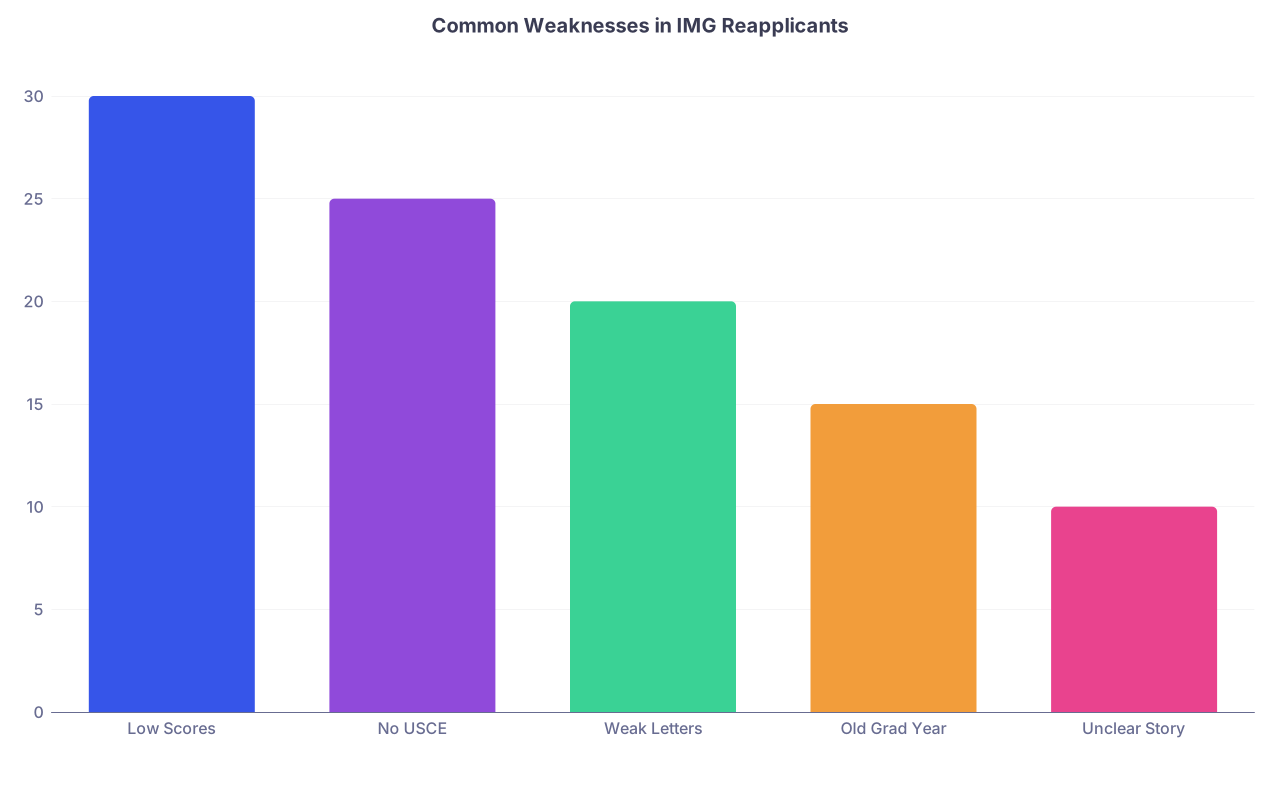
| Category | Value |
|---|---|
| Low Scores | 30 |
| No USCE | 25 |
| Weak Letters | 20 |
| Old Grad Year | 15 |
| Unclear Story | 10 |
A. Scores: what’s still fixable?
If you already passed Step 2 CK:
- Consider Step 3 if:
- You’re an older grad
- You need a visa (especially H1B)
- You had a Step failure and want to show “I can pass big exams”
But only if you are a good test taker and can score decently. A barely-passed Step 3 doesn’t fix a 199 Step 1 and 215 CK. It just adds another mediocre data point.
If you have not taken Step 2 yet (or did poorly and can retake under new rules/contexts), Step 2 CK is your single highest-yield fix. Many IM and FM programs weigh CK more heavily now that Step 1 is pass/fail for newer grads.
Do not casually sign up and “see how it goes.” If you’re reapplying, every exam attempt is part of your permanent record.
B. USCE: you can’t fake this
If you matched nowhere and had zero or minimal USCE, that’s priority #1.
Real USCE = hands-on inpatient/outpatient work where you:
- Present patients
- Write notes (even if they’re “for learning”)
- Work in EMR
- Are supervised by attendings who understand residency letters
Observerships are better than nothing, but externships/sub-i’s are stronger. For many IMGs, structured programs are expensive and feel like a scam. Some are. Some are not.
Accept the reality: without meaningful USCE, most community IM/FM/psych programs won’t risk you, especially as a reapplicant. Your year should be structured around locking in:
- 2–3 months of solid USCE
- 2–4 letters from US faculty who can say more than “pleasant and hardworking”
How do you get it without burning bridges?
- Use any prior contact: If you rotated at Hospital X before, email that attending, ask if they know anyone taking observers or externs. This is where not ghosting people pays off.
- Be honest, not dramatic: “I did not match or SOAP this cycle. I’m planning to reapply and would be very grateful for any opportunities for US clinical experience or observerships you might know of.”
- Don’t hound one person with five follow-ups. If someone doesn’t respond after 2 polite attempts spaced weeks apart, move on.
C. Your story: stop sounding like a robot
Programs hate incoherent applicants. You did internal med rotations, wrote a psych personal statement, and SOAPed into surgery and peds? That screams: will do anything, stands for nothing.
You can change that this year.
Pick a primary specialty that actually fits your profile. If you’re an IMG with okay but not stellar scores, older grad year, no big home institution name—competitive roadmaps like Dermatology, Ortho, Neurosurgery, Rad Onc should be off the table. Not because you’re not smart enough. Because the odds are mathematically terrible.
More realistic for many IMGs:
- Internal Medicine
- Family Medicine
- Pediatrics
- Psychiatry
- Neurology (with decent scores)
- Pathology (for those genuinely interested and with some lab/research background)
Whatever you choose, your actions this year must line up:
- Clinical work in that field
- Research or QI in that field (if possible)
- A personal statement that shows continuity, not last-minute scrambling
5. The “Bridge Year” Blueprint: What To Actually Do Month by Month
You’ve got about 4–14 months, depending on when you’re reading this, before the next ERAS opens and interviews roll in.
No, you don’t need a perfect Gantt chart. But a rough plan saves you from a wasted year.
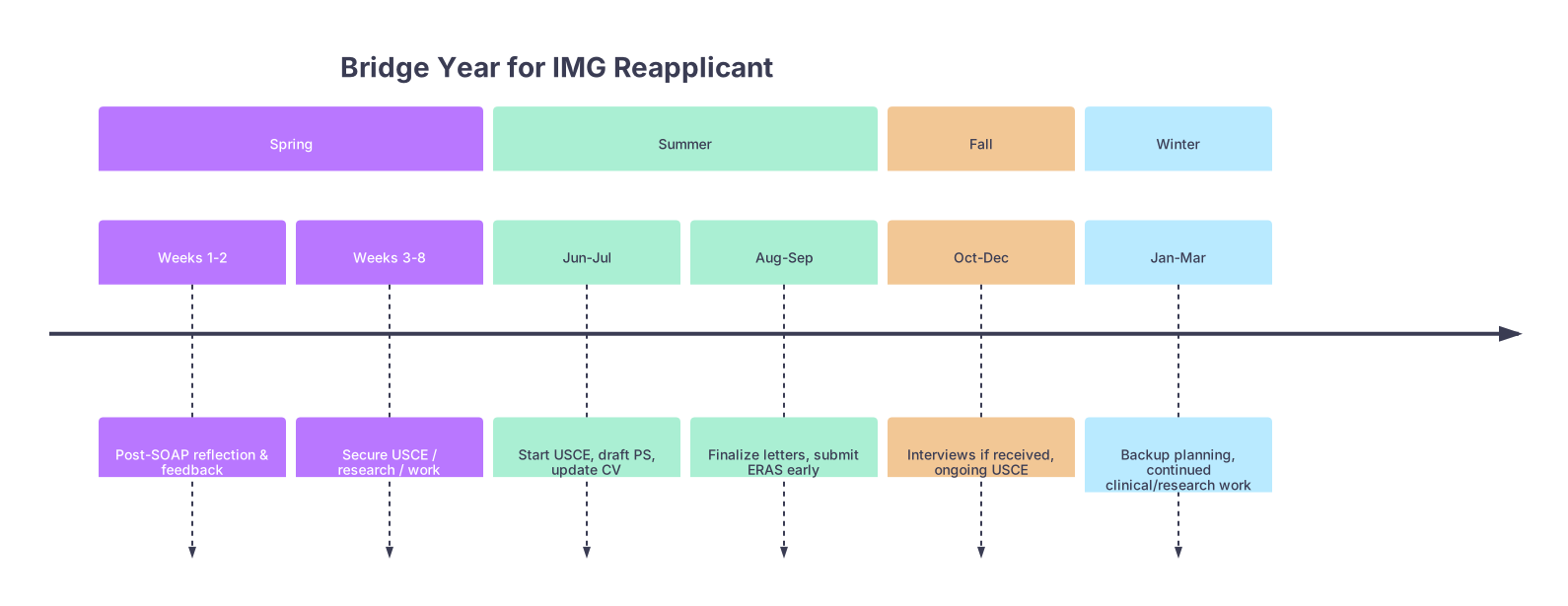
| Period | Event |
|---|---|
| Spring - Weeks 1-2 | Post-SOAP reflection & feedback |
| Spring - Weeks 3-8 | Secure USCE / research / work |
| Summer - Jun-Jul | Start USCE, draft PS, update CV |
| Summer - Aug-Sep | Finalize letters, submit ERAS early |
| Fall - Oct-Dec | Interviews if received, ongoing USCE |
| Winter - Jan-Mar | Backup planning, continued clinical/research work |
Here’s a tighter breakdown.
Months 1–2: Clean up and reconnaissance
- Request feedback from a small number of prior interview programs.
- Update your CV with everything you actually did this year (do not inflate).
- Identify your realistic primary specialty and maybe a backup field.
- Start emailing/contacting about USCE positions for the coming months.
If you need Step 2 or Step 3, schedule it 3–6 months out, then back-plan a study schedule around it.
Months 3–6: Build real currency
Ideally you’re now:
- Doing USCE
- Or working in a clinical-adjacent job (scribe, MA, research coordinator)
- Or actively preparing for and taking Step 2/3
Your primary tasks here:
- Impress people enough in USCE that they offer to write letters or say yes when you ask.
- Gather content for a stronger personal statement: specific cases, stories, what you learned.
- Keep one foot somewhat financially stable—don’t quietly go broke chasing 4 unpaid observerships.
This is also when you quietly strengthen your digital footprint. Clean up social media. Fix LinkedIn. If a PD googles you, it shouldn’t look like you vanished in 2022.
Months 7–9: Application season, round two
When ERAS opens:
- Submit early. No dragging your feet until October.
- Target realistically. You’re a reapplicant now; some programs auto-screen reapplicants or only consider them with strong improvements. That’s life.
- Customize your personal statement and program signals, if your specialty uses them, instead of spraying generic text everywhere.
For your reapplicant personal statement, one paragraph can directly address your prior unmatched year—but keep it short and mature:
“I applied to residency in 2024 but did not match. The experience forced me to reassess my preparation and gaps. Over the past year, I have completed [USCE/research/clinical work] at [institutions], strengthened my clinical reasoning, and confirmed that internal medicine is the right field for me.”
That’s it. No drama monologue.
6. How To Ask For Help Without Burning Bridges Or Sounding Desperate
You will need people this year. Mentors, former attendings, even residents.
Here’s how to do it like a grown professional, not a panicked reapplicant spamming DMs.
A. When asking for letters
Ask early and be direct:
“Dr. X, I truly appreciated the opportunity to work with you at [site] from [dates]. I will be reapplying to [specialty] residency this upcoming cycle and was wondering if you would feel comfortable writing a strong letter of recommendation on my behalf.”
“Strong” is intentional. It gives them an out. If they hesitate, you do not want that letter.
Give them:
- Your current CV
- Draft personal statement
- Bullet list of specific cases or projects you worked on with them
And for the love of your future, don’t badger them every 3 days. A polite follow-up 2 weeks later is fine.
B. When asking programs about observership/externship
Keep it short and clearly tied to their specialty:
“I am an international medical graduate who completed [home institution, year]. I am planning to reapply to [IM/FM/psych] this coming cycle and am very interested in gaining clinical experience in the U.S. in this field. I was wondering if your department offers any observership or externship opportunities for international graduates.”
No 800-word life stories. Not at this stage.
7. Managing The Optics Of Being A Reapplicant
Programs will see you as a reapplicant. There’s no hiding it. Your job is to make them think:
“Last year they weren’t quite ready. This year they are.”
So you make that narrative obvious.
On your application:
- Different, better personal statement
- New US letters from this year
- Updated experiences section with clear duties and outcomes
- If appropriate, mention Step 3 or other improvements
In interviews (if you get them):
When asked about not matching before, do not dodge:
“I applied last year and did not match. My main weaknesses then were [lack of US clinical experience / not enough specialty alignment / weaker interview performance]. Over the past year I’ve… [specific actions]. I now feel much better prepared to contribute from day one.”
Calm. Specific. No bitterness. That’s what they want.
8. When To Stop Reapplying (Yes, There Is A Line)
Someone has to say this bluntly: there is a point where reapplying again is more self-punishment than strategy.
If after two serious, corrected attempts (meaning: you fixed the big issues, not just reapplied identically), you still get almost no interviews, you owe yourself a hard conversation about pivoting.
Pivot options that still use your medical background:
- Clinical research coordinator roles
- Industry (pharma, CRO, medical affairs)
- Public health, epidemiology, global health NGOs
- Health tech / informatics positions
- Teaching (USMLE prep, allied health programs)
Is that “fair”? No. But beating your head against the same residency wall year after year, burning money and time, isn’t noble; it’s wasteful.
9. Common Ways IMGs Blow Up Their Second Chance
Learn from other people’s disasters:
- Posting angry rants about programs, PDs, or “the system” on public or semi-public platforms
- Reusing the exact same personal statement and letters as the prior year
- Applying again without any new USCE or meaningful improvement
- Harassing programs with weekly “any update?” emails
- Lying—about dates, duties, scores, positions. This gets caught more often than you’d think.
If you’re tempted to do any of these, remember: residency is four years for IM, three for FM, more for others. They’re hiring future colleagues, not short-term labor. They care how you handle disappointment. This year is basically your audition for that.
10. The Bottom Line: How To Rebuild Smart
You’re an IMG reapplicant after SOAP only. That’s a hard place, but not a dead end if you’re realistic.
Focus on three things:
Honest diagnosis and targeted repair
Figure out why you didn’t match. Then fix what you can: USCE, letters, scores, clear specialty focus.Relationships, not spam
Don’t ghost old contacts or blast cold emails randomly. Maintain and grow a small, real network: prior attendings, residents, mentors who can actually speak for you.Professionalism under pressure
How you act now—emails, follow-ups, interviews, social media—shows programs who you’ll be when a patient crashes at 3 a.m. or when you fail an in‑service exam. Act like the resident you want them to see.
You don’t need perfection next cycle. You need a clear upward trajectory and evidence that you learned from this year instead of just surviving it.