
The way most IMGs think committees read personal statements is fiction. The reality is faster, harsher, and more mechanical than anyone tells you—and the “hook” is the only thing that gives you a fighting chance in those first 20–40 seconds.
Let me walk you through what actually happens in that room when your name, your country, and your personal statement hit the screen.
How Your Personal Statement Really Gets Read
Most IMGs imagine some thoughtful faculty member settling in with coffee, reading every word of their carefully crafted statement. That’s cute. That’s not what happens.
Here’s the general pattern I’ve watched for years in internal medicine, FM, psych, even some prelim surgery:
- The coordinator or faculty opens your ERAS file on a big monitor during a review session.
- They glance at your photo, country of graduation, YOG, exam status/scores.
- They skim your experiences.
- Someone says, “What’s their story?”
- Then—and only then—they click the personal statement.
You do not get a slow read first. You get a quick scan for a story that justifies spending more time on you.
Most PDs and faculty do something like this:
Read the first 3–6 lines.
Jump once or twice down the page to see if there’s any substance (a concrete clinical scene, a clear reason for the specialty, something memorable).
Decide:
- “Okay, solid—keep.”
- “Generic—next.”
- Or, rarely: “This is a red flag—no.”
If your hook is weak, your beautifully crafted second and third paragraphs may never even be seen. That’s the part IMGs underestimate.
The Ugly Truth: What Committees Are Looking For in an IMG PS
They’re not reading your statement the way your English teacher did. They’re scanning for risk and payoff.
Risk = Are you going to be a headache?
Payoff = Are you likely to be safe, reliable, and possibly excellent on their wards?
Here’s how they actually think when reading IMG statements (these are almost word-for-word things I’ve heard in committee rooms):
- “Is this person trainable or a project?”
- “Do they understand medicine in the U.S., or is this still a fantasy?”
- “Is there anything here that explains the red flags? Gaps? Low scores?”
- “Do I believe this specialty choice, or did they just shotgun apply?”
- “Can I see this person presenting at morning report without crashing and burning?”
They’re not looking for poetry. They’re looking for evidence.
Your personal statement is evidence of:
- Judgment
- Insight into your own path
- Clarity of purpose
- Cultural awareness (do you understand U.S. clinical expectations?)
- Communication ability in English
And for IMGs, there’s a subtext: “If I put this person in front of my patients and nurses at 3 a.m., will they embarrass me?”
The Hook: Your First 5–7 Sentences Decide Everything
Most IMGs waste their hook. They open with:
- “My passion for medicine began when…”
- “Since childhood, I have always been fascinated by…”
- “Growing up in [country], I was exposed to the challenges of…”
I’ve seen faculty literally roll their eyes and scroll past entire paragraphs of this. One PD I worked with used to say, “If I can guess the second sentence after reading the first, I’m already bored.”
A strong hook for an IMG does three things quickly:
- Places you in a concrete, specific moment.
- Signals that you understand U.S. medicine or at least modern clinical reality.
- Hints why you belong in this specialty, here, now.
Let me show you the contrast.
Weak IMG hook (I’ve read hundreds like this):
“My journey in medicine began when I was a young child in [country], where I saw many people suffer from lack of healthcare. From an early age, I knew I wanted to become a doctor and help those in need.”
Faculty reaction? Mental auto-delete. They’ve read it 10,000 times.
Now compare:
“On my second week in a busy community hospital in New Jersey, the senior resident handed me the pager and said, ‘You’re covering 12 patients—start with room 408, he’s circling the drain.’ That night, I learned how quickly a stable patient can become a code, and how much it matters to recognize decompensation before everyone is running.”
That’s a hook. It screams: I’ve seen U.S. medicine, I’ve functioned in it, and I can talk like a resident.
Or, if you don’t have U.S. experience yet:
“The first time I presented a patient to a U.S.-trained attending, he stopped me after two sentences and said, ‘You’re giving me a story; I need a problem list.’ That conversation forced me to unlearn how I’d been taught for five years and rebuild my clinical thinking from the ground up.”
Again: concrete. Honest. Shows adaptation. That’s what makes them keep reading.
What Different Readers Actually Do With Your Statement
You are not writing for one person. You’re writing for three unofficial audiences:
- The Program Director
- The associate/program faculty reviewer
- The resident interviewer
Each uses your PS differently.
Program Directors: The Filter and the Risk Radar
PDs are usually not reading every PS in detail at first. When they do look, it’s because:
- They’re deciding on borderline applicants.
- They’re trying to understand red flags or gaps.
- They’re finalizing a small group for interview offers.
Their questions when reading an IMG PS:
- “Is their story coherent with their application?”
- “Does this explain the 5-year gap after graduation?”
- “Does this justify switching from surgery in home country to IM here, or is this just desperation?”
And they will absolutely catch contradictions. I’ve watched a PD say:
“They wrote that internal medicine has always been their passion, but their CV is 5 years of surgical residency and spine research, and they’re also applying to ortho prelim. Hard pass.”
Your hook for the PD has to match your file. If your file screams surgery and your PS screams “lifelong passion for family medicine,” no one believes you.
Faculty Reviewers: The Story and the Fit
Faculty who help screen often do actually read more, but they’re fast.
They skim the opening, then hunt for:
- Specific clinical stories.
- Any research or academic angle.
- Evidence of resilience and work ethic that isn’t just “I work very hard.”
They’ll say things like:
- “This person actually understands chronic disease management.”
- “They’ve clearly worked with underserved populations.”
- Or “Very generic. Nothing stands out. Next.”
They’re looking for something talkable in committee: “The IMG from [school] who retrained his thinking for U.S. practice” is more memorable than “the IMG who wants to help people.”
Residents: The Vibe Check
Residents often get your PS when they’re interviewing you. And I’ll be blunt: some of them skim it 5 minutes before shaking your hand.
They look for:
- Things to ask you about.
- Red flags they should probe.
- Whether you look like someone they can hand the pager to at 2 a.m.
If you write about a dramatic ICU experience, they will ask you to walk them through it. If you mention advanced procedures, they will test if you’re exaggerating.
Residents don’t care about flowery language. They care if your story feels real.
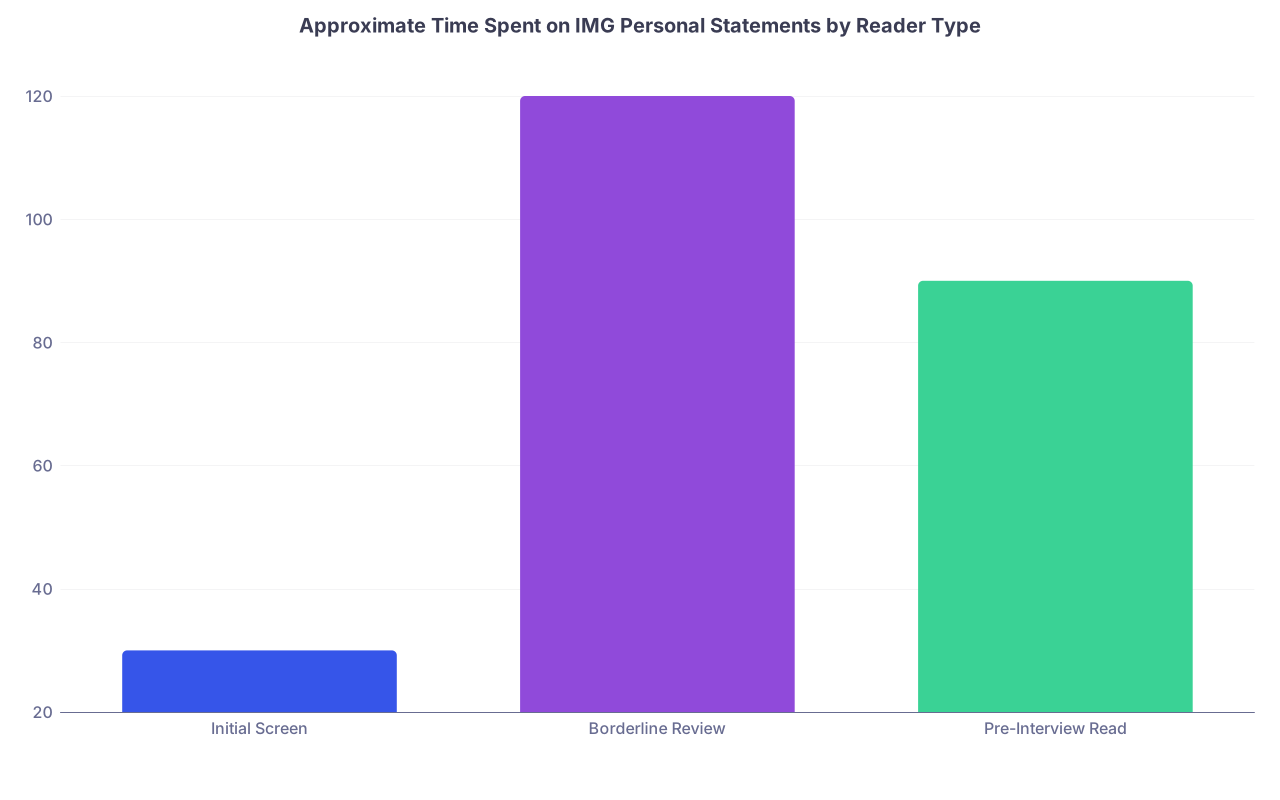
How Long Do They Actually Spend on It?
Let’s quantify this, because IMGs love numbers. You should.
| Category | Value |
|---|---|
| Initial Screen | 30 |
| Borderline Review | 120 |
| Pre-Interview Read | 90 |
- Initial screen: ~20–40 seconds on your PS, if they even click it.
- Borderline review: 1.5–2 minutes, more focused on explanation of gaps/red flags.
- Pre-interview: 1–2 minutes from residents to find talking points.
Write for the 30-second read, not the fantasy 10-minute literary session in your head.
The Common IMG PS Mistakes That Kill You Fast
I’ve seen the same self-inflicted wounds from IMGs across continents.
1. The “Chronological Life Story” Trap
If your first paragraph starts with childhood and then walks decade by decade, you’ve already lost.
Committees don’t care what 8-year-old you felt. They care about the last 5–7 years: medical school, clinical work, research, U.S. exposure, and decision-making.
2. Vague Motivation and Zero Specifics
Phrases that signal “generic, weak, forgettable” to committees:
- “I want to help others.”
- “I enjoy working with people.”
- “Internal medicine offers a wide variety of cases.”
- “I am very hardworking and compassionate.”
They’ve read that from weak candidates, strong candidates, and everyone in between. These phrases carry zero discriminatory value.
What does stand out:
- A specific patient encounter, with details and reflection.
- A clear reason you shifted specialties or countries, owned honestly.
- Concrete skills you’ve built (not buzzwords—real behaviors).
3. Overcompensating with Drama
Some IMGs think they need a tragic story to stand out. So they dramatize:
- Poverty
- War
- Personal illness
- Family tragedy
There’s nothing wrong with including real hardship. But when every sentence is turned into melodrama, PDs smell manipulation.
The line I’ve actually heard: “This reads like a Netflix script, not an application.”
4. Sloppy English and “Textbook” Phrasing
You do not need perfect idiomatic English. But you can’t have:
- Obviously copied phrases
- Mismatched tenses everywhere
- Weirdly formal phrases no native speaker would say, like “I availed the opportunity”
Committees will think: “If this is their best writing after multiple edits, what do their progress notes look like?”
You are an IMG. You’re already fighting assumptions about communication. Don’t hand them proof.
How a Good IMG Hook is Built (Step-by-Step)
Let me break down the actual architecture of a solid IMG opening. Not theory—what I’ve watched repeatedly catch attention.
You need four elements in your first ~5–7 sentences:
- A specific moment, not a life story.
- A hint of your current clinical level.
- A signal of reflection, not just description.
- A clear pivot to why you’re applying to this specialty in the U.S.
Here’s a skeleton you can adapt (don’t copy—adapt):
1–3 sentences: Drop into a scene. Where are you? Who’s there? What’s happening?
“At 2 a.m. in the step-down unit, I stood at the foot of a patient’s bed with a U.S.-trained intensivist asking me, ‘What’s your plan in the next 10 minutes?’ My mind went first to the protocol I’d learned in [home country], then to the different approach I’d seen in this hospital. I realized I had to reconcile both, fast.”
1–2 sentences: Reflect briefly. What did that moment teach you about how medicine is practiced, or about yourself?
“That night forced me to confront how much of my training was pattern recognition without deeper physiology, and how much I needed to grow to practice safely here.”
1–2 sentences: Pivot to specialty.
“That experience, repeated across my rotations in internal medicine, solidified my commitment to train in a program that values teaching on the physiology and systems level, not just the diagnosis list.”
Now the reader knows:
- You’ve seen real clinical work.
- You’ve interacted with U.S. attendings.
- You can reflect like an adult, not a premed.
- You’re already inside the right world.
That’s the hook. After that, you can expand on your path, but you’ve earned their attention.
How Committees Use Your PS Hooks in Borderline Cases
Let me tell you where your personal statement actually moves the needle: the borderline pile.
The clear “yes” and clear “no” piles are built mainly on scores, YOG, school reputation, and U.S. experience. Your personal statement doesn’t rescue a disastrous profile or sink a stellar one. That’s fantasy.
Where it matters:
- You have average scores but excellent U.S. letters.
- You have a gap after graduation.
- You switched specialties or countries.
- Your school isn’t well-known.
- You’re from a country/region that the program has mixed experiences with.
In that pile, I’ve watched this play out many times:
- Faculty: “I’m not sure about the 3-year gap.”
- Another reviewer: “Look at their explanation in the PS—they stopped to care for a sick parent, then did X, Y, Z to get back into clinical work.”
- PD: Scrolls. Reads the hook and the explanation paragraph.
- PD: “Okay, this is coherent. Let’s offer them an interview.”
Or the opposite:
- Faculty: “Scores are okay; letters are generic.”
- PD: “Read their PS.”
- PD skims. “This is 1,000 words of fluff without one clear reason they want IM in the U.S. Pass.”
Your hook has to lead cleanly into whatever your application needs to explain. The PS isn’t a memoir. It’s a legal brief for why you deserve an interview.
PS Hooks, Specialty, and the “One-Size-Fits-All” Mistake
IMGs often try to use one statement for multiple specialties or slightly tweak the same hook for different programs. The committees see right through it.
If you’re applying to multiple specialties (bad idea in most cases, but it happens), you must change:
- The opening scene
- The way you talk about patients
- The type of problems you focus on
An internal medicine hook that works:
“My favorite part of rounds has become managing the complicated, multi-problem patient who doesn’t fit neatly into one diagnosis list…”
A surgery hook that works:
“Standing scrubbed in as the attending handed me the needle driver, I felt the familiar mix of focus and calm that only happens to me in the operating room…”
If your “hook” could be used for pediatrics, IM, FM, psych, and neurology just by changing one word, it’s a bad hook. It tells committees you’re shopping for any job.
Behind the Scenes: How PS Hooks Get Talked About in Committee
You want to know the real sign that your PS hook worked?
People in the room refer to you by your story, not just by your AAMC ID.
Let me show you the difference, because I’ve literally heard these:
Bad:
“Next is the graduate from [X University] with 228/240 and one month U.S. experience.”
No hook. You’re numbers.
Good:
“This is the candidate who retrained their entire assessment style during their U.S. rotation after the attending called them out on giving ‘stories’ instead of problem lists.”
Or:
“This is the physician who left a surgical residency, spent two years in research, then came back to bedside care with a clear plan for IM.”
Notice the pattern? The hook created a narrative handle: “the one who…” That’s what you’re aiming for.
Quick Reality Check: What a Strong IMG PS Hook Cannot Do
Let me kill a fantasy so you don’t waste your time.
A brilliant personal statement hook will not:
- Overcome multiple failed attempts with no improvement.
- Erase a 10+ year gap with nothing clinical.
- Magic you into a competitive specialty with no supporting evidence.
But it can:
- Make you memorable in a sea of similar stats.
- Turn a question mark (“What’s with the gap?”) into a human story with a reasonable explanation.
- Counter the stereotype of the passive, scripted IMG who just repeats clichés.
That’s the game. Not heroics. Just enough differentiation and credibility to get you in the interview door.
A Simple Structure That Actually Works for IMGs
If you want a practical blueprint, not fluff, use this 4-part structure:
Hook (5–7 sentences)
A concrete clinical or professional scene that reveals how you think and what you’ve learned, linked to your specialty choice.Path and Preparation (~2–3 short paragraphs)
- Key steps in your training.
- Specific experiences that cemented your specialty interest.
- Any major transitions (country, specialty, break from medicine) explained briefly but honestly.
What You Offer Now (~1–2 paragraphs)
- Concrete skills: presenting patients, managing common scenarios, working in teams, teaching juniors, language skills, cross-cultural strengths.
- Acknowledge your growth areas without self-sabotage.
Looking Ahead (~1 paragraph)
- What kind of program you’re seeking (teaching style, patient population, not name-dropping).
- How you see yourself contributing as a resident in the next few years.
Keep it 700–900 words. Tighter is usually better.
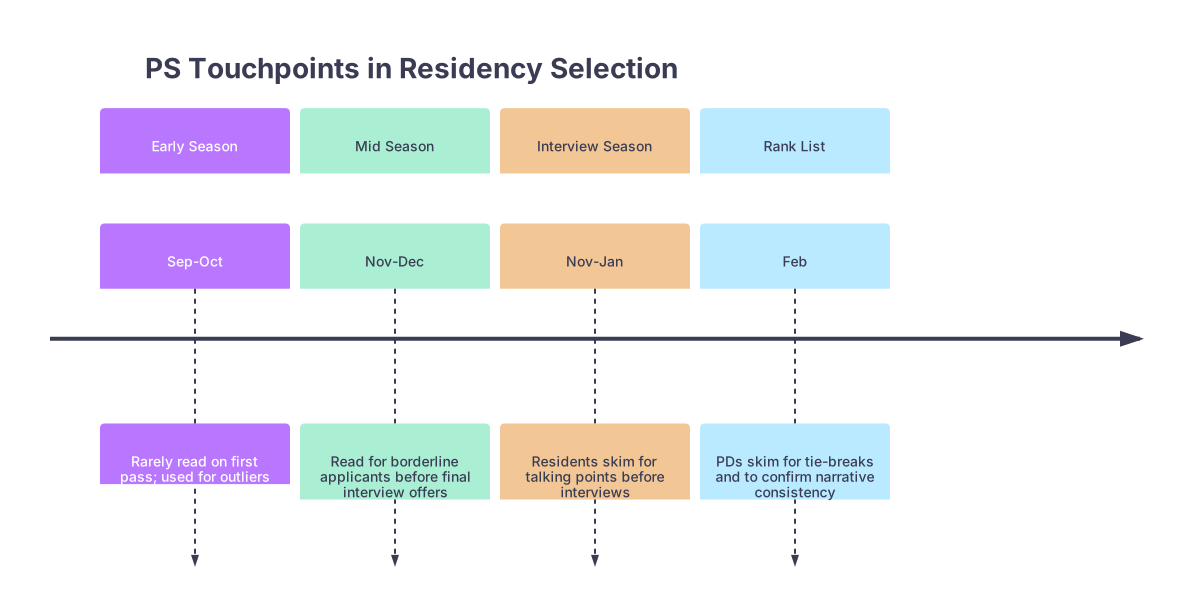
Mini Timeline: When and How Committees Touch Your PS
Just so you see where this fits in the season:
| Period | Event |
|---|---|
| Early Season - Sep-Oct | Rarely read on first pass; used for outliers |
| Mid Season - Nov-Dec | Read for borderline applicants before final interview offers |
| Interview Season - Nov-Jan | Residents skim for talking points before interviews |
| Rank List - Feb | PDs skim for tie-breaks and to confirm narrative consistency |
You’re writing something that lives with your file for months. It needs internal consistency and a clear narrative.
Frequently Asked Questions
1. Do committees actually reject people because of a bad personal statement?
Yes, but not usually for “boring.” Boring just fails to help you. Actual rejection-level problems are:
- Clear plagiarism or obviously generic templates used by multiple applicants.
- Wildly unprofessional tone, oversharing, or inappropriate jokes.
- Massive mismatch between claimed experiences and what your letters/CV show.
- Disorganized, incoherent writing that raises serious concern about your ability to document patient care.
Most of the time, a mediocre statement pushes you quietly into the “nothing special, no” pile when your numbers are borderline. A strong hook can pull you out of that pile. A disastrous statement can push you into the “absolutely not” bin.
2. Should I explicitly explain gaps, low scores, or failures in the personal statement?
If there’s something that will make every reader pause—yes, explain it briefly and directly, usually in the middle of the statement, not the opening line. One tight paragraph is enough:
- State what happened (failed exam, family illness, visa issue, burnout).
- Own your part without self-pity.
- Show what you did to correct course and how you’ve performed since.
- End on what you learned that will make you a better resident.
Do not write half your statement about your failures. But ignoring obvious red flags and hoping no one notices is delusional. They always notice.
3. Is it a mistake for IMGs to open with a U.S. clinical experience if they only have 1–2 months?
No. If that’s where you learned the most and it shows adaptation to U.S. practice, it can be a very strong hook. The key is honesty and depth:
- Don’t overstate your role (“I managed the ICU” when you were an observer).
- Focus on what you saw, learned, and changed about your practice or thinking.
- Tie that experience to your preparation for residency, not “look at me, I did observerships.”
One solid, truthful U.S. scene is worth more than five generic lines about “exposure to diverse pathologies.”
4. Can I reuse parts of my personal statement across different specialties or seasons?
You can reuse ideas and some background, but the hook and the specialty logic must be rewritten from scratch. Committees absolutely see “recycled” statements, and it destroys credibility, especially if you applied in a different specialty last year.
If you’re reapplying in the same specialty, you must update:
- Your opening hook to reflect what happened in the last cycle.
- Any new experience, exams, or growth since then.
- Your reflection on what you’ve improved to be more ready this year.
A reused, untouched statement from last year screams “minimal insight, minimal effort.” For an IMG, that’s fatal.
You now know how committees actually read IMG personal statements and how brutally fast the judgment happens. Your hook is not decoration—it’s your only chance to buy the reader’s attention long enough for your story to matter.
Next in your journey comes aligning that hook with your letters, your experiences, and your interview performance so your narrative stays coherent from first click to Match Day. But that’s a conversation for another night.