
The way IMG red flags are handled in residency meetings is harsher and more mechanical than anyone tells you openly.
People like to pretend every file gets a fresh, holistic read. It does not. Especially if you are an IMG with anything that smells like a “problem.”
Let me walk you through what really happens when your name shows up on that screen in a closed-door selection meeting.
How the Room Is Actually Set Up Against You
Most applicants imagine a committee carefully reading every detail, debating your potential like a book club. That’s fantasy.
In reality, by the time your application hits a ranking or selection meeting, you’ve already been pre-sorted by a combination of:
- Filters (Step cutoffs, year of graduation, visa status)
- Excel scores (some crude composite: scores + class rank + “fit”)
- Informal labels (“strong”, “borderline”, “do not rank”)
For IMGs, the default posture is suspicion until proved otherwise. Not because people hate IMGs personally, but because PDs have been burned—by visa delays, communication issues, professionalism problems, weak clinical exposure—and they remember the bad cases for years.
Here’s the dynamic that matters: in many academic programs, US MDs get the benefit of the doubt. US DOs get some skepticism, but still a chance. IMGs? You get a magnifying glass. Any red flag you have gets amplified.
Behind closed doors, the IMGs with no red flags are fighting uphill. The ones with red flags are often fighting for basic survival in the discussion.
The First Pass: Where Red Flags Silently Kill Your File
Most “red flags” don’t get debated in meetings. They kill your file long before that.
Think of three stages:
- Filter / Pre-screen – You might never be seen by a human if your numbers or YOG are off.
- Invite meeting – Committee decides who gets interviews. Red flags are a quick justification to exclude.
- Rank meeting – Committee decides where you end up (or if you are “do not rank”). Here, red flags are used to justify pushing you down or out.
IMG red flags are often algorithmic before they’re personal. Programs build silent rules—never published—that look like this:
| Criterion | Quiet Threshold Used | Effect on IMGs |
|---|---|---|
| Step 1 (if reported) | < 220 | Often auto-screened out |
| Step 2 CK | < 230–235 | Rarely considered |
| YOG | > 5 years | Needs strong advocate |
| Attempts | Any fail | Near-automatic rejection |
| Visa | Needs H1B | Many programs exclude |
No one will put this on the website. But I’ve sat in rooms where someone says, “We just don’t have bandwidth to remediate,” and that becomes code for “We are not touching Step failures, especially not for IMGs.”
The Red Flag Categories: What They Actually Say About You in the Room
Here’s where the uncomfortable truth shows up. I’ll walk you through how each type of red flag gets spoken about when your application is on the projector.
1. Failed USMLE Step Exams
This is the big one for IMGs. You know that. So do they.
How it’s actually discussed:
- “IMG with a Step 1 fail. Any reason to keep this?”
- “Step 2 is 245 but that fail worries me—what happens when they hit boards in residency?”
- “We’ve had bad luck with IMG fails before. I’d pass.”
The failure is often treated as a pattern, not an event. Even if it’s years ago. Even if you crushed Step 2.
What helps:
- A clear, documented explanation somewhere (personal statement or MSPE/Dean’s letter) that’s concrete and not melodramatic.
- A pattern of later strong standardized exams (NBME shelf scores, Step 2, or in-training exams if reapplying).
- A faculty advocate who can say: “They learned from that and they’ve been solid since.”
Without that, a Step failure for an IMG is frequently an automatic “No,” and it never reaches the table.
2. Multiple Attempts or Low Step 2
You want the most unvarnished version? Here it is:
For IMGs, Step 2 CK is your currency. Low scores or multiple attempts are read as, “If they struggle with multiple-choice tests at this level, what will happen with in-service exams and boards? And do we want to pay for a resident who might not board-certify?”
In the meeting:
- “IMG, 228 Step 2, no US clinical letters. I say no.”
- “Scores are borderline and we have a lot of local grads this year.”
I’ve seen a file where an IMG had a 229 on Step 2 but excellent US LORs and strong AOA-equivalent in their home school. They still got labeled “borderline” because the scores were not “clean.”
If you’re in this range, you don’t get discussed as “who is this person?” You get discussed as “is this risk worth it when we have 50 others without this issue?”
3. Gap Years / Old Graduate Status (YOG)
This one crushes IMGs quietly.
You’ll hear publicly: “We consider all applicants regardless of graduation year.”
Behind closed doors? That sentence dies fast.
Typical commentary:
- “Grad year 2017. What have they been doing?”
- “Six-year gap. I worry about clinical rustiness.”
- “They say they were doing research and family obligations—where’s the clinical continuity?”
The longer the gap, the more the burden is on you to prove you didn’t just fall off the clinical map.
Gaps tied to:
- Military service
- Ongoing clinical work (even if unpaid)
- A completed other residency in another country
Those get more grace. Random “preparing for exams” years with no meaningful activity? Death sentence in many programs.
4. Weak or Questionable Letters of Recommendation
Let me tell you what program directors really think when they see three letters from your home country and zero US-based letters:
“Either they couldn’t get US rotations or they didn’t impress anyone enough to get a strong US letter. Either way, this is not our problem to fix.”
And when a letter hints at red flags—without saying them outright—committee members absolutely notice the subtext. They read between the lines for a living.
Red flag phrases in LORs that will get brought up out loud:
- “With appropriate supervision…”
- “He will do well in a structured environment…”
- “She has shown improvement in professionalism…”
- “Given clear expectations, he performs adequately…”
I’ve literally heard: “This is a ‘do not touch’ letter disguised as polite praise.”
For IMGs, one lukewarm US letter is sometimes worse than no US letter. Because it proves you were seen—and not chosen.
5. Professionalism Issues, Remediation, or Probation
These are the radioactive red flags.
Anything involving:
- Formal professionalism citations
- Probation
- Academic remediation
- Dismissal/withdrawal from prior training
In the room, these are often the moments everyone sits up and starts paying attention. People remember the one resident who screamed at a nurse, or vanished mid-call, or lied about patient care. Those cases linger in a PD’s brain for a decade.
So when your MSPE says:
- “They had a lapse in professionalism in third year but showed improvement…”
- “There was a clerkship remediation due to concerns regarding communication…”
Expect:
- “We don’t have time for this.”
- “I don’t want another project resident.”
- “Too risky, especially for an IMG we don’t know well.”
If you have a professionalism red flag and you’re an IMG, you absolutely need one thing: a credible attending going to war for you in a letter or email. Someone who writes, “I know their history. I’d hire them myself. I trust them.”
Without that, you’re usually done.
6. Visa and Sponsorship Concerns
You think visa is “just paperwork.” They don’t. They think in terms of risk, administrative headache, and cost.
Typical backroom comments:
- “IMG on J-1 only? Fine.”
- “Needs H1B. We can’t do that.”
- “We had a DS-2019 delay last year, not going through that again.”
Visa is rarely called a “red flag” in polite language. But in practice, for many community and smaller academic programs, needing an H1B might as well be a red flag. A huge one.
I’ve seen IMGs with better stats than half the US grads in the pile get skipped because the PD said, “We are not dealing with visas this year.”
What Actually Happens in Those Meetings: The Play-by-Play
Let me give you a scene.
It’s January. Rank meeting. Ten people in a room: PD, APDs, a chief or two, maybe a coordinator. They’re tired. They’ve seen these applications for months.
There’s a spreadsheet projected on the wall. You’re a row in that sheet.
Your columns show:
- Name
- School (foreign)
- Step scores
- YOG
- Visa needs
- Interview eval scores (if you got that far)
- Coded red flags (yes/no, maybe a short note)
Now you get about 30–90 seconds of oxygen as your file scrolls into view.
For an IMG with a red flag, it goes something like:
“Next: [Your Name]. IMG, [Country]. Step 1 218, Step 2 232, grad 2018, J-1 needed, had a remediation note on MSPE, interview score average 3.5/5. Thoughts?”
Then:
- One person who interviewed you gives a quick impression: “Nice, motivated, but a little quiet. Seemed anxious.”
- Someone else: “What was the professionalism thing?”
- PD: “Something on a third-year rotation, they framed it as a misunderstanding with a resident… improvement since.”
Here’s the key. At this point, the default is not to rank you highly. The default is to move on. Someone has to actively argue for you, or you slide down or off the list.
How Much Time You Actually Get If You Have a Red Flag
Most of the time, for a borderline IMG:
- No strong advocate in the room? You go into “low rank” or “do not rank” without drama.
- One person mildly supportive but not energized? You get placed low as a compromise.
- One person strongly supportive and willing to spend political capital? You get a fair shot. Maybe even a mid-range rank.
The harsh truth: the red flag itself doesn’t kill you. The absence of someone willing to burn time and social credit on you does.
How Certain Red Flags Are “Fixable” and Others Basically Are Not
Behind the scenes, committee members mentally categorize your problem:
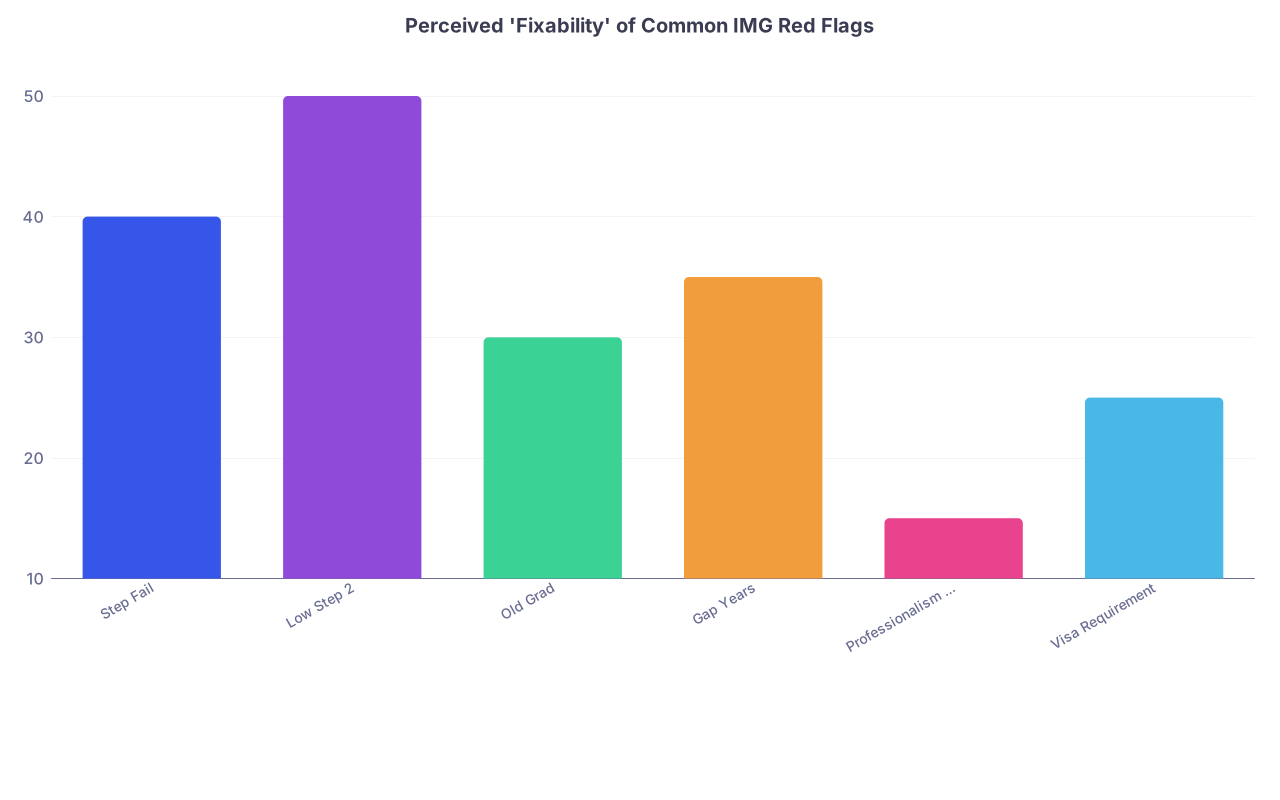
| Category | Value |
|---|---|
| Step Fail | 40 |
| Low Step 2 | 50 |
| Old Grad | 30 |
| Gap Years | 35 |
| Professionalism Issue | 15 |
| Visa Requirement | 25 |
Rough translation of how they think:
- Step fail / low Step 2 – “Maybe they just needed more time, maybe can improve with structured study.” Fixable, but risky.
- Old grad / gap years – “Clinical rust. Can they ramp back up? Might be manageable if they’re hungry and smart.”
- Professionalism issues – “Core personality or values problem.” They assume it’s almost not fixable.
- Visa needs – Not a training issue, but a system/risk issue. Many programs won’t bother.
That’s why if you’re an IMG with a professionalism red flag, your life is ten times harder than someone with a score issue. Not fair. But accurate.
The Quiet “Do Not Rank” Conversations
This part almost no one outside the room ever hears.
Sometimes, the PD or APD will create an informal “we do not rank for any reason” list. These are not always catastrophic applicants. Often they’re simply risky.
How you get put in that bucket as an IMG:
- Multiple attempts + long YOG + visa = “too many issues stacked.”
- Professionalism note + somewhat odd interview = “something feels off.”
- Unimpressive interview + poor communication in emails = “potential headache.”
You’ll hear stuff like:
- “I’m putting them on my personal no list.”
- “Even if they end up mid-queue, I’d rather leave the spot unfilled.”
Yes, you read that correctly. Some PDs would truly rather go partially unfilled, then scramble, than take an IMG with red flags they don’t trust.
Where You Actually Have Leverage as an IMG With Red Flags
You do have leverage points. They’re just not the ones most people focus on.
1. Strong, Targeted Advocacy
Your best weapon is a credible, well-known US physician who’s willing to personally vouch for you. Not a generic “great student” letter. A fight letter.
The kind that says:
- “I know about their Step failure and I would still put them at the top of my list.”
- “We had concerns early on, but they showed up, did the work, and I would trust them with my family’s care.”
The number of IMGs with red flags who have that kind of advocate is tiny. If you become one of them, your chances change dramatically.
2. Changing the Narrative of Your Red Flag
Most applicants either hide their red flag or write a melodramatic essay about it. Both approaches bomb.
In committee, people respond to:
- Concrete, adult explanations.
- Clear evidence of change.
- A stable pattern since the incident.
What works in your materials and interviews:
- “I failed Step 1 because I underestimated the exam and didn’t ask for help early. I changed my study plan completely, did X, Y, Z, and scored 245 on Step 2. Since then, all my exams have been above the 75th percentile.”
- “I had a professionalism citation for a conflict with a resident. I received feedback, completed a remediation plan, then actively asked nurses and attendings for feedback on my communication. My subsequent evaluations reflect that.”
That kind of language gives a PD something to say in the room when others hesitate.
3. Absolute Clarity About What You Offer Now
You are not getting in on “potential” as much as a US MD might. You get in on:
- Immediate usefulness
- Reliability
- Low drama
The committee wants to hear things like: “Always early, never complained, handled scut with a good attitude, patients loved them.” The more that shows up in comments, LOR text, and interview notes, the more they’re willing to tolerate one red flag.
I’ve seen borderline IMGs with old grad status but brutal work ethic and glowing community hospital letters get ranked well above cleaner but bland IMGs. Because everyone remembered: “This person is going to show up and work.”
Example: Two IMGs, One Red Flag Each, Very Different Outcomes
Let me show you this with a simplified comparison.
| Factor | IMG A | IMG B |
|---|---|---|
| YOG | 2016 | 2019 |
| Step 1 / Step 2 CK | Fail / 245 | 228 / 231 |
| Red Flag | Step 1 fail | Gap of 2 years post-grad |
| US Clinical | 3 months observerships | 4 months hands-on electives |
| US LORs | Generic, abroad-heavy | 2 glowing US letters, 1 abroad |
| Advocacy | None | APD at affiliate hospital pushing |
| Visa | Needs H1B | J-1 OK |
| Interview Impression | “Shy, answers short” | “Warm, reflective, clear” |
| Outcome | Not ranked | Ranked mid-list, matched |
Both had red flags. Only one had:
- Strong US clinical performance
- A real advocate in the room
- A clean story and present-day value
You can’t remove the red flag. You can surround it with enough trust that people say, “We’ll take the chance.”
How You Should Strategize If You Know You Have a Red Flag
You can’t afford magical thinking. You have to play the game the way the people in that room are actually playing it.

| Step | Description |
|---|---|
| Step 1 | Identify Main Red Flag |
| Step 2 | Retake/Strengthen Exams |
| Step 3 | Address Narrative Head-on |
| Step 4 | Secure Strong US LORs |
| Step 5 | Target Programs Where Advocate Has Influence |
| Step 6 | Build New Relationships via Rotations |
| Step 7 | Apply Selectively, Avoid Blind Mass Apps |
| Step 8 | Score-based? |
| Step 9 | Have Advocate? |
Stop thinking of yourself as an anonymous file. Ask yourself:
“Who is going to speak my name in that room and push for me when my red flag appears on the screen?”
If you cannot name that person for at least some programs, you are relying on luck. PDs do not design their rank lists around hope and charity. They design them around risk management.
The One Thing Most IMGs Don’t Realize
You’re not just being evaluated for your red flag. You’re being judged against the memory of every IMG that program has ever trained.
If the last IMG with a Step failure washed out, you’re fighting their ghost.
If the last IMG with an H1B had a visa nightmare, you’re paying their debt.
That’s why some programs shut the door very quietly on entire categories of IMGs—with no announcement, no policy change, just a shift in filters and “gut feelings.”
The way around that is not perfection. It’s being so obviously valuable, mature, and supported that you feel less like a risk and more like a solution.
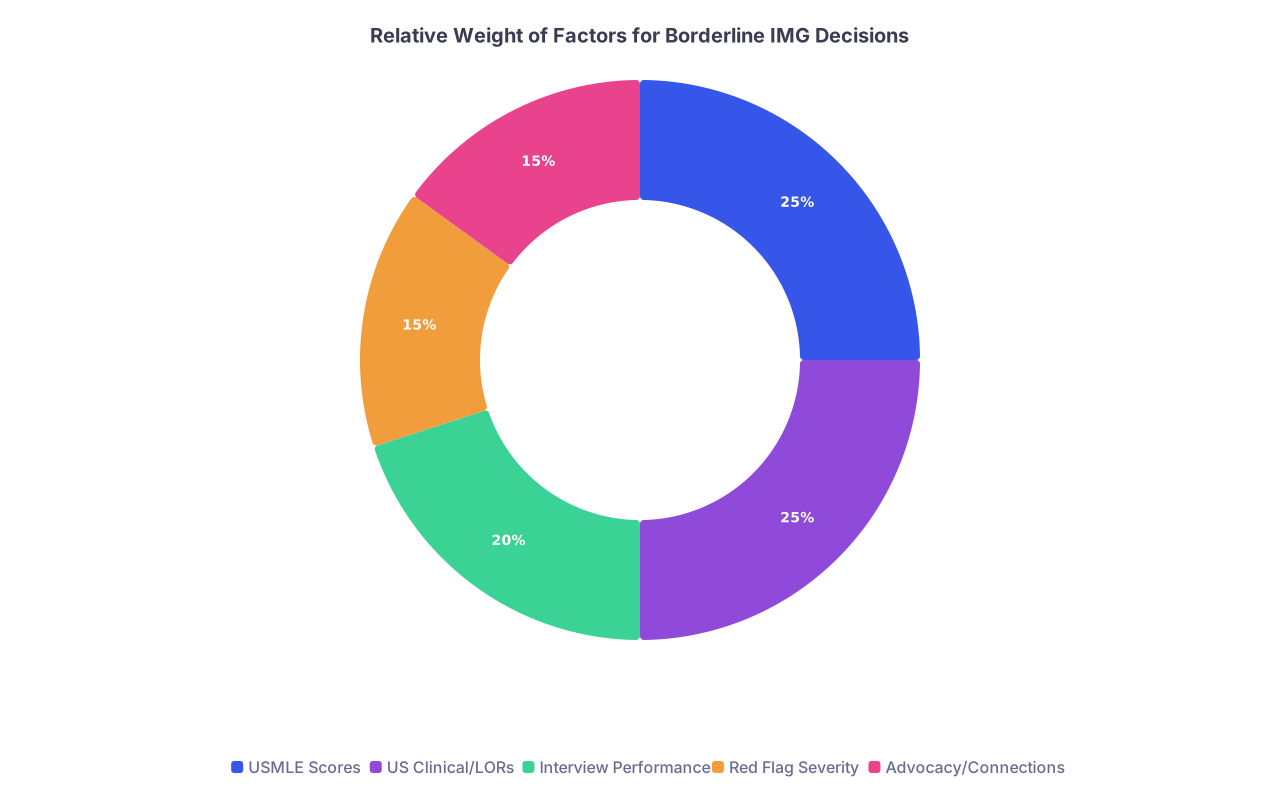
| Category | Value |
|---|---|
| USMLE Scores | 25 |
| US Clinical/LORs | 25 |
| Interview Performance | 20 |
| Red Flag Severity | 15 |
| Advocacy/Connections | 15 |
Notice something in that breakdown: the red flag itself isn’t 80% of the decision. It just becomes the easiest excuse to say no when everything else is mediocre or unknown.
Your job is to make the rest so strong that saying no feels like a loss, not the safe option.
FAQs
1. If I have a Step failure as an IMG, should I address it directly in my personal statement?
Yes, but surgically. One short, direct paragraph: what happened, what you changed, how your later performance proves growth. No self-pity, no drama. Then move on to your strengths. You’re giving the PD language they can repeat in the meeting when someone says, “What about the fail?”
2. Do programs ever completely ignore red flags if they really like you?
They rarely “ignore” them. What actually happens is: a strong advocate reframes the red flag as a conquered obstacle, and the rest of your file is so solid that the committee decides the risk is acceptable. The red flag doesn’t vanish—it gets outweighed.
3. Is it worth doing an unpaid observership if I already have a red flag?
If that observership can produce one truly strong US letter from someone who has any regional influence or knows PDs, then yes. Another generic “hardworking, punctual” letter is useless. You need a letter that actively argues for your reliability and growth.
4. How can I tell if a program is secretly filtering out IMGs with my type of red flag?
You look at their resident roster and patterns over the last 3–5 years. No IMGs? Few visas? No older grads? That’s your answer. Also listen closely on interview day—if they dodge questions about visa or older grads or Step issues, it usually means the door is half-closed. Your time is better spent on places that routinely take people like you and see them succeed.
Two things to remember:
- Your red flag is not evaluated in a vacuum. It lives inside a story—and you control more of that story than you think.
- In that closed room, you’re a name, a pattern, and a memory someone fights for—or doesn’t. Your real work is making sure there’s at least one person in that room who refuses to let you be quietly dismissed.