
It is late July. You just got another email: “Dear Doctor, we are pleased to offer you an observership in our prestigious hospital…” The logo looks impressive. The fee is… steep. But you are an IMG trying to match in the United States. You are in your home country, your visa clock is ticking, and everyone in your WhatsApp group is talking about stacking observerships.
This is where a lot of IMGs make quietly fatal mistakes.
Not dramatic, obvious errors. Slow, expensive ones: the wrong observership, at the wrong place, at the wrong time, for the wrong reasons. On paper you “did everything” — but your CV is padded with low-yield experiences, your letters are weak, and your optics scream “does not understand the U.S. system.”
Let me walk you through the biggest ways IMGs misuse observerships, why programs view some of these very negatively, and how to avoid making your application look worse instead of better.
1. Treating Any Observership as Automatically Valuable
The first big mistake: assuming “U.S. clinical experience is U.S. clinical experience.”
Programs do not see it that way. At all.
What PDs actually look for
Most program directors care about three things from your U.S. clinical experience:
- Can you function in the U.S. system (workflow, communication, EMR culture)?
- Did a credible U.S. attending see you long enough to write a meaningful letter?
- Does your choice of experience show judgment and intention, or just desperation?
If an observership does not strongly support at least one of those, it is not helping you. It might even raise questions.
I have seen applications where the CV lists six observerships, all at unknown private clinics, all two weeks each, all paid. On paper it looks like hustle. To many PDs, it looks like:
- No continuity
- No real responsibility
- No substantial evaluation
- “Bought” exposure rather than earned opportunities
That is the opposite of what you are trying to project.
The worst version: pay-to-watch mills
There is a specific category of observership IMGs need to be careful with: the pure pay-to-watch model in low-acuity community settings with:
- No residents
- No academic structure
- No real team interaction
- No clear supervision or evaluation process
Those places exist for one reason: to sell “U.S. experience” to desperate IMGs. Programs know it. They see the same clinic names over and over.
If your CV looks like an advertisement for those firms, you risk being silently filtered out. No one tells you this in the brochure.
2. Confusing “Any U.S. Experience” with “Match-Relevant Experience”
You are applying to internal medicine. You have:
- 3 months of U.S. dermatology observership
- 1 month of plastic surgery clinic shadowing
- 2 months of “clinical research observership” in an outpatient cardiology office that publishes nothing
Then you wonder why IM programs are not impressed.
Misalignment looks like confusion
Programs want to see that your U.S. experience:
- Matches your target specialty
- Shows you understand what that specialty involves in real U.S. practice
- Refines, not randomizes, your narrative
If you apply to family medicine with nothing but ICU and interventional cardiology observerships, it reads as: “I wanted something more competitive, did not get it, and now I am parking here.”
Is that always true? No. Does it often look like that on paper? Yes.
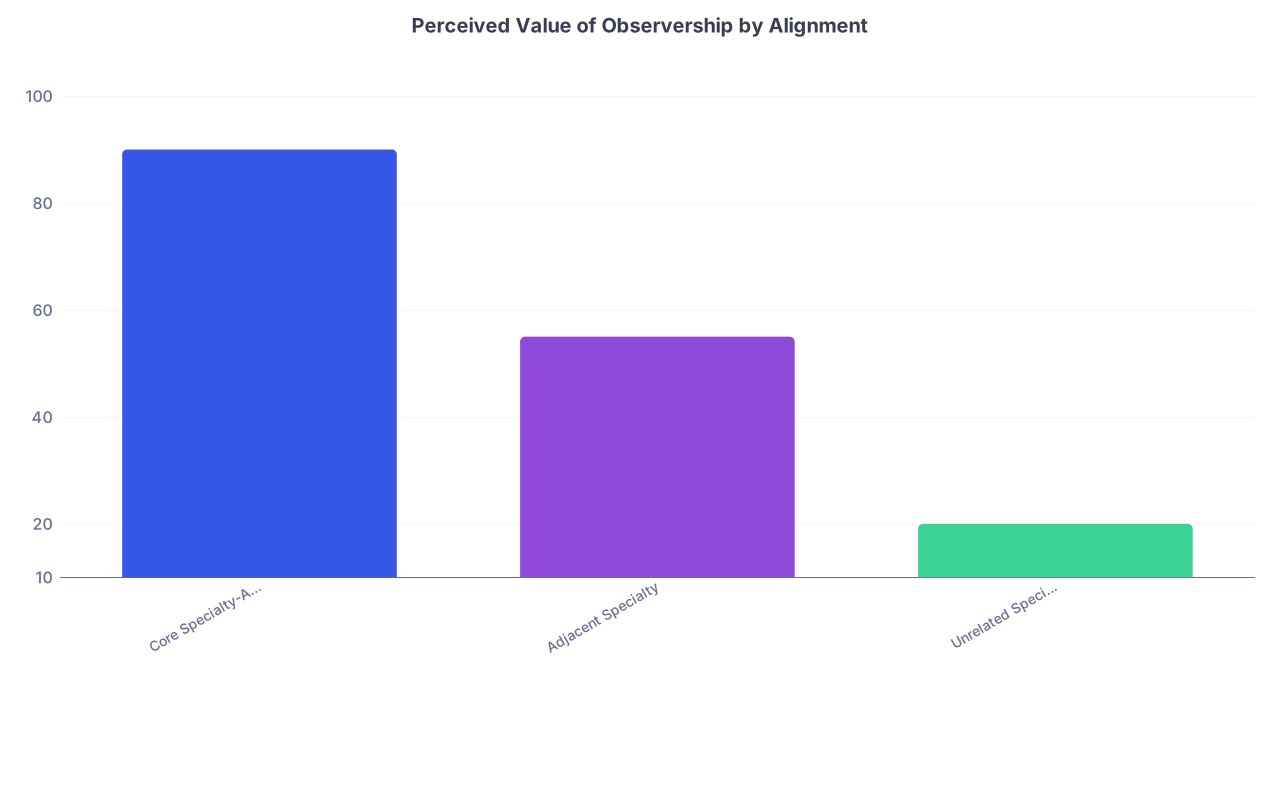
| Category | Value |
|---|---|
| Core Specialty-Aligned | 90 |
| Adjacent Specialty | 55 |
| Unrelated Specialty | 20 |
The rough hierarchy for IMGs (from a PD perspective) is:
- Specialty-aligned inpatient or mixed inpatient/outpatient experience
- Adjacent fields with strong general medicine relevance
- Completely unrelated specialties with no clear link to your application story
If you already did a year of dermatology back home and now want IM, one derm observership is fine as a narrative bridge. Four of them is not. It starts to look like you do not know what you want.
3. Over-Paying for Brand Names and Under-Valuing Evaluators
Another enormous mistake: chasing big-name hospital logos instead of people who will actually advocate for you.
IMGs obsess over “Mayo,” “Cleveland Clinic,” “Harvard,” “Johns Hopkins,” on the masthead of an observership certificate. But certificates do not match. People do.
The question PDs silently ask
When they see an observership at a famous institution, the real question is not:
“Wow, Harvard?”
It is:
- “Who supervised you?”
- “How long did they observe you?”
- “Did they write you a letter?”
- “Does their letter sound like they actually know you?”
You can spend $4,000 for a month of shadowing at a top-10 place where you stand in the back of the room, never touch a chart, barely speak to the attending, and the final “letter” is a generic template used for every observer.
That is almost meaningless.
Versus a lesser-known, unglamorous community teaching hospital where:
- You join the team daily
- Present patients informally
- Communicate with nurses and case managers
- Get specific feedback
- Earn a detailed letter from an attending who knows your story
I will take the second option every single time. So will many PDs who actually read letters.

Where money goes to die
The worst pattern I see:
- $3,000–$5,000 per month in fees
- Plus housing and basic living costs
- For experiences that explicitly will not write letters
- Or produce only one master template letter that gets “signed” by various faculty
You are essentially buying one extra line on the CV that says “Observer, XYZ Medical Center.” That is an expensive illusion of progress.
4. Using Observerships to “Fix” Things They Cannot Fix
This one is brutal, but you need to hear it.
Observerships do not fix:
- Irreparably low scores
- Massive time gaps without explanation
- Failure to clear Step 2 or OET early enough
- Unprofessional behavior or red flags
Yet many IMGs throw observership after observership at fundamental issues, hoping volume will compensate. It does not.
| Area | Observership Helps? |
|---|---|
| Lack of U.S. exposure | Yes |
| Needing U.S. LORs | Yes |
| Weak understanding of system | Yes |
| Poor Step scores | No |
| Long unexplained gaps | Limited |
| Failed exams | No |
If you failed Step 2 twice and you now have 8 months of observerships, the question becomes:
“Why so much observing and so little evidence of academic recovery?”
You would have been better off:
- Fixing exams first
- Doing fewer, higher-quality targeted observerships later
- Using part of that time for research, QI, or something that shows cognitive strength
Observerships are amplifiers. They make a strong profile stronger. They do not magically turn a weak profile into a competitive one. Piling them on to cover structural problems is a common, very costly error.
5. Doing Too Many, Too Short, and Too Fragmented
Another misuse: turning observerships into a traveling circus.
Two weeks at a nephrology clinic. Three weeks on a hospitalist team. Two weeks in GI. One more week in a private practice. All in different states. No continuity. No depth.
From the IMG side, the logic is: “More institutions, more exposure, more lines on CV.” From the PD side, it looks like: “No one really worked with this person long enough to know them well.”
Letter writers need time to:
- See how you handle feedback
- Watch you show up consistently
- Notice if you ask good questions
- Trust your professionalism
That does not happen in ten days.
An observership under 4 weeks is almost never optimal unless there is some very specific reason. And doing 5–6 rotations of 2–3 weeks each can make your application look scattered and superficial.
Quantity vs usefulness
Think of it this way:
- One 8‑week IM observership at a teaching hospital with a strong letter = high yield
- Four separate 2‑week observerships at assorted clinics with no letters = mostly noise
Yet I repeatedly see CVs stacked with “2-week observer” entries, each costing a fortune in fees and housing. It signals poor priority-setting and weak mentorship.
6. Ignoring Optics: When Observerships Make You Look Worse
Some observership choices are not just low-yield. They actively hurt.
Red flags programs quietly notice
Here are patterns that set off alarms:
- Only experience is in for-profit “IMG pipeline” clinics with identical names on many applications
- Long strings of observerships with no U.S. LORs
- Observerships continuing deep into application season instead of focusing on interviews and communication
- Observerships that overlap with Step exam periods, suggesting divided focus
- Repeated observerships in the same department where you never advanced beyond passive shadowing
Another subtle issue: if your U.S. work history is almost entirely “observer,” “shadow,” “volunteer,” with nothing showing increasing responsibility or initiative, some PDs question your drive.
7. Misrepresenting Observerships as Hands-On
This part is unforgiving: misrepresenting observerships as clinical duties can end your chances fast.
I have seen IMGs list under “Experience”:
- “Managed a panel of 15 inpatients daily”
- “Performed procedures including paracentesis, central line placement”
- “Wrote progress notes and orders”
Then you look closer, and the experience is explicitly labeled “Observership / Shadowing Only.”
That is not optimism. That is dishonesty.
Programs know IMGs are not credentialed to do hands-on clinical duties during standard observerships. If you claim anything that sounds like unsupervised or credentialed work, you are either:
- Misrepresenting the experience, or
- Participating in something sketchy and unsafe
Both are disqualifying in the minds of many PDs.
You can say:
- “Presented patients informally to the attending”
- “Participated in team discussions and morning rounds”
- “Observed and discussed management plans for X condition”
You cannot claim to have “admitted patients,” “wrote orders,” or “performed procedures” unless you held an official, credentialed role (e.g., prelim intern, research fellow with defined clinical duties, etc.), and it is clearly documented.
This is a fast way to get your application tossed in the “integrity concerns” pile.
8. Wasting Prime Time: Bad Timing and Poor Sequencing
Even a good observership becomes harmful if you do it at the wrong time.
Common timing mistakes:
Observerships before you have key exams
Spending months in the U.S. “for observerships” while your Step 2 CK is pending or unprepared is backward. Programs care far more about a solid Step 2 score than yet another month of shadowing.Too close to application deadlines
Starting an observership in August or September, when ERAS opens, means that letter will be late or missing from your first wave of applications. Programs often pre-screen early. That letter may arrive just in time to help… next year.During heavy interview season
October to January, your priority is responding to invites, scheduling, preparing, and performing well on interviews. Being stuck in a full-time observership that does not offer flexibility can cost you interviews or force you to cancel them. Completely backwards.
Here is a more rational structure:
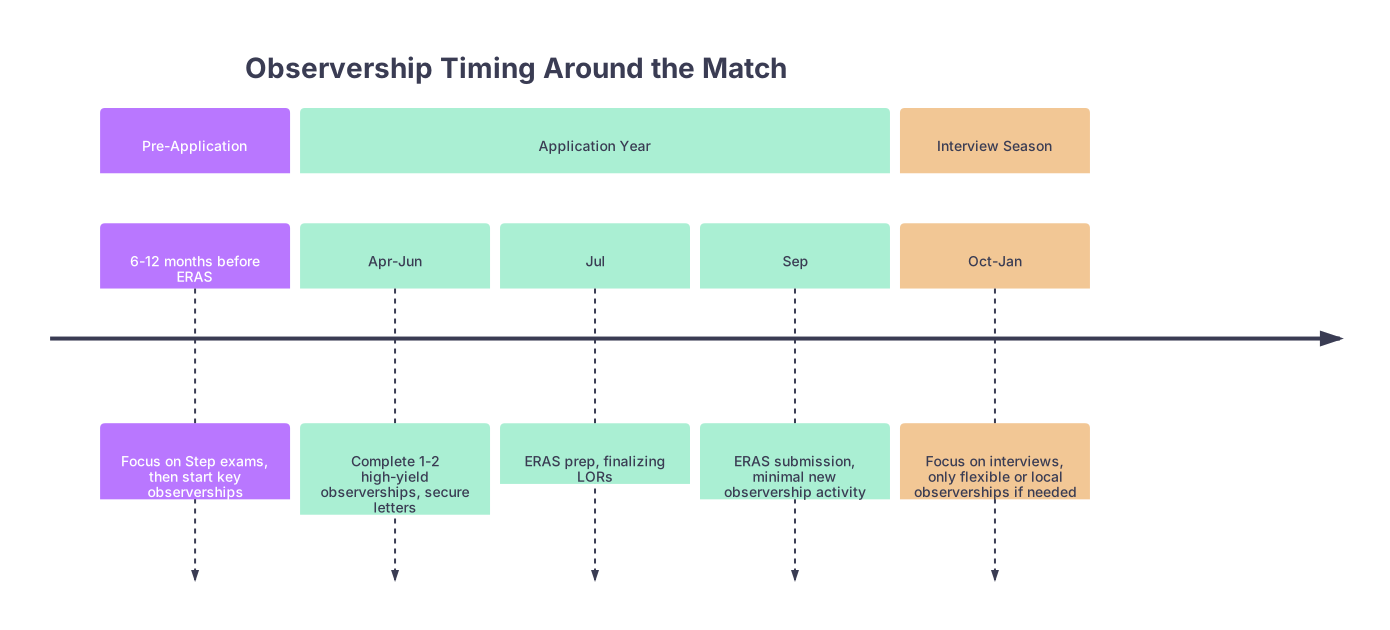
| Period | Event |
|---|---|
| Pre-Application - 6-12 months before ERAS | Focus on Step exams, then start key observerships |
| Application Year - Apr-Jun | Complete 1-2 high-yield observerships, secure letters |
| Application Year - Jul | ERAS prep, finalizing LORs |
| Application Year - Sep | ERAS submission, minimal new observership activity |
| Interview Season - Oct-Jan | Focus on interviews, only flexible or local observerships if needed |
If your choice is:
- One more observership vs. enough time to properly study and raise your Step 2 by 10–15 points
You choose the Step 2 improvement. Every time.
9. Not Vetting Programs and Ending Up in Exploitive Setups
This is where I get protective.
There are entire ecosystems built around IMGs’ fear and urgency. They:
- Charge thousands, cash only
- Refuse to give clear descriptions of duties in writing
- Guarantee nothing about letters
- Rotate you through 3 preceptors in 4 weeks
- Put you in clinic rooms without clear supervision
You must vet these places harder than they vet you.
Red flags when considering an observership:
- Website is mostly marketing language about “U.S. medical dream” with minimal real details
- No clear affiliation with a hospital or accredited residency program
- Cannot give you the exact name and role of your supervising physician ahead of time
- Over-promising: “Guaranteed strong LOR after 4 weeks”
- No mention of any structured evaluation or feedback process
- They pressure you to “book now, limited spots”
If you do not aggressively check these things and just swipe your credit card because the email said “affiliated with X University,” you are easy money for them and not much closer to a match.
Use Google Scholar, PubMed, hospital websites, and state medical license databases to confirm:
- The physician exists, in that specialty
- They have real credentials
- They actually work where claimed
It is tedious. It also saves you thousands and protects your optics.
10. Failing to Extract Real Value From a Decent Observership
Even when IMGs land in a good observership, they often underuse it.
They show up, stand in rounds, say little, smile politely, go home. Four weeks later they leave with:
- A generic “was present” letter
- No real advocate
- No ongoing connection
And then they wonder why the experience did not matter.
A well-used observership should aim for:
- One attending who knows your story and goals
- Specific feedback and mid-rotation check-ins
- Concrete contributions: mini-presentations, literature reviews, QI ideas
- Some continuity of interaction with residents and staff
You do not need to be loud or fake. But you must be visible and intellectually present. If you are socially invisible, your letter will reflect that.
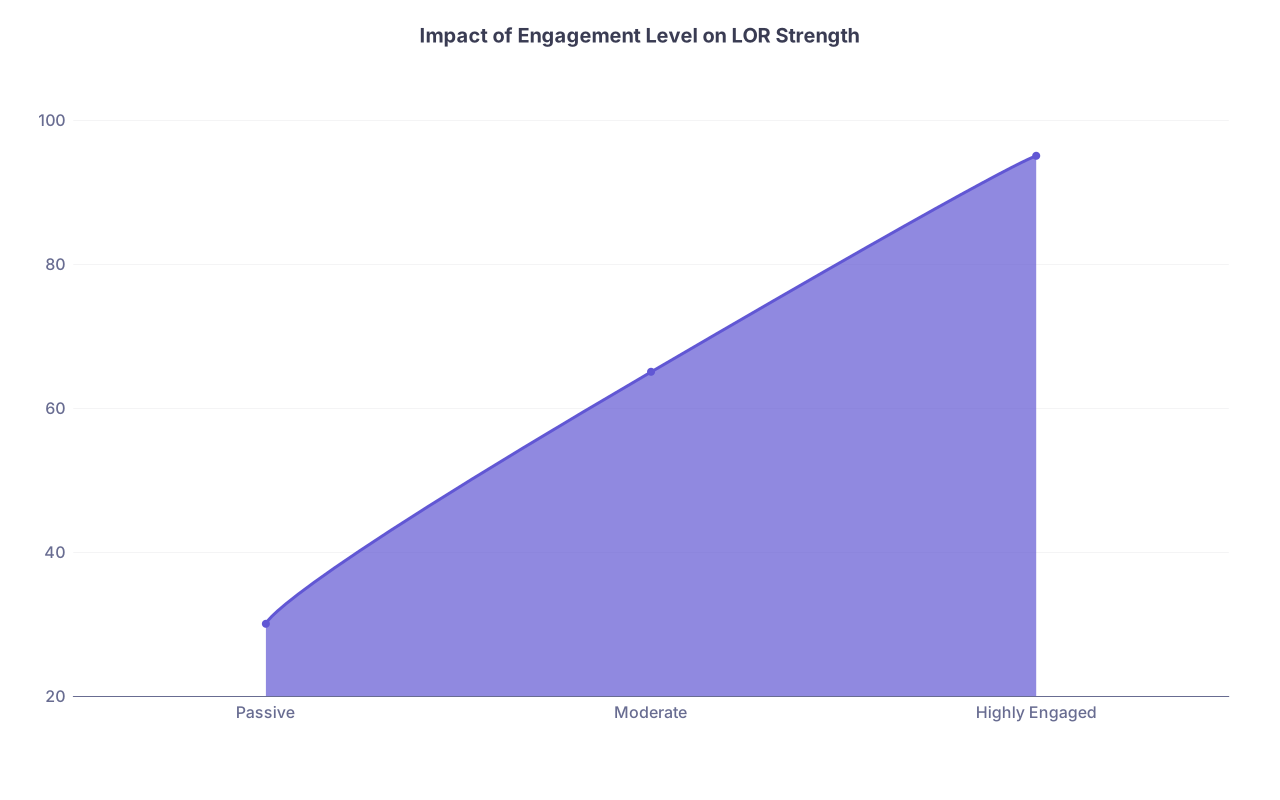
| Category | Value |
|---|---|
| Passive | 30 |
| Moderate | 65 |
| Highly Engaged | 95 |
I have read letters that say, “Dr. X attended rounds daily and was polite.” That is code for, “I have nothing else to say.” You cannot afford that.
Use the time intentionally:
- Prepare 1–2 short, evidence-based presentations
- Ask for specific feedback midway: “What should I improve in how I present patients or ask questions?”
- Clarify expectations early: “What do strong observers do differently here?”
If you are not doing this, you are wasting even a good observership.
11. When to Say No: Hard Truths About Skipping Observerships
Here is the part no one selling you observerships will admit: some IMGs should do fewer of them. Some should pause completely.
Examples:
- You have 6+ months of U.S. observerships already and 0 publications, 0 recent exam scores. Stop collecting “observer” lines and fix other gaps.
- Your Step 2 is pending and underprepared, but you are about to fly for a 2‑month observership. You should probably stay and study.
- You already have 2 solid IM observerships with good letters and are being pushed into “just one more” by an agency. You likely do not need it.
Sometimes the smartest move for optics is to not add another flimsy, fee-based, short, or misaligned observership to your CV. The pattern matters more than the count.
Key Takeaways
Not all observerships help. Pay-to-watch mills, short fragmented experiences, and misaligned specialties can waste money and make your application look weaker or more desperate.
Program directors care less about logos and more about depth, alignment, credible letters, and your judgment. A few strong, well-timed, relevant observerships with real engagement beat a long list of low-yield ones.
Do not use observerships to hide or “fix” structural problems like poor scores or long gaps. Fix the fundamentals, be brutally honest about optics, and choose observerships only when they clearly add real value to your story, your skills, and your recommendations.