
The biggest trap for IMGs in the US is this: you get a stable non‑clinical job “for now” and 3–5 years later you’ve quietly killed your residency chances.
If you’re already in that non‑clinical job, you’re not doomed. But you do not have margin for vague plans and wishful thinking. You need a timeline, a narrative, and receipts.
This is for you if:
- You’re an IMG already in the US
- You’re working non‑clinically (research, scribe, MA, QA, utilization review, pharma, IT, whatever)
- You still want residency, but each passing year feels like it’s closing doors
Good. Let’s treat this like what it is: a recovery mission.
Step 1: Get Honest About Your Starting Point
Before you do anything dramatic—quitting jobs, expensive observerships, random research “certificates”—you need a cold, unfiltered snapshot of where you are.
A. Define your “risk factors”
Here’s how programs silently judge your file when you’re an IMG coming from a non‑clinical job:
| Factor | Low Risk | Moderate Risk | High Risk |
|---|---|---|---|
| YOG (Year of Graduation) | 0–3 years | 4–6 years | 7+ years |
| USMLE failures | None | 1 attempt on one exam | Multiple fails |
| Gaps | Continuous activity | Short unexplained gaps | Long unexplained gaps |
| US clinical experience | 3+ months | 1–2 months | 0 months |
| Non-clinical time | <1 year | 1–3 years | 4+ years |
Be brutally honest. Not what you wish it looked like. What it actually is.
Write this out:
- YOG:
- USMLE status (scores, attempts):
- Current non‑clinical job title:
- Years in this job:
- Last time you touched a patient:
- Months of US clinical experience (real, hands‑on or true observerships, not “visited family friend’s office”):
If:
- You’re 5+ years from graduation
- You have no current clinical work
- And you’re just sending 150 ERAS applications each year “to see what happens”
—that’s not a strategy. That’s a lottery ticket.
You can still get in. But you’ll need to look different in 12–18 months than you look right now.
Step 2: Decide: Commit or Quit (for now)
You can’t half‑do this. Programs can smell “backup plan” energy from a mile away.
You need a decision on paper:
- “I am going all‑in for residency for the next 2 cycles.”
- “I’ll give it one structured attempt, then walk away.”
- “I’m done trying. I’ll grow in my current (or another non‑clinical) path.”
All three are valid. What’s cowardly is floating in between, year after year, wasting application fees and emotional bandwidth.
If you choose 1 or 2, here’s the rule:
Your life for the next 12–24 months has to look like someone preparing for residency, not like someone idling in a random job who applies on the side.
That means:
- Visible clinical involvement
- A coherent story for “why I left, why I’m back”
- A plan to fix whatever killed your previous cycles (scores? YOG? no USCE? bad application?)
Now we build that.
Step 3: Rebuild Clinical Credibility While You’re Still Working
You’re in a non‑clinical job. Fine. You still need to show:
- Clinical proximity
- Clinical relevance
- Clinical trajectory back to residency
The worst look:
“IData Analyst at insurance company, 4 years, no clinical anything, but ‘medicine is my passion.’”
A. Re‑enter the clinical orbit without quitting your job (yet)
You’re going to stack these:
US Clinical Experience (USCE)
You need recent and recognizable USCE. Ideally within the last 12–18 months by the time programs see your file.Priorities:
- Hospital‑based > private clinic
- Structured program > informal shadowing
- Hands‑on (if allowed) > pure observership
Concrete moves:
- Buy 1–2 months of observerships/externships (yes, many are paid, and many are predatory; choose carefully)
- Ask your employer for:
- PTO blocks
- Unpaid leave
- Shift consolidation (4x10s instead of 5x8s) to create observership windows
- Target institutions that actually write LORs that programs recognize
Volunteer clinical roles
Free clinics, community health fairs, refugee clinics, mobile health units, COVID vaccination sites (or their modern equivalents).Even if you’re not “doctor” there. It still shows:
- You’re in the clinical environment
- You’ve seen US patients and systems recently
- You’re not just a desk worker wishing from afar
Reframe your current job for medicine
Whatever your non‑clinical job is—research coordinator, scribe, case manager, data analyst—pull it as close to your target specialty as possible.Example:
- You’re a data analyst at a health plan → start working with the quality metrics team on diabetes control, HEDIS measures, readmissions.
- You’re in IT at a health system → volunteer to work on the EPIC optimization project for ambulatory clinics.
- You’re in pharma safety → focus your narrative on clinical decision‑making, adverse event interpretation, multidisciplinary discussions.
The point: when a PD looks at your job, they shouldn’t think “random corporate.” They should see “healthcare‑adjacent, clinically relevant.”
Step 4: Fix the Story: Why You Left, Why You’re Back
Programs hate confusion. Your file needs a clear, believable arc.
Here’s what doesn’t work:
- “I always wanted to do medicine but had visa/financial/personal issues and so I took a job in [vague business role] while preparing for exams.”
- “I was always passionate about research and now I want to come back to clinical work.” (Why now?)
You need a story that:
- Admits reality
- Shows growth
- Makes the return to residency feel like a logical next step, not a panic move
A usable frame:
“After graduating from medical school in [country], I came to the US and initially [exam struggle / visa challenge / financial pressure]. To support myself and stay within healthcare, I accepted a role as [job title] at [organization].
Working there, I developed [specific skills] and gained a deeper understanding of [US healthcare / population health / outcomes / systems]. Over time, though, I realized that I wanted to be back at the bedside, making direct clinical decisions.
Over the last [X] months, I’ve intentionally shifted back to clinical medicine through [recent USCE, volunteering, research in your specialty]. Now I’m applying to residency with both my original clinical training and a stronger understanding of [whatever your job taught you that is actually useful to a resident].”
Notice:
- It doesn’t whine.
- It doesn’t sound like you “failed” into your job.
- It makes the return feel like a matured decision.
You’ll use variations of this in:
- Personal statement
- ERAS experiences descriptions
- Interview answer: “Tell me about your path since graduation”
- Interview answer: “Why now?”
Step 5: Build a Concrete 12–18 Month Plan
Stop thinking in vague “next year’s match” language. You need a project plan.
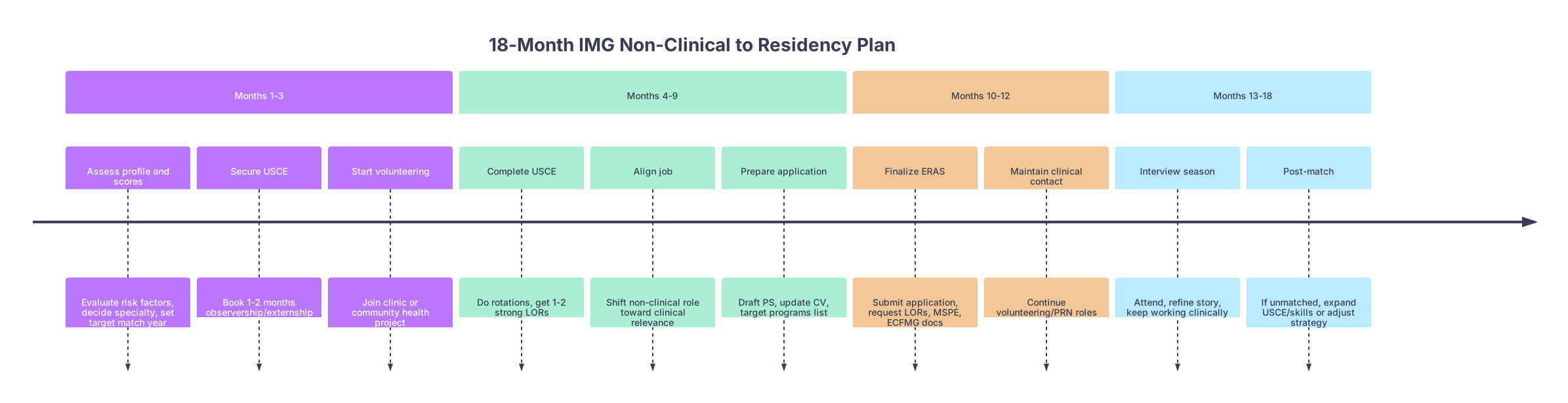
Here’s what a realistic 18‑month transition can look like for an IMG in a non‑clinical job:
| Period | Event |
|---|---|
| Months 1-3 - Assess profile and scores | Evaluate risk factors, decide specialty, set target match year |
| Months 1-3 - Secure USCE | Book 1-2 months observership/externship |
| Months 1-3 - Start volunteering | Join clinic or community health project |
| Months 4-9 - Complete USCE | Do rotations, get 1-2 strong LORs |
| Months 4-9 - Align job | Shift non-clinical role toward clinical relevance |
| Months 4-9 - Prepare application | Draft PS, update CV, target programs list |
| Months 10-12 - Finalize ERAS | Submit application, request LORs, MSPE, ECFMG docs |
| Months 10-12 - Maintain clinical contact | Continue volunteering/PRN roles |
| Months 13-18 - Interview season | Attend, refine story, keep working clinically |
| Months 13-18 - Post-match | If unmatched, expand USCE/skills or adjust strategy |
During this period, your calendar should show:
- Specific dates for USCE
- Weekly clinical volunteering hours
- Dedicated application work time (personal statement, program list, etc.)
- If needed: Step upgrade (Step 3, CK retake if allowed and makes sense)
If there’s nothing on your calendar that scares you a little—time off for rotations, serious sacrifice, money spent strategically—you’re probably not doing enough.
Step 6: Make Your Non‑Clinical Job Work For You, Not Against You
Program directors are used to seeing IMGs in non‑clinical roles. What matters is:
- Is your role steady and credible?
- Does it connect to patient care, even indirectly?
- Did you grow in it?
- Does it explain your timeline without looking like you gave up on medicine?
Don’t do this:
- Frequent job hopping every 6–9 months without explanation
- Jumping into totally unrelated industries (e.g., retail, rideshare, random call center) and pretending it didn’t happen
- Hiding your non‑clinical job on ERAS (they will ask what you did for those years)
Do this instead:
Clarify your title and duties in ERAS
Example:- Bad: “Analyst, XYZ Corp”
- Better: “Healthcare Data Analyst – Population Health, XYZ Health Plan”
Description: “Analyzed clinical outcomes for 50,000+ patients with diabetes and hypertension, collaborated with MD quality leads to design interventions improving A1C control and reducing readmissions.”
Highlight physician interaction
If you work with physicians—even tangentially—say it. PDs want to know you still speak “clinical.”Show progression
Promotions, new responsibilities, leadership roles, projects you owned. Not because they want businesspeople, but because it signals reliability and work ethic.
Step 7: Address the Big Three Red Flags Directly
Being in a non‑clinical job isn’t your only problem. Usually it’s layered on top of one or more of these:
1. Year of Graduation (YOG) > 5 years
Programs will silently wonder: “Why now? Why didn’t anyone take this person earlier?”
You counter that by:
- Showing consistent activity (no big blank gaps)
- Having recent, strong USCE and LORs (within the last year or two)
- Demonstrating something unique from your non‑clinical time (systems thinking, QI, research, population health)
2. Step attempts or low scores
You don’t fix scores with essays. You fix them with:
- Step 3 (if reasonable and compatible with your specialty target)
- Strong LORs that explicitly comment on knowledge, work ethic, and teachability
- A specialty choice that matches your profile
(If you’re sitting on 210s/220s and aiming for Derm or Ortho as an IMG, stop. You’re not “underdog inspiring”; you’re delusional in program eyes.)
3. No recent clinical touch
This is lethal. If the last time you saw a patient in any meaningful way was 5+ years ago in another country, your chances tank.
Your goal: by the time programs read your file, you want them to see some of this:
- “2025 – Internal Medicine Observership, [US Program]”
- “2025 – Volunteer Clinician Assistant, [Free Clinic]”
- “2024–present – Research Assistant, [Hospital Department] focusing on [relevant clinical topic]”
You’re trying to make the question shift from “Can this person even function clinically?” to “Do they fit our program?”
Step 8: Stop Wasting Applications; Start Targeting
Spray‑and‑pray ERAS is a money bonfire, especially for an IMG in your position.
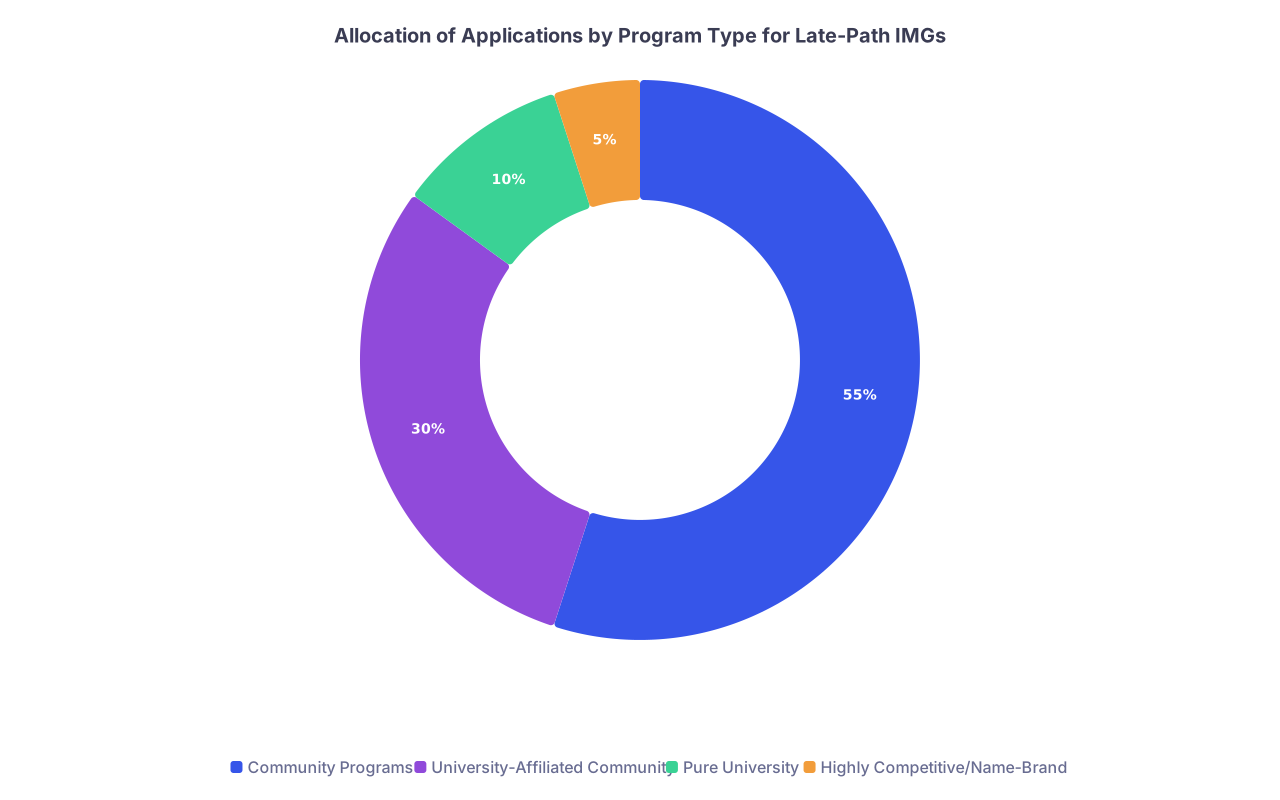
You need a targeting strategy, not vibes.
| Category | Value |
|---|---|
| Community Programs | 55 |
| University-Affiliated Community | 30 |
| Pure University | 10 |
| Highly Competitive/Name-Brand | 5 |
For someone in a non‑clinical US job with YOG > 3 years, typical high‑yield targets:
- Community programs
- University‑affiliated community programs
- Programs with a history of taking IMGs
- Geographies less saturated with US grads (Midwest, some South, certain rural regions)
What you should not be doing:
- Applying heavily to big‑name university hospitals that historically take 0–1 IMGs per year
- Ignoring program websites where they clearly state “We prefer graduation within last 3 years”
- Applying in super‑competitive specialties with a weak clinical narrative
If you’re still not sure where you stand, build a quick self‑audit:
| Area | Strong | Average | Weak |
|---|---|---|---|
| USMLE performance | |||
| Recent USCE | |||
| YOG recency | |||
| Specialty competitiveness | |||
| LOR quality |
If you have more “Weak” than “Strong” in that row for a competitive specialty, adjust the specialty or fix the weaknesses before the next cycle.
Step 9: Handle Interviews Without Sounding Defensive
You will be asked some version of:
- “Tell me about your journey since medical school.”
- “Why were you working in [non‑clinical job]?”
- “Why now?”
Do not:
- Over‑apologize
- Trash your non‑clinical job
- Make it sound like you only took it because you were “stuck”
Do:
- Own your choices
- Emphasize what you gained that helps you as a resident
- Show clear, decisive movement back toward clinical work
Example structure:
One sentence on the challenge:
“After graduation, I faced significant [visa/financial/family/score] barriers to entering US residency.”One sentence on why you took the non‑clinical job:
“To support myself and remain connected to healthcare, I accepted a role as [job] at [place].”2–3 sentences on what you learned that’s actually relevant:
“In this role, I worked closely with [physicians/clinical teams] on [projects], which gave me a deeper understanding of [systems, quality, outcomes, communication].”Strong pivot to now:
“Over the last [X] years, however, I realized that I missed direct patient care and decision‑making. That’s why, over the past year, I’ve intentionally returned to the clinical environment through [USCE, volunteering, research], and I’m fully committed to training as an [specialty] physician.”
You’re not begging for forgiveness. You’re explaining a mature, coherent trajectory.
Step 10: Know When to Stop
Hard truth: not everyone in your situation will match. Some will do everything “right” and still not break through.
You need guardrails to protect your life from indefinite limbo.
Make this explicit:
- “I will give myself [1 or 2] serious, structured cycles with clear upgrades (USCE, Step 3, LORs). If I am not matched by [year], I will stop pursuing residency and commit to advancing in [non‑clinical path or alternative clinical path like NP/PA/other country].”
Write it. Share it with someone you trust.
Does that feel harsh? Maybe. But drifting in endless half‑effort cycles is worse.
A Quick Specialty Reality Check
Some specialties are basically off the table for late‑path IMGs in non‑clinical jobs unless you’re wildly exceptional.
Realistically:
- More possible: Internal Medicine, Family Medicine, Pediatrics, Psychiatry, Neurology
- Very tough: General Surgery, OB/GYN, EM, Anesthesiology (possible but you’ll need serious firepower)
- Nearly impossible as a late, non‑clinical IMG: Derm, Ortho, Plastics, Neurosurgery, ENT, Rad Onc, Ophtho
If you’re serious about matching, anchor yourself in reality, not fantasy.
Putting It All Together on Paper
Your transformed profile should eventually look like this:
- YOG: 2018
- Current job: “Clinical Research Coordinator – Cardiology, [US Hospital] (2021–present)”
- USCE:
- Cardiology observership, [US academic center], 1 month, 2025
- Internal medicine observership, [community program], 1 month, 2024
- Volunteering:
- Free clinic volunteer, 4 hrs/week, 2024–present
- Exams:
- Step 1 (P/F)
- Step 2 CK 234
- Step 3 passed 2024
- LORs: 2 US attendings (2024–2025), 1 home country supervisor
- Story: “I worked in research to stay in US healthcare, gained strong exposure to US cardiology practice and outcomes research, then moved deliberately back into clinical medicine with recent USCE and community clinic work.”
Versus the original:
- YOG: 2018
- Job: “Data Analyst, Tech Company”
- No USCE
- Gaps
- Vague PS about “always loving medicine”
Same person. Completely different signal to programs.
Your One Concrete Action Today
Do this right now:
Open a blank document and write three headers:
- “Where I Actually Am”
- “What My Profile Must Look Like by Next September”
- “What I Will Change in the Next 3 Months”
Under “Where I Actually Am,” list:
- YOG
- USMLE status
- Current job
- Years non‑clinical
- Last clinical experience (date and type)
If you can’t fill that honestly, you’re not ready to fix anything.
Once it’s written, set one non‑negotiable task for the next 7 days—book an observership, email a free clinic, talk to your manager about time flexibility, or draft the first version of your “why I left/why I’m back” story.
Then actually do it.