
Should IMGs Rank All Programs That Interview Them? Pros and Cons
What do you do with that one program that felt off—but might be your only shot at training in the U.S. this year?
Let me be direct: for most IMGs, the default should be to rank every program that interviewed you. But there are times when leaving a program off your list is absolutely the right move.
I’ll walk you through exactly when to rank everything, when to cut a program, and how to make that call without sabotaging your match.
Core Reality: The Match Algorithm Is On Your Side
Before we get into feelings about programs, you need to understand the math behind this.
The NRMP algorithm is applicant-proposing. Translation: it tries as hard as possible to give you the highest program on your list that will take you.
So:
- Ranking more programs never hurts your chances at your top choices.
- A low-ranked program cannot “bump out” a higher-ranked one.
- The only thing that happens when you leave a program off is: you can’t possibly match there.
This is why generic advice says: “Rank every program you’d be willing to attend.”
For IMGs—who usually face fewer interviews and more risk—that default is usually correct.
But “willing to attend” is doing a lot of heavy lifting in that sentence. That’s where you need to think clearly.
Clear Rule: The One Question You Must Answer
Here’s the single honest question to ask for each program:
“If this were the only program I matched at, would I rather do this residency, or go unmatched this year?”
If your answer is:
- “I’d rather match here than go unmatched” → Rank it.
- “I would actually rather go unmatched than train here” → Leave it off.
Most people say they’d prefer “anything over going unmatched.” Then I ask a few follow-ups:
- Are you okay being in a toxic environment for 3+ years?
- Are you okay with minimal supervision and patient safety concerns that could follow you forever?
- Are you okay living in a place that will ruin your mental health or isolate you completely?
Sometimes the answer becomes “No, I wouldn’t actually accept that spot.” That’s when omitting a program is rational.
But those are exceptions. Not the rule.
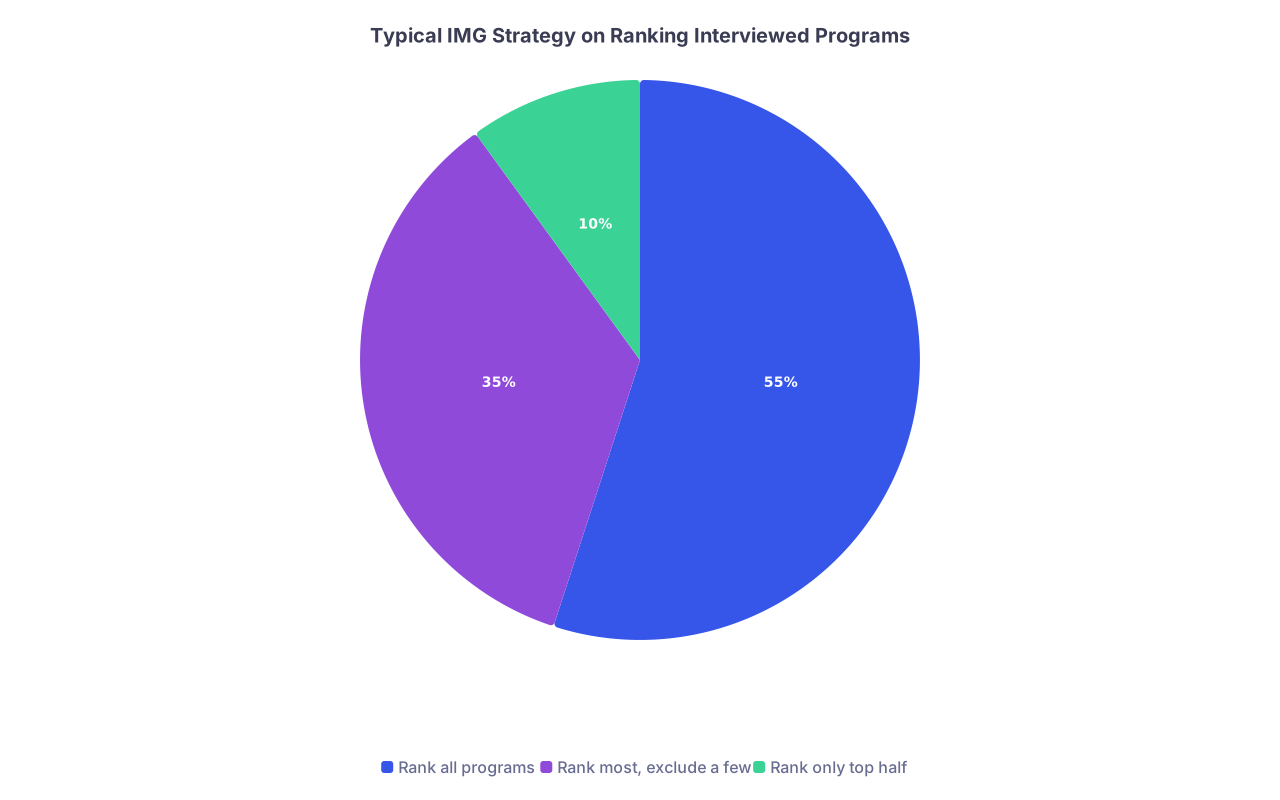
| Category | Value |
|---|---|
| Rank all programs | 55 |
| Rank most, exclude a few | 35 |
| Rank only top half | 10 |
Pros of Ranking All Programs That Interview You (as an IMG)
Let’s walk through why the “rank them all” strategy is usually smart.
1. You Dramatically Increase Your Match Probability
If you’re an IMG with, say, 5–10 interviews, each additional program on your list can be the difference between matching and scrambling for SOAP.
I’ve seen this exact pattern multiple times:
- IMG, 7 interviews, ranks all 7 → matches at #6.
- Same profile, but only ranks “top 4” because of pride or vibes → unmatched.
They didn’t “save” anything by omitting the lower ones. They just removed safety nets.
2. The Algorithm Won’t Punish You For Long Lists
You do not get “penalized” for ranking programs you’re lukewarm about. If you rank Mass General #1 and a small community program #12, you’ll never end up at #12 if #1 (or #2–11) will take you.
The order is what matters. Not the length.
3. Your Interview Was Already Your Screen
You’ve already done some filtering:
- You applied to that program.
- They looked at your file and still invited you.
- You showed up, saw the residents, the hospital, the city.
Yes, you might have doubts. You’re allowed. But most programs that make it through that whole pipeline are at least workable.
4. You May Be Underestimating the Cost of Going Unmatched
Here’s what “I’ll just reapply next year” actually looks like for many IMGs:
- One year of gap on your CV that you must explain.
- VISA complications, expiration, or added risk.
- Loss of clinical relevance (USCE gets stale fast).
- Mental burnout and financial strain.
Would I take a decent but unglamorous community IM program over reapplying from scratch as an IMG? In almost every case, yes.

Cons & Real Risks: When Ranking a Program Is a Bad Idea
Now for the less sugar-coated part. There are programs you shouldn’t rank.
Here are the real reasons to leave a program off your list as an IMG.
1. Seriously Unsafe Training Environment
Not “they seemed disorganized.”
I mean real red flags that risk license, patient lives, or your sanity:
- Residents openly say, “We have no attendings after 5 pm. You’re on your own.”
- Chronic duty hour violations, pressure to falsify hours.
- Constant talk of ACGME citations, probation, or losing accreditation.
- Residents discouraged from reporting errors or mistreatment.
You’re not just there to get a visa or paycheck; you’re building your whole professional foundation. A truly unsafe or chaotic program can burn that down.
If you leave an interview thinking, “I would be scared to have my family treated here,” that’s a strong don’t-rank signal.
2. Complete Mismatch With Your Non-Negotiables
Everyone has preferences. Those don’t matter much. Non-negotiables do.
Non-negotiables might be:
- You must be in a certain geographic region for family/health/legal reasons.
- You have specific religious or safety concerns about a location (e.g., strong discrimination you’ve already experienced).
- You absolutely cannot do nights-only or a schedule the program clearly runs.
If matching at that program would realistically lead you to quit or transfer after a year, it’s better to be honest now.
3. Extreme, Openly Toxic Culture
Every program has some drama. That’s life. I’m talking about red-level dysfunction:
- Current residents strongly advise you not to come. Not subtle hints—direct warnings.
- Open bullying on interview day. Residents mocking others, PD dismissive or condescending.
- Nobody can say a single positive thing about being there when you ask, “What do you like about this program?”
If you think, “I’d burn out or have a breakdown if I spent 3 years here,” that’s not you being soft. That’s you seeing clearly.
4. Ethical Conflicts You Can’t Accept
You see or hear:
- Pressure to “code” documentation in ways you’re not comfortable with.
- Strong hints to manipulate billing, admissions, or discharges.
- Prejudice toward certain patient groups that goes unchallenged.
If being part of that would make you ashamed of your work, skip it.
| Scenario | Recommendation |
|---|---|
| Program is average but safe | Rank it |
| Poor location but solid training | Rank it |
| Strong safety and supervision concerns | Don't rank |
| Residents warn you not to come | Usually don't rank |
| Only dislike: prestige or “brand name” | Rank it |
A Simple Framework to Build Your Rank List (As an IMG)
Let’s make this practical. Here’s how I’d tell an IMG with, say, 8 interviews to build their list.
Step 1: Sort by “Would I Rather Go Unmatched?”
For each program, answer honestly:
- “Match here > go unmatched” → goes on your list.
- “Go unmatched > match here” → leave it off.
Don’t overthink the exact order yet. First pass is just yes/no.
Step 2: Among the “Yes” Programs, Rank By Fit + Training Quality
Now, put the “Yes” group in order.
Factors to prioritize:
- Quality of training: board pass rates, fellowship placement, supervision.
- Resident happiness: did they seem tired-but-functional or dead-inside?
- Geography you can live with.
- VISA support reliability for IMGs (very real for you).
Do NOT over-weight prestige. I’d rather you be in a supportive, mid-tier community program that actually cares about IMGs than at a “big name” where you’re disposable.
Step 3: Stop Gaming the Algorithm
Common IMG mistake: “If I rank this competitive university program first, and they don’t want IMGs, will I fall down the list and lose my chance at others?”
No. That’s not how the algorithm works.
Rank your true #1 first. Then #2. And so on. The algorithm will try each program in your order until one that also wants you is found.
Trying to outsmart the algorithm usually just hurts you.

| Step | Description |
|---|---|
| Step 1 | Interview Completed |
| Step 2 | Do NOT rank this program |
| Step 3 | Add to rank list |
| Step 4 | Compare with other programs |
| Step 5 | Order by training quality, fit, location, visa |
| Step 6 | Submit final rank list |
| Step 7 | Would I prefer this program over going unmatched? |
Special IMG Situations: VISAs, SOAP, and “Desperation Ranking”
VISAs: When You Feel You Have No Choice
IMG reality: your visa can force your hand.
- If you absolutely must match this year or you lose status, your tolerance for less-than-ideal programs may go up. That’s rational.
- But even then, completely unsafe programs that risk your license are not a good visa solution.
Program says they “usually” sponsor but are vague? Ask directly, in writing if needed. If visa support is shaky, that’s a valid reason to lower them or skip them.
SOAP Safety-Net Thinking
If you’re worried about going unmatched and relying on SOAP, remember:
- SOAP spots are extremely limited and chaotic.
- IMGs are at a disadvantage in SOAP.
- Most SOAP programs are not better than the weaker ones that interviewed you.
So don’t secretly think, “I’ll just SOAP into something better.” You probably won’t.
In most cases:
Weak but safe program you already interviewed at > fantasy SOAP outcome.
Desperation vs. Strategy
I’ve seen IMGs rank truly problematic programs because “this might be my only chance.” They ended up:
- Leaving after 1 year with no solid backup.
- Burned out, with worse odds of re-matching.
- Stuck in visa nightmares.
So yes, rank widely. But not blindly.

Red Flag vs. Just “Not My Dream”: Don’t Confuse Them
You need to separate three categories:
Deal-breakers (don’t rank)
Unsafe training, extreme toxicity, ethical violations, absolutely intolerable location/situation.Not my dream, but acceptable (rank lower)
Less prestige, small city, older hospital, not your top academic interest, less ideal call schedule.Genuinely good fit (rank higher)
Supportive faculty, solid training, residents you can see yourself working with.
Most programs you interview at will fall into category 2 or 3. Only a small minority are true deal-breakers. Do not throw category 2 into the trash just because it doesn’t look great on Instagram.
FAQ: IMGs Ranking Residency Programs
1. If I rank a program low, will they see that and hold it against me?
No. Programs have no access to how you rank them. The NRMP keeps lists confidential. They only see where you actually matched, not your full rank order list.
2. I have only 3 interviews as an IMG. Should I rank all three, even if one felt “off”?
Almost certainly yes, unless that “off” was a real deal-breaker (unsafe, toxic, unethical, or unlivable for you). With only 3 interviews, leaving one off can significantly raise your unmatched risk.
3. Can I change my rank list after I certify it?
Yes, up until the ROL deadline. You can modify and re-certify as many times as you want before the cutoff. After the deadline, nothing can be changed—what’s last certified is final.
4. What if I’m not sure if a program is truly unsafe or I’m just anxious?
Talk to multiple current residents separately, not just during the official tour. Ask very direct questions about supervision, hours, and culture. If several people independently give you concerning answers, take that seriously.
5. As an IMG, should I ever intentionally rank fewer programs than I interviewed at for strategy?
No. There is no strategic advantage in ranking fewer programs. Your only legitimate reason to leave a program off is if you would rather go unmatched than train there. Otherwise, rank it—just place it honestly lower on your list.
Key takeaways:
- As an IMG, you should usually rank every program where you’d rather train than go unmatched.
- Only leave a program off if it’s truly unsafe, unethical, or personally unlivable—not just because it’s not your dream.
- The algorithm rewards honest, longer lists. Rank in your true preference order, and let the math work for you.