
It’s late November. You refresh your email for the tenth time in an hour. Your classmates are talking about “blocking out January for interviews,” and you’re counting… three invites. Maybe four. You start doing mental math: “How many interviews do I actually need as an IMG to not end up unmatched?”
Let me give you a straight answer, then we’ll unpack the nuance.
The Short Answer: Target 10–12, Understand 7–8
For most IMGs applying to Internal Medicine, Family Medicine, Psychiatry, Pediatrics, Neurology, and other moderately competitive specialties in the U.S.:
- Around 10–12 solid interviews is where most IMGs start to feel reasonably “safe”
- Around 7–8 interviews is a yellow zone: not hopeless, but absolutely not comfortable
- Below 5 interviews: you are in the danger zone, even with a strong application
If you’re talking about highly competitive specialties (Derm, Ortho, ENT, Plastics, Neurosurgery, Rad Onc, etc.), there is no “safe” number for IMGs. Ten interviews in those can still be risky.
Now let’s go deeper and be specific.
How The Numbers Actually Work (And Why “Safe” Is Tricky)
The NRMP publishes data every year on match outcomes. They break down how many interviews people had and what percent matched.
There are two big reality checks:
- Their “interviews” = programs on your rank list, not just invites
- Data is mostly US seniors and US-IMGs/Non-US IMGs lumped together, so you have to interpret with some caution
But patterns are consistent.
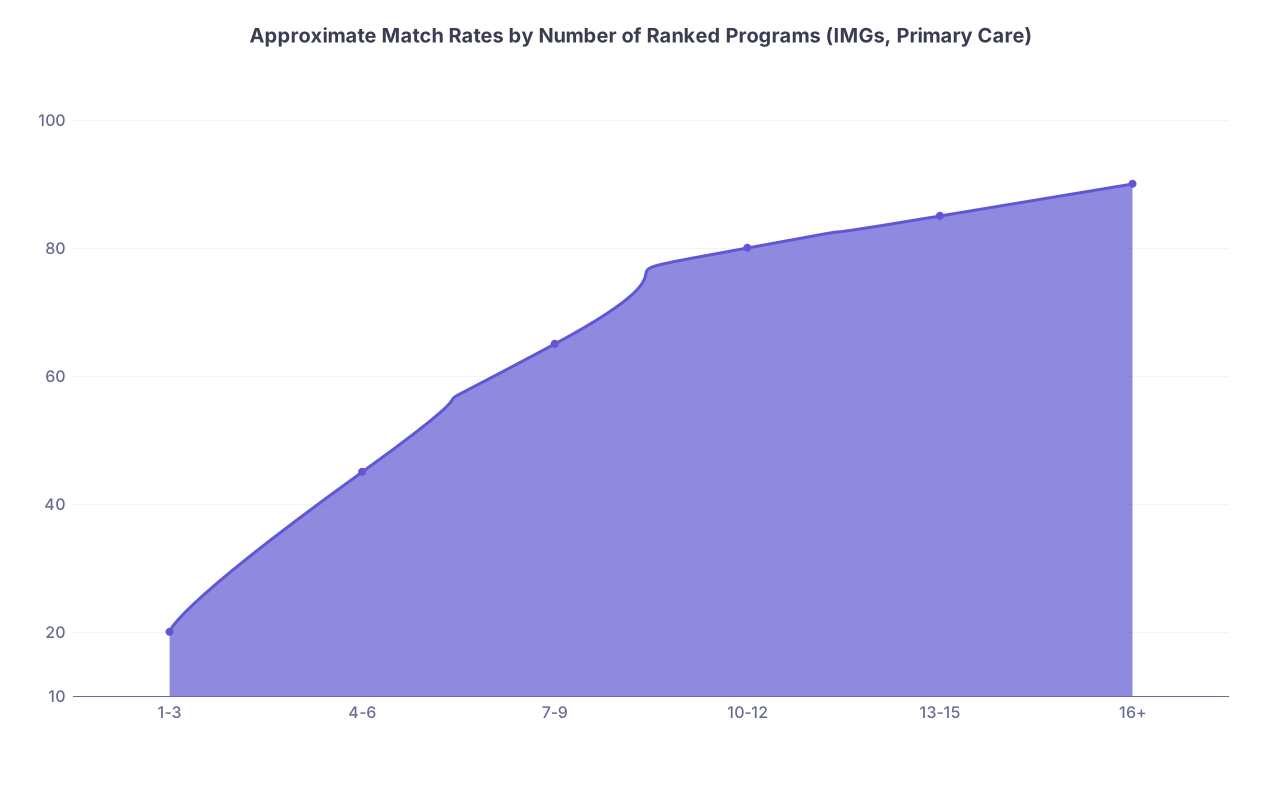
| Category | Value |
|---|---|
| 1-3 | 20 |
| 4-6 | 45 |
| 7-9 | 65 |
| 10-12 | 80 |
| 13-15 | 85 |
| 16+ | 90 |
What this rough pattern tells you:
- 1–3 programs ranked → most IMGs do not match
- 4–6 programs ranked → coin flip territory
- 7–9 programs ranked → odds start tilting in your favor
- 10–12+ programs ranked → most IMGs in primary care do match
“Safe” is not guaranteed. It’s probability. But you are not trying to be cute here—you want to be in the high-probability bracket.
So the working rule:
- As an IMG, treat 10–12 interviews (that you actually attend and can rank) as a realistic safety target for primary care and less competitive fields.
Different “Safe” Numbers For Different IMG Profiles
You’re not just “an IMG.” You’re a specific type of IMG. That matters.
I’ll break it into four rough buckets:
| IMG Type | Specialty Type | Safer Interview Target |
|---|---|---|
| Strong US-IMG | Primary care / less competitive | 8–10 |
| Strong Non-US IMG | Primary care / less competitive | 10–12 |
| Average IMG (gaps / lower scores) | Primary care / less competitive | 12–15 |
| Any IMG | Highly competitive specialties | No true safe number |
1. Strong US-IMG (Caribbean or US-based IMG schools)
Profile: Step 1 pass on first try, Step 2 CK 240+, recent grad, some US clinical experience, decent letters.
- Primary care (IM, FM, Psych, Peds):
If the rest of your app is solid and you’re not weirdly unprofessional on interview, 8–10 interviews is often enough to feel reasonably safe. - Would I relax at 6? No. At 10? You can breathe a little.
2. Strong Non-US IMG
Profile: Non-US school, strong clinical record, Step 2 CK 240+, decent USCE (observership/externship), no major red flags.
- You’re competing with both US grads and US-IMGs.
- 10–12 interviews is where you want to land to feel reasonably safe in IM/FM/Psych.
3. Average or Red-Flag IMG
Profile: Multiple attempts on Steps, >5–7 years since graduation, minimal USCE, or weaker letters.
You can absolutely still match; I’ve seen it many times. But the bar for “safe” is higher:
- If you manage to secure 10+ interviews, you’ve already beaten the odds for your profile.
- I’d call 12–15 interviews a more realistic safety buffer for this group, because programs may rank you lower and you can’t assume you’ll land in everyone’s top half.
4. Any IMG in Highly Competitive Specialties
Derm, Ortho, ENT, PRS, Neurosurgery, integrated IR, etc.
Harsh truth:
There is no number of interviews that is truly “safe” for IMGs here. The match numbers are tiny, and preferences are heavily skewed to US MD seniors.
- Even 10 interviews in these fields doesn’t give the same safety as 10 interviews in IM.
- Most IMGs who match these fields had a combination of: insane scores, serious research, US connections, or a transitional/prelim year that led to an in-house spot.
If you’re in this camp, you should have an honest Plan B, and probably apply to categorical IM/FM as well if you need a match for visa or career reasons.
It’s Not Just “How Many” – It’s “Which” and “How You Do”
Number of interviews is only one dimension. Two other variables change your real safety: the type of programs and your interview performance.
Program Type: All Interviews Are Not Equal
Five IVs at Harvard/Mayo/MGH is not safer than ten IVs at mid-tier community programs that actually rank IMGs highly.
You should feel better if:
- You have multiple community programs in IMG-friendly regions (NY/NJ, Michigan, Illinois, Texas, Florida, etc.)
- Programs explicitly have high percentages of IMGs on their current resident pages
- You have mixed geography (not all in the same competitive metro where everyone applies)
You should not overestimate safety if:
- Your invites are mostly prestigious university programs that only match 1–2 IMGs per year.
- You’re heavily relying on one region or one “dream” program.
Interview Performance: Where People Quietly Blow It
I’ve watched people tank their odds with decent interview numbers.
Red flags on interview day:
- Poor communication or awkward, one-word answers
- Inability to explain gaps, scores, or visa needs without getting defensive
- Sounding uninterested, arrogant, or like you’re using a script
- Generic answers that show no idea what makes that program unique
If you walk out of 10 interviews knowing you fumbled half of them badly, your “safe” number just shrank.
On the flip side, if PDs and residents seem genuinely engaged, ask you to keep them updated, and your interviews feel conversational and positive, your effective safety goes up even if you “only” have 8–9.
Timing: When To Panic, When To Pivot, When To Chill
Here’s the mental framework by month. This is where I’ve seen people either salvage their season or sit frozen and lose their chance.
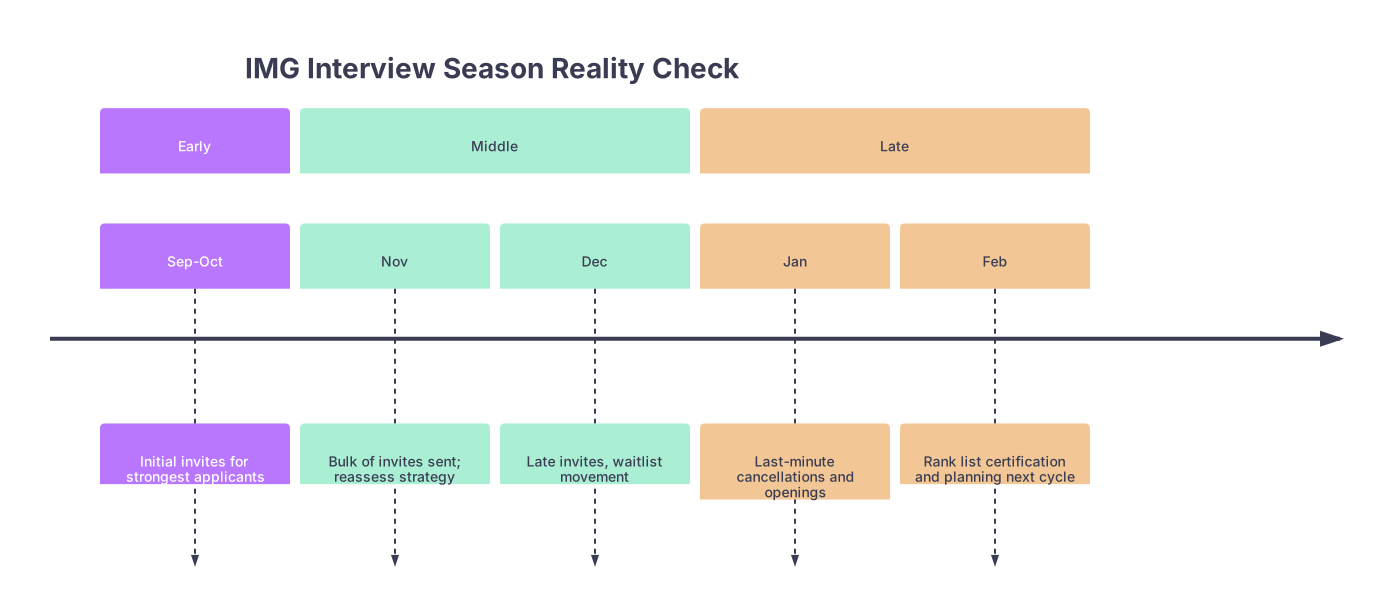
| Period | Event |
|---|---|
| Early - Sep-Oct | Initial invites for strongest applicants |
| Middle - Nov | Bulk of invites sent; reassess strategy |
| Middle - Dec | Late invites, waitlist movement |
| Late - Jan | Last-minute cancellations and openings |
| Late - Feb | Rank list certification and planning next cycle |
By Early November
- Strong IMG with 0–2 interviews:
Start active outreach. Email coordinators, update programs with new scores/USCE, ask for waitlist consideration, leverage any connections. - Strong IMG with 4–5+ interviews:
Not ideal but not catastrophic. Keep applying selectively (SOAP-style backup list), keep networking.
By Early December
- If you have <5 interviews and your app is already out to 80–100+ programs in a primary care specialty:
You should assume this season is high risk. Keep chasing late invites, but also start building a Plan B (research year, prelim year, reapplication strategy). - If you have 7–9 interviews:
Focus hard on preparation and crushing each interview. This range can absolutely match, but you cannot coast.
By January
- Last-minute cancellations open spots.
Stay responsive. Keep your email/phone on. Same-day or next-day interviews can appear. - At this point, if you’re stuck at 3–4 interviews, do everything you can to:
- Not waste those chances
- Prepare for a strong reapplication
Strategy If You’re Below the “Safe” Zone Right Now
If you’re reading this mid-season and your number is low, don’t just panic. Do something.
Here’s the blunt checklist:
Clean up your email / spam / ERAS messages
You’d be surprised how many people miss invites because of this.Send smart, targeted interest emails
Not “please interview me.” Actual updates:- New Step 2 CK score
- New US rotation
- Updated CV or publication And a single, specific sentence on why you like that program.
Leverage any real connections
Alumni from your school at that program. Attendings from your USCE who know someone. This is how most “late” invites happen.Consider applying to additional IMG-friendly programs
Especially:- Community IM/FM in less popular locations
- Programs listed by other IMGs as historically friendly on forums (filter the noise, but there’s some value here)
Perfect your interview game
If you only have 4–6 shots, you don’t get to be “rusty” for the first few.
Do 3–5 serious mock interviews with someone who will actually criticize you.
Special Cases: Visas, Prelims, and Couples
If You Need a Visa (H-1B or J-1)
Visa need doesn’t change the number of interviews you want, but it absolutely affects how “safe” that number is.
- A Non-US IMG needing H-1B with 10 interviews all at visa-friendly programs is much safer than one with 10 interviews where only 3 sponsor visas.
- Track this explicitly. Do not guess.
Prelim / Transitional Year
If you’re applying prelim IM / Surgery as a stepping stone:
- These spots can be more chaotic.
- You might match with fewer interviews, but it’s incredibly variable program to program.
- I still like 8–10+ as a mental target, especially if you’re counting on this for visa.
Couples Match
If you’re couples matching as an IMG (or IMG plus US grad), your “safe” number is higher and messier, because now you’re dealing with pair probabilities.
- Two people with 10 interviews each is not the same as 20 combined.
- If you’re an IMG couple, I’d be nervous with fewer than 12–15 interviews each, unless one partner is very strong at highly IMG-friendly programs.
Quick Reality Table: Where You Actually Stand
Use this as a sanity check for primary care specialties (IM, FM, Psych, Peds) as an IMG:
| Interviews (attended) | Outlook (assuming no huge red flags) |
|---|---|
| 0–2 | Extremely high risk, very unlikely to match |
| 3–4 | Serious danger zone, possible but low odds |
| 5–6 | Borderline; must interview very strongly |
| 7–9 | Decent chance; not guaranteed, but hopeful |
| 10–12 | Reasonably safe for many IMGs |
| 13+ | Strong position, assuming mixed program types |
This is not a promise. It’s a realistic feel based on years of watching IMGs go through this.
FAQ: Common IMG Questions About “Safe” Interview Numbers
1. I’m an IMG with 6 interviews in Internal Medicine. Should I be worried?
Yes, a bit. Six is not catastrophic, but it is not comfortable either. Many IMGs have matched with 6; many have not. You should:
- Treat each interview like it really matters
- Keep chasing late invites through December and even early January
- Prepare aggressively for interviews to avoid wasting any chance
2. Do virtual interviews change how many interviews I need?
They change logistics more than probabilities. Programs might interview a few more people because virtual is easier, but that doesn’t automatically increase your odds. The basic safety ranges (7–9 borderline, 10–12 safer) still hold. The advantage is you’re not limited by travel costs, so you can actually attend more.
3. Are 5 interviews at university programs better than 10 at community programs?
For most IMGs, no. Ten solid community programs that routinely take IMGs are much safer than five big-name university hospitals that match almost all US grads and maybe one IMG when their chair’s nephew from abroad applies. Prestige doesn’t protect you from being ranked low or not at all.
4. I have 9 interviews but they’re all in one state. Is that a problem?
Not automatically. Many applicants match within a single state or region. What matters more is:
- Are they a mix of community and university-affiliated?
- Are they historically IMG-friendly?
- Are you actually interested in ranking all of them?
If yes, 9 in one state can still be a solid, reasonably safe position.
5. Does being a recent graduate vs. older grad change the “safe” number?
Yes. Older grads (5–7+ years since graduation) are often ranked more cautiously, especially with gaps. That means your match probability per interview is a bit lower. In that case, I’d want to be on the higher end—12–15 interviews to feel about as safe as a recent grad with 10–12.
6. Do observerships or externships affect how many interviews I need?
Indirectly. They don’t change the mathematical “safe” number, but they increase your chances of getting interviews and being ranked higher if they lead to strong letters or internal support. An IMG with US hands-on experience and strong letters usually needs fewer applications to get to that 10–12 interview zone, but the target zone itself stays similar.
7. If I only end up with 3–4 interviews, should I still enter my rank list?
Yes. Always submit a rank list. People match from 3–4 interviews every year. Your odds are lower, but they’re not zero. You should rank all programs where you’d be willing to train, then simultaneously prepare a serious backup plan for the next cycle or SOAP if eligible.
Key Takeaways
- For most IMGs in primary care specialties, 10–12 real interviews is a realistic “safer” target.
- Below 7–8 interviews, don’t pretend you’re safe—focus hard on getting more invites and maximizing performance.
- The quality and type of programs, your profile, and your interview performance matter almost as much as the raw number.