
What actually happens to an otherwise strong IMG application if all of your letters are from your home country and none from a big-name US academic center?
Here’s the blunt answer:
You do not need US LORs from academic centers to match. But having strong US LORs—especially from academic centers—can absolutely change how many interviews you get and which tier of programs you’re competitive for.
Let’s break this down like an attending walking you through a consult note: what matters, what helps, what’s optional, and what’s quietly killing some IMG applications.
1. The Core Question: Are US Academic LORs Mandatory?
No, they’re not mandatory. But the details matter.
Residency programs care about three things with letters for IMGs:
- Can this applicant function safely and effectively in a US clinical environment?
- Does any US physician stake their name on this person?
- Is there someone I know or trust vouching for them?
US academic letters are just an efficient way to answer all three “yes.”
If you have:
- Strong scores (or solid pass results)
- No red flags
- Clear clinical experience
You can match with:
- No US academic LORs (for some community programs, certain specialties, certain locations)
- LORs from home-country attendings plus maybe a US community physician
But. You’re probably cutting down your interview volume and capping your ceiling of program competitiveness.
Think of it like this:
| Scenario | Interview Impact |
|---|---|
| No US LORs | Lowest, higher risk filter |
| 1–2 US community LORs | Moderate, some reassurance |
| 1+ US academic LORs | Noticeable boost |
| 2–3 strong US academic LORs + others | Strongest profile |
You can match with any of the first three scenarios. The fourth one is where you start playing in the “match well” category at more competitive programs.
2. What Program Directors Actually Look For in IMG LORs
I’ve watched selection meetings where letters are pulled up and read out loud. Here’s what people actually say.
They are not impressed by:
- “To whom it may concern, I have known Dr. X for 2 weeks and find them to be hardworking and motivated.”
- Generic, adjective-stacked letters from home institutions with no US comparison.
- Professors who clearly barely know you: “Dr. X attended my lectures and was a punctual student.”
They do care about:
- Direct clinical observation: “I supervised Dr. X on the inpatient medicine team for 4 weeks.”
- US context: “Dr. X performed at least as well as our US MD seniors.”
- Specific behaviors: handling cross-cover, calling consults, notes, communication with nurses, response to feedback.
- Clear, comparative statements: “Top 5% of trainees I’ve worked with in the past 5 years.”
Here’s the real hierarchy for IMGs:
- US academic LOR from someone who actually worked closely with you and writes well.
- US community LOR from someone who really knows you clinically.
- Strong home-country LOR with detailed, specific, and comparative content.
- Title-only or vague LORs from big-name people who barely know you.
Notice: #1 and #2 beat #4 every single time. Name-dropping with a weak letter backfires more often than it helps.
3. Academic vs Community Letters: What’s the Real Difference?
Programs don’t have a formal checkbox that says, “Reject if not from an academic center.” That’s not how this works. What academic letters often provide is:
- A familiar institution name (e.g., “Cleveland Clinic,” “UCLA,” “Mount Sinai”)
- A referee who understands how to compare you to US medical students and residents
- Credibility with the PD or faculty who may know or respect the letter writer
But strong community letters can punch way above their weight if they’re detailed and honest.
Here’s how I’d rank real-world impact, assuming all letters are well-written and specific:
- 3 strong LORs from US academic centers: excellent for most specialties
- 2 academic + 1 community US letter: still excellent
- 1 academic + 1–2 community US letters: very good and realistic for many IMGs
- 2–3 strong community US letters (no academic): still solid, especially for community and mid-tier programs
- 0 US letters, all foreign: possible for some programs/specialties, but you’ll be filtered out by a lot
4. Specialty Differences: When Academic US LORs Matter More
Not all specialties treat letters the same way. Some care a lot more about academic pedigree.
Use this as a rough guide:
| Specialty | Value of US Academic LORs |
|---|---|
| Internal Medicine | High (esp. university programs) |
| Family Medicine | Moderate |
| Pediatrics | High |
| Psychiatry | Moderate to High |
| Neurology | High |
| General Surgery | Very High |
| Pathology | High |
| Anesthesiology | High |
If you’re aiming for:
- University-based IM, peds, neuro, path, surgery: US academic letters aren’t technically required, but they’re a major competitive lever.
- Purely community FM or psych: you can do very well with strong community US letters plus good stats.
- Very competitive specialties (derm, ortho, radiology, etc.): as an IMG, no US academic letters is basically playing on hard mode nightmare difficulty.
5. “But My Home Country Letters Are Excellent…”
Good. Keep them. But understand how they’re interpreted.
A strong home-country LOR can:
- Support your clinical foundation and professionalism.
- Show continuity (e.g., a mentor who’s known you for years).
- Add depth about your growth over time or research involvement.
A strong home-country LOR cannot fully substitute for:
- Proof you can function in US-style systems: EMR, documentation, teams, communication style.
- Comparison with US trainees in the same environment.
The safer setup for an IMG aiming to “match well” (not just “maybe match somewhere”) looks like:
- 2–3 US clinical LORs (at least 1 academic if possible)
- 1 strong home-country LOR for continuity and long-term perspective
Most programs will read 3–4 letters. They’ll skim more if you upload extras, but the primary 3 matter most.
6. What If You Can’t Get US Academic LORs?
Let me be direct: some IMGs waste years chasing only university observerships that never materialize, instead of locking down any solid US clinical experience.
If you can’t get academic LORs, here’s how to still build a competitive file:
Maximize any US clinical exposure you can get
- Community hospitals, private groups, outpatient clinics that do real teaching.
- Prioritize hands-on or at least high-involvement roles: notes, presentations, team discussions.
- You want the attending to actually see your work, not just your name on a badge.
Be intentional with letter writers
- Work consistently with fewer attendings rather than superficially with many.
- Tell them clearly: “I’m an IMG applying to internal medicine, I’m hoping for a detailed letter comparing me to US trainees if you feel you can do that honestly.”
- If they hesitate, that’s your signal to find another writer.
Make your CV and personal statement do extra work
- Emphasize adaptability to new systems/environments.
- Explicitly tie your experiences to US medicine: EMR use, QI, evidence-based care, communication with staff.
- Show that you understand US training culture, not just medicine in your own system.
Be strategic about your program list
- Apply heavily to community and community-affiliated university programs that routinely take IMGs.
- Look at current residents’ backgrounds. If nobody there looks like you (education-wise), that’s data.
7. How Many US LORs Do IMGs Really Need?
For most IMGs in core specialties (IM, FM, peds, psych, neuro, path):
- Target: 2–3 US clinical LORs
- Minimum that still feels competitive: 1 strong US LOR + 2 strong non-US LORs
- For academic programs: Aim hard for at least 1–2 academic US letters if you can
- Do not: Submit 5–6 letters hoping “more is better.” Programs don’t have that kind of time.
The quality of each letter matters more than the label “US” or “academic.” But from a risk-reduction standpoint, a strong US academic letter is like an extra layer of insulation on your application.
8. How Strong Does a “Good” US Academic LOR Need To Be?
You’re looking for language like:
- “One of the strongest international graduates I have ever worked with.”
- “On par with our US MD seniors in terms of clinical reasoning and professionalism.”
- “I would be happy to have Dr. X as a resident in our own program.”
- “Dr. X handled cross-coverage calls independently with appropriate judgment and knew when to escalate.”
Versus weak signals like:
- “Dr. X was punctual, respectful, and got along well with staff.”
- “Dr. X completed all assigned tasks.”
- “I have no hesitation in recommending Dr. X.” (With no specifics. That’s basically a shrug.)
You don’t see the actual letter in ERAS, but you can infer some of this by how well the attending knows you and how committed they sound when you ask.
9. Concrete Timeline: When To Secure These Letters
If you’re 12–18 months before applying:
- Prioritize arranging US clinical experiences (start with emails, alumni connections, paid externships if needed, realistic options).
- Aim for at least 2 significant blocks (4 weeks each) in your target specialty.
If you’re 6–12 months out:
- Lock in your letter writers by the end of your rotations.
- Give them:
- Your CV
- Personal statement draft
- A short summary of cases you worked on with them
- A reminder of your timeline (ERAS submission, etc.)
If you’re less than 6 months out and have no US LORs:
- You’re playing catch-up. Look for any short-term observerships, telerotation-style programs, or community rotations, even if not “big-name.”
- One strong letter from a recent US rotation is better than pretending your home-country letters alone will carry you for academic programs.
10. Bottom Line: Do You Need US Academic LORs?
To answer the title question as directly as possible:
Do IMGs need US LORs from academic centers to match at all?
No. Many IMGs match every year with community or foreign letters.Do IMGs need US academic LORs to match well at university or more competitive programs?
Strictly speaking, no—they’re not mandatory.
Practically speaking, they often separate those who get multiple good interviews from those who get screened out early.If you can’t get US academic LORs, are you doomed?
No. But you must:- Secure strong community US letters,
- Apply strategically,
- Accept that certain tiers of programs may be long shots.
If you can get even one solid US academic letter in your specialty, do it. It won’t magically fix weak scores or major red flags, but it will help PDs feel safer giving you a chance.
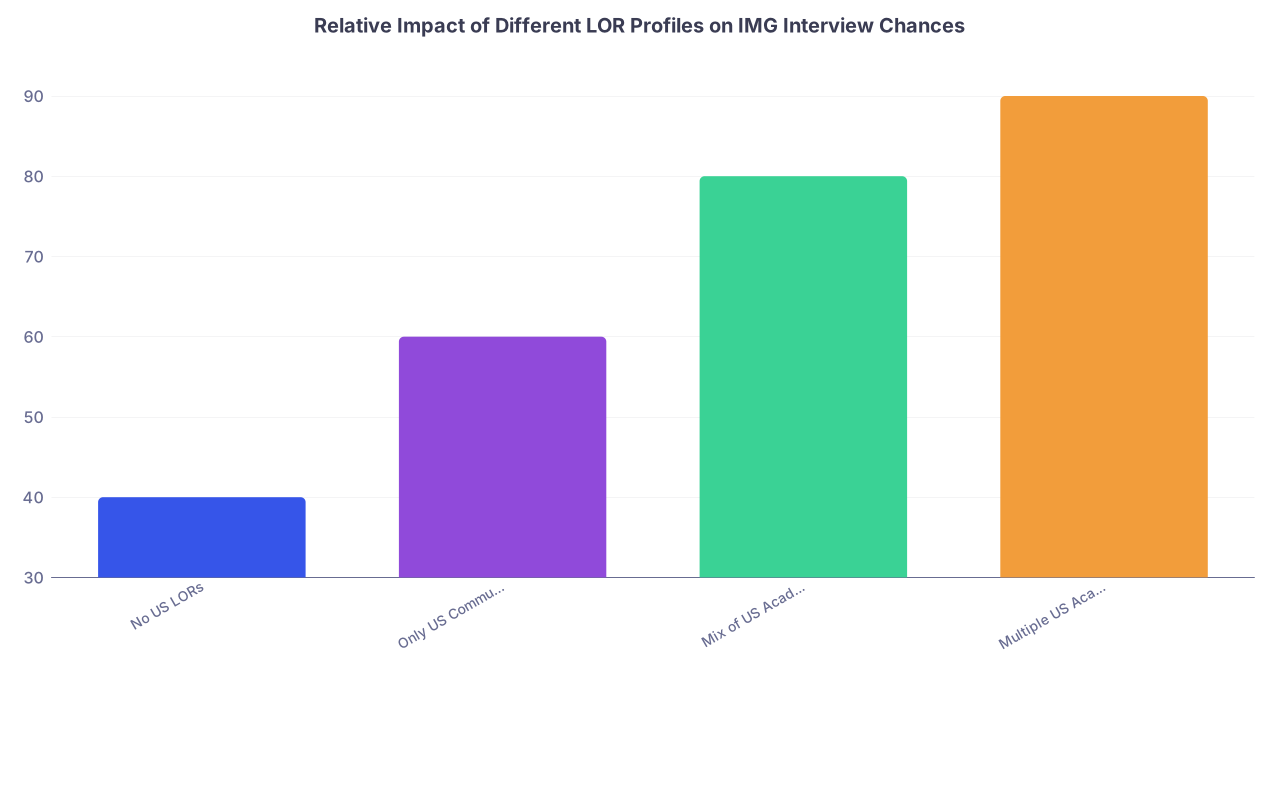
| Category | Value |
|---|---|
| No US LORs | 40 |
| Only US Community LORs | 60 |
| Mix of US Academic & Community | 80 |
| Multiple US Academic LORs | 90 |

| Step | Description |
|---|---|
| Step 1 | IMG Planning to Apply |
| Step 2 | Try to Arrange US Rotations or Observerships |
| Step 3 | Prioritize Academic Rotation in Target Specialty |
| Step 4 | Maximize Community Rotation & Responsibilities |
| Step 5 | Ask 1-2 Attendings for Detailed LORs |
| Step 6 | Ask Strongest Community Attendings for LORs |
| Step 7 | Combine with 1-2 Strong Home LORs |
| Step 8 | Apply Strategically to IMG-Friendly Programs |
| Step 9 | Any US Clinical Experience? |
| Step 10 | Academic Site Available? |
FAQ: IMGs and US Academic LORs
1. I’m an IMG with only home-country LORs but strong scores. Can I still match internal medicine?
Yes, you can, especially in community programs and IMG-heavy institutions. But you’ll likely miss out on some academic programs and more competitive locations. If you have any runway before applying, even one solid US clinical month and a strong letter will materially improve your chances.
2. Is it better to have a weak US academic LOR or a strong home-country LOR?
A strong home-country LOR beats a weak, generic US academic letter. A lukewarm or obviously template-based academic letter can hurt you. Ideally, you combine strong home letters with at least one genuinely strong US letter from someone who observed you closely.
3. Can research LORs from US academic centers substitute for clinical LORs?
They help, but they don’t fully substitute for clinical letters. A research PI can vouch for your work ethic, communication, and intellect, but programs still want at least 2 clinical letters addressing your bedside skills, judgment, and team function. Use a research letter as your 3rd or 4th, not your only US letter.
4. Do letters from private practice physicians carry less weight than academic letters?
Not automatically. A detailed, specific letter from a private hospitalist who clearly supervised your daily care of patients is often stronger than a vague, name-brand academic letter. For academic programs, yes, academic letters are somewhat more influential, but community letters are absolutely respected if they’re substantive.
5. How recent do my US LORs need to be as an IMG?
Within the last 1–3 years is ideal. Older than that and programs start to wonder if your skills are current. If you graduated 5+ years ago, recent US clinical experience plus recent letters (within 12–18 months) becomes especially important to counter the “old grad” concern.
6. What’s one practical way to improve my chances of getting a strong US academic LOR?
During your rotation, pick one attending you work with most and actively ask for feedback: “Is there anything I can improve on to perform at the level of your US students?” Then actually implement their suggestions. Near the end of the rotation, remind them of specific cases you handled, and directly ask if they’d feel comfortable writing a strong, detailed letter comparing you to US trainees.
Now, your next step: list your current and potential letter writers on a piece of paper today. Next to each name, label them: home, US community, or US academic—and how well they know you (1–10). That’s your starting map. Where are the gaps?