
You’re one year from finishing medical school abroad. Your friends are scrambling for internships back home. You, meanwhile, have twenty tabs open: ERAS, Step 2 CK forums, “US research positions for IMGs,” and one terrifying Reddit thread saying any “gap” in medical education is a red flag.
A PI has just replied to your email. They might have a spot in their lab for a 1‑year research position. Unpaid, of course. You’re staring at the message thinking:
If I take a research year, will programs see me as motivated—or as someone who couldn’t match?
Here’s the answer you actually need: a research gap year can be either a smart move or a disaster for an IMG. It depends on three things: your current profile, how you structure that year, and how you explain it.
Let’s break this down like a program director would.
1. Do Programs See a Research Gap Year as a Red Flag for IMGs?
They can. But not automatically.
Here’s how US program directors tend to think about “gaps”:
- Clinical gap (no patient care, no real medical activity): high suspicion
- Structured, explained year (research, MPH, fellowship, etc.): neutral to positive
- Unexplained year (“personal reasons,” nothing documented): big red flag
For IMGs, the default bar is already higher. Programs are asking:
- Have you stayed clinically and academically active?
- Are you moving steadily toward residency, or bouncing around?
- Are you using time to strengthen your application—or hiding a weakness?
So if your “gap” is:
“I did a one-year structured research position at a US institution, published 3 abstracts, got strong US letters, and then applied”
That is not a red flag. That is a story that makes sense.
Where it becomes a problem:
- You label it “research year” but have nothing to show—no outputs, no clear mentor, vague timeline.
- You stack multiple gap years back-to-back with thin justification.
- You stop all clinical activity and show no effort to maintain clinical skills.
Programs do not hate research years. They hate unexplained or unproductive time that suggests low drive or poor judgment.
2. When a Research Gap Year Is Clearly a Good Idea
If you’re an IMG and you see yourself in any of these buckets, a research year can be a strong move.
A. You’re Targeting Competitive Specialties
Think: dermatology, radiology, neurology at “name” institutions, academic internal medicine (university-based), some subspecialty-leaning programs.
If you’re aiming for:
- University of Michigan Internal Medicine
- Mayo Clinic Neurology
- Academic IM with strong cardiology or heme/onc
You’re competing with US grads who often have 10+ pubs, first-authorships, and big-name mentors.
In that world, a research year that gives you:
- Multiple abstracts/posters/oral presentations
- 1–3 pubs (even case reports, if good quality)
- A strong letter from a recognizable US academic
…is not optional. It’s your ticket into that tier.
B. You Need to Fix a Step Score Problem
You cannot erase a low Step score with research. But you can:
- Show you are resilient and can produce high‑level work despite earlier setbacks.
- Get a US mentor who will say, “Yes, their score is X, but they’re one of the hardest working people I’ve had in my lab.”
- Demonstrate consistent productivity and attention to detail.
If your profile is:
- Step 1 pass (OBVIOUSLY)
- Step 2 CK borderline or low for your target specialty
- Minimal US clinical experience so far
A research year + strong Step 2 (if you haven’t taken it yet) + US letters can move you from “auto‑reject” to “let’s at least look closer.”
C. You’re Switching Specialties
Classic scenario: You started on a surgery path back home, then realized you want internal medicine in the US. Or you did psychiatry in your country and now want neurology here.
A research year in your target specialty:
- Explains the pivot (“I became increasingly interested in X and spent a dedicated year focusing on it.”)
- Gives you specialty-aligned publications.
- Helps you build letters from attendings in the field you’re now targeting.
That narrative makes sense to selection committees.
3. When a Research Gap Year Is a Bad Idea or Overkill
Now the part most people do not want to hear.
There are absolutely cases where a research year is a waste of time, money, and emotional energy.
A. You Want Community IM/FM and You Already Have a Decent Profile
If your stats look like:
- Step 1 pass, Step 2 CK ≥ 235 (or solid for your country’s cohort)
- Graduation within the last 2–3 years
- Some US clinical experience (2–3 months of electives/observerships)
- Okay letters (at least one US letter)
…and your target is:
- Community Internal Medicine
- Family Medicine
- Some mid‑tier community-based programs
You do not need a research gap year to match. You need:
- A good Step 3 (if taken)
- More targeted, broad applications
- Strong personal statement and solid interviews
In this situation, a research year might help you get into a more academic program, but if your real goal is simply to match to IM or FM in the US, it’s often not worth delaying your life.
B. You Are Already 5+ Years Out From Graduation
Big one for IMGs.
Programs get nervous about people 5–7+ years out from medical school. Every extra “gap” year adds to that concern.
If you graduated in 2017 and you’re considering doing a research year in 2026:
- Many programs will already filter you out by “year of graduation.”
- Another non‑clinical year will push you closer to 10 years out.
Here, a better path is often:
- Get US clinical experience ASAP.
- Take/retake necessary steps (Step 2 CK, Step 3).
- Apply broadly sooner rather than later.
A research year might look like hiding the fact that you haven’t been clinically active.
C. The Position Is Poorly Structured or Exploitative
Red flags on the actual research offer:
- No clear PI/mentor.
- No defined projects—“We’ll see what comes up.”
- No record of past IMGs from that lab matching into anything.
- 60–80 hours/week of pure data entry with zero chance of authorship.
That is not a research gap year. That is cheap labor.
A good research year has:
- A PI who sends people to residency regularly.
- Concrete projects where your name will actually be on outputs.
- A mix of responsibilities—not just data entry, but manuscript work, presentations, meetings.
4. What Makes a Research Gap Year Look GOOD on Your Application?
Programs judge the year on outcomes, not intentions.
If you’re going to do it, you need to treat it as a high‑stakes one‑year project with clear deliverables.
| Aspect | Strong Year | Weak Year |
|---|---|---|
| Publications | 1–3+ pubs or accepted manuscripts | 0–1 low-quality abstracts |
| Presentations | National/regional conferences | None or minor local posters |
| Letters | 1–2 detailed US academic letters | Generic or non-academic letters |
| Role | Manuscript writing, analysis, ideas | Pure data entry or chart review |
| Narrative | Clear story tied to specialty | Vague “I was just doing research” |
Core elements of a strong research year for IMGs:
Clear specialty alignment
If you want IM → do IM research.
If you want neurology → do neuro research.
“Generic” research is better than nothing, but alignment gives your story weight.Documented productivity
You do not need 10 papers. You do need something real:- 1–3 manuscripts (submitted/accepted)
- Several abstracts/posters at known meetings (ACP, AAN, ACC, etc.)
Strong, name-recognizable letters
One excellent letter from a US academic in your specialty is worth more than three generic letters from people the program has never heard of.Minimal clinical drift
If possible, combine research with limited clinical exposure (observer shifts, teaching conferences, patient-oriented projects).
Shows you’re still engaged with medicine, not just spreadsheets.
5. How Programs Actually Read a “Research Gap Year” in Your Timeline
Here’s roughly how the story lands when they look at your ERAS timeline:

| Step | Description |
|---|---|
| Step 1 | Medical School Timeline |
| Step 2 | Standard Application |
| Step 3 | Look at Activities |
| Step 4 | Publications, Letters, Specialty Fit |
| Step 5 | Unclear Gap / Red Flag |
| Step 6 | Neutral to Positive Impression |
| Step 7 | Negative Impression |
| Step 8 | Gap Year? |
| Step 9 | Research Year Structured? |
Your job is to make sure your year clearly lands in the “structured, productive, specialty-aligned” box—so the gap transforms from a concern into a reason to believe in you.
6. How to Decide: Do YOU Need a Research Gap Year?
Here’s a simple framework. Be honest with yourself.
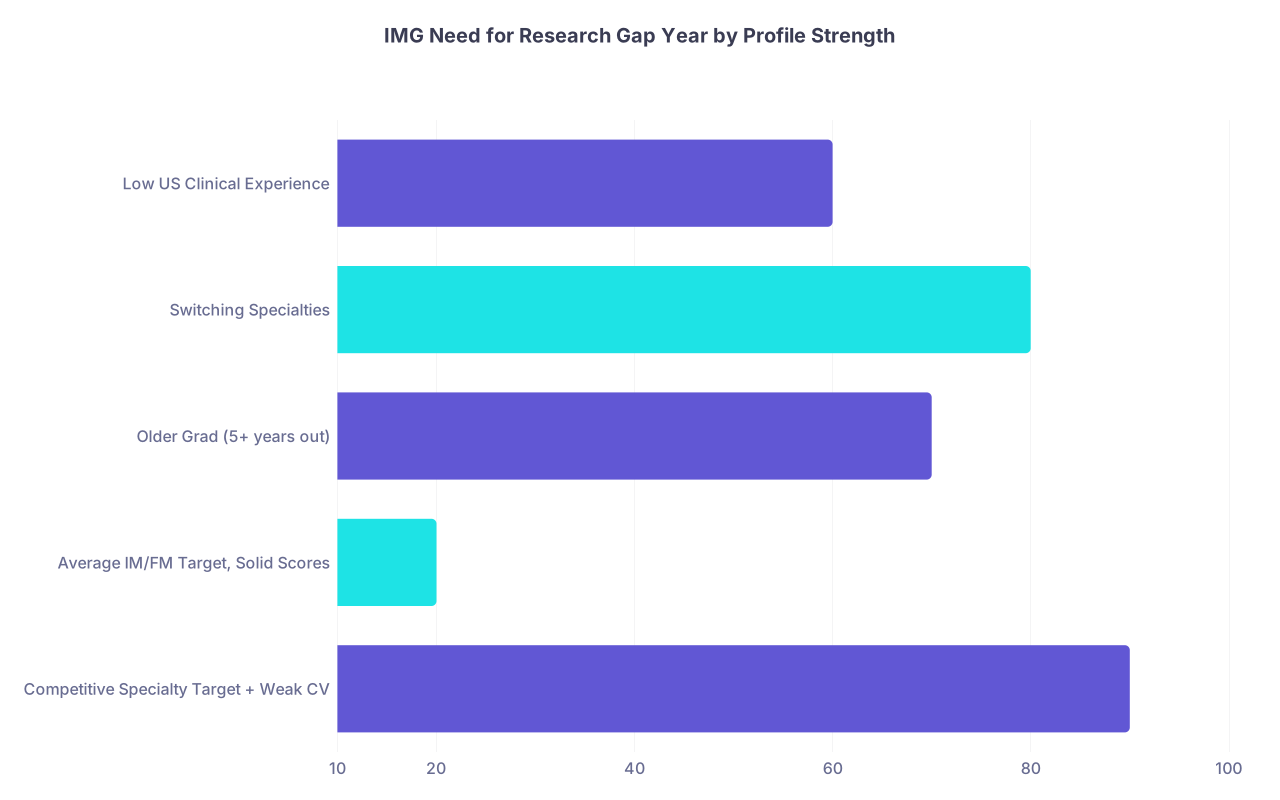
| Category | Value |
|---|---|
| Competitive Specialty Target + Weak CV | 90 |
| Average IM/FM Target, Solid Scores | 20 |
| Older Grad (5+ years out) | 70 |
| Switching Specialties | 80 |
| Low US Clinical Experience | 60 |
Think about four questions:
What specialty and tier are you realistically targeting?
- Academic IM, neuro, radiology, etc., at name‑brand places → research year can be high-yield.
- Community IM/FM where Step filters are king → research may be optional.
What’s your real weakness?
- If it’s lack of research and academic involvement → research year makes sense.
- If it’s low scores, old graduation year, poor communication, or lack of US clinical experience → research alone won’t fix that.
What’s your time since graduation and clinical activity status?
If you’re already 4–5+ years out and not clinically active, adding another non-clinical year may hurt more than help.Can you secure a genuinely good research position?
If you can’t get into a lab/team with a track record and decent mentorship, the ROI drops dramatically.
If you answer:
- “Competitive specialty,”
- “I have zero research,”
- “I’m relatively recent grad,”
- “I can get into a real research group at Hospital X or University Y”
Then yes, a research gap year is likely a net positive.
7. How to Explain a Research Gap Year So It Strengthens You
You need a clean narrative you can repeat in your personal statement, interviews, and letters.
Bad version:
“I couldn’t match so I just did some research while I reapplied.”
Better version:
“After medical school I recognized that I wanted an academic career in internal medicine. I took a dedicated research year at [Institution] in [field] where I focused on [simple description]. During that year, I presented at [conference], contributed to [papers], and worked closely with US attendings. It confirmed my interest in [subfield] and improved my skills in [relevant things—critical appraisal, communicating results, working in multidisciplinary teams].”
Core principles:
- Make it sound planned—even if it originally wasn’t.
- Tie it to your future goals (academic medicine, subspecialty, teaching).
- Point to concrete outcomes: “This led to X, Y, Z.”

8. If You Don’t Do a Research Year—What Should You Focus On Instead?
Some of you reading this are thinking, “I can’t afford a year of unpaid research in the US.” That’s valid. It’s a privilege move, frankly.
If a research year isn’t realistic or strategic for you, then double down on what actually moves the needle for IMGs:
- Strong Step 2 CK (and Step 3 if possible before applying)
- Solid US clinical experience (observerships, electives, hands‑on where legal)
- Good letters from US clinicians who have actually seen you work
- Applying broadly and smartly—right specialties, right mix of community and university‑affiliated programs
- Clear, honest personal statement without weird unexplained gaps
The worst thing you can do is drift for a year doing “a bit of this and that” and call it a research year. Either commit properly or focus on building the parts of your application that matter more for your situation.
9. Quick Reality Check: What Programs Actually Care About
For IMGs applying to US residency, most programs prioritize:
, Research & Publications](https://cdn.residencyadvisor.com/images/articles_svg/chart-program-priorities-for-img-applicants-6657.svg "Program Priorities for IMG Applicants")
| Category | Value |
|---|---|
| Exam Scores/Passing Status | 30 |
| Year of Graduation & Gaps | 20 |
| US Clinical Experience | 25 |
| [Letters of Recommendation](https://residencyadvisor.com/resources/img-residency-guide/the-soft-signals-pds-look-for-in-img-recommendation-letters) | 15 |
| Research & Publications | 10 |
Research is not at the top of the list for most community programs. It becomes more important as you move toward:
- Academic institutions
- Competitive specialties
- Subspecialty-focused internal medicine programs
So the question isn’t “Is research important?” It’s “Is research the best way to improve my odds, given my scores, graduation year, goals, and resources?”
10. Bottom Line: Is a Research Gap Year a Good Idea or a Red Flag?
Condensed answer:
- A structured, productive, specialty‑aligned research year at a real institution → for many IMGs, especially those targeting academic programs or competitive specialties, this is a good idea and not a red flag.
- A vague, unproductive, poorly documented “research” gap → this absolutely looks like a red flag and can hurt you.
- If your main weaknesses are scores, old graduation year, or lack of clinical exposure, research alone will not rescue you.
If you’re going to do it, treat the year like a high‑stakes project with clear deliverables: publications, presentations, letters, and a coherent story.

Key points to walk away with:
- A research gap year is only an asset if it’s structured, productive, and clearly tied to your specialty and future goals.
- For many IMGs targeting community IM/FM with solid scores and recent graduation, a research year is optional at best and sometimes a distraction.
- The real “red flag” isn’t the word “gap”—it’s having a year you cannot explain with concrete outcomes, activity, and a clear narrative.