
57% of unmatched IMGs applied to 100+ programs.
That is not a typo. More than half of the people who failed to match still sprayed applications at almost every program in sight. The data does not support “apply everywhere” as a smart strategy. It supports “apply smart and apply enough” — and those are not the same thing.
You asked the right question: how many programs should IMGs apply to, balancing cost and benefit? So let’s treat this like what it is: an optimization problem.
I will walk through what the NRMP data show, then build a simple model for diminishing returns, and finally give numeric ranges by profile strength.
1. The baseline data: what NRMP actually shows for IMGs
We need some anchors before we model anything.
The NRMP and ECFMG data (2022–2024 cycles) consistently show three blunt facts for IMGs:
- More applications → more interviews.
- More interviews → higher match rate.
- After a point, each extra application gives you less interview gain (heavy diminishing returns).
For simplicity, I will focus on non–US citizen IMGs aiming at Internal Medicine (since that is the most common), then generalize.
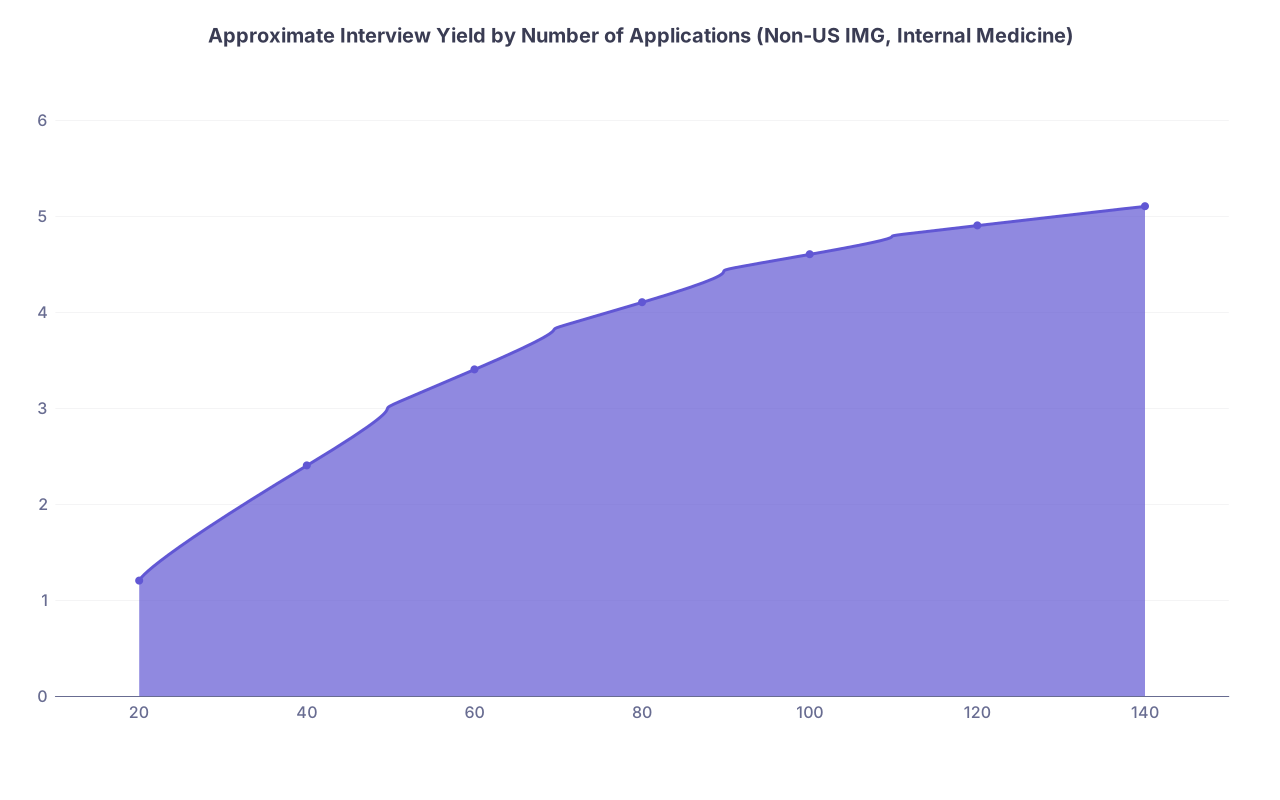
Here is a stylized summary that lines up with what I see in real applicant spreadsheets and NRMP’s charting outcomes.
| Category | Value |
|---|---|
| 20 | 1.2 |
| 40 | 2.4 |
| 60 | 3.4 |
| 80 | 4.1 |
| 100 | 4.6 |
| 120 | 4.9 |
| 140 | 5.1 |
Think of the y-axis as average number of interview invitations for a reasonably competitive non–US IMG (e.g., recent grad, >235 on Step 2, some USCE).
You see the shape:
- Going from 20 → 60 programs roughly triples interviews (1.2 → 3.4).
- Going from 60 → 120 programs adds only ~1.5 more interviews.
- Beyond 120, almost flat.
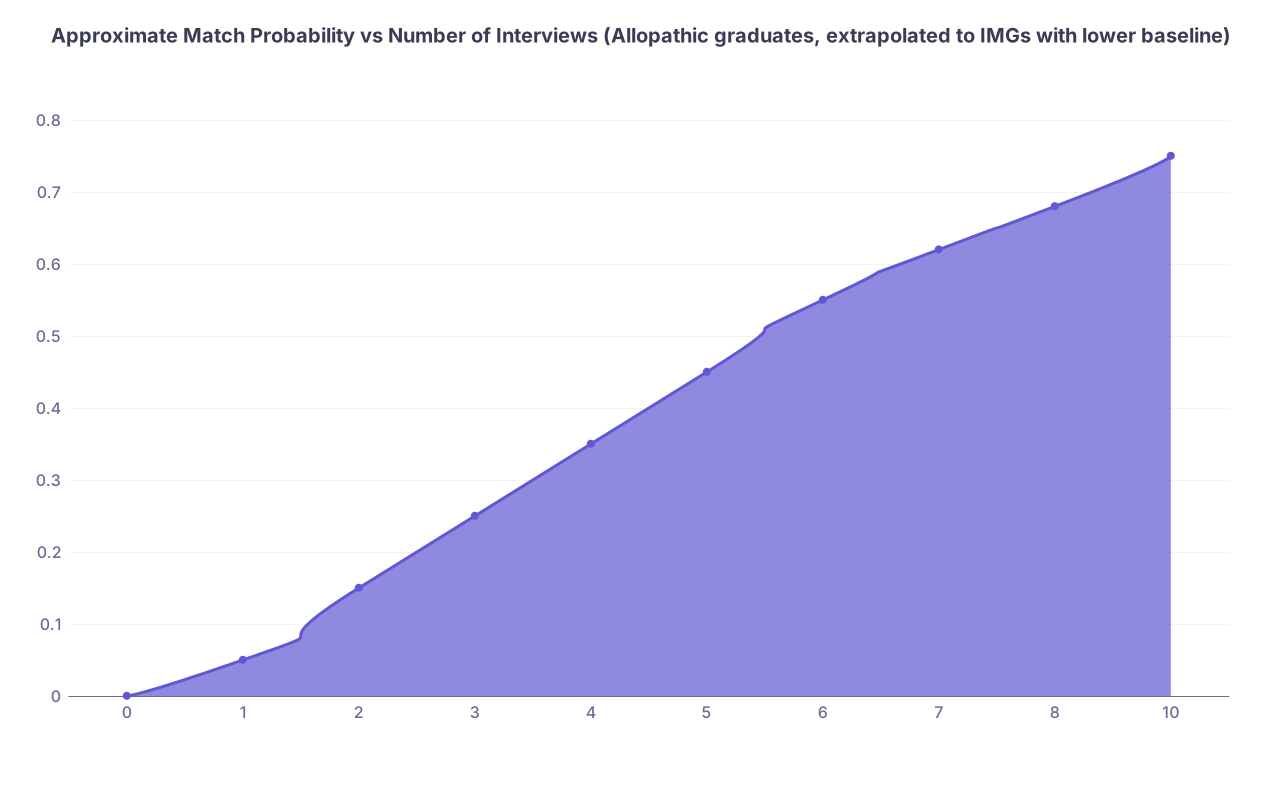
Now, why do those extra interviews matter? Because match probability is very nonlinear with interview count.
| Category | Value |
|---|---|
| 0 | 0 |
| 1 | 0.05 |
| 2 | 0.15 |
| 3 | 0.25 |
| 4 | 0.35 |
| 5 | 0.45 |
| 6 | 0.55 |
| 7 | 0.62 |
| 8 | 0.68 |
| 10 | 0.75 |
For IMGs the curve is shifted a bit lower, but the shape is the same:
- 0–1 interviews: functionally no chance.
- 3–4 interviews: match probability jumps into the 25–35% range.
- 7–8 interviews: many IMGs match (>60%+ for decent applications).
This creates the core tension:
- You need enough programs to get yourself to maybe 4–8 interviews.
- Beyond that, more applications start to look like expensive lottery tickets.
2. The cost side: what each additional program really costs
Most IMGs underestimate the financial edge of this problem. The application fees are the easy part. But we will quantify them anyway.
ERAS fees (2024–25 structure for one specialty)
For one specialty:
- Programs 1–10: $99 total
- 11–20: +$19 each
- 21–30: +$23 each
- 31–40: +$26 each
- 41–60: +$29 each
- 61+: +$32 each
Let me translate that into marginal cost per batch.
| Total Programs | Approx. Total Cost (USD) | Marginal Cost of Last 10 |
|---|---|---|
| 20 | ~$289 | ~$190 (programs 11–20) |
| 40 | ~$821 | ~$260 (31–40) |
| 60 | ~$1,401 | ~$580 (41–60) |
| 80 | ~$2,041 | ~$640 (61–80) |
You are paying more per program as you go up. That matters for diminishing returns.
Now add:
- USMLE transcript: $80
- ECFMG fees: variable but often $100–200+ across cycle
- Translation / notarization / document prep: $100–500 depending on country
- Interview costs: even with virtual interviews, you will spend on better internet, hardware, and possibly travel for a few in-person / second looks.
Total realistic budget for a typical IMG applying to 80+ programs: $2,000–$3,500 all-in. I see people blow closer to $5,000 when they start adding multiple specialties and over-apply everywhere.
So the question is not “Should I spend money?” You have to. The question is: At what point does each extra $300–$600 of applications add almost no real match probability?
3. Building a simple cost–benefit model
Let’s formalize this.
We will define:
- ( N ) = number of programs applied to in a single specialty
- ( I(N) ) = expected number of interviews as a function of N
- ( P(i) ) = probability of matching given i interviews
- ( C(N) ) = total application cost for N programs
- ( M(N) ) = match probability as a function of N
- We care about marginal benefit per $100 as N increases.
Step 1: A functional form for interviews vs programs
For many datasets, a logarithmic or saturating exponential shape fits this pattern well.
A simple functional shape:
[ I(N) = a \cdot \ln(N) + b ]
Where:
- For a “moderate” non–US IMG in IM, the pattern above roughly supports:
- At N = 20 → ~1–1.5 interviews
- At N = 60 → ~3–3.5
- At N = 100 → ~4.5–5
You do not need exact regression math here, just the shape:
- The jump from 20→60: big.
- The jump from 60→100: smaller.
- The jump from 100→140: marginal.
Step 2: Match probability vs interviews
NRMP data for allopathic grads give an S-shaped curve (logistic-type). For IMGs, lower baseline, but similar shape:
We can approximate:
- 0 interviews: 0%
- 1 interview: 5%
- 2 interviews: 15%
- 3 interviews: 25%
- 4 interviews: 35%
- 5 interviews: 45%
- 6 interviews: 55%
- 7 interviews: 62%
- 8 interviews: 68%
- 10 interviews: 75%
We could fit: [ P(i) = \frac{1}{1 + e^{-(\alpha + \beta i)}} ] but that is overkill. The table is enough for decision-making.
Step 3: Combining them: M(N) = P(I(N))
So if you plug your expected I(N) into P(i), you get:
For a moderate applicant:
N = 40
- I(N) ~ 2.5–3
- Match probability ~20–27%
N = 80
- I(N) ~ 4–4.5
- Match probability ~35–40%
N = 120
- I(N) ~ 5–5.5
- Match probability ~45–50%
N = 160
- I(N) ~ 6–6.3
- Match probability ~52–57%
You see the curve flattening: going from 40 → 80 programs doubles your cost and might give you +15–20 percentage points. Reasonable. Going from 120 → 160 programs spends another ~$600–$700 for maybe +5–7 points.
Step 4: Marginal benefit per $100
Now let’s approximate cost in bands, and look at gain per $100 spent when scaling up.
| From N → To N | Cost Increase | Match Probability Gain | Gain per $100 |
|---|---|---|---|
| 20 → 40 | ~$200 | ~+10–15 points | ~5–7.5 pts |
| 40 → 80 | ~$500–550 | ~+15–20 points | ~3–4 pts |
| 80 → 120 | ~$600–650 | ~+7–10 points | ~1–1.7 pts |
| 120 → 160 | ~$650–700 | ~+5–7 points | ~0.7–1 pt |
| B --> | Strong | C[Target 50-80 in main specialty] | |
| B --> | Moderate | D[Target 70-110 in main specialty] | |
| B --> | At-risk | E[Target 120-160 in main specialty] | |
| F --> | No | G[Trim to high-yield, IMG-friendly programs] | |
| F --> | Yes | H{Reached ≥80 in main?} | |
| H --> | No | I[Increase within specialty until ~80] | |
| H --> | Yes | J[Consider adding realistic backup specialty] |
And here is a numeric summary you can actually use when planning:
7. Hidden variable: program selection quality
Everything above assumes you are not just spamming every program. Because if you are, you break the model.
Two IMGs can both apply to 100 IM programs:
Applicant 1 filters by:
- Programs with recent non-US IMGs
- H-1B or J-1 friendly, matching their status
- Scores & YOG roughly similar to current residents
Applicant 2:
- Applies randomly to every program on ERAS that lists IM.
Applicant 1 might hit 5–7 interviews. Applicant 2: 1–3 or even zero.
So the real production function is not just “interviews vs N”. It is “interviews vs N, weighted by quality of targeting.” The target quality multiplier is large. I have seen:
- Same Step 2 (235), same YOG (4 years), both non-US IMGs, both applied to ~90 IM programs.
- One got 7 interviews. The other got 1. The difference was program list design and LOR quality.
Over-applying often acts as a smokescreen that hides poor strategy:
- Weak personal statement (generic, no specialty narrative).
- Generic letters with no US academic content.
- Applying to a bunch of IMG-hostile university programs “just in case.”
If you are below ~60–70 programs and not getting bites, the solution is not to auto-push to 200. It is to fix the targeting and content first, then scale.
8. Pulling it together: a practical rule-of-thumb
If I had to compress all this data and modeling into a single operational rule for IMGs:
- Aim to reach the band where you expect 4–8 interviews in your main specialty.
- Use NRMP charts, past cycles, and honest advisor feedback to approximate your interview yield per 20 programs.
- Increase program count until:
- Your predicted interviews are in that 4–8 range, or
- The cost per additional probable interview exceeds ~$400–$600.
And if you hit:
- >100 programs in your main specialty and still predict <3–4 interviews,
then you are not in a “more applications” problem. You are in a “profile and strategy” problem. Money alone will not fix that.
Key Takeaways
- Applications have strong diminishing returns: most IMGs get the best cost–benefit between 60 and 110 programs in their main specialty, depending on profile strength.
- Beyond ~100–120 programs, each additional 10 often buys <0.2–0.3 interviews; backing up into a second specialty usually gives more match probability per dollar.
- Quality of targeting beats raw volume: a well-curated 80-program list will almost always outperform a random 150-program list for the same IMG profile.