Understanding ECFMG Certification as a US Citizen IMG
For a US citizen IMG (international medical graduate)—often an American studying abroad—ECFMG certification is the bridge between your international medical school and postgraduate training in the United States. It validates that your medical education meets US standards and that you’ve passed the required licensing exams for entry into an ACGME-accredited residency.
Key points upfront:
- You must be ECFMG certified to start any ACGME-accredited residency in the US.
- The certification process is multi-step and can take 12–24 months from the first exam to receiving the certificate.
- As a US citizen IMG, you avoid visa issues, but you still compete directly with US MD/DO and non-US IMG applicants—so timing and strategy are critical.
This guide will walk you through:
- What ECFMG certification is and why it matters
- The current ECFMG requirements and exam roadmap
- Strategic timelines specifically for Americans studying abroad
- Common pitfalls and how to avoid delays
- Practical tips to align ECFMG certification with residency applications
What Is ECFMG Certification and Why It Matters
The Educational Commission for Foreign Medical Graduates (ECFMG) is the organization that certifies international medical graduates for eligibility to enter US residency training.
What ECFMG Certification Confirms
ECFMG certification is not a medical license; it is a credential stating that:
Your medical school is recognized
- ECFMG verifies that your school and your degree are acceptable under current ECFMG requirements for medical school accreditation, graduation, and listing.
- Your school must be listed in the World Directory of Medical Schools (WDMS) with an ECFMG-eligible note.
You’ve passed required exams
Historically this meant Step 1, Step 2 CK, and Step 2 CS. The landscape has changed:- USMLE Step 1 – Required; now Pass/Fail.
- USMLE Step 2 CK – Required; numerically scored and extremely important for residency selection.
- Clinical/communication assessment – Replaced Step 2 CS. ECFMG has implemented Alternative Pathways and OET Medicine requirements that evolve over time; you must follow current policy for your application year.
Your credentials are primary-source verified
- ECFMG must receive and verify your final medical diploma, and often your transcript and other documentation, directly from your school.
Why US Citizen IMGs Need to Prioritize ECFMG Early
As a US citizen IMG, you may feel “safe” because you don’t need a visa. However:
- Programs still require ECFMG certification at the time you start residency (July 1st for most programs).
- Many programs prefer or require passed exams before applying.
- ECFMG processing times can threaten your ability to start residency if you cut it too close.
Aligning your ECFMG timeline with ERAS and NRMP deadlines is non-negotiable if you want a smooth path to the Match.
Core ECFMG Requirements and Exam Strategy
Before you dive into “how to get ECFMG certified,” make sure you fully understand the components you must complete.
1. Medical School Eligibility
Step 1: Confirm your school’s status as early as possible.
- Go to the World Directory of Medical Schools (WDMS).
- Search for your school.
- Check that:
- The school is currently listed.
- The “ECFMG Sponsor Note” (or similar wording) indicates your school’s graduates are eligible for ECFMG certification.
If your school does not meet these criteria, your path to US residency may be blocked or severely limited. Do not delay this check.
Special note for Americans studying abroad:
- Newer Caribbean, Eastern European, or Asian schools may have changing statuses.
- Some schools lose eligibility or face accreditation issues—this can affect your ability to become certified even if you’ve already enrolled.
- Ask your Dean’s office about prior graduates’ success with ECFMG and US residency placement.
2. USMLE Exams Required for ECFMG
At the time of writing, typical ECFMG requirements for exams include:
- USMLE Step 1 – Must be passed.
- USMLE Step 2 CK – Must be passed.
- Clinical/communication demonstration – Fulfilled by ECFMG’s current framework (often including OET Medicine and/or an approved pathway). Requirements change; always confirm on ECFMG’s website for your specific cycle.
Strategic notes for US citizen IMGs:
- Step 1 (Pass/Fail):
- Your goal is a solid pass on first attempt.
- Because scores are no longer reported, program directors will lean heavily on Step 2 CK, clinical performance, and MSPE/letters.
- Step 2 CK (Scored):
- As an American studying abroad, this is your flagship metric.
- Competitive specialties (derm, ortho, plastics) may be unrealistic from many IMG schools without exceptional results and research.
- For primary care (FM, IM, peds, psych), strong Step 2 CK and US clinical experience can offset some school-related disadvantages.
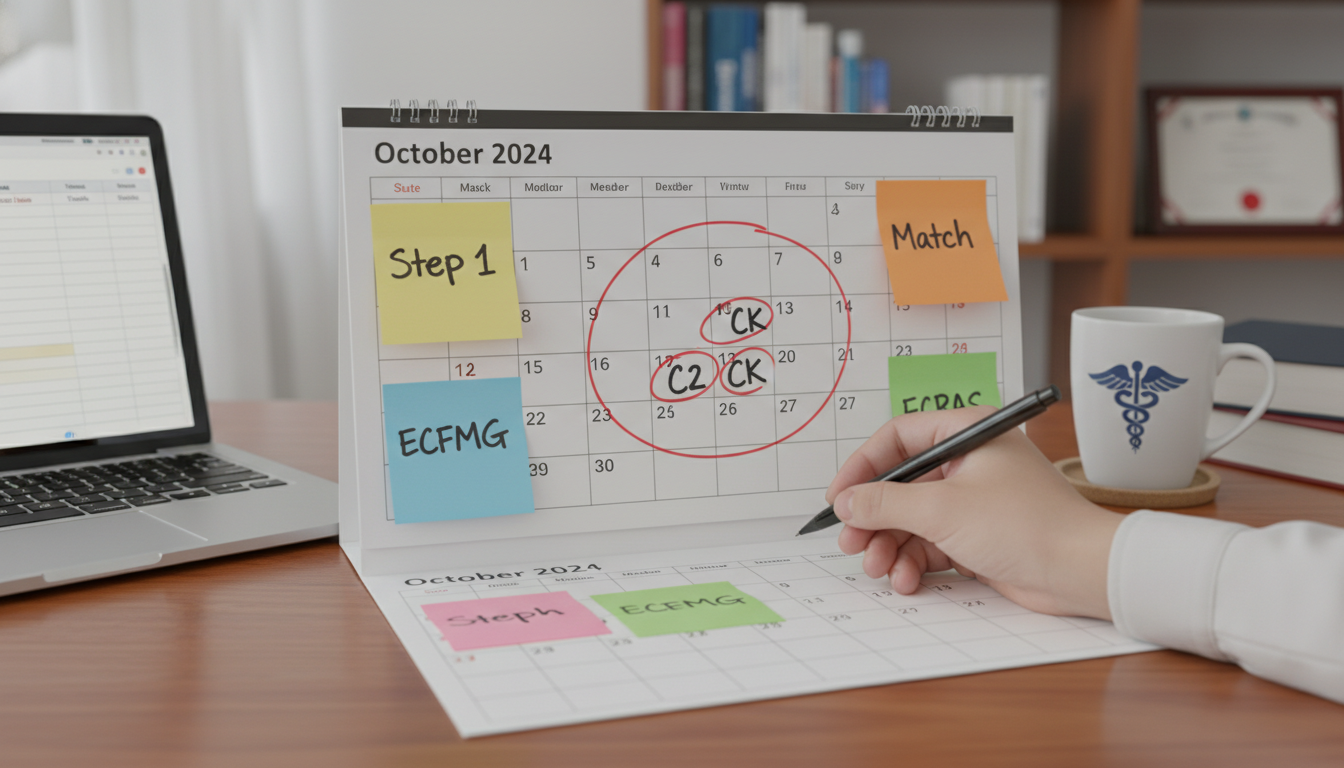
Optimal Timeline: Aligning ECFMG Certification With Residency Applications
One of the biggest strategic errors US citizen IMGs make is mis-timing the ECFMG process. You want to be exam-ready and application-ready by the beginning of the ERAS season of your final year.
The General Timeline Overview
Assuming a traditional 6-year European curriculum or 4–6 years in Caribbean/Asian schools, and targeting residency start in July of Year X:
- ERAS Application Opens: September of Year X–1
- Rank Order List Certification Deadline: February of Year X
- Residency Start Date: July 1 of Year X
Goal: Be ECFMG-certified or nearly certified at the time you apply in September of Year X–1, and fully certified by May–June of Year X.
Year-by-Year Strategy Example
Preclinical Years (Years 1–2 or 1–3, depending on curriculum)
- Confirm school’s ECFMG/WDMS status.
- Plan finances for USMLE exams and travel (if needed).
- Start building a US-focused CV:
- Online research collaborations with US faculty.
- Remote electives or observerships during breaks, if available.
Clinical Transition (Typically Year 3 or 4)
- Begin USMLE Step 1 preparation in earnest 6–9 months before test day.
- Aim to take Step 1 by late clinical year 3 or early year 4:
- This timing leaves you space to:
- Remediate if needed.
- Prepare Step 2 CK before ERAS submission.
- This timing leaves you space to:
Tip: For Caribbean schools with an integrated USMLE track, anchor your Step 1 date to the end of core basic science curriculum.
Advanced Clinical Years (Final 2–3 years)
Target timeline (example):
12–16 months before desired Match (ERAS opening):
Take Step 1.8–12 months before ERAS opening:
Begin intense Step 2 CK prep.3–6 months before ERAS opening:
Take Step 2 CK so:- You receive your score before or very close to ERAS submission.
- You have time for a retake if absolutely required (not ideal, but safer than cutting it close).
Before or early in final clinical year:
Complete OET Medicine or any required clinical/communication assessment, depending on your timeline and ECFMG policy.Final clinical year:
Schedule:- US core or sub-internship rotations, ideally:
- July–December for letters in time for ERAS.
- Keep in communication with ECFMG and your medical school’s registrar about:
- Graduation date
- Diploma issuance
- Required forms (e.g., Form 186 or its electronic equivalent)
- US core or sub-internship rotations, ideally:
Aligning ECFMG Certification with Graduation
To be fully ECFMG certified, you must:
- Pass required exams (Step 1, Step 2 CK, and any required clinical/communication assessments).
- Graduate from your medical school.
- Have your medical diploma and credentials verified by ECFMG.
For Americans studying abroad, the key risk is diploma issuance delays. Some schools:
- Give final exam results months before they issue official diplomas.
- Have bureaucratic delays in sending documents to ECFMG.
Action steps:
- Ask your Dean’s office specifically:
- “When will my official diploma be issued after finishing final exams?”
- “How long does credential processing typically take for students seeking ECFMG certification?”
- Aim to have your diploma arrive at ECFMG no later than March–April before your July 1 start date.
Step-by-Step: How to Get ECFMG Certification
This section walks you systematically through how to get ECFMG certified, from registration to final credentialing.
Step 1: Create an EPIC/ECFMG Account
- Go to the ECFMG website and create an online account (IWA/EPIC as required).
- Provide accurate personal information consistent across:
- Passport
- USMLE registration
- ERAS and NRMP profiles
Common mistake: Using different name formats (e.g., middle initials vs full names) creates documentation headaches later.
Step 2: Confirm Eligibility and Submit Initial Application
- Confirm your medical school and expected graduation date.
- Submit the initial Application for ECFMG Certification (through IWA).
- This creates your “candidate file” and allows you to register for USMLE exams.
You’ll typically need:
- A valid passport.
- Personal identification information.
- Payment for fees.
Step 3: Register and Sit for USMLE Step 1
- Use your ECFMG/USMLE account to select your Step 1 eligibility period.
- Schedule the exam at a Prometric test center.
- Ensure your passport and scheduling permit details match exactly.
Pro tip for US citizen IMG students:
- Take Step 1 when:
- You have covered all basic sciences.
- You’ve had at least 4–6 dedicated study weeks (many IMGs aim for 8+ weeks).
Step 4: Register and Sit for USMLE Step 2 CK
- Repeat the process for Step 2 CK registration.
- Align your eligibility window so:
- Score results are available by early ERAS season.
- You have some buffer for setbacks (illness, unexpected delays).
Preparation considerations:
- Use core clerkships as content foundation—internal medicine, surgery, pediatrics, OB/Gyn, psychiatry.
- Aim for a Step 2 CK score that is at or above the mean of US MDs in your target specialty whenever possible.
Step 5: Meet Clinical/Communication Requirements (e.g., OET Medicine)
With Step 2 CS discontinued, ECFMG uses evolving strategies to verify clinical and communication skills. As of recent cycles, this often involves:
- Passing OET Medicine with scores that meet ECFMG thresholds, and/or
- Completing an ECFMG Pathway depending on your graduation year and experience.
Because these rules evolve, your job as a US citizen IMG is to:
- Monitor ECFMG’s official site at least every 6 months.
- Check the exact Pathway requirements for your graduation year and Match cycle.
- Register for required exams (e.g., OET Medicine) with enough time to retest if needed.
Step 6: Graduation and Primary-Source Verification
Once you complete all your academic requirements:
- Graduate and obtain your diploma as soon as available.
- Work with your school’s administrative office to:
- Send your diploma and transcript directly to ECFMG (following ECFMG’s instructions).
- ECFMG will:
- Verify authenticity with your medical school.
- Confirm all exams are passed and requirements met.
When all elements are confirmed, ECFMG grants Certification and issues your official certificate.

Strategic Advice for US Citizen IMGs: Standing Out While You Certify
ECFMG certification is necessary but not sufficient for residency success. As an American studying abroad, your application must reassure program directors about:
- Quality of training
- Exam performance
- Clinical readiness
- Professionalism and communication
Here’s how to leverage the certification process as a strategic asset.
1. Schedule US Clinical Experience Aligned With Exams
- Use your time in the US for high-yield rotations:
- Internal Medicine, Family Medicine, Pediatrics, Psychiatry, General Surgery.
- Aim for at least 8–12 weeks of US clinical experience, preferably:
- In ACGME-accredited teaching hospitals.
- During your final 1–2 years so letters are recent.
Tactical tip:
Schedule heavier US rotations after Step 1 but before Step 2 CK, so you can apply clinical learning directly to exam prep.
2. Build a US-Based Professional Network
During your US rotations:
- Identify attendings who are US-trained and residency-linked.
- Ask about:
- Their impressions of IMGs from your school.
- What they look for in resident applicants.
- If you’ve worked well with them, request strong, personalized letters of recommendation that:
- Comment on your clinical reasoning.
- Compare you to US medical students they’ve taught.
- Highlight reliability and communication skills.
For a US citizen IMG, a letter stating “performs at the level of my US MD seniors” carries significant weight.
3. Use Step 2 CK as a Redemption Opportunity
If your school is less known or you had academic bumps:
- A strong Step 2 CK score is your chance to:
- Demonstrate mastery of clinical medicine.
- Reassure programs about your readiness.
If Step 1 was borderline or required a repeat (but you passed), a standout Step 2 CK and strong clinical evaluations can partially offset the concern.
4. Avoid Common Pitfalls That Delay Certification
Pitfall 1: Last-minute exams
- Taking Step 2 CK in October–December of application year can:
- Delay score release beyond peak interview season.
- Make programs reluctant to invite you without a score.
Aim: Step 2 CK by June–August before ERAS opens.
Pitfall 2: Diploma issues
- Students discover too late that their school:
- Issues diplomas 3–4 months after final exams.
- Is slow with ECFMG forms.
Solution: Discuss timeline and process with the registrar a full year before graduation.
Pitfall 3: Inconsistent documentation
- Name variations, missing middle names, discrepancies in date of birth.
- Leads to additional identity verification and delays.
Solution: Keep all documents consistent. If something changes (e.g., name change), inform all bodies promptly.
5. Plan Financially and Logistically
ECFMG certification involves several cost centers:
- USMLE Step 1 and Step 2 CK exam fees.
- OET Medicine or other exam fees.
- ECFMG application and certification fees.
- Travel and lodging costs for US exams and rotations, if needed.
Build a budget early. US citizen IMGs often underestimate living costs during US rotations and exam windows, which can force suboptimal timing.
Putting It All Together: A Sample Strategy Roadmap
Here is a sample template you can adapt as a US citizen IMG:
Year 1–2 (Preclinical):
- Confirm your school’s eligibility for ECFMG certification.
- Begin light USMLE prep (Anki, First Aid, etc.).
- Explore short US observerships during summer.
Year 3 (Early Clinical):
- Create ECFMG/IWA account; apply for ECFMG certification.
- Register for Step 1 eligibility window (end of year).
- Plan first US rotation (e.g., Internal Medicine) after Step 1.
Year 4:
- Take Step 1.
- Complete 8–12 weeks US clinical rotations.
- Begin structured Step 2 CK prep.
Year 5 (Final full year before ERAS application):
- Take Step 2 CK by June–August.
- Complete OET Medicine/Pathway requirements as instructed by ECFMG.
- Collect letters of recommendation from US attendings.
- Prepare ERAS/NRMP materials.
September (ERAS opening):
- Apply broadly, particularly in specialties/programs known to be IMG-friendly.
- You have: passed Step 1 and Step 2 CK, in-progress or completed pathway/OET, strong US letters.
Final Year / Post-Match:
- Complete graduation requirements.
- Ensure diploma and credentials are sent promptly to ECFMG.
- Confirm ECFMG certification before July 1 to start residency.
FAQs: ECFMG Certification for US Citizen IMGs
1. Do I need to be fully ECFMG certified before I apply to residency?
Not necessarily, but you must:
- Have passed Step 1 and Step 2 CK (and usually OET/Pathway requirements) to be competitive for most programs.
- Be fully ECFMG certified by the time your residency begins (July 1).
Many programs prefer applicants who either already hold ECFMG certification at the time of application or are clearly on track.
2. I’m an American studying abroad; is my process different from non-US IMGs?
The ECFMG certification steps and requirements are the same regardless of citizenship. However, as a US citizen IMG:
- You typically do not need a J-1 or H-1B visa, which some programs view as a logistical advantage.
- You still compete in the same pool of IMGs, so exam performance and US clinical experience remain critical.
3. How long does ECFMG certification take from start to finish?
From the time you:
- Start the exam process (Step 1) → obtain final certification can be 12–24 months, depending on:
- How quickly you progress through exams (Step 1, Step 2 CK, OET/Pathways).
- When you graduate and how fast your school sends documents.
- ECFMG processing times, which can be several weeks or more.
Build at least a 3–6 month buffer between expected graduation and residency start date.
4. What if my medical school’s status in the World Directory changes while I’m enrolled?
Policy can be complex, but generally:
- If your school loses eligibility or accreditation during your enrollment, your ECFMG pathway can be affected.
- Some students are “grandfathered in” depending on timing and ECFMG policy; others may face new restrictions.
If you hear of any status change:
- Contact ECFMG directly with your graduation year and details.
- Speak with your Dean’s office and recent graduates who successfully obtained certification.
- Do this early—waiting can close off options if corrective actions are needed.
By understanding the full arc of ECFMG requirements, planning your exams and credentialing strategically, and leveraging your status as a US citizen IMG, you can transform ECFMG certification from a stressful obstacle into a structured, manageable step toward your residency goals.