Some program directors genuinely prefer IMGs over U.S. grads. They just will never say that on the record.
I’ve sat in those closed-door ranking meetings. I’ve watched the public narrative (“We value diversity, holistic review, blah blah”) melt away and the real calculus come out. And here’s the part nobody tells you: in the right context, being an IMG is not a handicap. It’s your edge.
Not everywhere. Not in every specialty. But in more places than you think.
Let me walk you through how PDs actually talk about IMGs when the Zoom recording is off and the GME office is not listening.
The Quiet Reality: Why IMGs Aren’t Just “Accepted” — They’re Wanted
There’s this lazy myth that IMGs “fill the gaps” when programs cannot get U.S. grads. That’s a partial truth, and it misses the more interesting part: some PDs actively build their programs around strong IMGs because they know exactly what they’re getting.
I’ve heard versions of these lines from PDs at community internal medicine, mid-tier university programs, and even a couple of surgical prelim years:
“If I need workhorses who will actually read the chart, follow up, and not melt at 2 a.m., I’ll take the IMGs every time.”
“Our IMG residents keep the program running. The U.S. grads rotate through. The IMGs live here.”
Behind those comments are specific reasons. PDs are not romantic. They’re tactical.
Here’s what they like about you, whether they say it to your face or not.
Reason 1: IMGs Have Already Proven They’ll Suffer for This
U.S. medical education is hard. But for many IMGs, just getting to the point of applying to U.S. residency is a multi‑year test of pain tolerance and persistence that PDs quietly respect.
They might not phrase it nicely, but the subtext in meetings sounds like this:
“She finished med school in 2018, worked, then prepped for USMLE, did observerships, and is still here trying? She wants this more than 90% of our MS4s.”
“He moved from Pakistan, rewrote his life here, and is working as a research assistant at $42k while studying for Step. That’s commitment.”
PDs know reality: residency is a grind. They’re not looking for the most “naturally talented” person. They want the person who still shows up after three bad nights, a family crisis, and a malignant attending.
Many IMGs already proved they’ll:
- Leave home and family.
- Repeat exams, sometimes multiple times.
- Work low‑paid research or assistant jobs just to get a foothold.
- Tolerate uncertainty for years.
To a PD, that equals retention and reliability. Two words they care about more than “genius” or “charisma.”
I’ve watched PDs explicitly say: “Look, this U.S. grad is smart, but if they get an offer in their hometown next year, they’ll ghost us. This IMG? If we take her, she’s staying, she’ll grind, and she’ll appreciate the chance.”
That “gratitude” factor is real. And yes, it’s a little exploitative. But it’s how decisions get made.
Reason 2: IMGs Stabilize Programs That Are Quietly Struggling
You will never see this in a brochure, but some programs are in survival mode.
They’re in locations that U.S. grads avoid (Rust Belt towns, rural South, low‑pay costal community hospitals). They’ve had ACGME citations. Their case mix is brutal with high social complexity and low support.
Who saves those programs? Not the Harvard MS4 using them as a backup.
IMGs do.
Here’s the ugly truth from the inside:
Service-heavy programs know they need residents who will not break under volume. PDs have data: over years, they see fewer remediations, fewer professionalism issues, fewer vanish-into-psych-leave cases among their strong IMG cohort versus their weaker U.S. grads who ranked them low and ended up there by accident.
High-need hospitals (county, safety net, under-resourced systems) depend on residents who show up, cover gaps, and say “yes” more than “no.” Often, those are IMGs who have worked in under-resourced environments long before residency.
I’ve heard lines like:
“If we didn’t have IMGs, our call schedule would collapse. Period.”
“Our best chiefs the last 5 years? All IMGs. They kept the ship from sinking.”
So when PDs are fighting with their DIO (Designated Institutional Official) about positions, they quietly think: “As long as I can keep pulling strong IMGs, we’ll be okay.”
Do they say this publicly? No. Publicly, it’s all about diversity, global viewpoints, and educational mission. In the room, the words are: “We need people who will actually do the damn work.”
Often, that’s you.
Reason 3: Work Ethic and Documentation — The Unsexy Things PDs Prize
Let me be blunt. PDs are terrified of three things:
- Patient safety events.
- ACGME citations.
- Lawsuits.
What reduces those risks? Residents who are compulsive about:
- Documentation
- Following up labs and consults
- Communicating clearly with nursing and consultants
- Showing up on time, every time
Guess who they’ve learned to trust on those fronts? Strong IMGs.
Not all, obviously. There are lazy IMGs just like there are lazy U.S. grads. But pattern-wise, many IMGs come from systems where:
- Medical errors could cost you your license in a month.
- Documentation is rigidly policed.
- Hierarchy is harsh; you do not casually cut corners.
So you show up to U.S. residency and you:
- Double-check orders.
- Read the old notes.
- Clarify with the nurse instead of disappearing.
- Stay late to finish your notes cleanly.
And PDs notice.
In evaluation meetings, I’ve heard:
“She over-documents, but I’ll take that over the guy who disappears after sign-out and leaves messes.”
“Our IMG interns may be slower, but they’re careful. They don’t cowboy stuff.”
That last part is key. A surprising number of U.S. grads get burned early because they’re overconfident from big-name med schools, under-supervised sub-Is, and they think they’re mini-attendings. They make big decisions loosely.
PDs sleep better with the resident who asks one more question rather than one fewer. IMGs often lean that way early on.
And more than one PD has quietly said, “Our IMGs saved us from being cited on handoff quality, because they actually write decent sign-outs.”
Reason 4: Loyalty and Program Culture – The Long Game PDs Play
Here’s the part applicants rarely think about: PDs are playing a 10‑year game, not just a Match Day game.
They want:
- Future chiefs who won’t implode.
- Alumni who come back as faculty.
- Residents who’ll speak well about the program to future applicants.
They’ve figured out that a solid IMG core is often the backbone of that long-term culture.
Patterns PDs bank on:
Retention: IMGs are far more likely to stay as hospitalists or junior faculty at the same institution, especially if visa sponsorship was involved. For the hospital, that’s pure gold. Recruiting is expensive and painful.
Chiefs: Look at many community and mid-level academic internal medicine programs: chief lists over the past 5–10 years are loaded with IMGs. Why? Because they show up, do the admin work, and maintain decent relationships. Chiefs are not just the “smartest”; they’re the ones PDs trust not to create drama.
Program reputation: A program that “takes care of IMGs” gets flooded with enthusiastic IMG applicants who will work hard to match there. PDs know this. Once their IMG word-of-mouth pipeline is strong, they can be selective and choose top-tier IMGs year after year.
Behind the scenes you hear:
“If we support our IMGs and help them get cards/fellowships, they send us their friends. It’s a self-sustaining pipeline.”
“Our best faculty recruit the best applicants. Half of those recruiters are former IMGs we hired as attendings.”
So yes, PDs lean into IMGs not out of charity, but strategy.
Reason 5: Clinical Experience and Grit – Especially in Tough Rotations
A lot of PDs will say privately that their IMGs “feel like residents” faster on the wards.
Why?
Because many of you have:
- Already finished internship or even part of residency abroad.
- Taken care of critically ill patients with fewer resources.
- Seen broader pathology than some U.S. grads, who spent half their clerkships behind an EHR screen or in OSCE simulations.
So when you start:
- You’re not rattled by a GI bleed at 3 a.m.
- You’ve already delivered babies, managed DKA, or run codes.
- You’re not afraid to talk to families.
I’ve heard attendings on ICU and night float say things like:
“If I’m on with the IMG senior, I relax. They’ve seen disaster before.”
No one will put this in an official evaluation form, but the culture remembers who held it together when three admissions came in at once and the nurse was paging nonstop.
PDs quietly log that in their mental files.
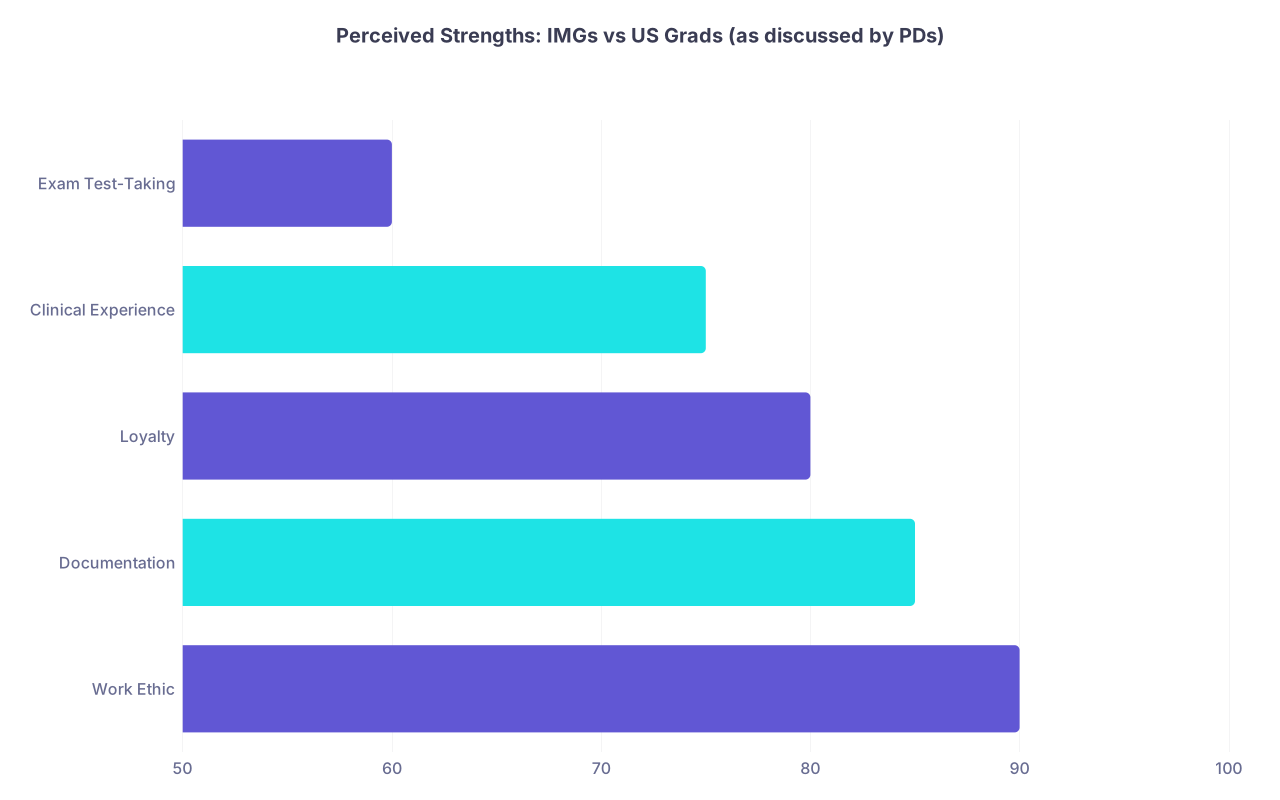
| Category | Value |
|---|---|
| Work Ethic | 90 |
| Documentation | 85 |
| Loyalty | 80 |
| Clinical Experience | 75 |
| Exam Test-Taking | 60 |
Reason 6: Visa Reality – A Hidden Advantage If You Understand It
Here’s one of the messier truths: visa status is both your biggest liability and, in some programs, your hidden asset.
Some PDs and hospital systems avoid visas completely. That’s real. But among programs that do sponsor visas, there’s a different calculation:
If they go through the trouble and cost of H‑1B or J‑1 paperwork, they want a high ROI resident who will give them stability for 3+ years, maybe more.
They know that if you’re visa-dependent, you are far less likely to quit mid-residency, switch programs, or coast. Your entire life is tied to performance.
I’ve heard this exact quote:
“If I sponsor this guy’s H‑1, he’s not going anywhere. He’ll take extra shifts, he’ll cover when people call out, because he doesn’t want to risk it.”
From their perspective: predictable, reliable manpower.
Does that mean they exploit? Some do. Some just pragmatically factor in that their visa-dependent IMGs are less “flighty” than the U.S. grads who have 10 safety nets.
So if you are on a visa, you need to understand how PDs at visa-friendly programs see you:
- High commitment.
- Higher likelihood of staying on as hospitalist.
- Strong motivation to perform.
That’s leverage, not just vulnerability.
How This Plays Out in Committees: The Actual Conversations
Let me give you a rough, anonymized snapshot of how a ranking discussion sounds at a mid-tier IM program where IMGs are common.
Two applicants:
- U.S. grad from a mid-level MD school, Step 1 pass, Step 2 CK 232, okay letters, decent but generic interview.
- IMG, Step 2 CK 248, multiple years out of graduation, did observership there, strong letter from a faculty member known to the PD, on a J‑1 path.
In the committee:
APD: “The U.S. grad is fine, but very lukewarm. Didn’t seem committed to our city. Said he’d ‘see how it goes’ with location.”
Faculty: “The IMG did a month here. Reliable, worked hard, followed up with consults. Nursing liked her. She asked thoughtful questions.”
PD: “If we rank the U.S. grad high, we might match him, but he’s a flight risk and may try to transfer. The IMG has been chasing this for 3 years, already integrated well. She’ll likely stay and maybe be chief material.”
Final outcome: the IMG gets ranked ahead of the U.S. grad.
No one outside that room will know that happened. You’ll just see match stats: “X% IMGs.” But those numbers hide dozens of those micro-decisions where your IMG profile won.
Where IMGs Are Actively Loved vs. Barely Tolerated
Now, let’s not romanticize this. Not every PD loves IMGs. Some tolerate them. Some avoid them. Here’s the kind of breakdown you’ll never see publicly but you need to understand.
| Program Type | Typical PD Attitude Toward IMGs |
|---|---|
| Small community IM (Northeast/Midwest) | Often strongly pro-IMG |
| County/safety-net IM/FM | Very receptive, see IMGs as backbone |
| Mid-tier university IM | Mixed but many pro-IMG if strong |
| Top 20 academic IM | Selective, only top-tier IMGs |
| Competitive surgical specialties | Generally IMG-averse (few exceptions) |
At IMG-heavy programs, PDs talk about you as core infrastructure. At name-brand, super-competitive places, you’re the exception—only the very top IMGs get real consideration.
Your strategy should adapt to this reality instead of wishing it were different.
How to Lean Into What PDs Secretly Value About IMGs
Knowing all this, how do you position yourself so that the PD who already likes IMGs looks at your file and says, “Yes, that one”?
A few specific levers you control:
1. Show longitudinal commitment to their program or region
PDs who already value IMGs are suckers for continuity.
- Do an observership or research there and get a real letter from someone with power.
- Mention specific rotations, patients, or experiences at their hospital in your personal statement or interview answers.
- Show you actually understand their patient population and city.
You’re trying to trigger that internal monologue: “She already lives in this world. She’s not guessing.”
2. Make your work ethic visible, not just implied
Everyone says they’re hardworking. That’s noise.
You have to bake it into your story:
- Years you spent in research or as a medical assistant while studying for exams.
- Extra responsibilities you took on at home institution (teaching, QI, leadership) while dealing with limited resources.
- Concrete examples of doing unglamorous work consistently.
PDs like to see: “This person already lives like a resident.”
3. Translate your prior clinical experience into U.S. value
Do not just say “I worked as a resident in X country for 2 years.”
Spell out the parts PDs care about:
- Managing high volume with low support.
- Complex pathology with minimal technology.
- Making decisions under uncertainty.
- Dealing with distressed, poor, or low-literacy patients.
That maps almost perfectly to many U.S. county/community experiences. Say it that way.
4. Be brutally realistic about where you’re competitive
I’ve watched too many excellent IMGs sabotage themselves by chasing a prestige mirage. They construct a list full of university programs that see IMGs as a “maybe,” while ignoring solid community programs where PDs quietly love IMGs.
You want to be in markets where you’re not a begrudging backup, but a valued asset.

| Step | Description |
|---|---|
| Step 1 | Strong IMG Profile |
| Step 2 | Target IMG-heavy community IM |
| Step 3 | Mix of community + mid-tier university IM |
| Step 4 | Do observerships / research at those sites |
| Step 5 | Secure strong US letters |
| Step 6 | Apply broadly but prioritize IMG-positive programs |
| Step 7 | Visa-friendly? |
The Part PDs Won’t Admit, But You Should Know
I’ll say the quiet thing out loud: some PDs lean on IMGs because they believe IMGs will tolerate more—more call, more cross-cover, more weekend sacrifices—without complaining.
You need to be aware of that dynamic so you can protect yourself from being exploited while still benefiting from the doors it opens.
Loving IMGs does not always mean treating them fairly. Sometimes it means, “They’re our dependable workforce.” You want the programs where admiration and respect accompany that dependence, not the ones that treat you like disposable labor.
You can pick this up in:
- How many IMGs are chiefs.
- How long IMG grads stay on as attendings.
- How past IMGs talk about the program in forums or quietly over email/LinkedIn.
Patterns don’t lie.
FAQ: IMG Residency Realities PDs Won’t Put in Writing
1. Do PDs really ever prefer an IMG over a comparable U.S. grad?
Yes. I’ve watched it happen. When the IMG has proven commitment to the program, stronger work samples (observership, research, letters), and seems more likely to stay and work hard, they’re often ranked higher than a lukewarm U.S. grad with similar numbers.
2. Is being on a visa always a disadvantage?
Not always. Some systems avoid visas, full stop. But in programs that sponsor regularly, PDs may prefer visa-dependent IMGs because they expect higher retention and fewer mid-residency exits. Your job is to target those programs, not the ones trying to dodge immigration paperwork entirely.
3. Why do so many IMGs end up as chiefs?
Because PDs pick chiefs they trust to show up, take on thankless admin tasks, and not create drama. Many strong IMGs fit that profile: consistent, organized, and very invested in the program that gave them a chance. So they get tapped for leadership more often than applicants realize.
4. If PDs value IMGs so much, why is it still so hard to match?
Because demand massively exceeds supply, and a lot of programs still don’t touch IMGs for political, institutional, or bias reasons. Where IMGs are loved, there’s intense competition among IMGs themselves. You’re not fighting U.S. grads there—you’re fighting other strong IMGs.
5. What’s the single best way for an IMG to stand out to a PD who is already IMG-friendly?
Get direct, recent, U.S.-based evidence of your value inside that ecosystem: an observership, research position, or job at their or a similar hospital, with a strong letter from someone who has the PD’s ear. Numbers get you screened in. Trusted voices get you ranked up.
Key takeaways:
Some PDs don’t just “accept” IMGs—they build their entire program around you because they know IMGs bring work ethic, loyalty, and stability that their system depends on. Your real leverage comes from understanding which programs quietly value that, then giving them concrete proof that you’re exactly the kind of IMG they’re already fighting to recruit and keep.